The fragile earth, p.1
The Fragile Earth, page 1


Author’s Note
All pieces in this collection were originally published in The New Yorker. The publication date is given at the beginning of each piece.
Contents
Cover
Title Page
Author’s Note
Foreword by David Remnick
Part I: A Crack in the Ice: How we got here
Reflections: The End of Nature by Bill McKibben
What does the greenhouse effect mean for us?
The Climate of Man by Elizabeth Kolbert
Disappearing islands, thawing permafrost, melting polar ice.
The Darkening Sea by Elizabeth Kolbert
What carbon emissions are doing to our oceans.
Writers in the Storm by Kathryn Schulz
How weather went from symbol to science and back again.
The End of Ice by Dexter Filkins
Measuring the disappearance of a Himalayan glacier.
The New Harpoon by Tom Kizzia
Can Alaska’s whale hunters protect the waters they fish in?
Part II: Hell and High Water: Where we are
The Sixth Extinction? by Elizabeth Kolbert
There have been five great die-offs in history. This time, the cataclysm is us.
The Ice Retreat by Fen Montaigne
The fate of the Adélie penguin.
The Inferno by Christine Kenneally
How Australia reckoned with the worst wildfires in its history.
The End of the End of the World by Jonathan Franzen
What I saw on my journey to Antarctica.
The Emergency by Ben Taub
Warfare, climate change, and extreme hunger converge in Chad.
The Day the Great Plains Burned by Ian Frazier
When warnings went ignored, the prairies went up in flames.
Life on a Shrinking Planet by Bill McKibben
With the earth at risk of growing uninhabitable, the assault on facts continues.
Part III: Changing the Weather: What we can do now
Green Manhattan by David Owen
Everywhere should be more like New York.
Big Foot by Michael Specter
Making eco-friendly choices is more complicated than it seems.
The Great Oasis by Burkhard Bilger
Can a wall of trees stop the Sahara from spreading?
The Climate Fixers by Michael Specter
Is there a technological solution to global warming?
Adaptation by Eric Klinenberg
How can cities be “climate-proofed”?
Power Brokers by Bill McKibben
American startups compete to bring electricity to Africa.
Value Meal by Tad Friend
Saving the world by inventing a better burger.
Trailblazers by Nicola Twilley
A new plan to solve California’s forest-fire problem.
Afterword by Elizabeth Kolbert
Acknowledgments
List of Contributors
About the Authors
Copyright
About the Publisher
Foreword
David Remnick
In the nineteen-eighties, a writer named Bill McKibben was regarded around The New Yorker office as something of a prodigy. The pieces in the Talk of the Town section in those days were unsigned, but everyone at 25 West Forty-third Street knew that McKibben was often writing half of them, sometimes more. Still in his twenties, he went wherever William Shawn, the editor of the magazine, sent him—to trade shows, ballgames, political rallies, the piers—and, in no time at all, he returned to the office and bashed out something charming or funny or sharp. Some writers in that era did not know what to make of him. McKibben had the laconic bearing of an Episcopal novitiate but worked with the metabolism of a hummingbird. And, as addicted as he had become to turning out his metropolitan dispatches on a snug weekly deadline, he was also eager to write something longer, more deeply reasoned, more far-flung. He had a particular passion for environmental matters and was a devoted reader of Henry David Thoreau and John Burroughs, Wendell Berry and Rachel Carson. Perhaps he’d do something in that mode. After giving the matter considerable thought, he approached Shawn with a proposal.
“Can I write about my apartment?” he asked.
What McKibben had in mind was rather high-concept. He lived in a nothing-special apartment at Bleecker Street and Broadway. What would he learn, he wondered, if he followed every pipe and wire and chute that connected his apartment to the greater world to see where it all led? Where exactly did his water and electricity come from? Where did all his coffee grounds and apple cores go?
With a notebook and a credit card, McKibben flew off to Brazil to see where Con Edison was getting its oil. He visited the La Grande hydroelectric dams in subarctic Quebec; water flowed from there into the James Bay, into the Hudson Bay, and, eventually, into Bill McKibben’s faucet. He saw uranium being extracted at the Hack Canyon mine, in Arizona—and eventually brought to the Indian Point nuclear power plant, the better to provide electricity for the lights and air-conditioners at Bleecker and Broadway. McKibben’s essay on the exploitation of nature and its resources, titled “Apartment,” ran in the March 17, 1986, issue of the magazine.
An important outcome of that piece, for its author, was that it suggested further work. “‘Apartment’ had the effect of reminding me, or maybe teaching me for the first time, that the world was physical,” McKibben tells me. “Somehow, I became attuned to the idea that the world and human arrangements were more vulnerable than I had ever thought. I could see what these lifelines looked like. And, at that moment, I also started reading the emerging literature of climate science.”
One voice in particular stood out. In June, 1988, James Hansen, a scientist best known in his early career for the study of Venus and its atmospheric conditions, came before a Senate committee and testified that the Earth was now warmer than it had ever been in recorded history, and that the chief cause was our heedless consumption of fossil fuels. This warming, he said, was intensifying all the time and would soon lead to rising sea levels and extreme weather conditions—powerful hurricanes, ruinous droughts and fires and floods. It would unavoidably threaten natural systems and the social order.
McKibben was paying attention. The next year, he published a long, scrupulously reported, yet meditative piece of writing on climate change and what it could mean for the planet. It was called “Reflections: The End of Nature,” and it was the first truly extensive exploration of climate change in the nonscientific press. At the time, some people viewed the piece as exceedingly pious and comically apocalyptic. Lewis Lapham, the editor of Harper’s Magazine, wrote: “‘The End of Nature’ plays to the superstitions of the environmental left. The author, a young man of sensibility named Bill McKibben, strives for sanctimonious effect that is earnest, doom-ridden, precious, and tear-stained.”
Still, the charges levelled against McKibben—of self-righteousness, fear-mongering, exaggeration—did not yet come from more organized and ominous forces. The oil-and-gas industry and right-wing, anti-environmentalist groups would eventually mobilize in an effort to discredit the work of writers like McKibben. Young men with video cameras would try to capture him in acts of hypocrisy, like getting into his car. He would be on the receiving end of death threats. But all of that came later.
When “The End of Nature” first appeared, it felt like speculative literature. The more alarming signs of climate change—melting ice sheets, species disappearing by the thousands—were not yet a matter of constant coverage in the press. Which makes it all the more remarkable that McKibben managed to bring both the science and the politics to a general audience. No corner of the earth, he made plain, could now be considered wild; everything, every ecosystem, was affected by human civilization. He studied the ramifications of a global crisis precipitated by the “awesome power of Man, who has overpowered in a century the processes that have been slowly evolving and changing of their own accord since the earth was born.” McKibben’s classic essay was, in effect, an echo of James Hansen’s lonely testimony, the beginning of the literature on climate change.
THE NEW YORKER HAS A LONG TRADITION OF PUBLISHING PIECES about the natural world and its vulnerability, among them Rachel Carson’s “The Sea” (1951) and “Silent Spring” (1962), John McPhee’s “Encounters with the Archdruid” (1971), and Jonathan Schell’s “The Fate of the Earth” (1982). Carson’s work had a distinct political impact, changing the national mind-set about the dangers of pesticides. McPhee’s work explored the clashing values of those who sought to protect the environment and those who sought to exploit it. Schell dramatized, at the height of the Cold War, the costs to the earth of nuclear conflict. What this anthology aims to represent is the magazine’s efforts, over the past three decades, to examine what is now referred to as the climate emergency—its explanation and origins; the conditions it has already created; the likely consequences if we go on as we have; and (with some measure of hope) the possibilities of mitigation or adaptation.
In the worst sense, we have come a long way since “The End of Nature.” If McKibben presaged a speculative dystopia, we now live in its opening chapters. In the intervening years, the world’s governments have done precious little of the work and the coördination needed to ease the overheating of the atmosphere. The oil companies have conspired to buy off opposition through vast lobbying efforts in Washington and around the world. Awareness of climate change has certainly intensified, but, so far, w
Hansen’s early alarms have largely proved accurate or have been grimly overtaken. In September, 2019, the Intergovernmental Panel on Climate Change, a U.N. commission led by a hundred scientists from around the world, issued a report about a crisis that was already upon us—record heat waves, catastrophic fires, devastated coral reefs, monster storms, disappearing glaciers and thinning ice sheets, rising sea levels—with far worse to come if CO2-emission levels were not radically reduced. Floods that were, in the past, freakish, once-in-a-century events will, by 2050, be an ordinary occurrence. Sea levels could rise more than three feet by the end of the century. Coastal cities all over the world will be endangered. Los Angeles, to take but one example, will face not only constant fire seasons but economic devastation along the shore; Marina del Rey and Venice Beach could be swamped. Other jeopardized cities, according to the U.N. report, include Bangkok, Barcelona, Honolulu, Jakarta, Lima, Manila, Miami, San Diego, San Juan, and Sydney. The state of the world’s oceans is perilous, the report said: the water is growing warmer and more acidic, a deadly combination for marine ecosystems. More than five hundred million people already live in areas that are turning into deserts. Certain cities and regions in the Middle East, Africa, and South Asia will become so hot that they will be uninhabitable.
The social and economic concerns are vast. The report noted that, in a world in which more than ten percent of the population is undernourished, climate change could lead to food shortages, mass migrations, and political upheaval. As Jonathan Blitzer has reported in The New Yorker, climate change in Central America, which has devastated farming, is a leading cause of migration north to Mexico and the United States. The implications of all these current and impending conditions beggar the imagination. Profound changes in political and human behavior—in the way we eat, the way dispose of our trash, the way we heat and cool our homes, the way we travel—are necessary.
Citizen activists around the world, many of them very young, have lost patience with the indifference of their elders and the floundering efforts of the political élites. Time, they know, is slipping away. “If you choose to fail us,” Greta Thunberg told a gathering of world leaders at the U.N., “we will never forgive you.”
WHEN I WAS A YOUNG REPORTER AT THE WASHINGTON POST, I WORKED under Leonard Downie, a gifted editor who was a consistent champion of investigative reporting. He also had a peculiar fondness for weather stories. Rainstorms, blizzards, heat waves—he was enthralled by them all. On the eve of a storm, he liked nothing more than to deploy a huge cast of reporters and editors to cover it. Then he would give the weather immense front-page play. He was often mocked for this, but, in fact, he understood something significant. The weather is what we have in common; it affects everyone’s life in the most immediate ways.
Weather stories are now of a radically different order and frequency. We already live in a landscape of increasingly common hurricanes, tornadoes, droughts, and fires. For most of us, the penny has dropped: the adverse weather we are facing is no longer just a matter of nature acting on its own. Our behavior—our heedlessness, our inability to alter our patterns of consumption and greed—is the dominant factor. Unless this planet’s human inhabitants change our ways, and swiftly, weather conditions will only worsen. On this score, climate experts are happy to show us their finely calibrated models. Yet how can their findings be made vivid and comprehensible to a broader audience?
In the twenty-first century, The New Yorker’s leading voice on the environment has been Elizabeth Kolbert. Bill McKibben continues to write for this magazine and for other publications; he also publishes books and teaches. Much of his time, however, has been taken up with organizing and activism. As the leader of 350.org, he has led hundreds of climate-related demonstrations around the world. But the beat he established at The New Yorker could not remain empty. Kolbert came to the magazine from the New York Times, in 1999, with the intention of covering City Hall. When she had had her fill of Rudy Giuliani and Michael Bloomberg, though, she turned to climate change; there could be nothing more important for her to pursue. She announced her ambitions, in 2005, with a three-part series called “The Climate of Man.” Since then, she has extensively travelled the world—visiting Arctic glaciers, tropical rain forests, United Nations offices—and charted the forms and forces of its depredation. Her prose is razor-sharp, unforgiving, unillusioned. She aims not to soothe but to state things plainly, unmistakably, with the trenchancy of precision. I remember coming across this paragraph in her 2009 article “The Sixth Extinction” and feeling as if I’d had the wind knocked out of me:
Once a mass extinction occurs, it takes millions of years for life to recover, and when it does it generally has a new cast of characters; following the end-Cretaceous event, mammals rose up (or crept out) to replace the departed dinosaurs. In this way, mass extinctions, though missing from the original theory of evolution, have played a determining role in evolution’s course; as Richard Leakey has put it, such events “restructure the biosphere” and so “create the pattern of life.” It is now generally agreed among biologists that another mass extinction is under way. Though it’s difficult to put a precise figure on the losses, it is estimated that, if current trends continue, by the end of this century as many as half of earth’s species will be gone.
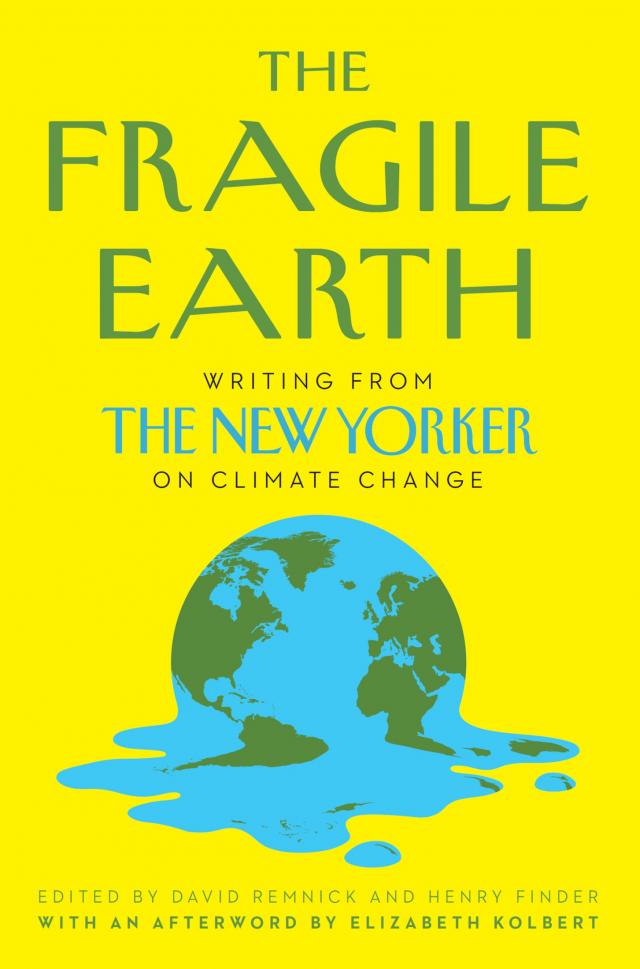
In this anthology, you will find different approaches to climate change, across a range of geographies. To tell the story of the crisis—its past, present, and future—the book will take you from Greenland to the Great Plains, into sepulchral laboratories and emerald rain forests. It will tell you how human beings created this epochal condition, even as early warnings were sounded; it will assess the consequences that climate change has already wrought, describe what the very near future portends; and explore what can be done to either forestall or try to cope with a looming cataclysm. You’ll find science writers, foreign correspondents, essayists, and more engaged in the critical task of trying to think through our predicament. Collectively, their work will underscore what many people have, at long last, come to recognize: that climate change isn’t an “issue” to be considered among a list of others. Rather, it concerns the very preconditions for all species to go on living on this planet. “The Fragile Earth” seeks to illuminate the emergency from a multitude of perspectives. We hope that it contributes to a shared sense of urgency—and to a shared spirit of change.
Part I
A Crack in the Ice
How we got here
Reflections: The End of Nature
Bill McKibben
September 11, 1989
Nature, we believe, takes forever. It moves with infinite slowness through the many periods of its history, whose names we can dimly recall from high-school biology—the Cambrian, the Devonian, the Triassic, the Cretaceous, the Pleistocene. At least since Darwin, nature writers have taken pains to stress the incomprehensible length of this path. “So slowly, oh, so slowly, have the great changes been brought about,” John Burroughs wrote in 1912. “The Orientals try to get a hint of eternity by saying that when the Himalayas have been ground to powder by allowing a gauze veil to float against them once in a thousand years, eternity will only have just begun. Our mountains have been pulverized by a process almost as slow.” We have been told that man’s tenure is as a minute to the earth’s day, but it is that vast day that has lodged in our minds. The age of the trilobites began six hundred million years ago. The dinosaurs lived for a hundred and fifty million years. Since even a million years is utterly unfathomable, the message is: Nothing happens quickly. Change takes unimaginable—“Geologic”—time.
This idea about time is essentially misleading, for the world as we know it, the world with human beings formed into some sort of civilization, is of quite comprehensible duration. People began to collect in a rudimentary society in the north of Mesopotamia some twelve thousand years ago. Using twenty-five years as a generation, that is four hundred and eighty generations ago. Sitting here at my desk, I can think back five generations—I have photographs of four. That is, I can think back one-ninety-sixth of the way to the start of civilization. A skilled genealogist could easily get me one fiftieth of the distance back. And I can conceive of how most of those forebears lived. From the work of archeologists and from accounts like those in the Bible I have some sense of daily life at least as far back as the time of the Pharaohs, which is almost half the way. Three hundred and twenty generations ago, Jericho was a walled city of three thousand souls. Three hundred and twenty is a large number, but not in the way that six hundred million is a large number, not inscrutably large. And within those twelve thousand years of civilization time is not uniform. The world as we really know it dates back to the Renaissance. The world as we really know it dates back to the Industrial Revolution. The world as we feel comfortable in it dates back to perhaps 1945.