The outfit, p.1
The Outfit, page 1


Published 2022 by Rebellion Publishing Ltd, Riverside House, Osney Mead, Oxford, OX2 0ES, UK
ISBN: 978-1-78618-447-4
Copyright © Rebellion Publishing IP Ltd 2022
The right of the author to be identified as the author of this work has been asserted in accordance with the Copyright, Designs and Patents Act 1988.
All rights reserved. No part of this publication may be reproduced, stored in a retrieval system, or transmitted, in any form or by any means, electronic, mechanical, photocopying, recording or otherwise, without the prior permission of the copyright owners.
This is a work of fiction. All the characters and events portrayed in this book are fictional or are used fictitiously, and any resemblance to real people or incidents is purely coincidental.
www.rebellion.com
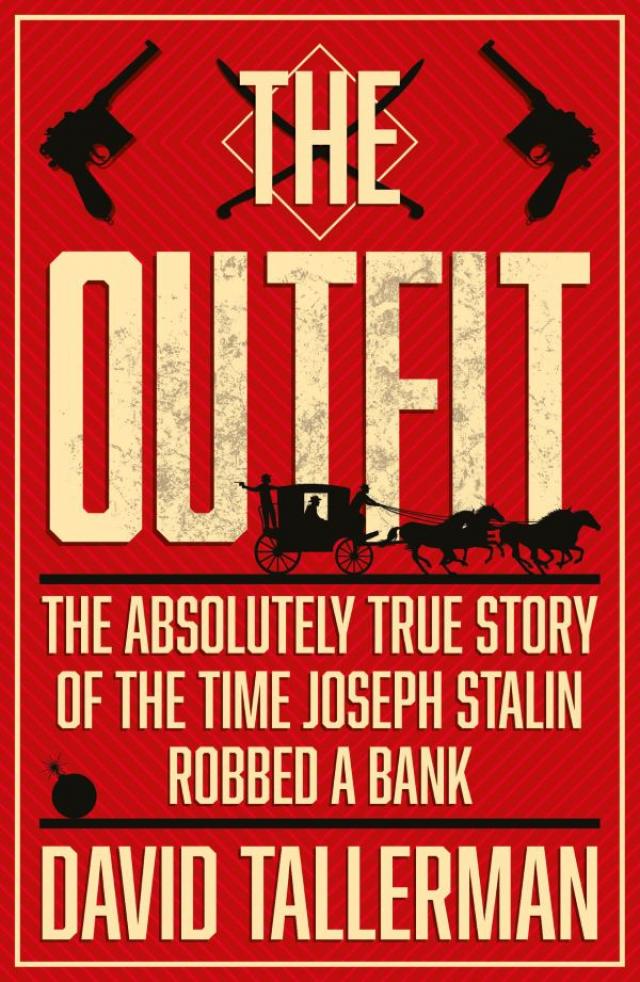
THE OUTFIT
The Absolutely True Story Of The Time That Joseph Stalin Robbed A Bank
David Tallerman
To My Aunt Maggie,
With Fond Thanks
And To Revolutionaries
Past, Present, and Future.
“As for death... I am sure you have seen it close up sometime in your life. Death, after all, is only that and nothing more.”
Alexander Bogdanov, Red Star
PROLOGUE
LENIN WASN’T ENJOYING Tammerfors: not the place, and not the conference currently being held there.
As regarded the former, Finland was at once too familiar and too unlike the homeland he’d spent so many years in exile from for him to feel altogether at ease. And wasn’t it humiliating that they should find themselves gathered here, the great thinkers and fighters of the revolution to be, rather than in St. Petersburg as they’d originally intended? Doubtless it was ironic that the ferment in the capital had rendered plotting revolutions there unwise, but Lenin was in no mood for ironies.
Which brought him to the principle source of his annoyance, and the Worker’s Hall here in Tammerfors, and the first conference of the Russian Social Democratic Labour Party—though in practice that meant his own Bolshevik faction, because plainly there could be no traitorous Mensheviks diluting the socialist waters. Yet even then, cleansed of obvious impurities and reduced to one harmonious mind, Lenin wasn’t getting his way.
Life had taught him, through much hardship, that compromise was a weakness. It had likewise shown him the true path, whittled down from many possibilities. But socialists, damn them, even right-thinking socialists, loved to argue. Or maybe it was only Russians that loved to argue. Lenin was forced to admit that plausibly the blame lay there: when there was no topic two Russians would ever fully agree on, perhaps it was optimistic to expect unanimity on how to overthrow the centuries-old tyranny of Tsarism.
The man beside him, however, was not a Russian but a Georgian, from the bottommost tip of the empire, where it almost threatened to become Asia, and he spoke the language of Russia with a heavy accent. He had also, despite the letters they’d shared and the note of adulation Lenin had read in them, insisted on emphatically voicing his own opinions, whether or not they were in keeping with Lenin’s own.
At this moment, standing outside the recently built and unpleasantly modern workers’ hall, dressed in nothing but trousers and a red satin shirt regardless of the extreme November chill, the man named Joseph Djugashvili—who went by the nom de guerre of Koba—was enthusiastically demonstrating the virtues of the Mauser pistol he clutched in his right hand.
“See how long the barrel is?” he was declaiming. “That’s part of what makes it so special. Good stopping power. Which is to say, you shoot someone, and they stay shot.” He chuckled. “Important in our line of work.”
At a distance, Koba was ruggedly handsome, wolfish and brooding and with a louche scruffiness that might have been an affectation and might have been an inability to afford decent clothing—and was probably a combination of both. His most distinctive feature was his eyes, which were of a peculiarly golden shade and flashed at the slightest spark of anger. Close up, as Lenin was, the story was somewhat different. Koba’s face was badly pockmarked, and what wasn’t pockmarks was freckles. It was impossible not to note the stiffness in his left arm, more evident because he tried to hide it, or the crookedness with which he stood, likely the results of childhood infirmities of the sort poverty tended to inflict.
All of which, to Lenin, made him a perfect peasant revolutionary, that being the best kind of revolutionary, and the opposite of the over-theorising intellectuals he was too often surrounded by. As such, Lenin had already decided to forgive the young man his infidelities, accepting that they were a product of the same youthful enthusiasm that had made him conclude that waving a gun around in a foreign country among a group of known radicals was a sensible idea.
Lenin waited for a lull in the lecture—Koba had removed the magazine from the boxy pistol and was illustrating how it slid back into place—and then tapped him on the elbow. “Might I borrow you a minute, comrade? There’s a little matter I’d like to discuss.”
There was no mistaking how pleased Koba was by the invitation. “For the mountain eagle of the Bolsheviks? By all means.” Showily, he slipped the Mauser into the waistband of his trousers and turned his back on the crowd he’d taken it on himself to educate.
Lenin led the way, until they were out of earshot but not out of sight; let the others wonder what the pair of them were debating, a dash of rivalry was no bad thing. To his distaste, Lenin noticed that Koba had plucked a cigarette from his shirt pocket and was proceeding to light it. But rather than comment, Lenin positioned himself so that the bitter wind blowing around the corner of the hall carried the foul stench of burning tobacco away from him.
They stared at the city. Koba took a fierce drag on his cigarette and watched philosophically as a thread of grey rose toward the pristine blue sky.
“I’m sorry for my hot-headedness earlier,” he said, in the faintly confrontational manner of a schoolboy who’d been taken aside to be given a telling off he knew he deserved and would contest anyway. The incident he referred to had involved him storming out in a rage and firing the pistol he’d just been showing off into the air until he’d calmed down. “But when you’ve led men in fighting as I have, it’s hard not to get your blood up sometimes.”
For all that part of him wanted to laugh at the younger man’s posturing, those words were music to Lenin’s ears. Truly this Caucasian bandit was what he needed, the antidote to so much of what made him despair about his fellow Bolsheviks.
“Nothing to apologise for there,” he said. “I’d have gladly done the same on plenty of occasions.” There was no reason to mention that he’d hardly ever held a gun, let alone fired one. “Between you and me, I was quite impressed. It’s only right to find all this frustrating.”
Koba frowned. “That’s how you see it? But aren’t we on the verge of great things? Isn’t Russia at the tipping point, waiting for a hefty shove? That’s my feeling!”
Lenin paused while the smoke on Koba’s breath dispersed, and to pick his own words with care. “Perhaps,” he said. “If it weren’t for those accursed Mensheviks, and all the other traitors and compromisers. Perhaps we’d have had our revolution by now, perhaps we’d have had it a dozen times over. If we could make Bolshevism the loudest voice then, yes, I’ve faith that we might get it done.” He sighed weightily. “But to be loud costs money. Everything costs money. Ultimately, the problem is always money.”
He let his own eyes settle on Koba’s amber ones, lest there be any question that this was the end for which he’d commandeered him.
There was a smugly feline cast to the curl of Koba’s lips. He’d taken the hint. “Ah, well... if that’s the case, I may have just the thing.” He shrugged lazily, as though these were the kinds of conversation he indulged in every day. “Yes, maybe so. Myself and a few like-minded friends. I’m thinking we’d call ourselves ‘The Tiflis Expropriator’s Club,’ how does that sound?”
It sounded like precisely what Lenin had been hoping to hear. “It’s got quite the ring to it. And what exactly did you propose to expropriate?”
Koba looked thoughtful. “Oh, whatever we can lay our hands on. Boats, stagecoaches, wherever there’s an easy catch to be had. The trick is not to draw too much attention.”
Lenin nodded slowly, and for long enough to make clear that, this time, he hadn’t received entirely the answer he’d expected. “But comrade Koba, you don’t strike me as a man who’s afraid of a spell in jail. We’ve all had our Siberian holidays at the Tsar’s pleasure, haven’t we? And the moment for the revolution is coming soon, as you say. Hell, it’s already overdue!”
Koba’s golden eyes glinted. They really were extraordinarily expressive, and it wasn’t anger that glimmered there now, it was excitement. “So, you’re talking about something... bigger?”
Lenin smiled what he considered to be his most conspiratorial smile. “Actually, I believe the time has come for something very big indeed.”
PART ONE
ONE
KOBA HAD BEEN surprised to see Ter-Petrosian at his wedding, for the reason that he’d not invited him. Even if they were old friends, there was a brand of people you wanted at such an event and a brand you didn’t, and Simon Ter-Petrosian, known to all and sundry by his nickname of Kamo, was definitely in that second category. To put it simply, the man was a lunatic.
But he was Koba’s lunatic. And so, once they’d left the small candlelit church and travelled across town for the wedding supper, he made a point of singling Kamo out as soon
“I’m glad you made it!” Koba declared. “I hardly had time to invite anyone, not even those I most wanted here. Kato had her heart set on a church wedding, and we couldn’t get a priest to perform the ceremony. My papers are false, and they said they couldn’t marry a man with false papers, the cowards. So, when Father Tkhinvaleli agreed to do it, we jumped at the chance, no matter that it meant getting married at two o’clock in the morning.” He chuckled to himself. “What a farce! But it’s done with, and word got around somehow, so my friends were here to wish me well after all.”
Kamo was only half listening. Instead, he was observing Kato, talking to her parents on the far side of the cramped room, with what had to be regarded as naked hunger. “She’s a beauty, a real beauty. You’re a lucky man, Koba.” He tore his eyes away with obvious regret. “And this is the end of our professional acquaintance, eh? You’ll be settling down; no more giving Pharoahs the runaround and plotting revolutions under their noses?”
Kamo was speaking loudly, and there were those in the gathering whom Koba would prefer not to learn about his history with the ‘Pharoahs’—that was, the police.
Koba caught his friend by the elbow, yanked, and said, “Don’t be a fool.” But he said it without harshness, and as he led Kamo to the door, he leaned closer and added, “It’ll take more than marriage to put Joseph Djugashvili on the straight and narrow.”
Outside in the warm Tiflis night, Koba guided Kamo toward a shaded alley. Dawn couldn’t be far off, but at present he was obliged to find his way by keeping a hand outstretched to brush the rough wood of the wall. Reaching a spot he was satisfied with, where the darkness was particularly deep, he drew a packet of cigarettes from his upper pocket and lit one for himself and another for Kamo, who snatched it gratefully from his fingers.
Perhaps he ought not to be talking business on the day of his wedding, but with circumstances as they were, it had been a while since he’d had an opportunity like this, to lay bare what had been eating at him ever since those vital minutes in Tammerfors when the mountain eagle of his party had taken him to one side.
“You heard about Helsinki?” he said. “The robbery the Latvians pulled off in February? They got away with a hundred and seventy thousand roubles. We can’t let a damned bunch of Latvians be better socialists than we are, can we?”
“You’ve got something in mind,” Kamo remarked, not phrasing it as a question. They had known each other for a long time.
But actually, all Koba had was an itch, which had been growing since that conversation with Lenin, when he’d made a promise he was yet to keep. “Not specifically,” he admitted. “Except that, whatever we do, it has to be bigger than what they managed.”
Kamo laughed delightedly. “I like the sound of that. But will Kote go for it, do you think? He’s a cautious one.”
Kote Tsintsadze was the current leader of the Tiflis Expropriator’s Club, a name Koba was beginning to find too glib to represent the gallery of rogues he’d accumulated. And likely Kamo was correct and Kote wouldn’t be on side for an operation on the scale he was conceiving. Of course, Kamo’s enthusiasm wasn’t for the crime itself, nor the money it would hopefully bring the Bolsheviks, but for the prospect of action—or, if Koba was being really honest, of violence.
“I’ll deal with Kote if I have to,” Koba said, not altogether certain what he meant by it. Kote was a good sort, and a good enough leader. Maybe it would merely be a case of making him appreciate what was at stake. “But I’m glad you’re on board, Kamo. You’ve always been my strong right hand.”
This time, Kamo’s laugh was vaguely obscene. “Then I suppose I won’t be needed much from here on out, that Kato of yours is better than any right hand.” He dropped his cigarette at his feet and stomped at it vengefully. “Tell me when you’ve picked a target, you can count on me. But now there’s celebrating to be done. Are you coming?”
“In a minute,” Koba said. “You go on ahead.”
He watched the wraithlike shape of Kamo’s retreating back and took a drag from his own cigarette, which he was scarcely halfway through. The Helsinki robbery had been gnawing at him, just as his meeting with Lenin had. They’d pulled a few minor jobs in the meantime, had sent a few not-inconsiderable donations to the party, and that was all very well, but was it worthy of the man he knew himself to be, or of the trust Lenin had placed in him? Nothing he’d done would pass into Bolshevik legend as the Latvian Social Democratic Workers’ robbery had.
Koba sucked at his cigarette, took it from his lips, and stared at the red jewel of its tip. He should go inside. Kato would be fretting over his absence, tonight of all nights. Notwithstanding, something held him.
This had happened so fast, since that fateful day when Kato had confessed she’d missed her period and was positive she was carrying his child. That didn’t mean the same to revolutionaries as it did to normal folks, how could it? Marriage, monogamy, all that hypocrisy belonged to the old order and would be swept away in time. Yet Kato was traditional when it came to some topics—her family certainly were—and what was it to him, anyway? The advantage of disbelieving in an obsolete custom was that it didn’t matter whether you complied with it or not. And if he suspected there was nothing in him that could be called love, not the way others seemed to describe it, nevertheless he liked her more than he’d ever liked anyone. Perhaps there were worse fates than raising a child with a beautiful young bride who also happened to be a fine socialist.
Koba discarded the stub of his cigarette, ground it to crumbs under his heel—and tensed. The noise that had come from behind him was indistinct and trivial, and had no right to be there: footsteps approaching stealthily along the alleyway. He dug in his jacket for his pistol, before recalling how he’d decided that attending his nuptials with a gun in his pocket might not be fitting.
The footsteps halted, far enough away to be out of his reach. A throat was cleared, thunderous amid the blackness. A voice said laconically, “Congratulations on the day of your wedding, Joseph Djugashvili.”
“Yeah,” came a second voice, this one strident and self-amused, “congratulations, Djugashvili.”
Koba didn’t turn around. He didn’t need to. He’d long ago developed a sixth sense for identifying policemen. There was a characteristic stink, an odour you didn’t detect through your nostrils but in the pit of your stomach. The sole question was which stripe he was facing: the Pharoahs, the regular police who’d have difficulty finding their arseholes with help and a diagram, or the Okhrana, the secret police who were secret in name only and infinitely more dangerous.
Koba had had his run-ins with both types over the years. If this was the former, the most he had to fear was a roughing-up, because they hadn’t a thing on him, and he’d give as good as he got. But if it was the latter, the possibilities were potentially less pleasant.
Best, then, to be diplomatic for the moment. “Thank you,” he said.
“We won’t keep you,” the first voice informed him. “I’m sure you’re eager to get back to that blushing bride of yours.”
The second voice just snickered, apparently at the word blushing.
“Yes,” Kamo said, “I probably should. Thanks for stopping by, though. I’d ask you in for supper, but you know how it is. Not much space for unexpected guests.”
“Oh, we quite understand.” It seemed the first voice would be doing all the talking. “And we wouldn’t want to intrude. You’d better be on your way.”
Koba hated to give this pair the satisfaction, but not so vehemently as he hated letting this stunt of theirs drag on longer than was necessary. He took a step toward the end of the alley, counting the seconds until the phantom speaker summoned him back.
He barely made it to two. “However, there is one thing we need to discuss before you go.”