Out of the shadows, p.1
Out of the Shadows, page 1


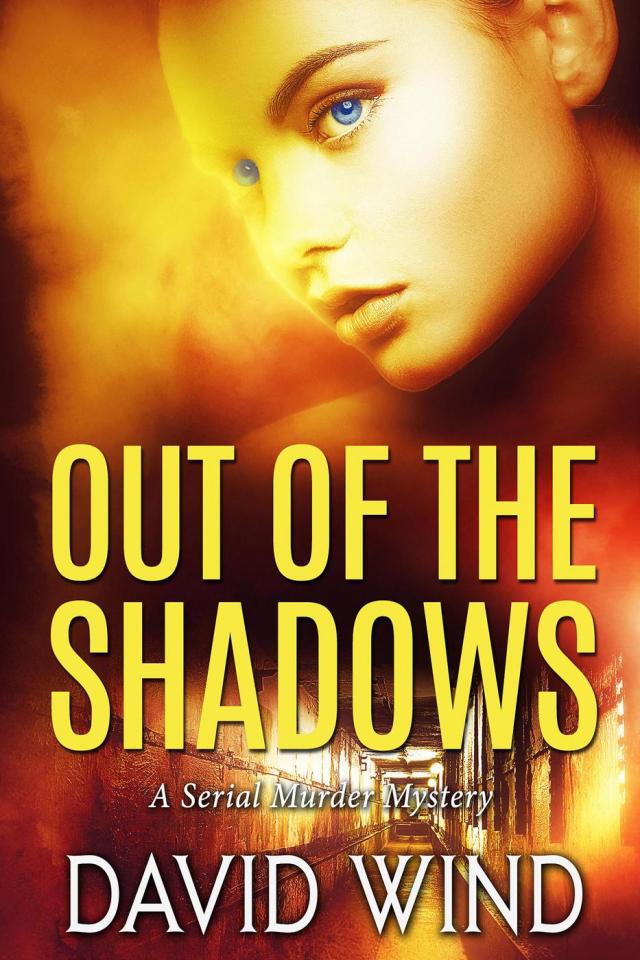
Out Of The Shadows
By: David Wind
This eBook is licensed for your personal enjoyment only. This eBook may not be re-sold or given away to other people. If you would like to share this book with another person, please purchase an additional copy for each recipient.
<><><>
Editing: Pelican Proofing
Cover: Steven Novak: Novak Illustrations
<><><>
All rights reserved.
Copyright © David Wind
This is a work of fiction. The names, characters, places and events are fictitious. Any similarity to real persons, living or dead, places or incidents are coincidental and not intended by the author.
Previous Novels by David Wind
A listing of David Wind’s previous novels is at the end of this eBook Edition, along with the author’s notes and bio. [Click to view]
<><><>
NEWSLETTER
For Information about Special Giveaways, Free Books (from myself and other authors), New Releases and other news, Please click here to sign up for my newsletter. My newsletter goes out 4-6 times a year.
<><><>
ACKNOWLEDGEMENTS
Much thanks to my Beta readers, Terry Vanlandingham and Bonnie Wind
Dedication
For Devon and Alana
ONE
“MY FATHER WAS A COP. He always told me how tough it was to be a cop on the Job. He also told me there were a great many disadvantages to be a cop: your friends had to love you for you, because if they didn’t, they wouldn’t trust you because you were a cop.
“People in general didn’t want to know you if you were a cop, unless they needed your help. Yes, he always told me how hard a life it was, and how unrewarding it was most of the time.
“But he also told me the flip side of a cop’s life. He told me about the good feelings he got from helping people, and the sense of accomplishment at being able to stop the bad from hurting or taking advantage of the good. He said it helped to make up for the discouragements.
“And when he finished telling me about the good parts, he would tell me again that there was nothing tougher, and nothing harder than being a cop.”
She paused to gaze at the faces staring back in rapt attention. Every shade of skin, every race, and definitely every color of eye watched as she moistened her lips and said, “But he was wrong. There’s something tougher and harder than being a cop. And that something is being a woman, and being a cop.”
Stopping again, as puzzled expressions grew on the fifteen faces, she smiled inwardly at their naiveté. She wondered how long it would last. Not long. The thought momentarily saddened her. “And that, ladies, is why I call this class Feminine Education. My name is Lieutenant Amy Morgan. Prior to my assignment to the academy staff, I was with homicide. The reason I’m here now, is to teach you that being a female cop is not what you think it is.”
“Why is it tougher than being a man?” The woman, a curly but not frizzy-haired brunette in the first row, had a strong face with smooth skin the color of mocha and deep brown eyes, verging on black. She had small hands, with graceful tapering fingers. The nails were unpolished. “Your name?”
“Trina Rivera,” she answered.
“Where are you from, Cadet Rivera?”
Her voice took on a defensive edge. “A Hundred and Sixteenth Street.”
“Tough neighborhood. What do the people there think about cops?”
She snorted. “Not too much.”
“That’s right. Now take a couple of those macho men—you know the type—the ones who like to mouth off to the cops, but who’ll back off the instant the cop braces them. You take those men, put them up against a woman cop, and watch what happens. They don’t like it, Cadet Rivera. They don’t like it, not one damned bit.”
The woman reacted to the hard words, but she did not take her eyes from Amy’s. Amy liked the reaction. It showed her that Trina Rivera had courage.
“Ladies, this class will meet once a week while you are at the academy. During our class, I will tell you about a woman’s life in the blue. By the end of your training, you will either go on to be good cops, or you will drop out. But what you won’t do, if I have anything to say about it, is end up like me.”
Amy waited quietly until all their expressions were alike—puzzlement combined with a bit of nervousness.
“You see,” she went on, pacing before them, using words to distract them as she worked her uniform blouse loose. “Two years ago, I was on a homicide case, in which several women had been raped and murdered. My squad caught the case. Caught, ladies, is police language for assigned. Well, my squad fielded the case. It was a real mystery: no witnesses and no evidence other than semen, which turned out to be from a normal blood type.
“We spent a lot of time on this case. Not on this one alone, we had a full caseload, but we spent a fair portion of our allotted time on it. Anyway, one cloudy and drab Friday morning, I went to an address one of my informants had given me. I met two detectives from my squad, who had gotten there ahead of me.”
She looked at them, her eyes skipping from face to face, taking in their fascinated attention. “I was in uniform that morning because I’d been assigned a special-duty function for the afternoon. And by uniform, I mean full-dress uniform with ribbons and all. I’d taken a cab to get to the address. I got out of the cab across the street from the apartment building, and walked to the sidewalk, where the two detectives stood. There was a man outside the building. He was loading a truck. As I went to meet the two detectives, I sensed someone staring at me. I glanced back and saw this man’s head turned toward me. Although I never got a clear look at the man, because his face was shadowed by a hat, I sensed hatred coming from him.
“The only physical detail I could see about him was a bushy mustache. I sensed he was ugly—not physically ugly; rather, it was an inner feeling that made me think he was ugly.
“When I tried to get a closer look at him, he bent forward, made a gargling sound in his throat, and spit toward my shoes. He was a sweet one. He swore at me, saying, ‘Ya stupid bitch—ya need more than just a uniform and a gun. Ya need something between your legs to be a man.’
“I started to go after him, but one of the other detectives stopped me. So instead of going over to him and getting a clear look at him, we went inside. The lead turned out to be a dud. We went back outside and, as the detectives and I talked, I saw the man get into his truck and drive away.
“We spent five more minutes talking before I started across the street. I was halfway to the squad car when one of my men shouted a warning.”
Amy looked at her students’ faces. They were all watching with wide-eyed expectancy. “I looked over my shoulder. I saw that the man who’d spit at me was now behind the wheel of his truck, not a dozen feet from me. He was going fast.
“I tried to run, but I didn’t make it. He hit me good. Real good.” She dropped her voice on the last words in an effort to hide the emotions that had built in her throat.
“But you’re all right now?” asked Trina Rivera.
She dredged a smile from somewhere. “Between the nightmares and the pain and the fear, you might say that. But it’s also the reason I’m here. You see, ladies, when the truck hit me, it broke my back.”
Turning away from them, she lifted the blouse over her head. The gasps were audible, and there was even one low ‘Sweet God in heaven,’ before she lowered the blouse to cover the mass of scars from the four operations needed to put her back together.
Slowly, Amy faced them. “My back is the reason I’m here. I spent eight months in the hospital, and then another four months learning how to move and walk again. And when I was able to function, those wise men who populate the upper levels of headquarters, told me I was eligible to take medical retirement.
“I fought it, but they wouldn’t let me go back on active duty. However, we came to an... arrangement. I stayed on the Job, as a teacher. That’s why I’m speaking to you today. My job is to teach you how to be more than just a cop. It’s how to be a woman cop. And that’s about all for today. See you next week at the same time.”
Amy watched the class file out and noticed that Rivera and one other cadet hung back. The woman with Rivera was a tall slender blonde. She reminded Amy of herself, a decade ago, in the same cadet uniform.
It was the blonde who spoke, “Cadet Wahl, Lieutenant. May I ask a question?”
“Go ahead.”
“What did they do to the truck driver?”
Amy looked at them. Only two out of the fifteen had thought it through enough to ask the question. “Nothing.” Their faces registered shock. Amy wanted to laugh, but enough time hadn’t passed to give her that luxury.
“I don’t understand. He tried to kill you.” Indignation reverberated in Trina Rivera’s voice.
“Strangely, they couldn’t manage to find him. Now, ladies, you think about that.”
When they left, she walked through the door and closed it. She needed to be alone for a few minutes, to regain her composure before going out to face the rest of the staff.
Her throat was raw. The emotions gripping her while she’d spoken still lingered. She looked up at the gray and dingy ceiling, trying to see through it and up to the sky.
“I’m sorry, Daddy, but you were wrong. Your job was easy. You just had to be bigger than them.”
TWO
“WHAT’S THE FIRST THING to look for in a homicide investigation?” Amy asked, looking at the cadets seated in t he classroom.
“The guy who did it.”
Ignoring the snickers from the other cadets, Amy turned to the speaker. He was a blue-eyed, red-haired man, not more than twenty-three. She leaned toward him and read his name tag. She almost smiled.
“Usually, Cadet McRooney, you have the perp, or know who it is. Most homicides are not television police show dramas. Most homicides are committed in the heat of passion, or are from long-standing feuds. Most people know their murderer, Cadet McRooney. Only a few homicides are true mysteries. And, ladies and gentlemen,” Amy said, looking back at the class, “a mystery is what the people at homicide call a case in which they don’t yet have a perpetrator.
“Now, Cadet McRooney, let’s try it again,” Amy said in a tolerant tone. “What’s the first thing you look for in a homicide?”
The young Irish cadet no longer smiled. “The weapon?”
“Close. Homicide is usually a crime of passion, and although passion bespeaks spontaneity, it can also be premeditated. There are many elements involved in murder. Robbery can turn into murder. Revenge can become an act of murder. Infidelity and greed are two other paths to murder. There are also gang fights, drug deals, and many, many more. So, the first step in catching the perpetrator, or in proving the death to be a true homicide, is to find out one very basic fact—the why of the crime.”
“The motive,” Cadet McRooney said.
“Yes, the motive.”
The class bell rang. Amy straightened to her full height and looked at the cadets. “Study the first chapter in your text. We’ll discuss it in the next class. Dismissed.”
The cadets left in an orderly file. Cadet McRooney was the last. “Sorry,” he apologized, as he went past her.
She smiled at him. “This isn’t high school. You don’t have to be the cool one to get noticed—just the best.”
A smile grew on the cadet’s very Irish face. “That’s fair enough.”
Amy laughed. “We’ll see.”
When the room was empty, Amy went to her desk. She gathered her papers, and set them into her attaché case. The clock over the door read three-fifty. Her teaching day was over.
She walked down the long central hall of the Police Academy classroom wing. TGIF, she thought. It had been a long week, and a strange one for her.
Amy Morgan had never thought of herself as a teacher. She’d always considered herself a cop; but, in the two years it had taken her to regain her ability to walk and function in the real world, she’d almost been able to come to terms with her new life...almost.
Now she needed to find a way to come to terms with one more thing—teaching. How do I do this? she asked herself, acknowledging that it was harder than running down a perp, and more time consuming than going through mug-shot books and yellow sheets.
As she’d told the young cadet, if you wanted to be noticed, you had to be the best. Amy wanted to be noticed, not by her peers or academy administration, but by the cadets. She wanted to be noticed, and needed to be listened to. If she was, then she could do what was necessary. She would teach the people coming into her profession how to do their job, and if she was lucky, she’d teach them how to stay alive as well. “Lieutenant?”
Amy stopped in front of the gray-haired man who had just stepped into the hall. “Captain Jaeger.”
“How was your special class?”
“Good, I hope. I’ll know better in a few weeks, Captain.” The man smiled, showing a toothy grin. “Well, having someone with your experience can help them. Carry on, Lieutenant, and have a pleasant weekend.”
“Thank you, Captain. You, too,” she added, as the man stepped back into his office.
Amy moved along the hallway again. Captain Arnold Jaeger was well known in the department. The chief administrator of the Police Academy, he was in charge of the academic division. Under his command, the academic training of police cadets had grown into a significant program, rivaling the best academies in the country.
Turning at the next junction, Amy walked twenty feet down a smaller hallway to a door with her name on it.
She entered her office, set the attaché case next to her desk, and sat down. She looked around, trying to get adjusted to the office. The walls were regulation blue, the ceiling off white and the floor blue and white tile. The office’s sole window faced out at the parking lot. Her utilitarian beige metal desk was neat. The only items on it were a phone, a notepad, and a picture of her son, Paul. To the side, and as utilitarian as the desk itself, was a small table holding a computer.
A credenza rested against one wall, housing the computer’s printer and several textbooks.
The walls of the office were undecorated, except for her college diploma and certificate of graduation from the Police Academy.
The office, like a hospital room, was sterile. Yet, unlike a hospital room, she knew she had to get used to it. It was going to be her place in life for a long time to come.
The phone rang, breaking into her thoughts. She picked it up automatically. “Lieutenant Morgan.”
“Amy, I just wanted to remind you to pick up Paul on your way home. Don’t forget, Ron’s picking up Paul at six.”
Amy momentarily closed her eyes. She’d forgotten it was her ex-husband’s weekend with their son. “Thanks, Mom, I’m just getting ready to leave.”
“See you soon.” Joan Morgan hung up.
Amy looked at her watch and leaned back in her chair. She had a few minutes before she had to leave. She closed her eyes and willed herself to relax. The end of her first week felt good. It hadn’t been easy, but it was better than sitting at home, much better.
But never as good as... She tried to stop herself from going into another morose journey of her past and to concentrate on the present and future, but couldn’t quite get there.
Once, she’d been the upcoming star of the Metropolitan Police Department. She’d been the first woman homicide detective in the department’s history to reach the rank of lieutenant, and she’d done it by the age of thirty-two.
Only a few people had inferred that she’d made the rank because of her father, rather than by her ability as a cop. Those people never bothered Amy, because she was aware there would always be people who needed to look for a negative reason for someone whose ability bested their own. She understood small-minded people because she’d been up against them all her life. And there were just as many small-minded people in the police department as there were outside of it.
Besides, Amy knew better than anyone else, the last thing Captain Paul Morgan would do was use his very great influence to get his daughter promoted. She finally pushed away the melancholy usurping her mood, stood, grabbed her attaché case, and left the office.
<><><>
He watched her move along the sidewalk; her walk was graceful and athletic. Her body swayed with some inner rhythm and her dark blonde hair bounced freely with each step. Her body was like her walk, lithe, athletic, and womanly.
He liked looking at her. He liked watching the way she walked. He sat perfectly still as he tracked her through the parking lot to her car.
His body tensed under the inner knowledge that she was all he wanted. He tasted his anticipation like a fine wine, knowing it was aged just for him. He could already feel the velvet of her skin beneath his fingers.
He smiled, thinking about later, and the expression that would be on her face when she got his message. He exhaled a long hissing sigh. “Soon,” he whispered, as Amy Morgan got into her car.
<><><>
“I’ll be back by eleven,” Joan Morgan said.
“Call if you need me to come and get you,” Amy told her mother.
“I’m going to a quilting class five blocks away. I’m sure I can manage such a significant distance myself. You know, sweetheart, lately you’ve been sounding like your father.”
Amy cocked her head to one side. “Is that a compliment or a criticism?”
Her mother’s eyes misted. “A little of both, I suppose.”
“Do you still miss him as much?”
Swallowing, Joan Morgan nodded. “Thirty-seven years together is a long time.”
Amy didn’t know what to say, so she said nothing. A moment later her mother smiled. “Okay, I’m off. Say hello to Ron for me. I’ll see you later.”