

Knights wyrd, p.1
Knight's Wyrd, page 1


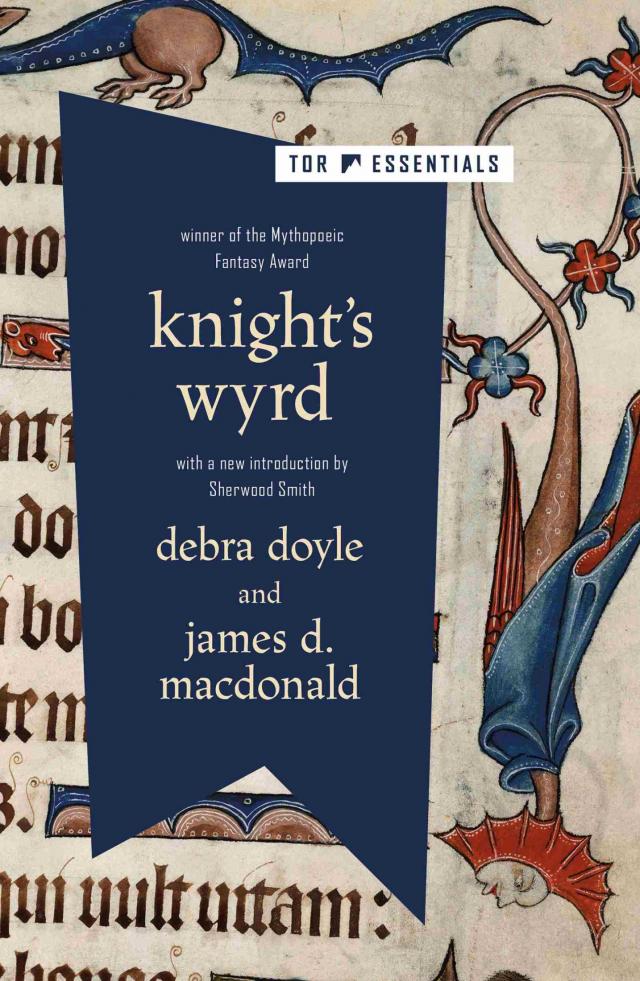
Begin Reading
Table of Contents
About the Authors
Copyright Page
Thank you for buying this
Tom Doherty Associates ebook.
To receive special offers, bonus content,
and info on new releases and other great reads,
sign up for our newsletters.
Or visit us online at
us.macmillan.com/newslettersignup
For email updates on Debra Doyle, click here.
For email updates on James D. Macdonald, click here.
The author and publisher have provided this e-book to you without Digital Rights Management software (DRM) applied so that you can enjoy reading it on your personal devices. This e-book is for your personal use only. You may not print or post this e-book, or make this e-book publicly available in any way. You may not copy, reproduce, or upload this e-book, other than to read it on one of your personal devices.
Copyright infringement is against the law. If you believe the copy of this e-book you are reading infringes on the author’s copyright, please notify the publisher at: us.macmillanusa.com/piracy.
introduction
by Sherwood Smith
After I discovered Rosemary Sutcliff in fourth grade, I looked for stories set in medieval times. As the years went by, I noticed that most books by modern writers tended to either feature characters who thought and spoke like twentieth-century people, despite being dressed in tunics and houppelandes as they scratched their lice and spat rotten teeth, or suffer from flat characters who spoke forsoothly as the story trudged under the weight of See How Much Research I Did.
There are two that I come back to for rereading: one is Barbara Leonie Picard’s One Is One, and the other is this book in your hands, Knight’s Wyrd by Debra Doyle and James D. Macdonald.
Both these books are relatively short and appear to be simple, linear tales following a young man who wants to become a knight. Both were first published for young adults, though I first read them, and continue to reread them, as an adult.
Debra Doyle and James Macdonald certainly have the chops. They met and married while heavily involved with the Society for Creative Anachronism. James had gone into the navy—his form of chivalric adventure—while Debra was in the process of completing a doctorate in Anglo-Saxon studies. After James finished his naval hitch, they returned to the United States, where they settled down to raise their four kids and collaborate on nearly thirty books.
They each brought complementary strengths to their collaboration. James, who became an EMT (still on those chivalric adventures), would during his downtime spin out cinematic plots that Debra then turned into prose.
I am not a medieval scholar. I never made it past grade-school-level Latin, but I did toil through some Middle High German greats like Hartmann von Aue and Wolfram von Eschenbach while focusing on German literature. It was hard going much the same way reading Chaucer is, but I found it worthwhile because of the glimpses of medieval life gleaned through these texts. When I visited museums to look at medieval manuscripts, my attention was drawn not only to the beauties of hand-decorated Biblical texts, but also to scribbled notes at the edges of the elaborate lettering, and the quick sketches in margins, hints of what entertained those young monks and nuns during their long days in the scriptorium.
It’s those little details, evocations of medieval life, that I find resonating through this fast-paced tale, which begins with Will Odosson, a squire soon to be knighted, fighting a couple of thieves about to rob an old woman of her pig. It’s a hard fight, one he barely wins. He comes out of it badly beat up. He still must keep vigil in church all night before his knighting ceremony, enduring discomfort as he tries to focus his mind on knightly virtues instead of thinking over that fight. In the wee hours, Master Finn, a local wizard, comes to him and relates a vision—Will’s wyrd. Unfortunately, it sounds pretty dire.
“Wizard”?
So this is a fantasy? Yes—and no, which is one of the reasons why this book works so very well. We know there were no wizards in medieval Europe. At least not by name. This wizard, who is friends with the local priest, is a reminder that during medieval times, science and religion went hand in hand. Scholarly clerics delved deeply into mystical as well as physical sciences as they tried to comprehend the cosmos.
The concept of the wyrd was well known; the word is a noun formed from the Old English verb weorþan, meaning “to come to pass; to become.” Visions were very much a part of medieval life and literature. Ditto the belief that trolls and wights and ogres and ghosts walked the world.
The next day, Will and his buddies among the squires set out to catch up with the tourney season, because that’s what young knights did, if they were not under orders to fight or defend their lord’s castle; another of the ways I appreciate this story is the way Doyle and Macdonald evoke the medieval mindset with respect to chivalry, which nowadays we might regard as ritualized violence. Chivalry was a way to try to put the brakes on violence in a time when there wasn’t much of a safety net for ordinary people. Tourneys were martial skills contests, with rules; ransoms for the winners, paid by the losers; and perhaps a prize offered by the host of the tourney. They were also great shows for the locals, in a time when you made your own entertainment.
Will briefly meets Isobel, the young woman he is destined to marry according to their respective parents’ wishes, only to discover that she has her own goals, which don’t necessarily include marriage to him. But then she disappears, and Will joins the search to find her because he takes his vows seriously, and tries to be a good knight.
He encounters other knights sworn to Duke Anlac, who are motivated by the usual human enthusiasms: greed, lust, ambition, and of course there are what we’d call the adrenaline junkies who are there for the fun of bashing up each other’s armor, in spite of not only the dangers on the field, but accidents like running into a tree branch that you can’t see in your heavy helm, and breaking your neck. As happens to Will’s first opponent, Sir Beorn.
The downsides of fighting in armor, the battle-trained horses, the camaraderie and rivalry of the knights are so vividly evoked. So far, this is a fun, fast-paced tale with a dash of sensory realism to ground it.
But then comes this moment when Will attends Mass with the other knights:
“Hello, Will Odosson,” whispered the man kneeling to Will’s left. “I’m happy to see you here with us.”
Will kept his head bowed, but looked sidelong at the speaker and saw only a dark form muffled in a hooded cloak. Then the speaker’s head turned, and Will saw inside the deep hood the face of Sir Beorn of Stanburh.
Before Will could speak, another whisper came, this time from Will’s right. “Hello, Will Odosson. I also am happy to see you here.”
Will turned his head. Another muffled figure knelt beside him at his right hand. This one, too, he recognized: Sir Ohtere, whose corpse lay waxy-pale before the altar where the old priest chanted the funeral prayers.
On my first read, this is where the hairs on the back of my neck rose. It wasn’t so much the ghosts—we’ve met at least one before—it was the repetition, the liminality of the scene, that threw me back into my readings in that difficult old German.
Until that moment I’d assumed I could predict the trajectory of the novel, which would follow the form popular for readers today. And I was fine with that: Will would fight some bad guys, overcome the sinister wyrd, earn a title, marry the sensible Isobel—happy ending.
But when he sees that ghost to his left, and another to his right, I realized I had no idea where this story was going. The repetition, the symbols with sets of threes, the forests, the stonework that evokes the upward-reaching Gothic lines, resonate with all those ancient poems that were the huge bestsellers of the twelfth century.
The more I read, the stronger I felt that Doyle and Macdonald got as close to what delighted our medieval ancestors as a contemporary person can, giving us a tale that might have been shared on snowy winters’ evenings during the time when jousting and tourneys were still being fought. Questions of honor and meaning, friendship and enmity, horror and awe, and of course laughter, entertained people a millennium ago, as they do now. Knight’s Wyrd shimmers with emotional complexity and liminal engagement with the numinous, evoking the mindset of a thousand years ago in a way that I find essential for a medieval story.
for professor russell peck—
“a wight of mickle lore.”
authors’ note
Anglia isn’t England, in spite of the occasional similarities, and the background of Knight’s Wyrd isn’t meant to reflect English history in the world as we know it. Among the more obvious differences: in the real world, the Giants’ Causeway between Great Britain and Ireland is a natural stone formation (and mostly submerged, at that); and the island of Britain has never been inhabited by giants, ogres, unicorns, or other magical beasts.
A few words on pronunciation may be helpful as well. Most of the names are pronounced as they appear but with vowel sounds more like those of modern French or German. The letter h in words like Ohtere and Stanburh represents a breathy, back-of-the-throat kh-sound like the ch in the Scots loch. Ohtere is pronounced in three syllables, as Okh-ter-uh; Seamus as Shay-mus; and Raeda in two syllables with the ae sounding like the a in hat. Wyrd is pronounced with a vowel sound somewhere between word and weird; and Gyfre and ogre, in spite of their spellings, are pronounced Gyf-fer and oh-grr.
chapter 1
The spring rain had fallen for a week on Restonbury Castle, but on the day before Will Odosson’s knighting the clouds parted and the sun came out to dry the steaming earth. Squires and bachelor knights poured out of the castle like wild ponies escaping through a broken gate, to work off their excess energy in hunting the Baron of Restonbury’s deer.
Will felt glad to ride out of the castle for a few hours. Knighthood was a solemn calling, and all during the long and rainy week Father Padraic the priest, and Master Finn the baron’s wizard, had taken the opportunity to put the finishing touches on years of lectures.
“If it wasn’t one of them, it was the other,” he said to his friend and fellow squire Tostig Raeda, the redheaded son of Restonbury’s shire-reeve. “I’ve heard enough about the mysteries of knighthood over the past seven days to last me the rest of my life.”
“They just want to make sure you don’t disgrace the barony when you ride out to the tourneys,” Tostig replied. “Nothing mysterious about that.”
“Just you wait,” put in Seamus of Ierne, another of the squires. He was a distant cousin of Will’s on Will’s mother’s side, and the youngest son in a family that had been noble long before Duke Rollo sailed from Norroena to break Anglia in half. “Once Will gets his spurs, he’ll be so full of mysteriousness the rest of us won’t be able to talk to him.”
Garth of Orwick—a Nordanglian, and at twenty-three the oldest of Baron Odo’s household knights—regarded the squires with mock severity. “A good thing, too,” he said. “Maybe we can get some work out of the rest of you for a change.”
“Who do you think’s been doing most of it all along?” Will asked. “Don’t worry, though—you’ve still got Ranulf if you need something done.”
As he spoke, Will glanced over at his younger brother, who was riding nearby. Ranulf looked both flattered and a little nervous—he was only twelve to Will’s eighteen, and hadn’t been a squire long enough to shed his awe of the knights with their white belts and gilded spurs and huge, thundering warhorses.
Will grinned. After his little brother had cleaned enough of the leather belts and polished enough of the spurs and rubbed down enough of the horses, he’d be looking at knighthood in a clearer light. Will opened his mouth to say as much, but before he could speak the hounds began to bay. Off in the woods the baron’s chief huntsman blew his horn to begin driving the prey toward the waiting knights.
Moments later, Will heard crashing noises in the underbrush. A white deer burst out from among the leaves. Against the bright golden green of the early spring foliage, the pale shape of the running deer gleamed like a streak of silver. The hounds ran faster as their quarry came into view, while the troop of knights and squires increased their speed to match.
Will galloped along with the rest. His horse, Grey Gyfre, soon brought him up to the forefront of the riders, overtaking the knights on their heavier chargers. The wind of his passage blew his ginger-colored hair off his forehead and back past his ears.
The white deer was drawing ahead again. The belling of the pack grew loud and fierce. Will leaned forward over Gyfre’s neck and strove to narrow the gap between himself and the plunging, panting deer. Somewhere behind him another knight shouted his name, and Tostig Raeda gave a high, piercing whistle. But the clamor of the hounds sounded even louder than the voices of his friends, and the drumming of Gyfre’s hooves on the woodland turf seemed to roar in his ears like the sea.
Then, as suddenly as it had appeared, the white deer vanished. The voices of the pack fell silent. And Will saw that except for Grey Gyfre and a single lop-eared hound, he was alone in the forest.
He looked about for landmarks—some misshapen lump of rock or lightning-struck tree that might set this part of the forest off from all the others—and found nothing. He waited quietly for a few minutes, listening for the sound of the hunt in the distance. All he heard was his own slow, regular breathing, underlaid with the faint clink and squeak of Gyfre’s saddle and bridle, and the whuffling noises made by the hound as it sniffed around the roots of the trees.
Will frowned. He wasn’t afraid of the trolls and other unpleasant creatures who still infested the wilder parts of Suthanglia—not in broad daylight and this close to home, with a good horse under him and a sword by his side. But working his way back by the lie of the land and the angle of the sun was going to take time, and he didn’t have a hope of slipping into the castle unnoticed. He was, after all, the lord of Restonbury’s eldest son and heir, whose knighting tomorrow was the reason for all the celebration and overcrowding.
“Blast it,” he told the hound. “I don’t want to spend the rest of my life hearing about how I got lost in the woods the day before Duke Anlac made me a knight.”
The hound lolled out its tongue and grinned at him.
“Learn to live with it, you say?” Will sighed. “You’re probably right. Well, let’s get started.”
He stayed where he was for a moment or so longer, sorting out his memories of the chase. The forest lay to the north and west of Restonbury, and the hunting party had set out heading northward. But which way had the deer led them after that? He wasn’t sure. After some thought, he decided to ride southward, in the hope of breaking free of the forest. Once out in the open, he could spot the grey stone towers of Restonbury Castle as soon as they thrust up over the horizon.
He squinted upward through the green leaves at the general position of the sun and started out toward what he hoped would be the south. He’d been riding for a few minutes in that direction when he heard a commotion in the underbrush ahead: hoarse shouts, a cracked voice shrieking, and the high-pitched squeal of an unhappy pig.
The noise was loud enough to mask the sound of his approach. The angry yells grew louder, the curses more bitter. Will urged his horse onward in the direction of the noise.
He rode out of the underbrush into a forest glade. A narrow footpath, half overgrown, came out of the woods to his left and ran across the open ground into the shadows of the trees on the other side. An old woman in drab homespun stood in the middle of the path, her hands clenched on one end of a stout rope. The other end of the rope was tied around the neck of a well-fleshed milk-white pig. Two large men with drawn swords circled around them both.
“Come on now, granny,” one man said. The words were soft and wheedling, but the heavy blade in his right hand gave his voice the lie. “We don’t want to hurt you. Just give us the piggie and go on your way.”
As he spoke, the other man lunged for the pig. The plump beast squirmed free with surprising agility. It gave a fierce squeal and dashed out of the outlaw’s reach.
The woman wound the rope even tighter around her knobby, work-soiled hands. “He’s mine, I tell you,” she said, hauling the pig in close against her patched and mended skirt. “He’s all that I have.”
“He’s too good an animal for the likes of you,” said the man who had grabbed for the pig. “I’ll wager you stole him from some lord’s pigsty.”
“I never did!” cried the old woman. “I bought him for tuppence at the market-fair in Delminster.”
The other man seized her from behind as she spoke. “You should have saved your coppers, granny. He’s ours now. Take the pig, Osbert.”
Will reined in Gyfre to a stop and drew his sword. The blade left its sheath with a steely whisper. He moistened his lips with his tongue.
“Leave the woman alone.”
The two outlaws turned at the sound of his voice. They looked from his bare sword to the horse he sat on—no knight’s warhorse, as he was not yet a knight, but a trim, fast animal—and then back at him. The man who had been holding the old woman spoke first.
“Here, now, son. You wouldn’t take advantage of us by using that beast, would you? Where’s the honor in that? Dismount and fight us man to man.”
Will looked at the two outlaws. Neither one was armored, and neither had a shield. Will wore his coat of mail and carried his shield slung on his back. Mounted, he held every advantage except that of numbers alone, and even at two against one the men on foot would be hard pressed.


