

Savage her reply, p.1
Savage her Reply, page 1


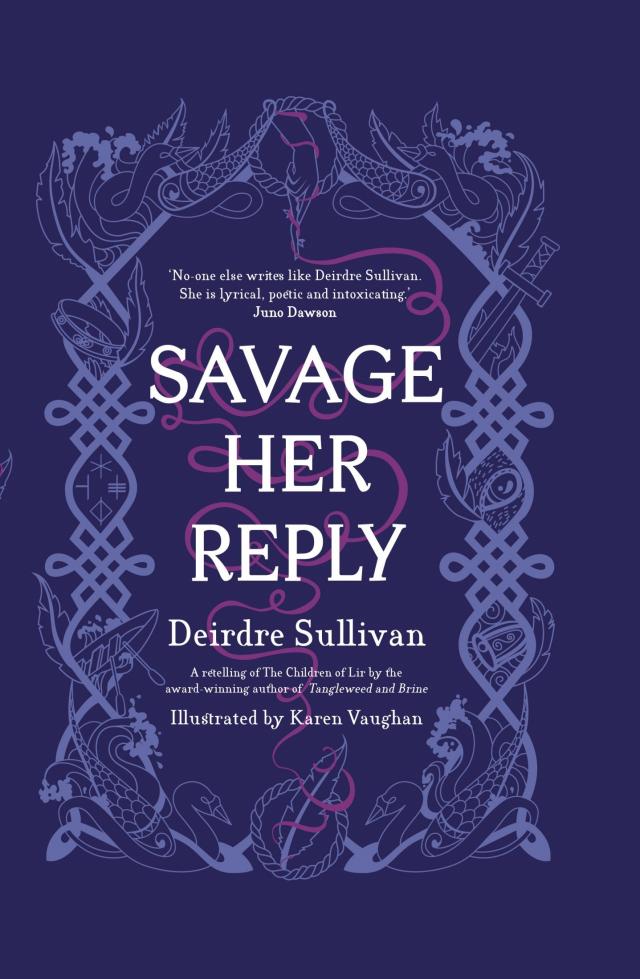
SAVAGE
HER
REPLY
SAVAGE
HER
REPLY
DEIRDRE SULLIVAN
ILLUSTRATED BY KAREN VAUGHAN
PRAISE FOR
Tangleweed and Brine
Winner of the Children’s Books Ireland Book of the Year Award 2018
Winner of the Young Adult Book of the Year at the Irish Book Awards 2017
Winner of the Irish Times Ticket Readers’ Choice for Best Young Adult Fiction 2017
‘A tapestry of retellings and reimaginings that foreground women … enriched by Vaughan’s sharp, intricate, Beardsleyesque illustrations.’ The Guardian
‘An absolute stunner of a book.’ The Irish Times
‘Sullivan muddies the black-and-white narratives … Her language is heavily perfumed with meaning.’ The Times Literary Supplement
‘Sullivan’s sinuous, lyrical writing will have you transfixed.’ The Irish Independent
‘These fairytale retellings are remarkable: they stop you in your tracks. They make you exclaim “What! What did I just read?”’ Achuka
‘Inspirational, poetic and beautiful.’ Writers Review
‘As wonderful to read as it is to look at. Deserves a place on your shelf stat.’ Buzzfeed
‘Deirdre Sullivan’s terse and stark renditions … challenge us to rethink what the destinies of young women were in traditional fairy tales.’ Jack Zipes
‘Exquisitely written and powerful … I’m enchanted by it.’ Marian Keyes
‘Sullivan’s writing is beguiling, bewitching and poetic. Her prose is almost dreamlike, reminiscent of Angela Carter.’ Juno Dawson
‘These thirteen fairy-tale retellings already feel like feminist classics.’ Claire Hennessy
‘Dark, intimate and poetic, these stunning feminist fairytales give voice to the witches and the wicked queens and twist the familiar into something salty and seductive.’ Moira Fowley-Doyle
PRAISE FOR
Savage Her Reply
‘No-one else writes like Deirdre Sullivan. She is lyrical, poetic and thoroughly intoxicating.’ Juno Dawson, author of Wonderland
‘Unsettling, haunting, and darkly lyrical, Savage Her Reply is a beautiful thing.’ Louise O’Neill, author of After The Silence
‘An evocative, poetic and enigmatic brew that is bold, striking, confident and keeps you hungry for more.’ Laura Dockrill, author of What Have I Done?
‘The writing is so beautiful, sharp as a knife – you’re bleeding before you know you’ve been cut … It’s such a fierce, bitter kiss of a book.’ Melinda Salisbury, author of Hold Back The Tide
‘Sullivan is a scholar and an artist: she is the perfect conduit for this myth. This book is stirring and shocking, a feat of absolute poetry.’ Sarah Maria Griffin, author of Other Words for Smoke
‘To call this a retelling would do not do it justice. Sullivan has expanded and enriched one of our best-known fables until it feels as complex and robust as any blockbuster fantasy epic. This is Irish mythology as it is meant to be read.’ Dave Rudden, author of The Knights of the Borrowed Dark
‘An old, familiar tale made startling again. Not a single word is out of place: like a poem, or a spell.’ Tara Flynn, actor and writer
‘The unique choice of viewpoint breathes new life into the story’s bones, making for a truly haunting and compelling tale.’ Catherine Doyle, author of The Storm Keeper’s Island
‘Astonishingly beautiful and moving. Deirdre Sullivan grows stronger with every book.’ Celine Kiernan, author of The Moorehawke Trilogy
‘I devoured every word of this extraordinary book – from its thrilling, breathless, lyrical opening, to its reverberating end. Deirdre Sullivan breathes magnificent, fiery life into one of Ireland’s oldest stories. Nothing will ever be the same.’ Sarah Moore Fitzgerald, author of The Apple Tart of Hope and A Strange Kind of Brave
SAVAGE HER REPLY
First published in 2020 by
Little Island Books
7 Kenilworth Park
Dublin 6w
Ireland
Text © Deirdre Sullivan 2020
Illustrations © Karen Vaughan 2020
Epigraph from Early Irish Myths and Sagas, translation, introduction and notes copyright © Jeffrey Gantz 1981, published by Penguin Classics 1981. Reproduced by permission of Penguin Books Ltd.
The Author has asserted her moral rights
All rights reserved. No part of this book may be reproduced, transmitted or stored in a retrieval system in any form or by any means (including electronic/ digital, mechanical, photocopying, scanning, recording or otherwise, by means now known or hereinafter invented) without prior permission in writing from the publisher.
A British Library Cataloguing in Publication record for this book is available from the British Library.
Cover and interior illustrations by Karen Vaughan
Typeset by Niall McCormack
Proofread by Emma Dunne
Print ISBN: 978-1-912417-64-3
Ebook (Kindle) ISBN: 978-1-912417-65-0
Ebook (other platforms) ISBN: 978-1-912417-66-7
Little Island has received funding to support this book from the Arts Council of Ireland
10 9 8 7 6 5 4 3 2 1
For Siobhán Parkinson
Le míle buíochas
‘Savage her reply,’ said Conare.
‘Let her in, then, despite the geiss against it.’
From Early Irish Myths and Sagas
(Jeffrey Gantz, 1981)
NUIN
I am old. I am older than books, I am older than keep cups, I am older than the internet, I am older than Christ, I am older than trains. I am older than your oldest living relative’s oldest memory and her mother’s before her and her mother’s before her and you could keep on going, going, going. I am older than your governments, your laws, I am older than bus stops, I am older than the words you shape inside your mouth and I am older than your mouth. The tongue I spoke when I was something else has changed entirely and it sounds jarring in this bright and humming world. I am older than electricity, I am older than oil lamps, I am older than the alphabet, I am older than the months you use, I am older than chocolate, I am older than Christmas, I am older than iron.
And yet … I am younger than blood, than salt, than sea. I am younger than war, I am younger than heroes, I am younger than marriage, I am younger than Tara, I am younger than tears, I am younger than poetry, I am younger than time, I am younger than cats, I am younger than wolves, I am younger than swans, I am younger than stones, I am younger than the Boyne, I am younger than people wanting things they cannot have, I am younger than thirst, I am younger than bread, I am younger than spells, I am younger than trees, I am younger than knives, I am younger than hands, I am younger than sleep, I am younger than sex, I am younger than breath, I am younger than rage, I am younger than bones, I am younger than the lake that welcomed their despair, I am younger than birth, I am younger than death, I am younger than hate, I am younger than love, I am younger than hope, I am younger than Ireland, I am younger than horses, I am younger than a child’s despair, I am younger than pleading, I am younger than cruelty, I am younger than earrings, I am younger than mercy, I am younger than sorcery, I am younger than kisses, I am younger than boats, I am younger than storms, I am younger than feathers, I am younger than thrones, I am younger than fathers, I am younger than husbands, I am younger than answers.
I am younger than milk.
And when you read about the things I did, the thing that I’ve become, try your best to reach out and to meet me.
Here.
Before all this.
I was a little girl.
And someone took me.
NGETAL
SCÉAL
Long, long ago in Ireland, the time came to elect a new high king. The chieftains from all five provinces assembled, and it was decided that Bodhbh Dearg, or Bodhbh the Red, was the man for the job, which left Lir of Sídh Finnachadh in a fury. He left that place in dark humour, and returned home to more misfortune. His dear wife became ill and died soon after. The new high king, in his wisdom, generously offered Lir the hand of one of his three foster-daughters to replace the woman that he had lost. Lir chose the eldest and noblest, Aébh, and soon she was with child, and they were happy.
OIR
Some say destiny is woven by the skillful fingers of a goddess. Others claim that it is carved in stone. I don’t remember my mother’s hands, or how she used them. Our attendants were, in some way, mothers to us. They gave me much. But the relationship is different, I think. They were warrior women, sworn to keep us safe. I don’t remember what my father looked like, what made him smile. It has been said to me that I was like him. Comments made in passing, but I held to them like jewels. We missed our family, but we understood why we had to leave. Bodhbh had asked for us, and our parents wanted what they had to be safe. They needed his protection, power, kinship. And so they gave us up. It wasn’t supposed to be for ever. We were supposed to return more connected, not less. We were supposed to return.
There are them that think we forge our own destiny. After all this time, I am still unsure. Apart from this: I know that I don’t know. That there are things we do and do not choose. We are ourselves, and we are also stories people tell. When we faded from our parents’ lives, we must have become a different sort of thing to what we were. An honour or a threat. Or something blurry in between the two. It cannot have been easy to let us go, their only c hildren, Ailbhe just a babe. With fosterings it was unusual to take all that a person had. But our foster-father was an unusual sort of man, and it was necessary to indulge him. People can always find ways to twist customs and traditions to suit their own ends. Those who love power will gather power. And it will never be as warm and trusting as the skin of a sleeping child, but that sort of thing is hard to value when your eyes are fixed upon a crown.
My sisters and I crossed the sea on a tiny boat that smelt of wood and leather and the sea-spray kissed our little faces. The three of us together, as it always was, from there on out. Aébh, the eldest, and Ailbhe, the baby. And myself, in the middle. We huddled together like kittens in the bottom of the vessel, watching the sure hands and grim faces of the women who attended us. And it was frightening, and it was cold. I know that there are siblings who do not love each other as we did. Had we been left at home, perhaps we would have drifted apart. We were different sorts of people the one from the other, but all of us clung to this half-remembered dream of home. We fed each other with it. Where we were going, this was beyond price.
I was very good, the women said. I only roared when they put me on land. As though I could feel myself being pulled from where I’d been, from who I was and all I could become. A roar, they said. They wanted us to be like them, like warriors. Strong and sure, adapting seamlessly to all that was required. And I just wanted somewhere to belong. I craved a sense of ownership over my home, my clothes, my words, my heart, my body. I can’t have been an easy child to guard, and Dechtaire and Smól must have been very glad of my sisters at times, that they distracted me from my screamings and my rantings at the various slights and denials that were always being visited upon me. I often, as a child, imagined an invisible hand reaching from the place that hurts the most when you’ve been running, that little stitch that throbs beneath the heart, over the fields and hills towards the stones and mountains, to where the sea fights earth and over that again. And to what?
To faces I don’t know, that wouldn’t know me.
The stars were bright that night, as the boat moved through the water, and we could see them. When we arrived at the shore, there were chariots and horses waiting. Dechtaire and Smól bundled our stuff on to them and continued towards Sídh Femuin, the home of Bodhbh the Red. I remember so little of what happened to me before then. Of the place I came from. But that journey that began my transition from daughter to fosterling is a vivid one. The cold wind and the wild sea and the bright stars. The grass was grey, and after a time, everything faded from my vision till the morning. But I kept those stars inside me, wondering if I could read them, know them, and would what lay ahead be as terrifying as that first departure. Would I always long for the sound of my father, the smell of my mother, the warmth of my hearth? Was there any comfort to be had? I couldn’t find much. Later on, I learned to look at the stars a little differently. And now they are old friends, though it is rarely that I try to read them. The future stretches wide and is hard to look at. The past is not so easy, mind you, either.
DUIR
Our people were different in many ways to the humans of today, longer limbed and longer lived, but there were similarities as well. Perhaps that is why so many of our stories still survive. The overlapping pieces of our hearts. I was young in the time before things were written down. Druids memorised our history and lore, fed it back to us, and gained importance. People heard things and told them to other people, to lengthen evenings or to shorten roads. But, even with events that really happened, with every teller something tends to change. Hair colour, or the food served at a feast. The number of eyes in your head, the number of scars on your back. The right and wrong of it. We put ourselves into the tales we tell, and to do that, we must remove a part of someone else.
Stories can be weapons, persuading people of things about themselves, about each other. Before I was in one, I loved to listen. To gather things around me, bits of knowledge. I would seek out druids, poets, musicians, gossips, warriors, and plague them with questions, until I was told that was enough. I would repeat the stories to my sisters and put extra pieces in to make them smile. A fight for Ailbhe, something sweet for Aébh. I loved them, so I looked to make them happy. They were all I had now, in this place. And wasn’t I lucky to have them by my side, as I grew up in the home of Bodhbh the Red, where loyalty was as valuable as its uses, and we were a hold he had on someone else.
Our foster-father was a strange and charismatic sort of man. In those days, there were smaller kings and then a high king to unite them. When we encountered him first, he had yet to be elected high king, but had established a powerful reputation. His place was large and comfortable, and his allies plentiful. Many fine fat cows grazed on his lands, and powerful bulls as well. As a ruler, he was famous for his wisdom and ability to solve problems to the satisfaction, largely, of all concerned. Kingship pleased him, and his people pleased him. We tried our best to please him in a different way, out of desperation or a need for love. If he had asked one of us for a hand, we would have cut it off for him without a moment’s thought. Our family needed him. We needed him. And he could be kind. He exuded warmth and fairness. People liked him. He was ambitious, for himself as well as for his people. A better king than most.
But always busy. We would gather around him sometimes and he would ruffle our hair and ask us how we were getting on, study our strengths, our faces and our forms. I thought back then he cared, that it was interest, not assessment.
His wife, Ban, was a kind woman, but distant. She had her own children, and a household to run, and we were fed and clothed and taught skills that would help us to be useful to Bodhbh as we aged. Managing a sídh, bartering, presenting ourselves well, repairing clothes, arranging hair, speaking softly, listening well. Making sure we knew who people were and their place and function in relation to our own. Being a credit to our foster-father. Everything on the territory he ruled over, his tuath, reflected him and on him. We were a sacrifice at his altar. The jewels upon his fingers, round his neck.
Let me draw you a picture of him, as I remember. It was said of him that he was the son of our great god, the Dagda, and in his presence you could well believe it. His voice was deep and resonant, and he had a booming laugh that made all who heard it laugh along. People didn’t seem to try to curry favour for favour’s sake with Bodhbh. They wanted him to like them, because he was a marvellous sort of man, and his good opinion could help a person on the inside as well as on the outside. He didn’t need to taste a magic fish to give him wisdom. Years of experience, combined with his powerful lineage, had given him solidity and the appearance of trustworthiness. There was a weight to him, like a well-made sword. He had a ruddy face, a two-forked beard. Long golden hair that tumbled past his shoulders. He generally wore it held back with either a leather thong or a thin gold thread. Skin like hide. His hands were large and inelegant, with wide palms and long, thick fingers. They were always doing something, or about to do something. A vow. A threat.
Bodhbh’s features underneath the beard were delicate, almost feminine. His body tall and broad, his arms thick. He could wrap his hands around your ribcage and throw you up in the air, and the fear and delight would consume you.
We were rarely, if ever, alone with him. He had nine warriors he kept around him. And they were nice men too, but fierce. We used to try to get them to smile at us, and sometimes one of them would and we would laugh, triumphant, at each other. A strange game, but satisfying too. Aébh, being lovely, was the best at that, as easy to like as I was hard to take.
Bodhbh’s feet were big, and his smallest toes tilted to the side so that the nail pointed out towards the walls, rather than up towards the roof. Sometimes he would have hairs in his nose or ears and sometimes they would be gone. I never knew what he did with them.
He was kind. He was. He did his duty by us and more besides. But we were an investment. Calves in a field. A lush field, full of clover. Sun in the sky and milk inside our bellies. Of course we hoped, of course we played together. And didn’t think that we would become cows and then meat to be served to this warrior or that one, until there was nothing left of us but memory.


