

Crossroads of oblivion b.., p.1
Crossroads of Oblivion (Book 2): A Portal Progression Fantasy Adventure Series, page 1


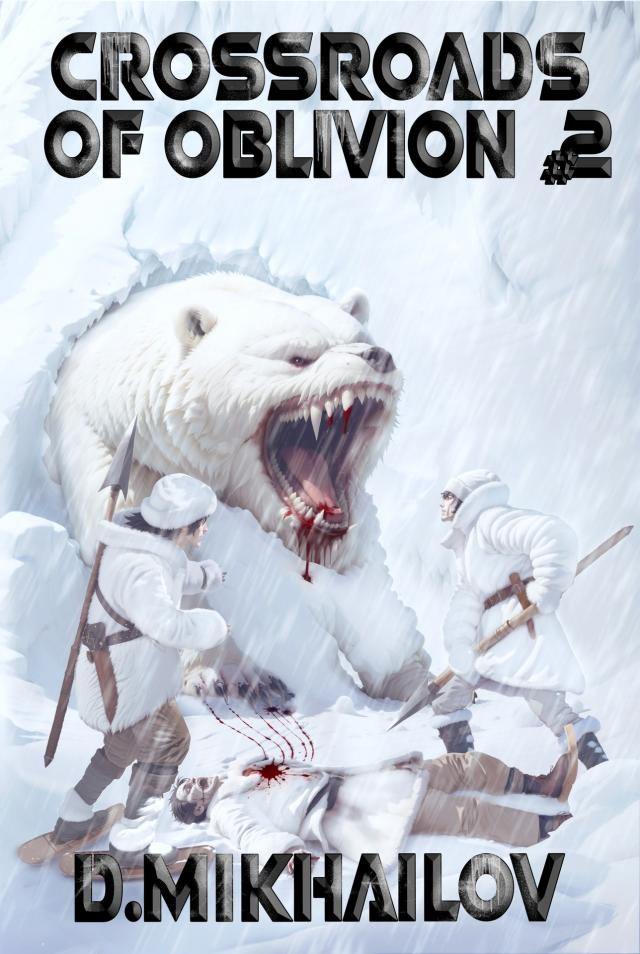
Dem Mikhailov
Crossroads of Oblivion
Book Two
A Portal Progression Fantasy Adventure Series
Published by Magic Dome Books
in collaboration with 1C-Publishing
Crossroads of Oblivion
Book 2
Copyright © Dem Mikhailov 2024
Cover Art © Linni 2024
Art Designer © Vladimir Manyukhin 2024
English translation copyright © Peter Ward 2024
Published by Magic Dome Books in collaboration with 1C-Publishing, 2024
All Rights Reserved
ISBN: 978-80-7693-413-9
This book is licensed for your personal enjoyment only. This book may not be re-sold or given away to other people. If you would like to share this book with another person, please purchase an additional copy for each recipient. If you’re reading this book and did not purchase it, or it was not purchased for your use only, then please purchase your own copy. Thank you for respecting the hard work of this author.
This book is entirely a work of fiction. Any correlation with real people or events is coincidental.
New and upcoming releases from
Magic Dome Books!
If you like our books and want to keep reading, download our FREE Publisher's Catalog, a must-read for any LitRPG fan which lists some of the finest works in the genre:
Tales of Wonder and Adventure: The Best of LitRPG, Fantasy and Sci-Fi (Publisher's Catalog)
Table of Contents:
Prologue
Chapter One
Chapter Two
Chapter Three
Chapter Four
Chapter Five
Chapter Six
Chapter Seven
Chapter Eight
Chapter Nine
Chapter Ten
Chapter Eleven
Chapter Twelve
About the Author
Prologue
“That boy of yours is an odd one!” The voice of the old lady standing by the low fence betrayed unrestrained pleasure. “They were playing ball in the yard the other day, mine and yours. Now mine’s a big boy, mind. Strong! He can really kick that ball. Bam! Bam!” She clapped her hands with each “bam” for emphasis. “Gonna be an athlete! It’s cause I feed him right. Makes me proud. But your boy just sat there watching him. Like a kitten or something. I saw him kick the ball one time, then sit back down. Not a word! Mine’s a talker too! And a singer! Always humming a tune. I don’t know about yours though — it’s not right being so quiet. Makes you wonder what kind of a man he’ll turn into, don’t it…?” At that, the old bag realized she’d probably said enough. She crossed herself and simply said, “Forgive me, Lord… Now, don’t you worry, that boy will stretch out and learn some words sooner or later. He’ll get some spunk. I’ve tried showing him a thing or two. He looks me in the eye, sure enough, but it goes in one ear and out the other…”
Finally pausing her monologue and catching her breath, the old lady stared expectantly in our direction. My grandmother stood up slowly, leaning on the well-worn handle of her garden hoe, and threw a look first at me, sitting on an old stump and drawing, before training her eyes on our uninvited interlocutor. Finally, she spoke:
“I saw them playing.”
“You did, did you?!! My boy was everywhere with that ball! Wham! Bam! And your boy just sat there… watching it all. Maybe he was jealous? What did my boy ever do to him? Not his fault his granny feeds him pie and milk every day.”
As if not even listening to the woman, my grandmother continued in a quiet, easy voice:
“But they weren’t playing soccer, Matveyevna. They were playing gorodki[1], trying to knock down the skittles by the shed.”
“Well, sure, my boy was — ”
My grandmother’s voice took on a new tone as she cut Matveyevna off, “Your boy couldn’t hit the broad side of a barn. That’s why he was kicking the ball so much. My boy watched him make a fool out of himself. Then he got up, aimed, kicked, and knocked down all the pins. The game was over, so he sat down. And yes, he’s quiet and discreet. He doesn’t feel the need to waste energy filling the air with words. That, to me, is the mark of a real man. You know me well, Matveyevna. Don’t you dare talk about my grandson like that in front of him. And don’t you ever try to teach him anything, or I’ll come right over to your house and break this hoe over your head.”
“Now, now… no need to get irate…”
“You raised three sons. And they all abandoned you. Your daughter is a fat cow who visits twice a year — once to drop off your grandson and again to pick him up when the summer’s over. She also begs you for money. Well? Are you satisfied with your brood? Raised them right, did you? And apparently you haven’t done enough harm… you’re raising your grandson too! But that’s none of my business. Don’t you dare touch my grandson! Got it?!”
“I never… please, enough…”
“Don’t you touch him!” my grandmother repeated. “You can only do harm! And get this through your thick skull: a man isn’t all empty words and wild energy. A man takes aim. He does the job. He thinks about work, does the work, and loves the work! He has integrity and he doesn’t rush! He doesn’t waste energy! At least that’s what I think. You can think what you want, but don’t you dare talk to my grandson with that poison tongue of yours! Now get out of here!”
“Oh my…”
“Get out of here! And send your boy over here if you ever want him to learn any sense! Now get! Go!”
My grandmother stomped her foot, and the old woman was blown away as if by the wind. Looking down, I continued drawing a thick black line on the flat side of a milled log.
“Going okay?”
I nodded silently and added another inch, nearly completing the rough cutting line.
“Throw it away,” my grandmother ordered me, pointing at the log with the handle of her hoe. “See that? It’s cracked. And there’s a knot. Take it to the bathhouse, it’s firewood. Find a new one — give it a good hard look. No cracks or knots. And remember — a man must choose wisely. With hand and heart. You understand?”
“I do”
“Go. And don’t forget to weed the cabbage patch behind the bathhouse.”
“I already did.”
“All three beds?”
“Two.”
“Then take the wood to the bathhouse. Something’s strained my back — it needs a good steam. Can you do that? You’re not tired?”
“I’ll do it. I’m not tired…”
Chapter One
“OUT OF NOWHERE, my rod bowed! I thought it would snap and send me into the water! I pulled gently, trying to stay patient. Boy, it was hard… but I got that sonofabitch — a monster of a catfish she was! I laid her out on the grass by my tent and just stared. I couldn’t believe it! What a beauty! I lit a smoke and got out my hip flask. As soon as I took a sip — wham! I woke up in my cell… Yep… That was day one for me,” the old man who called himself Danilich said with a quivering smile. “But I served my forty. From bell to bell! And what now? What do you do with such an unlucky life? My youth is long gone. But I’m alive! I enjoy what I can. And that’s what matters, right?”
“Of course,” I said with a smile and a nod. “You made it, that’s what matters. Each new day is another victory.”
“Well, I'll be going. Thanks for the chat. Gonna go see if I can bum a smoke off someone. As for ammo… sorry to say I can’t help you there, Grave Robber. But keep your chin up.”
“Don’t worry about it,” I said, nodding again. “If you hear anything let me know — I’d appreciate it. Have a smoke for your trouble, Danilich.”
Shaking my silver cigarette case, I removed one of three and handed it to him. Talking with him had been a waste of time. Just a bunch of old fishing stories.
“Oh, thanks!” he said, carefully accepting the cigarette.
There followed a ritual of sorts that I watched with interest.
First, the cigarette was carefully placed on the stone table. Then a flat, long metal box was placed next to it. Inside it was an empty pack of Golden Javas and a lighter. The cigarette was placed in the empty pack and the metal box was carefully clicked shut and returned to the inside pocket of Danilich’s patchy old, quilted jacket. Standing up, the man gave me a solemn but shallow bow.
“Thank you, my young friend!”
“Don’t mention it.”
Watching the old man shuffle away, I sighed and slowly crossed out his name in my oilskin notebook — won in a trade for a filterless cigarette. I was told Danilich was a reliable source of information. But he didn’t give me a single straight answer.
One thing was certain, though — the real currency down here was cigarettes!
There were tons of smokers and hardly any smokes. Danilich’s claim that he was going to go “bum a smoke” from someone was pure fantasy. It was like asking for free money. The only way to get a cigarette was buying one through work or information. The only reason he got one from me was because I was feeling generous and wanted to show some respect for the old graybeard — eighty-six was an impressive feat, especially here…
My hopes in Danilich were misplaced.
Putting the notebook back into the bag around my neck, I zipped up my jacket and shoved my hands i nto my pockets. It was time to go find the next fountain of knowledge.
My questions were simple but numerous:
Who has ammo for sale or trade?
Who has firearms for sale or trade?
Who can tell me how to hunt bears?
What do I need to know about frostworms?
That was just some of what I wanted to know, but I couldn’t get answers to any of it. Everyone was eager to chat, but no one said anything of substance. And if anyone said anything even mildly interesting, the next person immediately refuted it with wildly emphatic arguments.
An hour ago, I learned that you had to shoot the bears between the eyes. There was a weak spot in the skull there, through which a bullet could pass easily into the brain. Shooting at its fat, hide-protected body was useless. The bullet would merely get lodged in the fat and the wound would only make the animal more ferocious.
But half an hour later, a wiry legless old man and longtime resident of Freetown, had a good laugh when I explained that theory to him. When he was done, he coughed for a while, holding his chest, and asked me for a sucker before finally telling me that shooting a bear was no plan at all. Only with a very powerful weapon would that have an effect. He asserted there was nothing better than a good old-fashioned spear and hatchet. You stopped the beast with the spear, and while one person held it there, the other went around behind it and gave it a few good whacks in the spine with the ax. Then you could calmly finish the incapacitated beast off and start quickly skinning it and loading the sled. If you took too long, the frostworms would come and steal your prize. Once they smelled fresh blood, they’d be on you in an instant and would eat everything, including you. Trying to fight the worms was hopeless. It was always better to run and just drag your fresh kill with you. Once you reached the safety of the Bunker you could start skinning and butchering it. But it all depended on the size of the bear.
After considering both theories, I decided the latter story sounded more reliable. I’d seen the skull of a local “bear.” It was three inches thick in places! On top of that was hard muscle, hide, and thick fur… They didn’t have fangs. Instead, the jaws were lined with several rows of thin, sharp bony spikes — exactly what they needed to chew through crusty ice and worm meat, their main source of food. Despite being called “bears,” the beasts were more like whales. They were whales with paws that roamed the frozen wastes in search of food or a mate. They could weigh up to a ton or more. Their bottom jaws were flat and slid across the ice, scooping up worms and chewing them into a juicy slurry before sending them down to digest in their five-chambered stomachs. The bears were by far the greatest danger in the wastes. They were also the main source of food for those who lived here. Still, a successful hunt was never a guarantee…
Leaving the common area, I went down the stairs past four yawning guards and found myself in the Hall of Freedom. Nice name, but people called it Freetown. It even had a statue — the crudely carved figure of a freed prisoner holding two lengths of broken chain over his head. The statue stood in the middle of a large double stairway that led to the hall itself — a wide cavern with a low ceiling, on the far end of which stood a pair of large, locked gates.
Passing the statue, I placed a scrap of cloth on one of the steps and sat down — the stone was cold… and dirty. I surveyed my surroundings from my high perch on the stairs, choosing another promising target for questioning.
My thoughts wandered to the recent past, when I arrived in this strange place just two days ago.
We had escaped. The Sheriff, The Lobster, and the Grave Robber earned their long-awaited freedom from the prison in the sky. At least that’s what we thought at the time. But we soon encountered a problem: there was no way to land the cross. It simply refused to descend lower than a few hundred feet from the ground. Fighting with the controls, I realized that another squad of guards would show up any moment. They would come in greater numbers and with more powerful weapons. I had to make a decision fast. So I told my companions to hold fast and steered the great aircraft towards the peak of a tall hill.
That turned out to be not the best idea. The landing was anything but soft. We hit the peak at full speed, tearing open the cross’s belly, crushing the cockpit, and sending debris and parts flying everywhere. The heavy machine crashed hard into the hill and started sliding down it. Luckily, that didn’t last long — after about a hundred feet, enough snow had piled up in front of the behemoth to act as both emergency brake for the cross and an airbag for its crew. Once I had my wits about me again, I took stock of the damage.
I had dislocated my left pinky and smashed my face open. It was badly bleeding, and I had more cuts and bruises than I could count. My back was also killing me.
The Sheriff and Arny had an easier time — they had a dozen injuries between them and no broken bones. But the escape itself had left them in bad shape to begin with, so none of us really got out unscathed. Loaded up with our belongings and pulling Arny and the Sheriff on an improvised sled made from blankets, I pressed forward, following Arny’s instructions. That’s when I learned about the frostworms and bears… They almost ended our journey then and there. We barely escaped and finally found sanctuary…
Snapping back to the present, I got up and walked the rest of the way up the stairs, following the sounds of an argument that was growing more heated by the second.
“It’s your turn! Your turn!” the shrill voice of a shivering elder carried throughout the room.
Looking up, I saw that only one line of heat lamps was on. One of three. The reason for the quarrel was clear — levers again. No one wanted to spend their limited life force to turn on the heat.
“No, it’s not! I pulled it seven days ago! It’s Sipatiy’s turn!”
“He died, dammit! They buried him yesterday, you old fool!”
“So what? I still pulled it seven days ago! It’s not my turn!” Hands folded behind his back, the old man refused to yield.
“I’m on duty today, and I say it’s your turn!”
“No!”
“Good afternoon,” I said with a smile. Reaching out, I pulled the lever sticking out of the wall. Walking back to the opposite side of the wall, I pulled the other lever. The room suddenly lit up and waves of warm air came on with a hum. A calm sigh of relief washed over the hall, as the refugees sitting or lounging in its many recesses settled in comfortably again. The Hall of Freedom was ringed with five levels of bunks where former prisoners had built ramshackle abodes. It looked informal at first glance, but there was a strict code of laws here — squatters were harshly punished.
This was where we first arrived when we collapsed through the open gates. According to tradition, the gates opened wide to every newly released prisoner that came before them. No one cared that all the warm air rushed out when it happened. It was a ritual, an age-old tradition. As soon as the newcomer passed over the threshold, everyone who could stood up and shouted with one voice, “Freedom!”
I was stunned by the cacophonous roar.
“FREEDOM!”
It chilled me to the bone. I froze, looking around at the people surrounding me, sitting or lying in their bunks, standing by the tables, all shouting in unison:
“FREEDOM!”
Only then did I finally realize I wasn’t a prisoner anymore — I was free.
When the gates slammed shut behind us, the guards, old but large and severe, didn’t let anyone close to us. Later, I learned that Freetown was a den of rats. No one here was above a little petty theft as they hugged you and congratulated you. Not everyone was like that, of course, but many were. This was where the underclass dwelled — those who had committed crimes in the Bunker and become outcasts.
The Bunker… that’s what they called it.
Once a cave, it had been transformed into an expansive underground fortress by the patient hands of generations of former prisoners.
Arny exchanged a few words with the old men. They immediately began to bustle about, sending a messenger shuffling up the double staircase at a leisurely geriatric pace. We had been summoned. The same guards escorted us, shouting at anyone who dared get too close. That’s when it hit me — this place was a ghetto, overflowing with bitterness and desperation.


