

The swoose, p.1
The Swoose, page 1


Contents
Cover
Title Page
About the Author
By the Same Author
CHAPTER ONE
CHAPTER TWO
CHAPTER THREE
CHAPTER FOUR
CHAPTER FIVE
CHAPTER SIX
Copyright
About the Author
Dick King-Smith served in the Grenadier Guards during the Second World War, and afterwards spent twenty years as a farmer in Gloucestershire, the county of his birth. Many of his stories are inspired by his farming experiences. Later he taught at a village primary school. His first book, The Fox Busters, was published in 1978. He wrote a great number of children’s books, including The Sheep-Pig (winner of the Guardian Award and filmed as Babe), Harry’s Mad, Noah’s Brother, The Queen’s Nose, Martin’s Mice, Ace, The Cuckoo Child and Harriet’s Hare (winner of the Children’s Book Award in 1995). At the British Book Awards in 1991 he was voted Children’s Author of the Year. In 2009 he was made an OBE for services to children’s literature. Dick King-Smith died in 2011 at the age of eighty-eight.
Discover more about Dick King-Smith at:
dickkingsmith.com
Some other books by Dick King-Smith
BLESSU
DINOSAUR SCHOOL
DINOSAUR TROUBLE
DUMPLING
FAT LAWRENCE
THE FOX BUSTERS
GEORGE SPEAKS
THE GOLDEN GOOSE
HARRY’S MAD
THE HODGEHEG
THE JENIUS
JUST BINNIE
LADY DAISY
THE MAGIC CARPET SLIPPERS
MAGNUS POWERMOUSE
MARTIN’S MICE
THE MOUSE FAMILY ROBINSON
POPPET
THE QUEEN’S NOSE
THE SCHOOLMOUSE
THE SHEEP-PIG
SMASHER
THE SWOOSE
UNDER THE MISHMASH TREES
THE WATER HORSE
ONE
‘Mum,’ said Fitzherbert. ‘Why do I look different from all the other goslings on the farm?’
He did, there was no denying it. He was larger than the rest, his feet were bigger, and his neck was longer.
‘You are different,’ said his mother.
‘Because I’m an only child, d’ you mean?’
The other geese all had five or six goslings apiece, but Fitzherbert alone had hatched from his mother’s clutch of eggs.
‘An only child in more ways than one,’ she said. ‘I doubt if there’s another bird like you in the whole wide world. All these other youngsters will grow up to be ordinary common or garden geese, but not you, Fitzherbert my boy.’
‘But I’m a goose like you, Mum, aren’t I?’ said Fitzherbert.
‘No,’ said his mother, ‘you are not.’
She lowered her voice.
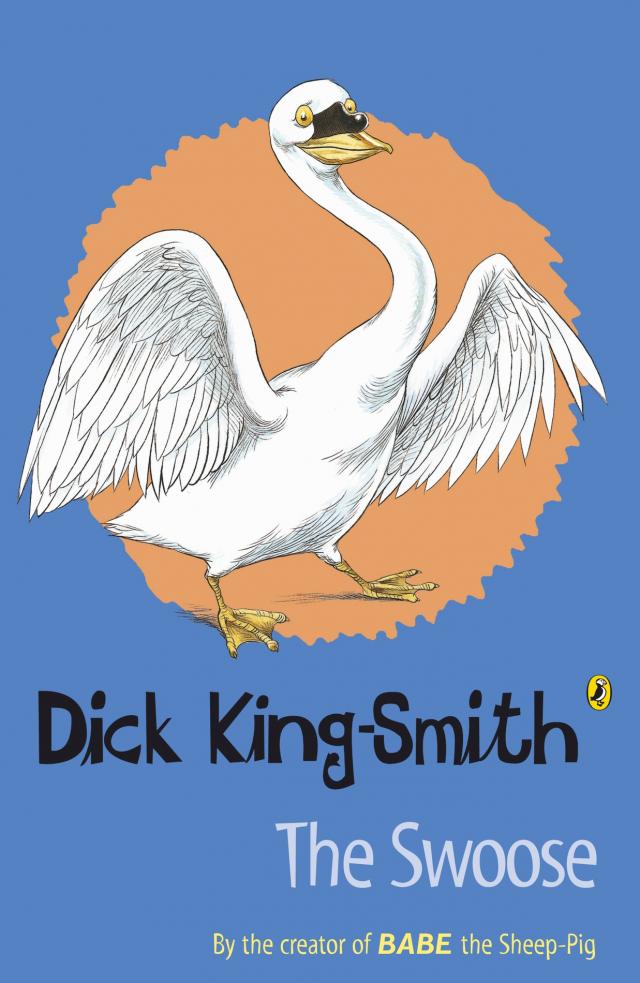
‘You,’ she said softly, ‘are a swoose.’
Fitzherbert coiled his long neck backwards into the shape of an S.
‘A what?’ he cried.
‘Sssssssh!’ hissed his mother, and she waddled off to a distant corner of the farmyard, away from all the other geese.
Fitzherbert hurried after her.
‘What did you say I was?’ he asked.
His mother looked around to make sure they were out of earshot of the rest of the flock, and then she said, ‘Now listen carefully. What I am about to tell you must be a secret between you and me, always. D’you understand?’
‘Yes, Mum,’ said Fitzherbert.
‘You are old enough now to be told,’ said his mother, ‘why you are unlike all the other goslings on the farm. They are the children of a number of geese, but all of them have the same father.’
‘The old grey gander, you mean?’
‘Yes.’
‘But isn’t he my father too?’
‘No.’
‘Then who is?’
‘Your father,’ said Fitzherbert’s mum, and a dreamy look came over her face as she spoke, ‘is neither old nor grey. Your father is young and strong and as white as the driven snow. Never shall I forget the day we met!’
‘Where was that, Mum?’
‘It was by the river. I had gone down by myself for a swim, when suddenly he appeared, high in the sky above. Oh, the music of his great wings! It was love at first flight! Then he landed on the surface in a shower of spray and swam towards me.’
‘But I don’t get it, Mum,’ said Fitzherbert. ‘What was he? Another sort of goose?’
‘No,’ said his mother. ‘He was a swan.’
‘What’s that?’
‘A swan is the most beautiful of all birds, and your father was the most beautiful of all swans.’
‘What was his name?’
‘He didn’t say. He was a mute swan.’
Fitzherbert thought about all this for a while.
Then he said, ‘So I might be the only swoose in the world?’
‘Yes.’
‘There aren’t any other swooses?’
‘Sweese.’
‘Eh?’
‘When there’s more than one goose, you say geese. So more than one swoose would be sweese.’
‘But there isn’t more than one. Just me. You just said so, didn’t you?’
As mothers do, Fitzherbert’s mum became fed up with his constant questions.
‘Oh, run away and play,’ she said.
But playing with the other goslings wasn’t a lot of fun for Fitzherbert. Already they had noticed that he was different. They poked fun at him, calling him Bigfeet or Snakyneck, and they wouldn’t let him join in their games.
Time passed, and Fitzherbert began to grow his adult feathers. Often, as he thought of his father swooping down from the sky on whistling wings, he flapped his own and wished that he too could fly. Farmyard geese like his mother and the rest couldn’t, he knew – they were too heavy-bodied to get off the ground. But swans could. How about a swoose? And the more he thought about his father, the more he wanted to meet him. So one day he decided to go down to the river by himself. He would say nothing to his mother about it, but just set off when she wasn’t looking.
He had never before been out of the farmyard, and he was not at all sure what the river looked like, let alone where it was, but luck was on his side. He walked across a couple of fields and there it was, in front of him!
Fitzherbert looked at the wide stretch of water, winking and gleaming in the sunlight and chuckling to itself as it flowed along. Never in his life had he swum upon anything but the duckpond at the farm, but this – this is the place for swimming, he thought, and he waddled down the bank and pushed off.
He paddled about in midstream, looking up at the sky, hoping that a snow-white shape would come gliding down to greet him.
Instead he suddenly turned to see a whole armada of snow-white shapes sailing silently downstream towards him. There must have been at least twenty swans, all making for this stranger who dared to swim upon their river. Their wings were curved in excitement, and the look in their black eyes was far from friendly.
Oh, thought Fitzherbert, as the fleet of swans approached, all now grunting and hissing angrily, oh dear, I really must fly!
TWO
As Fitzherbert swam hastily away from his pursuers, he spread his wings and beat them madly on the water in an effort to increase his speed. Harder and harder he flapped, and then he felt his body lift a little so that now, instead of swimming, he was slapping his broad webs on the surface in a kind of clumsy run.
Suddenly he was airborne, and the swans, satisfied that they had seen off the stranger, did not trouble to follow.
It wasn’t much of a flight, that first effort. For perhaps a quarter of a mile, Fitzherbert laboured along only a few yards above the water, and then, tired out by his efforts, flopped back down into the river. He looked anxiously around, but to his great relief, there was no sign of the swans. Nasty, bad-tempered creatures, he said to himself. I wasn’t doing them any harm. Why, my dad might have been one of that lot. I don’t know that I want to meet him after all.
He swam on, looking about him with interest. He could see other birds on the water – different sorts of duck, and moorhen, and coot – and there was a sudden brilliant flash of colour as a kingfisher darted across. There were people on the river too, in rowing boats and punts, and one very long thin craft shot by with eight large young men pulling at their oars, while a ninth much smaller man steered and shouted at them through a kind of tube held to his mouth.
‘In! Out! In! Out!’ he called, and the blades dipped and rose as one.
Fitzherbert drifted dreamily with the current, enjoying the sunlit scene, when suddenly a sharp voice cried, ‘Avast there, you landlubber, or you’ll run us down!’
Startled, the swoose looked down to meet the angry gaze of a small water vole.
‘Oh, sorry!’ said Fitzherbert. ‘I’m afraid I wasn’t looking where I was going.’
The vole did not answer, but swam to the bank. Fitzherbert followed.
‘I suppose you couldn’t tell me?’ he said.
The vole turned at the mouth of his burrow.
‘Tell you what?’ he said.
‘Where I’m going?’
The vole stared beadily at the swoose.
‘Are you feather-brained?’ he said.
‘No, I’m Fitzherbert.’
The water vole shook his blunt head as though to clear it.
‘Tell us something,’ he said. ‘You come sailing along without any regard for th e rule of the river, and then you go and talk a load of rubbish. Anyways, I never in my life set eyes on a bird like you before. What are you?’
‘I’m a . . .’ began Fitzherbert, and then he thought, oh no, I promised Mum I wouldn’t tell.
‘I can’t really say,’ he replied.
‘You don’t know what you are,’ said the vole. ‘You don’t know where you’re going. Next thing, you’ll be telling me you don’t know what river this is.’
‘No. I don’t.’
‘Then you don’t know the name of that town you can see, down at the end of the reach?’
‘No.’
‘Nor the castle on the hill above it?’
‘No.’
‘Nor who lives in that castle?’
‘No,’ said Fitzherbert. ‘I’ve never been outside our farmyard before. But I’d be very grateful if you’d tell me.’
‘You’re lucky, young fellow,’ said the vole. ‘You’ve come to the right chap. Now, if you’d asked a moorhen, or worse, a duck, you’d have been wasting your breath. But there isn’t much that I don’t know about this here stretch of the Thames.’
‘The what?’
‘The Thames. That’s the name of this river. Most famous river in all England, I’d say. And that town yonder is Windsor, and that’s Windsor Castle above it. Now then, surely you know who lives there?’
‘No.’
‘Why, the Queen, of course.’
‘Oh,’ said Fitzherbert. ‘What’s a queen?’ he said.
The water vole sighed deeply.
‘You’re a bright one,’ he said. ‘She’s only the most important person in the land, that’s all.’
At this point a pair of swans appeared in midstream.
Fitzherbert backed into a clump of reeds and kept his head down.
‘Now d’you see those swans?’ said the vole. ‘They belong to the Queen, they do, like every other swan in the country. Royal birds, swans are.’
Oh, thought Fitzherbert, I wonder if sweese are? I bet she’s never seen one.
‘This queen,’ he said. ‘What’s she called?’
‘Victoria. She’s been Queen for donkey’s years, she has.’
‘Donkey’s ears?’ said Fitzherbert.
‘Why, ’tis ages ago she lost her husband.’
‘Couldn’t she find him again?’
The water vole sighed and continued.
‘And ever since she’s shut herself up in that castle. Always dressed in black, she is. The Widow of Windsor, they call her.’
‘How do you know all these things?’ asked Fitzherbert.
‘I keep my ears open,’ said the water vole. ‘Windsor folk come out boating on the river and I listen to all the latest gossip.’
‘She doesn’t sound very happy, this queen,’ said Fitzherbert.
‘She isn’t. Grumpy old thing, from all accounts.’
‘Perhaps she needs cheering up.’
‘Easier said than done. Anybody tries making a joke, she says, “We are not amused”,’ said the vole, and with that he vanished into his burrow.
A moment later he stuck his head out again.
‘She might be amused at you,’ he said. ‘Why don’t you pay her a visit?’
Why don’t I? thought the swoose.
‘I will,’ he said, ‘and I’ll come back and tell you all about it.’
Then it occurred to him that there were probably a great many water voles living beside the Thames.
‘So can you tell me your name, please?’ he said.
‘Alph,’ said the vole, and he disappeared once more.
THREE
Dressed all in black, Queen Victoria stood at an upper window in Windsor Castle and looked down at the courtyard below. In the centre of this courtyard was a perfect square of brilliantly green grass, a lawn that was not only personally mown by the Royal Head Gardener, but afterwards finely manicured by a number of under-gardeners. No other feet were allowed upon this lawn, save those of the Queen’s pet dogs and of the footman who tidied up after them with an elegant brass shovel.
But now it seemed there was a large shape, right in the centre of the square of green.
The Queen held out a hand.
‘Our pince-nez,’ she said to her Lady of the Bedchamber, and when these were brought, she fitted them upon the bridge of the Royal nose.
For some moments she stared down, and then she said, ‘And what, pray, is that?’
‘It is a bird, ma’am,’ said the Lady of the Bedchamber.
‘We can see that,’ said Queen Victoria. ‘We are not blind. See that it is removed immediately. Whatever is it doing on our grass?’ and she turned away from the window.
The Lady of the Bedchamber heaved a sigh of relief that she’d avoided having to answer the Queen’s last question. She could see plainly what the bird had that moment done on the grass.
‘That’s better!’ said Fitzherbert as he waddled away from the large squelchy mess he had just made.
He was feeling pretty pleased with himself. Everything had gone swimmingly. He had swum on down the Thames, keeping well away from swans, and stopping every now and then to feed on juicy water-plants. It was late in the day before he came to the town, so he decided to wait till next morning before visiting the castle.
At dawn Fitzherbert looked up to see its looming walls and towers. Good job sweese can fly, he thought, and he took off and flew up the hill.
The town of Windsor was still asleep and its streets were as yet empty of the busy horse-drawn traffic. Only a milkman driving his cart with its load of brass-bound wooden churns noticed a large bird fly up Castle Hill and over the turrets of the Henry VIII Gate.
This, Fitzherbert’s second flight, was altogether a much more successful effort. Even so, he tired rapidly, and, seeing a square of grass in an inner courtyard, he landed thankfully upon it. It was a crash-landing that knocked the wind out of him, and for some time he lay and gasped for breath.
Finally recovered, he looked about him. Then he saw a movement at an upper window. Someone was looking down at him. He could not see the figure clearly, but it appeared to be dressed in black!
If that’s the Queen, thought Fitzherbert, I’d better make myself comfortable before I meet her. He stood up and suited his actions to his words.
‘That’s better!’ he said, and he waddled off slowly towards the nearest door. The Lady of the Bedchamber lost no time in contacting the Lord Steward of Her Majesty’s Household.
‘There’s a large bird,’ she said to him, ‘in the Queen’s private courtyard, and she wants it removed immediately.’
‘What sort of a bird?’ asked the Lord Steward.
‘I don’t know,’ said the Lady of the Bedchamber. ‘It was something like a swan. But, then again, it was something like a goose.’
The Lord Steward of Her Majesty’s Household sent for the Ornithologist Royal, the man who looked after the Queen’s birds.
‘There’s a large bird,’ he said, ‘in Her Majesty’s private courtyard. Get rid of it, will you?’
‘What sort of a bird?’ asked the Ornithologist Royal.
‘Part swan, part goose, apparently.’
‘Part swan, part goose!’ murmured the Ornithologist Royal excitedly to himself as he hurried to do the Lord Steward’s bidding. ‘Could it be . . .? Could it be?’
When the door into the courtyard opened, Fitzherbert was disappointed to see a man emerge. He seemed a nice man, however, for he produced some pieces of bread which he offered to the swoose. But no sooner had Fitzherbert begun to eat them than he was grabbed, his wings pinioned to his sides, and he was carried, kicking and struggling, away.
‘It is! It is!’ said the Ornithologist Royal as he listened to his captive’s cries of protest, a blend of the grunting bark of an angry swan and the cackling of an outraged goose. He carried Fitzherbert to the Royal Menagerie, where all manner of creatures were housed, presented as gifts to the Queen by visiting foreign rulers.
‘It is!’ said the Ornithologist Royal again as he feasted his eyes upon Fitzherbert, now shut in a large cage. ‘I had heard tales of such a bird, but never thought to see one! It is a swoose!’


