

Authorisms words wrought.., p.1
Authorisms: Words Wrought by Writers, page 1


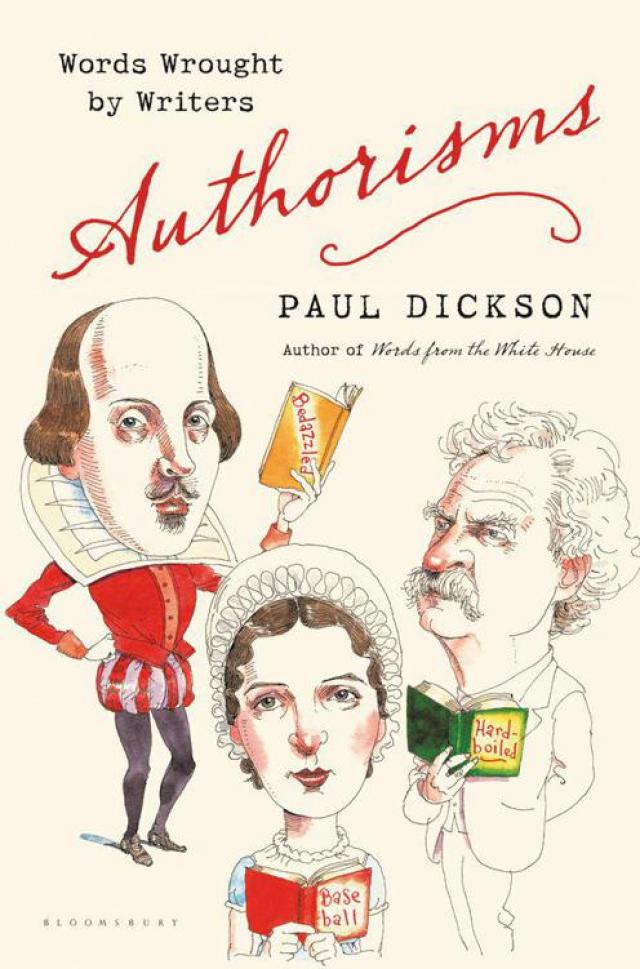
To two fellow writers who have helped me from the start: Joseph C. Goulden, good friend and fellow author who has helped me with all of my books beginning with my first, Think Tanks, published in 1971, and to Robert Skole, good friend, former boss, collaborator, and idea man extraordinaire. Thanks, Joe and Bob.
Published April 23, 2014, in honor of that day in 1564 marking the sesquiquadricentennial, or 450th anniversary of the birth of William Shakespeare, now and forever the greatest neologist of the English language.*
* * *
* The term sesquiquadricentennial was coined by John M. Morse and the staff of Merriam-Webster for the purposes of this work.
A man in all the world’s new fashion planted,
That hath a mint of phrases in his brain
—Shakespeare, All’s Well That Ends Well
Making up words is a respectable business, occasionally blessed with wide acceptance. Whoever made up innies and outies to describe navels that are either recessed or protruding must have experienced some satisfaction.
—Dave Matheny, Star Tribune, Newspaper of the Twin Cities, November 6, 1988
Contents
AUTHORISM
Introduction
A
B
C
D
E
F
G
H
I
J
K
L
M
N
O
P
Q
R
S
T
U
V
W
X Y Z
Epilogue—Cold Comfort
Appendix: How Many Words and Phrases Did Shakespeare Actually Coin?
Acknowledgments
Bibliography
Notes
A Note on the Author
Lexical Works by Paul Dickson
[from Middle English auctour, from Anglo-French auctor, autor, from Latin auctor promoter, originator, author, from augēre to increase + -nym “name”] 1. Obs. Authorship; the position or character of an author. From the letters of Horace Walpole (V.3): “a sensible man, but has not worn off his authorism yet, and thinks there is nothing so charming as writers, and to be one.” 2. The irresistible impulse for one to become an author in one form or another. This impulse often affects even those who have no right being an author. (Urban Dictionary) 3. Word, phrase or name created by or an existing term given a new meaning by an author or journalist; a literary neologism. William Shakespeare whose written vocabulary consisted of 17, 245 words including hundreds of authorisms. Some of them, true nonce words, never went further than their appearance in his plays, but others—like bump, hurry, critical, and road—are essential parts of our standard vocabulary today.
Introduction
The Sweet Click
Writers have long enjoyed their ability to create new words, to neologize—to write, read, and hear—what writer Arthur Plotnik, who has written on the subject of neologism in literature, calls the “sweet click of coinage” and which he terms one of the rewards of the vocation.
Early writers got to hear a lot of those clicks as they helped shape the language, beginning with Geoffrey Chaucer, who had a field day being the one to first leave a written record of several thousand words. The many words regarded as his coinages include bed, bagpipe, Martian, and universe. Sir Thomas More, who died in 1535, gets credit for having invented or discovered among many others—anticipate, explain, and fact.1 John Milton, who died in 1674, as far as can be determined minted such terms as impassive, earthshaking, lovelorn, and by hook or crook. He also coined the expression all hell broke loose.
“Milton,” wrote critic, essayist, and Milton scholar Logan Pearsall Smith in his Milton and His Modern Critics, “felt himself perfectly at liberty to lay tribute on all the possible resources of the nation’s linguistic coffers, from old archaic words to the new words he created for himself out of the rags and fragments found in their recesses. For Milton often coined the words he wanted, and the Oxford Dictionary finds in his writings the first appearance of many words which are now familiar to us all. They may possibly have been used before, yet, like the coins of a great king, they seem to bear his image stamped upon them.”
Smith then listed his own favorite Miltonisms: dimensionless, infinitude, emblazonry, liturgical, bannered, ensanguined, horrent, anarchy, Satanic, echoing, irradiance, and his great chaotic word pandemonium.2 According to Gavin Alexander, lecturer in English at Cambridge and fellow of Milton’s alma mater, Christ’s College, who has mined the Oxford English Dictionary (OED) for evidence, Milton is responsible for introducing some 630 words to the English language, making him that country’s greatest neologist. As explained in a 2008 article in the Guardian, “Without the great poet there would be no liturgical, debauchery, besottedly, unhealthily, padlock, dismissive, terrific, embellishing, fragrance, didactic or love-lorn. And certainly no complacency.”
Alexander’s count, which was apparently restricted to words not phrases, put Milton and his 630 neologisms ahead of Ben Jonson with 558, John Donne with 342, and William Shakespeare with a mere 229.3 Such exact numbers underscores the problem of counting neologisms, because Shakespeare coined—and here’s the rub—or popularized any number of additional words depending on the source you rely on, who is doing the counting, and the criteria used.
The Bard is also credited in the Oxford English Dictionary as being the first to use the terms bedazzle, archvillain, fashionable, inauspicious, vulnerable, sanctimonious, and outbreak. Whether or not those words were created by Shakespeare is up for debate, but he seems to have been the first to write them down. A May 2013 search of the online OED came up with 1,728 words (not words and phrases, but words) for which the Bard is given credit for “first use” ranging alphabetically from abrook (to endure, tolerate) to yravish (ravish). First use is different than coined or created because it simply acknowledges that this is the first evidence of a surviving record for use of that term, and over time this number is likely to go down rather than go up as earlier printed sources are uncovered and digitized to make the search easier.
The number of Shakespearean coinages has been a matter of speculation for decades and I have reserved a small bonus section in the back of this book to discuss the Bard’s lexical box score. Numbers notwithstanding, when it comes to Shakespeare, there are a number of ways to look at his impact. According to the book Coined by Shakespeare: Words and Meanings First Penned by the Bard by Jeffrey McQuain and Stanley Malless, there are, for example, at least ten words commonly used in sports lingo that originate from the work of William Shakespeare. They are: buzzer, negotiate, lackluster, undervalue, juiced, scuffle, vulnerable, rival, Olympian, and manager. In Shakespeare on Toast, Ben Crystal rattles off these Bardisms: “Even-handed, far-off, hot-blooded, schooldays, well-respected are Shakespeare’s too, as are lonely, moonbeam and subcontract.”4
It seems to go deeper than single words but also to phrases and expressions that are now part of the fabric of everyday life. As Brenda James points out in her book The Truth Will Out: Unmasking the Real Shakespeare, “It may well be that no educated English-speaking person goes more than (at most) a few hours without using one or more words coined by Shakespeare, almost certainly without knowing it.”5
Since the time of the Bard, the ability to create new words or even to be the first to use them has become tougher. But some standouts along the way to the present will be featured in this book, including many words or sayings that are in common use, names that are familiar to everyone—or what Shakespeare called household words, a term that makes its debut in the Saint Crispin’s Day speech in Henry V.
Old men forget: yet all shall be forgot,
But he’ll remember with advantages
What feats he did that day: then shall our names.
Familiar in his mouth as household words.
Acorns to Oaks
The question this raises is how do words make it into the realm of the household word at a moment when the language seems to have more than enough words to sustain itself. It is one thing to create a new word or catchphrase and quite another for one of your lexical offspring to find acceptance. As John Moore wrote in his book, You English Words, “The odds against a new word surviving must be longer than those against a great oak-tree growing from any given acorn.”
The author of this book has created more than fifty new words and new definitions for old words and all but two of them have thus far failed to germinate and have been relegated to the category of nonce words, a lexical purgatory for words used rarely and in the context of their creator.
My two neologisms appear as entries in the body of this book. One is word word for a word that is repeated to distinguish it from a seemingly identical word or name (a book book to distinguish the prior work in question from an e-book), a term that now shows up in several major reference books. But my bigger success as a neologizer has been the word demonym. It was created to fill a void in the language for those common terms that define a person geographically—for example, Angeleno for a person from Los Angeles. I have used the term in several articles and books and was pleased to note in 2013 that it had 3,870,000 Google hits. Then in April 2013 the term was used by the American nonfiction master John McPhee in the New Yorker. It seems that he collects books on American place-names and demonym has become part of his natural vocabulary.6
Coined or Collected—Mind or Mined
A dilemma posed by the author of this book is the issue of words actually coined by a writer versus those the writer acquired from someone or someplace else but that they have been credited with.
In 1900, a writer named Leon Mead actually wrote to Mark Twain to ask him if he had coined any words. Twain replied that he knew of no words he had coined that had become part of the language, but that he had given currency to some that were already in use, particularly words and phrases he had extracted from the Western mines.
Mead responded, “I think it is safe to say that Mark Twain has not only popularized words and phrases which might have died but for his tonic treatment of them, but has coined others which have become familiar, at least in our vernacular.” He added that the same may be said of Bret Harte (1836–1902), the American author and poet best remembered for his accounts of pioneering life in California who was getting his new words from those around him in locales like Poker Flat and Red Gulch.7
Twain’s point about the mines was important and he would expand on it, elsewhere insisting that many of the words and phrases attributed to him were actually things he had heard on the Mississippi River and points west. To Twain the language created in the wake of the Gold Rush was the richest. He once wrote: “The slang of Nevada is the richest and most infinitely varied and copious that has ever existed anywhere in the world, perhaps, except in the mines of California in the early days. It was hard to preach a sermon without it and be understood.”
Examples from Twain that came out of the mines and mining camp included struck it rich, which quickly applied to any human success; up the flume, signifying failure; hard pan, meaning a solid paying basis; petered out, which suggests a gradual decline and final suspension of resources; grubstake, the assistance given a new business enterprise on condition of a share in prospective or possible profits; bonanza, meaning sudden wealth or good fortune; and squeal, meaning to confess and betray companions. Twain is also credited by the OED with the first use in print of blow up (to lose self-control) in 1871, of slop (effusive sentimentality) in 1866, and of sweat out (to endure or wait through the course of) in 1876.
The issue of new words that are coined by the author vs. recording the words that are heard on the streets—or the mines and mining camps of the wild west or the inns and taverns of Stratford-on-Avon—applies to any writer who draws from the real life around him or her. As Leon Mead also pointed out, “The main secret of Dickens’ popularity was that he knew his types; their counterparts were in real life. They talked the argot of the London slums, the bombast of the Old Bailey, the sycophantic phrases of the counting-room, the cockney jargon of the slap-up swells.”8
So the caveat issued with this book is that some of the coinages were second strikes.
A
A MAN GOT TO DO WHAT HE GOT TO DO. Phrase that appears in American novelist John Steinbeck’s (1902–1968) The Grapes of Wrath in chapter 18 when Casy says, “I know this—a man got to do what he got to do.” This phrase is often attributed to John Wayne and to the lead character in the movie Shane, who utters lines similar to but not exactly this one.1
A MODEST PROPOSAL. Name for an outrageous proposal. The phrase is used commonly to describe heavy-handed satire. It comes from the name of such a satire with the full title A Modest Proposal for Preventing the Children of Poor People in Ireland, from Being a Burden on Their Parents or Country, and for Making Them Beneficial to the Publick, written by Anglo-Irish satirist, essayist, political pamphleteer, poet, and cleric Jonathan Swift (1667–1745), in which he suggests that the Irish eat their own children or sell them as food. Swift was Irish and deeply resented British policies toward the Irish and his insane proposal was an attack. In a letter to Alexander Pope in 1729 he wrote, “Imagine a nation the two-thirds of whose revenues are spent out of it, and who are not permitted to trade with the other third, and where the pride of the women will not suffer [allow] them to wear their own manufactures even where they excel what come from abroad: This is the true state of Ireland in a very few words.”2
ABRICOTINE. Apricot-colored. A nonce word created by poet Edith Sitwell (1887–1964) and employed in one of her poems. Nonce words are words made up for a specific, usually one-time use in literary pursuits. Counting her book of poetry, the OED in which abricotine is listed, and its appearance here, it would seem among the rarest of words. However, the 2013 online edition of the OED contains no less than 4,419 nonce words of which this word is the first in alphabetical order. The last is yogified, a nonce word meaning to be treated in a yogic manner. It was created by E. M. Forster ( 1879-1970).3
ACCORDING TO HOYLE. According to the highest authority; done with strict adherence to the rules. Coined in this sense in 1906 by O. Henry (1862–1910), which was the pen name for William Sydney Porter, an allusion to the books of card and game rules written by Edmond Hoyle.4
AFGHANISTANISM. A term coined by Jenkin Lloyd Jones (1843–1919), a former member of the National Conference of Editorial Writers as well as columnist and editor of the Tulsa Tribune, to describe the journalistic practice of concentrating on problems in distant parts of the world while ignoring controversial local issues. He explained, “It takes guts to dig up the dirt on the sheriff, or to expose a utility racket, or to tangle with the governor. They all bite back and you had better know your stuff. But you can pontificate about the situation in Afghanistan in perfect safety. You have no fanatic Afghans among your readers. Nobody knows more about the subject than you do, and nobody gives a damn.” 5
AGEISM. Prejudice or discrimination based on one’s age. A term coined by physician and author Dr. Robert N. Butler (1927–2010), who believed that as a society we should think about individual function, not age. Butler is known for his 1975 book Why Survive? Being Old in America, which won the Pulitzer Prize for General Nonfiction in 1976. He believed that society should confront ageism and work on constructive solutions to ameliorate it.6
AGNOSTIC. A term coined by English biologist and author (and grandfather of Aldous and Julian Huxley) Thomas Henry Huxley (1825–1895) in 1869 to indicate “the mental attitude of those who withhold their assent to whatever is incapable of proof, such as an unseen world, a First Cause, etc. Agnostics neither dogmatically accept nor reject such matters, but simply say agnostic—I do not know—they are not capable of proof.” Huxley was apparently tired of being called an atheist when he created this distinction.7
AHA MOMENT. A sudden realization, inspiration, insight, recognition, or comprehension. When this word was added to the 2012 edition of Merriam-Webster’s Collegiate Dictionary, much was made of the fact that television personality Oprah Winfrey had popularized the phrase in interviews with guests when moments of sudden insight occurred. The term actually made its debut in 1939 in the textbook General Psychology, written by Lawrence Edwin Cole, (1899-1974) in which he uses it to describe the moment of insight. The OED notes that Chaucer used “a ha” in this context in about 1386 in The Nun’s Priest’s Tale: “They cried, out! A ha the fox! and after him thay ran.”8
ALL HELL BROKE LOOSE. This phrase originated in Paradise Lost by John Milton (1608–1674). At the end of book 4, the angel Gabriel asks Satan why he came alone and “Came not all Hell broke loose?” Milton created several other well-known demonic phrases: better to reign in hell, than serve in heav’n is his as is pandemonium.9
ALMIGHTY DOLLAR. American money as a tool of power, a term coined by American author and diplomat Washington Irving (1783–1859). It appears first in a story of his called “The Creole Village” in 1836. “‘The almighty dollar,’ that great object of universal devotion throughout our land, seems to have no genuine devotees in these peculiar villages.” Irving was the first American author to make a living from writing novels.10


