

Clausewitz, p.1
Clausewitz, page 1


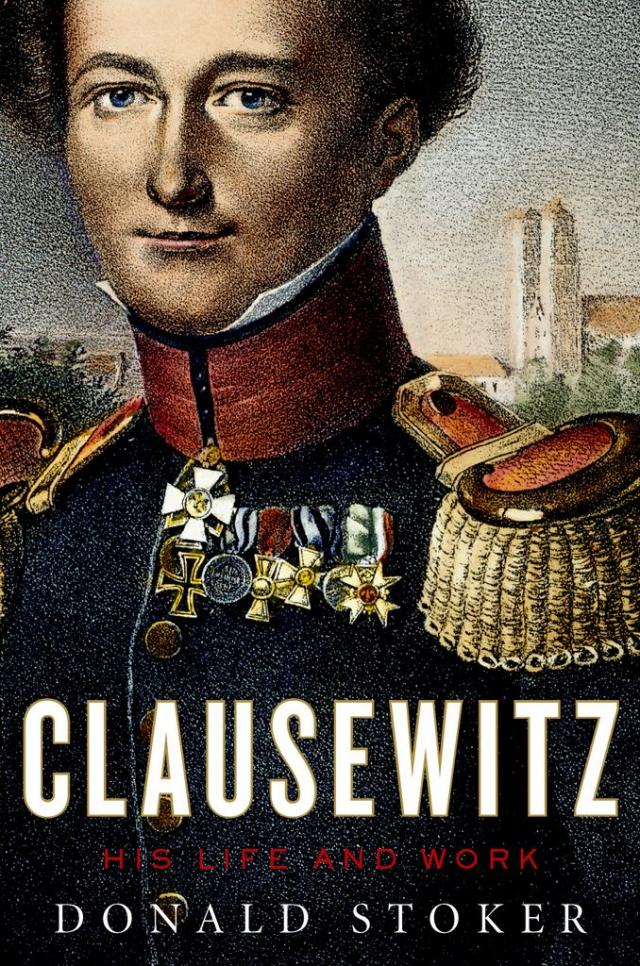
CLAUSEWITZ
CLAUSEWITZ
HIS LIFE AND WORK
DONALD STOKER
Oxford University Press is a department of the University of Oxford.
It furthers the University’s objective of excellence in research, scholarship,
and education by publishing worldwide.
Oxford New York
Auckland Cape Town Dar es Salaam Hong Kong Karachi
Kuala Lumpur Madrid Melbourne Mexico City Nairobi
New Delhi Shanghai Taipei Toronto
With offices in
Argentina Austria Brazil Chile Czech Republic France Greece
Guatemala Hungary Italy Japan Poland Portugal Singapore
South Korea Switzerland Thailand Turkey Ukraine Vietnam
Oxford is a registered trademark of Oxford University Press
in the UK and certain other countries.
Published in the United States of America by
Oxford University Press
198 Madison Avenue, New York, NY 10016
© Donald Stoker, 2014
All rights reserved. No part of this publication may be reproduced, stored in a retrieval system, or transmitted, in any form or by any means, without the prior permission in writing of Oxford University Press, or as expressly permitted by law, by license, or under terms agreed with the appropriate reproduction rights organization. Inquiries concerning reproduction outside the scope of the above should be sent to the Rights Department, Oxford University Press, at the address above.
You must not circulate this work in any other form and you must impose this same condition on any acquirer.
Library of Congress Cataloging-in-Publication Data
Stoker, Donald J.
Clausewitz : his life and work / Donald Stoker.
pages cm.
Includes bibliographical references and index.
ISBN 978–0–19–935794–9
1. Clausewitz, Carl von, 1780–1831. 2. Napoleonic Wars, 1800–1815—Campaigns—Russia—
Biography. 3. Prussia (Kingdom). Armee—Officers—Biography. I. Title. II. Title:
Clausewitz, his life and work.
DD422.C5S76 2015
355.02092—dc23
[B]
2014016786
eISBN 978–0–19–935796–3
To my students who fought the Global War on Terror.
Sound tactics win battles.
Sound operational art wins campaigns.
Sound strategy wins wars.
Sound policy wins the peace.
For all of these, judgment is the key.
Contents
List of Illustrations
Acknowledgments
Abbreviations Used in the Notes
Author’s Note
Introduction: The Point of It All
1. Boy Soldier (1780–1795)
2. The Ambitious Student of War (1795–1805)
3. Clausewitz at War: The 1806 Campaign
4. A Political Education (1807–1812)
5. War and Words: The Campaign of 1812
6. The Road to Tauroggen (1812)
7. 1813: War, Uprising, and Armistice
8. 1813: Leipzig, Göhrde, and the Stecknitz
9. Clausewitz and the Fall of Napoleon (1813–1814)
10. 1815: The Waterloo Campaign
11. The Sum of It All (1815–1831)
Conclusion: Clausewitz’s Legacy
Appendix: Clausewitz’s Battles
Notes
Select Bibliography
Index
List of Illustrations
Maps
1.1. The Siege of Mainz
1.2. The Area of Operations of Clausewitz’s 1793–1794 Campaigns
3.1. The Theater of Operations of the 1806 Campaign
3.2. The Battle of Auerstedt, Oct. 14, 1806
3.3. The Route of Clausewitz’s Retreat after Auerstedt
4.1. Napoleon’s Empire
5.1. The Invasion of Russia, 1812
5.2. The March from Smolensk and the Battle of Borodino (Sept. 7, 1812)
6.1. The Invasion of Russia, 1812
7.1. The Area of Operations, Spring 1813
7.2. The Battle of Lützen, or Großgörschen (May 2, 1813)
7.3. The Battle of Bautzen (May 20–21, 1813)
8.1. The Area of Operations, Fall 1813
8.2. Clausewitz’s War in North Germany
8.3. The Battle of the Göhrde (Sept. 18, 1813)
9.1. The Fall of Napoleon, 1813–1814
9.2. A Map of Dömitz Clausewitz Helped Draw in 1813
9.3. Clausewitz’s War in Holstein
9.4. Sehestedt
9.5. The Belgian and Dutch Theater
10.1. The Waterloo Campaign
10.2. The Battle of Ligny (June 16, 1815)
10.3. The Battle of Wavre (June 18–19, 1815)
10.4. Clausewitz’s March on Paris, 1815
Figures
1.1. Clausewitz’s Boyhood Home in Burg
2.1. Napoleon Bonaparte (1769–1821)
2.2. Gerhard von Scharnhorst (1755–1813)
2.3. Marie von Brühl (1779–1836)
3.1. Prince August’s Battalion Firing at French Dragoons at Prenzlau
4.1. August Neidhardt von Gneisenau (1760–1831)
6.1. The Conclusion of the Convention of Tauroggen
6.2. Clausewitz in His Russian Uniform
11.1. Clausewitz at Age Fifty
12.1. Clausewitz’s Gravesite in Burg
Acknowledgments
I have incurred many debts in the course of writing this book, not the least to my wife Carol, who has had to take up the parental slack during my all too frequent absences. Thank you, my love. My daughter Sarah has also been understanding. Thank you, Sarah.
I am deeply beholden to Michael Leggiere of the University of North Texas, an old friend from graduate school. Mike answered my endless queries, graciously pointed me to sources, and allowed me to read parts of three books he was writing (most of us only write one at a time). He also took the time to read the entire manuscript and make valuable suggestions and corrections. Thanks, Mike. I owe you one. Alexander Mikaberibzde helped me navigate the Russian microfilm collection on the Napoleonic period—in which I found a drop of new material on Clausewitz—and also answered many questions. Niels Nielsen translated Clausewitz’s works on 1813 and 1814, as well as some other things, and checked many of my own translations. Marc Guarin provided a translation of Clausewitz’s Strategie. I am grateful for the help of both and we hope to soon publish these three works, none of which exists in a complete English translation. Regina Kuehn helped refresh my slumbering German and deciphered some of the colloquialisms I encountered. Nils Bartholdy and the staff of the Rigsarkivet, Copenhagen, supplied the Clausewitz-related documents I requested. The staff of the British Library proved very helpful with my inquiries on the Sir Hudson Lowe papers, in which I found a previously unpublished letter by Clausewitz, and the British National Archives provided a copy of a heretofore forgotten map that Clausewitz helped draw in 1813. Vanya Eftimova Bellinger and Christopher Bassford kindly supplied illustrations from their own collections (I look forward to reading Vanya’s biography of Marie von Clausewitz). Other professional help and advice came from George Baer (who was always encouraging), Harold Blanton (who read much of the manuscript), John Dunn, the late Michael Handel (to whom I am indebted for my first analytical introduction to Clausewitz’s work), Peter Hofschröer, Michael Jones (who also read parts of the text), Kevin McCranie, Alfred Mierzejewski, Dan Moran (with whom I had an informative lunch), and Charles White. The staff and leadership of the College of Distance Education of the U.S. Naval War College were also helpful and encouraging. My thanks go out to Stan Carpenter, Fred Drake, Rose Drake, Jay Hickey, Doug Smith, and Walt Wildemann. Chiaki Gayle receives my special thanks as she provided much needed assistance photocopying and scanning critical material. The ideas and opinions expressed in this book are solely my own and do not represent those of the U.S. government, the Department of Defense, or the U.S. Naval War College.
Two of the other keys to this work’s completion were Zooey Lober and Irma Fink. They are the interlibrary loan gurus at the Naval Postgraduate School’s Dudley Knox Library. They worked very hard to track down what were sometimes very obscure sources. Thank you again, ladies.
The idea for a short biography of Clausewitz originated with my agent at POM, Inc., Dan Green. Tim Bent at Oxford proved supportive and worked over the draft manuscript with his customary competence and thoroughness. As always, I benefited from the diligent, hardworking professionals at Oxford University Press, particularly Lauren Hill, Jonathan Kroberger, Keely Latcham (who worked particularly hard to help pull together the maps and illustrations), Alana Podolsky, Christian Purdy, and Elyse Turr. Sunoj Sankaran provided excellent copy editing. Thank you all. SDG
Abbreviations Used in the Notes
“1806” Carl von Clausewitz. “Notes on the Jena Campaign.” Includes “Notes on Prussia in Her Grand Catastrophe of 1806” and “Prince August’s Battalion in the Battle of Prenzlau.” Conrad H. Lanza, ed. and trans. Command and General Staff School. Jena Campaign Sourcebook. Fort Leavenworth: The General Service Schools Press, 1922.
“1812” Carl von Clausewitz. “From the Campaign of 1812 in Russia.” In Historical and Political Writings. Peter Paret and Daniel Moran, ed. and trans. Princeton: Princeton University Press, 1992, 110–204.
1812 Carl von Clausewitz. The Campaign of 1812 in Russia. Foreword by Sir Michael Ho
1813 Carl von Clausewitz. The Campaign of 1813 to the Armistice, Niels Nielsen, trans. (Unpublished Manuscript, 2013). This is a translation of: Carl von Clausewitz. “Der Feldzug von 1813 bis zum Waffenstillstand.” HW (1862), 7:215–72.
“1814” Carl von Clausewitz. “Strategic Critique of the 1814 Campaign.” Niels Nielsen, trans. (Unpublished Manuscript, 2012). This is a translation of Carl von Clausewitz. “Strategische Kritik des Feldzuges von 1814 in Frankreich.” HW (1862), 7:307–404.
HPW Carl von Clausewitz. Historical and Political Writings. Peter Paret and Daniel Moran, ed. and trans. Princeton: Princeton University Press, 1992.
HW Carl von Clausewitz. Hinterlassene Werke des Generals Carl von Clausewitz über Krieg und Kriegführung. 10 vols. Berlin, 1832–37; 2nd ed., 1857–63.
Karl und Marie Carl and Marie von Clausewitz. Karl und Marie von Clausewitz: Ein Lebensbild in Briefen und Tagebuchblättern. Karl Linnebach, ed. Berlin: Warneck, 1916.
Leben Karl Schwartz. Leben des Generals Carl von Clausewitz und der Frau Marie von Clausewitz. 2 vols. Berlin: Dümmlers, 1878.
“Observations” Carl von Clausewitz. “From ‘Observations on Prussia in Her Great Catastrophe.’” In Peter Paret and Daniel Moran, ed. and trans. Historical and Political Writings. Princeton: Princeton University Press, 1992, 32–84.
Pertz-Delbrück, Gneisenau G. H. Pertz and Hans Delbrück. Das Leben des Feldmarschalls Grafen Neidhardt von Gneisenau. 5 vols. Berlin: Reimer, 1864–80.
Schriften Carl von Clausewitz. Schriften—Aufsätze—Studien—Briefe. Werner Hahlweg, ed. 2 vols. in 3. Göttingen: Vandenhoeck & Ruprecht, 1966–90.
Author’s Note
One of the pieces of so-called conventional wisdom about Clausewitz is that he was “just a staff officer,” meaning he never saw much—if any—combat. Clausewitz certainly spent much of his time as a staff officer—though carrying this office during the Napoleonic era did not mean safe duty in the rear—and as a young soldier Clausewitz had also not yet put on this mantle. Clausewitz had an enormous amount of combat experience (he was involved in perhaps three dozen battles), as did the literally millions of men who bore arms during the era of the French Revolution and Napoleonic Wars, one of the most intense periods of continuous, large-scale warfare in history. My primary focus has been upon reconstructing Clausewitz’s role in the various campaigns in which he served between 1793 and 1815. For understandable reasons, the bulk of the writing related to Clausewitz concerns his ideas and their development. Most previous works also march quickly over his combat experience, particularly that of 1813, 1814, and 1815. But, as we will see, reconstructing his battle experiences at places such as Göhrde, Sehestedt, Wavre, and others has much to teach us about Clausewitz as a soldier and a man. Clausewitz—who wrote profusely—was less prolific in regard to his own personal experiences. I have made use of what has come down to us, and added flesh to bone using accounts of those he served with or under, while placing him in the historical context of the campaigns in which he fought. While doing this I have also tapped his historical and analytical works to give his later assessments of individuals and their actions—especially their military decisions—in order to broaden our picture of his views of the campaigns. This also allows us to utilize some of his analysis and theoretical ideas in connection with events. His various works are touched upon along the way to mark the development of his ideas on his road to writing On War. The hope is that the result provides a basic introduction to Clausewitz’s life, as well as what he left us, and a map for those who wish to learn more. Peter Paret brilliantly traced Clausewitz’s intellectual development in his Clausewitz and the State, and those interested in deepening their understanding of Clausewitz and his age will be richly rewarded by his work.
It is self-evident that Clausewitz’s extensive military experience—combined with much study and thought—fed his theoretical writings, but drawing conclusive lines from any one event to an argument in On War is risky. However, studying his military experiences, when possible in toto, deepens our picture of the events that shaped Clausewitz’s mind and perhaps guided his pen.
Donald Stoker
Monterey, California
July 2014
Introduction
The Point of It All
We must not consider every possibility, but only probabilities.
July 29, 1831, Posen, Prussia (Now Poznan, Poland)
“If I should die, dear Marie,” Carl von Clausewitz wrote to his wife, “that is simply how things are in my profession. Do not grieve too much for a life that had little left to undertake in any event....I cannot say how great is my contempt for human judgment in leaving this world.”1 Three aspects of Clausewitz’s personality reveal themselves here, all constants in his adult life: frustration with the political situation of his time, melancholy (occasionally tinged with fatalism), and his abiding love for his wife.
The year before Clausewitz wrote his note, revolution and riot had engulfed much of Europe. The French ousted Charles X, the brother of the king they had guillotined in January 1793. Uprisings erupted in Germany, Italy, and Spain. The Belgians rose against the Dutch, the Poles against the Russians. It was the latter that brought Clausewitz to Posen as the chief of staff of the Prussian forces posted on an unstable frontier. Across the border, the Russian army fought the hapless Poles.
Eighteen-thirty was the year of revolution. Eighteen-thirty-one was the year of cholera. Clausewitz’s fatalism proved prescient. The disease didn’t take him immediately, but it did take him, on November 16, 1831. On August 23 it had claimed his longtime friend and mentor, the Prussian field marshal August von Gneisenau. The philosopher Hegel succumbed two days before Clausewitz. On June 31 it had killed Field Marshal Hans Karl von Diebitsch, the commander of the Russian army suppressing the Poles; Clausewitz had served under him in 1812. Tens of thousands more joined them as the epidemic burned its way from Asia, to Europe, then to the New World.
Clausewitz left only a deeply bereaved Marie, their union having produced no heirs, which always pained them. But Marie, an intelligent and exceedingly well-read woman—discussions of literature and art sprinkle their correspondence—played an indispensable role in creating a different kind of legacy for her husband. In the spring of 1830 Clausewitz had transferred to the artillery from his post as director of Prussia’s War College. Knowing he would no longer have time for scholarly pursuits, Marie wrote later, “he arranged his papers, sealed them in individual packages, gave each one a label, and bid a sad farewell to this activity, which he held so dear.”2 The bundles contained a number of works, among them histories of the Napoleonic campaigns of 1806, 1812, 1814, and 1815. One held a manuscript titled Vom Kriege, known to the English-speaking world as On War.
After her husband’s death, Marie worked with Major Franz August O’Etzel, who taught military geography at the War College, and her brother, Major General Friedrich Wilhelm von Brühl, to organize Clausewitz’s works. The ten volumes appeared from 1832 to 1837. On War encompassed the first three (1832–1834). The Berlin publisher Ferdinand Dümmler, like Clausewitz a veteran of what the Prussians called the Wars of Liberation (1813–1815), printed the texts, accompanied by maps drawn by O’Etzel. The firm has remained Clausewitz’s publisher since.3
Initially, On War caused only a small tremor in its narrow literary circle. The author of an 1832 review in a military journal judged it tough going, though worth the slog. Its “crystalline waters stream over particles of pure gold,” he wrote. In other words, one had to study the book—not merely read it—to grasp its merit. The work failed to impress Baron Antoine-Henri Jomini—the most important military theorist of the day—who branded it “too pretentious for a didactic discussion” due to its lack of clarity. He grudgingly admitted to pulling an occasional nugget from it, but criticized Clausewitz for being overly skeptical of established military theory.4
Nearly two centuries later, few beyond a narrow band of scholars and hobbyists read Jomini’s works, which is unfortunate, as he has much interesting and useful to say. Clausewitz, in contrast, has become a global brand, one constantly refreshed by a flow of books and articles debating his ideas. All or part of On War appears in an array of translations from Arabic to Vietnamese. Military staff colleges the world over assign Clausewitz’s text, largely to prepare their officers for staff positions and higher command. The Economist magazine titled its defense blog “Clausewitz.”


