

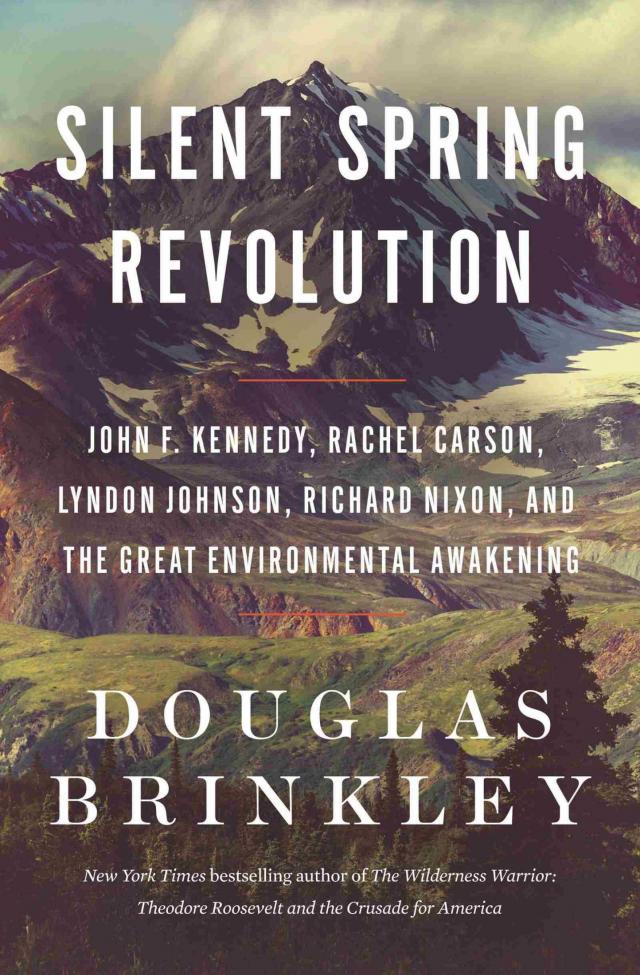
Silent spring revolution, p.1
Silent Spring Revolution, page 1


Dedication
Dedicated to my wife, Anne Brinkley . . . Everlasting Gratitude
and the Walden Woods Project
Epigraphs
The more clearly we can focus our attention on the wonders and realities of the universe about us, the less taste we shall have for destruction.
—Rachel Carson, accepting the John Burroughs medal (1952)
When will people fully understand and accept the obligation to the future—when will they behave as custodians and not owners of the earth?
—Rachel Carson to Stewart Udall, November 12, 1963
Contents
Cover
Title Page
Dedication
Epigraphs
Preface
Part I: Protoenvironmentalists (1945–1959)
Chapter 1: The Ebb and Flow of John F. Kennedy
Chapter 2: Harry Truman: Polluted and Radiated America
Chapter 3: Rachel Carson and the Shore of the Sea
Chapter 4: William O. Douglas and the Protoenvironmentalists
Chapter 5: Wilderness Politics, Dinosaur National Monument, and the Nature Conservancy
Chapter 6: Saving Shorelines
Chapter 7: Protesting Plastics, Nuclear Testing, and DDT
Part II: John F. Kennedy’s New Frontier (1961–1963)
Chapter 8: Forging the New Frontier: Stewart Udall and Lyndon Johnson
Chapter 9: Wallace Stegner’s “Wilderness Letter”
Chapter 10: The Green Face of America
Chapter 11: Rachel Carson, the Laurance Rockefeller Report, and Kennedy’s Science Curve
Chapter 12: The White House Conservation Conference (May 24–25, 1962)
Chapter 13: Rachel Carson’s Alarm
Chapter 14: Point Reyes (California) and Padre Island (Texas) National Seashores
Chapter 15: Campaigns to Save the Hudson River and Bodega Bay
Chapter 16: The Tag Team of John F. Kennedy, Stewart Udall, and Rachel Carson
Chapter 17: The Limited Nuclear Test Ban Treaty
Part III: The Environmentalism of Lyndon Johnson and Richard Nixon (1964–1973)
Chapter 18: JFK’s Last Conservation Journey
Chapter 19: The Mississippi Fish Kill, the Clean Air Act, and American Beautification
Chapter 20: The Great Society: Rachel Carson and Howard Zahniser’s Legacies
Chapter 21: The Wilderness Act of 1964
Chapter 22: Ending the Bulldozing of America
Chapter 23: America’s Natural Heritage: Cape Lookout, Big Bend, the Grand Canyon
Chapter 24: Defenders: Historical Preservation, Endangered Species, and Bedroll Scientists
Chapter 25: “Sue the Bastards!” and Environmental Justice
Chapter 26: The Unraveling of America, 1968
Chapter 27: Lyndon Johnson: Champion of Wild Rivers and National Scenic Trails (October 2, 1968)
Chapter 28: Taking Stock of New Conservation Wins
Chapter 29: Santa Barbara, the Cuyahoga River, and the National Environmental Policy Act
Chapter 30: Generation Earth Day, 1970–1971
Chapter 31: Nixon’s Environmental Activism of 1972: The Great Lakes Protection, the DDT Ban, and the Stockholm Conference
Epilogue: Last Leaves on the Tree
Acknowledgments
Appendix I: National Wildlife Refuges
Appendix II: National Parks
Appendix III: Protection for Animals Initial Endangered Species List: 1966–1967
Bibliography
Notes
Index
Photo Section
About the Author
Also by Douglas Brinkley
Copyright
About the Publisher
John F. Kennedy, Coos Bay, Oregon 1959. On his trip to the Pacific coast, he met with Senator Richard Neuberger, a lobbyist for the establishment of the Oregon Dunes National Seashore.
The Estate of Jacques Lowe / Getty Images
Preface
As I sit at my office desk at home in Austin, Texas, my bookshelves are packed with conservation histories. But across the room, I see arresting images on TV of California firefighters at Yosemite struggling to prevent some of the world’s oldest giant sequoias from burning. Amid the western slopes of the Sierra Nevada, John Muir’s hallowed Mariposa Grove, with its 200-foot trees, is right now in the path of the 4,200-acre Washburn Fire and swathed in columns of menacing white smoke. The big trees, as Muir called them, could normally withstand fire due to their thick, moist bark. Now, with warmer annual temperatures and sustained droughts, their bark is thinner, drier, and less able to keep the giant sequoias protected when they’re threatened.
Human-caused climate change is now everywhere, evident even in the bark of two-thousand-year-old trees. Massive wildfires have become so routine around Yosemite that visitors arriving at all four entrances are greeted by the charred reminders of the ongoing catastrophe. What California is experiencing isn’t a series of freak global-warming events, and Yosemite isn’t an anomaly. This is the new normal, courtesy of our nation’s—indeed, the world’s—addiction to fossil fuels. Here in Austin, it’s a brutal 110º Fahrenheit (about 43º Celsius)—while I sit inside, hiding in air-conditioned comfort from the weather, from nature, from my typically active life outdoors. Triple-digit heat has led to poor air quality, which exacerbates my asthma.
Writing Silent Spring Revolution during these drastic years of climate danger has been a long, affecting adventure, but one that buoyed my spirits over our current predicament. Exactly sixty years ago, Rachel Carson’s Silent Spring exposed the dangers of pesticides, turned environmentalism into a public health crusade, and helped galvanize a whole new generation of “green” activists. During the Long Sixties (1960–1973), this Silent Spring generation inspired three presidents to heroic environmental action and moved Americans of all stripes to stand up to protect the only planet we have from defilement.
Although it doesn’t constitute a major part of this narrative, I document how John Kennedy, Lyndon Johnson, and Richard Nixon all dealt with climate change. The burning of fossil fuels is the main cause of global warming, as greenhouse gases released into the atmosphere contain the sun’s heat, raising global average temperatures and fueling vicious weather events, including record-shattering heat. Both JFK and LBJ knew about the climate threat, courtesy of high CO2 emissions, but at the time it seemed like a distant problem. White House adviser Daniel Patrick Moynihan went so far as to write President Richard Nixon a memo in 1969 about “the carbon dioxide problem,” warning that the heated planet could cause ice caps to melt and oceans to rise. “Goodbye, New York,” Moynihan wrote. “Goodbye, Washington, for that matter. We have no data on Seattle.”
My journey to write Silent Spring Revolution began with my book The Wilderness Warrior: Theodore Roosevelt and the Crusade for America (2009), which I envisioned as the first of three volumes linking US presidential history (one of my fortes) to three waves of twentieth-century environmental progress and policy: Theodore Roosevelt (1901–1909); Franklin D. Roosevelt (1933–1945); and the Long Sixties triumvirate of Kennedy, Johnson, and Nixon. In The Wilderness Warrior, I described how our twenty-sixth president preserved over 234 million acres of wild America between 1901 and 1909. In Rightful Heritage: Franklin D. Roosevelt and the Land of America (2016), I documented the progressive second wave, in which Secretary of Interior Harold Ickes, Audubon Society–inspired Eleanor Roosevelt, and the US Forest Service’s intrepid mountaineer Bob Marshall acted on FDR’s enthusiasm for preserving treasured landscapes in every state.
Sandwiched in between, I wrote The Quiet World: Saving Alaska’s Wilderness Kingdom 1879–1960 (2011), which focused on the storehouse of natural resources situated in the Last Frontier and chronicled the guardians, from John Muir to Dwight Eisenhower, who campaigned to forever protect the wondrous paradise from Glacier Bay to the Arctic Range. These days the Greenland ice sheet is vanishing much faster than projected, which adds to the rising sea level. Alaska’s Arctic coastline is exposed to more sunshine, which causes intense warming, leading to unprecedented melting of blue-green glaciers and sprawling ice fields. The wild Alaska of The Quiet World, where over 60 percent of our national parks are located, is vanishing. The threatened polar bear has become the symbol for climate change awareness. How will Ursus maritimus survive in perpetuity if its Arctic habitat disappears?
Of all the many books I have written since earning my PhD from Georgetown University back in 1989, I consider these histories, taken together, to be a true cornerstone of my work, merging my presidential history focus with a deep-seated passion for national parks, ecology, and wildlife. (I am not including an additional title of mine from 2006—The Great Deluge: Hurricane Katrina, New Orleans, and the Mississippi Coast—because it is as much a story of political and civic crises as it is a tale of environmental upheaval.)
Silent Spring Revolution, then, completes what I have envisioned as a presidential trilogy, detailing how, after the radioactive shock of Hiroshima, a network of conscientious postwar anti-nuclear and protoenvironmental activists launched a reform-minded revolution and how three very different presidents drove a cascade of remarkable “green” reform measures into American public law.
During that era, trust in the federal government was sky-high before the Vietnam War brought it crashing down. When Kennedy was in office, three-quarters of the public expressed faith in the government; it is down to 18 percent today. Decade
Take, for example, the Clean Air Act of 1970, which passed the House by 374 to 1 and the Senate by 74 to 0. Likewise, the Endangered Species Act of 1973 was passed by a 355 to 4 vote in Congress and a 92 to 0 vote in the Senate. That’s roughly the way visionary environmental laws were enacted throughout the Kennedy, Johnson, and Nixon years. A lot of wrangling, frustration, and tireless negotiating eventually led to the introduction of well-reasoned bills on Capitol Hill, which were passed under the stalwart leadership of such conservationists as Senator Henry M. Jackson (D-Washington) and Thomas Kuchel (R-California).
Just about all of Washington’s power players in the Long Sixties seized on any last-gasp opportunities at hand to preserve America’s precious natural resources; embrace a high standard for quality of life; and deliver clean air and clean water bills to demanding constituents. Because the public insisted on a greener tomorrow, three presidents embraced environmental regulation as administration hallmarks. “Our resources will not be protected without the concern and help of every private citizen,” President Kennedy warned at the National Wildlife Federation (NWF) headquarters opening in Washington, DC, in 1961. “By mobilizing private efforts through the organization, you are helping not only to develop the wildlife resources of our country—but you are helping to create that kind of America of open spaces, of fresh water, a green country—a place where wildlife and natural beauty won’t be despoiled—where increasing urbanized population can still go to the country, can still turn back the clock of our civilization and find the material and spiritual strength upon which our greatness as a country depends.”
President Kennedy, under the rubric of the New Frontier, negotiated with the Soviet Union and Great Britain for the banning of atmospheric and underwater testing of nuclear weapons after the Cuban Missile Crisis. His administration also thoughtfully embraced the anti-pesticide findings of Carson’s Silent Spring as the scientific data ended up supporting her assertions. On July 23, 1962, at a famous press conference, Kennedy sought to tame the chemical industry’s outrage toward “Miss Carson’s book.” The words he offered from his bully pulpit were meant to discourage rising corporate attacks on Carson, the brave former US Fish and Wildlife Service employee who had once deemed oceans “the great mother of life” and spoke truth to power about the scourge of pesticides. Silent Spring began with a doomsday description of a fictional American town doused in DDT, which eerily could be various climate-affected zones of contemporary times: “Then a strange blight crept over the area, and everything began to change. Some evil spell had settled on the community: mysterious maladies swept to flocks of chickens; the cattle sickened and died. Everywhere was a shadow of death.”
That September, when Silent Spring triggered a crusade against DDT, there was no environmental policy-making in the modern sense. It was still the conservation movement of Theodore Roosevelt, John Muir, and Gifford Pinchot that held national sway, in all its preservation and wise-use variations. And while the Cold War conservation community had its bipartisan Wilderness Warriors such as Senator Frank Church (D-Idaho) and Representative John Saylor (R-Pennsylvania) in the 1960s, these lawmakers focused primarily on conserving pristine land for outdoor recreationists. It was Rachel Carson, full stop, who, in an urgent, visceral way, sparked an eco-revolution with Silent Spring by connecting Rooseveltian preservation with public health concerns about the pesticide DDT. Carson, the galloping Paul Revere of Earth stewardship, warned Americans that, depending on the communities in which they lived, their children weren’t safe playing on grassy lawns or netting crawfish in creeks or even wandering in a field of yellow wildflowers.
In the wake of Silent Spring, Lyndon Johnson upgraded New Conservation as a White House priority. With his own Texas Hill Country as his idyllic foundation—sixty miles from where I sit in Austin—and his wife, Lady Bird, urging him onward, he established thirty-five national parks, most within an easy commute of big cities. His environmental protection and beautification efforts were epic: the Land and Water Conservation Fund Act, the Water Quality Act, the Highway Beautification Act, the National Historic Preservation Act, the Clean Water Restoration Act, Air Quality Act, the National Trails Act, and the establishment of the Canyonlands (Utah), North Cascades (Washington), Redwood (California), Indiana Dunes (Indiana), Pictured Rocks (Michigan), and Guadalupe (Texas) as new National Park Service units—all in just five remarkable years.
President Johnson’s National Wilderness Preservation System, signed into law on September 3, 1964, saved pristine roadless backcountry from the destruction of bulldozers and steam shovels. Today such wilderness areas constitute about 4.5 percent of the United States’ landmass. “We must maintain the chance for contact with beauty,” Johnson wrote in Presidential Policy Paper No. 3 on November 1, 1964. “When that chance dies a light dies in all of us. We are the creation of our environment. If it becomes filthy and soiled, then the dignity of the spirit and the deepest of our values are in danger.”
Then came President Nixon. To the surprise of the political intelligentsia, the California-bred Republican became a reluctant environmentalist, promoting sewage treatment plants and clean air laws with the consummate skill of a New Dealer. Long before the Watergate scandal destroyed his presidency, the conservative politician shocked liberals by making environmental policy the centerpiece of his remarkable January 22, 1970, State of the Union address. Relying on his White House domestic policy adviser, John Ehrlichman, a smart land and water lawyer from Seattle, Nixon supported the Endangered Species Acts of 1969 and 1973, the Occupational Safety and Health Administration (OSHA), the Marine Mammal Protection Act (MMPA), and many more.
While it’s not as visually exciting as Senator Robert F. Kennedy (D-New York) shooting white-water rapids on the Colorado River or canoeist Sigurd Olson paddling the Boundary Waters of Minnesota and praising the “singing wilderness” in his journals—both recounted here in vivid detail—the culminating event of the Long Sixties ecology zeitgeist was President Nixon’s signing of the National Environmental Policy Act (NEPA) on New Year’s Day 1970 (at the Western White House in San Clemente, California). The act enshrined a legal foundation for United States environmental policy and required that “any major federal action significantly affecting the quality of human environment” would require an evaluation of the public disclosure of potential environmental impact through a required environmental impact statement (EIS). These goals have become the foundational stones of US environmental law in every administration from Nixon to Biden.
The Silent Spring vanguard really came into its own on July 9, 1970, when Nixon sent reorganized plans to Congress, creating the Environmental Protection Agency (EPA) and the National Oceanic Atmospheric Administration (NOAA). Carson, who had passed away from cancer six years before, would have been jubilant: her worries about pesticides, industrial pollution, and ocean protection had finally been taken seriously by the US government. The EPA officially opened its doors that December, with mandates to dispense with the hodgepodge of oversight agencies (the Atomic Energy Commission along with the Departments of Interior; Agriculture; and Health, Education, and Welfare) and streamline federal programs (for radiation standards, air and water pollution, pesticide control, and solid-waste management) under a single umbrella. The EPA was a godsend for a nation struggling with how to juggle the competing interests of economic growth and proper environmental stewardship.
Moreover, it was the EPA that finally banned DDT nationally, ten years after Carson’s book warned of its deleterious effects. William Ruckelshaus, the first EPA administrator, deserves the credit for that one. Investigative panels and committees throughout the decade substantiated the danger of pesticides. Ruckelshaus, in banning DDT, knew he was validating Carson for the ages. “The continued massive use of DDT,” Ruckelshaus said, “posed unacceptable risks to the environment and potential harm to human health.”


