

Crook o lune, p.1
Crook o' Lune, page 1


Thank you for downloading this Sourcebooks eBook!
You are just one click away from…
Being the first to hear about author happenings
VIP deals and steals
Exclusive giveaways
Free bonus content
Early access to interactive activities
Sneak peeks at our newest titles
Happy reading!
CLICK HERE TO SIGN UP
Books. Change. Lives.
Introduction © 2022, 2023 by Martin Edwards
Crook o’ Lune © 1953 by The Estate of E. C. R. Lorac
Cover and internal design © 2023 by Sourcebooks
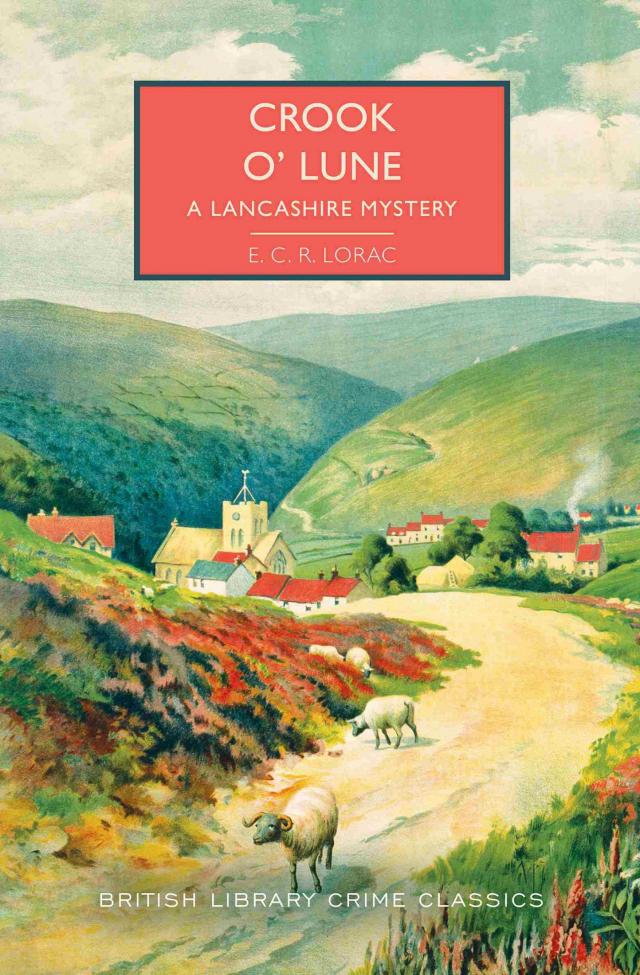
Front cover image © NRM/Pictorial Collection/Science & Society Picture Library
Sourcebooks, Poisoned Pen Press, and the colophon are registered trademarks of Sourcebooks.
All rights reserved. No part of this book may be reproduced in any form or by any electronic or mechanical means including information storage and retrieval systems—except in the case of brief quotations embodied in critical articles or reviews—without permission in writing from its publisher, Sourcebooks.
The characters and events portrayed in this book are fictitious or are used fictitiously. Any similarity to real persons, living or dead, is purely coincidental and not intended by the author.
Published by Poisoned Pen Press, an imprint of Sourcebooks, in association with the British Library
P.O. Box 4410, Naperville, Illinois 60567-4410
(630) 961-3900
sourcebooks.com
Crook o’ Lune was first published in 1953 by Collins, London.
Library of Congress Cataloging-in-Publication Data
Names: Lorac, E. C. R., author.
Title: Crook o’ lune / E. C. R. LORAC ; with an introduction by Martin
Edwards.
Description: Naperville, Illinois : Poisoned Pen Press, [2023] | Series:
British Library Crime Classics
Identifiers: LCCN 2022061916 (print) | LCCN 2022061917 (ebook) | (trade paperback) | (epub)
Subjects: LCGFT: Detective and mystery fiction. | Novels.
Classification: LCC PR6035.I9 C75 2023 (print) | LCC PR6035.I9 (ebook) |
DDC 823/.912--dc23/eng/20230105
LC record available at https://lccn.loc.gov/2022061916
LC ebook record available at https://lccn.loc.gov/2022061917
CONTENTS
Front Cover
Title Page
Copyright
Introduction
A Note from the Publisher
Foreword
Map of High Gimmerdale
Chapter I
Chapter II
Chapter III
Chapter IV
Chapter V
Chapter VI
Chapter VII
Chapter VIII
Chapter IX
Chapter X
Chapter XI
Chapter XII
Chapter XIII
Chapter XIV
Chapter XV
Chapter XVI
Chapter XVII
Chapter XVIII
Chapter XIX
Back Cover
INTRODUCTION
In Crook o’ Lune, first published in 1953, E. C. R. Lorac weaves a mystery puzzle into a novel of rural Britain. The story is unusual and the characters well-drawn, but the strength of the book is undoubtedly its setting. The events take place in Lunesdale, a lovely but (at least in comparison to its northern neighbour, the Lake District) unfrequented part of north-west England.
Lorac’s series detective, Robert Macdonald, arrives in Lunesdale in the fourth chapter. He hasn’t been summoned to investigate a crime; rather, he is taking advantage of a fortnight’s leave to accept an invitation to stay with his friends Giles and Kate Hoggett at Wenningby Farm. He had fallen in love with the area during his first visit (recorded in Fell Murder, also published as a British Library Crime Classic) and returned in The Theft of the Iron Dogs and Still Waters. Now he has inherited a sizeable legacy “from a thrifty Scots uncle” and is looking ahead to his retirement and buying a farm in Lunesdale.
Macdonald isn’t the only person to succumb to the charms of the area. The first three chapters are seen from the point of view of Gilbert Woolfall, a Yorkshire businessman, who has also benefited from an inheritance from an uncle. He is now the owner of a remote farmhouse called Aikengill, in High Gimmerdale, and is currently trying to sort out his late uncle’s papers and history of the family. In the opening pages he finds himself exhilarated by his return to the area. A “sense of enchantment… always possessed him when he looked down at the huddle of ancient stone steadings hidden away in this vast solitude of hill country.”
Gilbert finds himself increasingly tempted to make Aikengill his permanent home, rather than selling the property. While walking, he encounters young Betty Fell, who wants to marry Jock Shearling and offers to look after the house for Gilbert while he is away at work. The present housekeeper, Mrs. Ramsden, is planning to go and live with her sister in the village of Dent, but she too finds it a wrench to desert the charms of Lunesdale. Gilbert is soon disturbed by a couple of visitors. The first is Tupper, the disagreeable Rector, who has persuaded himself that Gilbert’s Uncle Thomas should have made a bequest to supplement his stipend. The second is Daniel Herdwick, a veteran local farmer, who has the grazing rights at Aikengill and is interested in buying the property.
It is fair to say that the mystery element of this story is a slow burn. Lorac seldom indulged in melodramatics, and the ratcheting-up of suspense was not her highest priority. Yet there is something quite subtle about the way she lays the groundwork for a case that will eventually intrigue Macdonald. At first, the only crime that seems to disturb the tranquillity of the neighbourhood is sheep-stealing, but a fire—which proves to be a case of arson—results in a tragedy that is all the more shocking because we care about Lorac’s people. From that point, the plot thickens nicely, while the characters remain more substantial than those sometimes found in Golden Age whodunits. Among the unexpected touches are a couple of references to T. S. Eliot.
Even as the mood darkens, we never lose sight of the appeal of Lunesdale. A sketch map of High Gimmerdale (drawn by the author, a talented artist) is included, and at times the descriptions of the countryside are quite lyrical. And as Gilbert Woolfall says: “When people in the south say that the county of Lancaster is dense with industrialism, and smoke-grimed cities, I should like to drop them on to Bowland Forest and let them sense those square miles of high moorland devoid of any habitation at all.” We are certainly not presented with a “chocolate box” or “picture postcard” view of the area. Farming in the hill country is tough, and Lorac makes no bones about the harsh realities of the lives led by the locals or the nature of a small community in which gossip “is blazoned abroad with the velocity of the infernal combustion engine.”
Period touches include the faded war-time posters concerning “Anti-gas…decontaminating measures,” while the local dialect is handled more crisply and less obtrusively than in many vintage mystery novels. In a foreword, Lorac says that she wrote the story “to give pleasure to kind friends from far and wide who have written to me and asked for another book about our valley, not forgetting Giles and Kate Hoggett… Incidentally, the house I have called Aikengill is not for sale, nor is it to let. I live in it myself.”
Crook o’ Lune offers an excellent example of Lorac’s method of blending fact with fiction, both in terms of characters (the Hoggetts were based on her sister Maud, and her husband John Howson) and places. There is a real Crook o’ Lune (i.e., a bend in the River Lune, which turns back on itself just below Caton), and the title is highly appropriate; in the United States, however, the book was renamed Shepherd’s Crook. High Gimmerdale is Lorac’s version of Roeburndale (which, to complicate matters further, is itself mentioned in the book), while Kirkholm is Hornby in disguise. Gilbert Woolfall arrives at Kirkholm station at the start of the book and at the time of publication there was indeed a station at Hornby. Alas, it closed more than half a century ago.
Although many of the locations in the story are fictionalised, Slaidburn in the Forest of Bowland is not. There is an endowed school there, as well as in other villages in the area such as Wray, on the edge of Roeburndale; a school endowment also features in the novel. The historic inn in Slaidburn where Macdonald has an evening meal, the wonderfully named “Hark to Bounty,” serves home-cooked food to appreciative customers to this day. The name, which appeals to Macdonald, is said to derive from a remark made by the local squire, whose favourite dog was called Bounty.
During the course of researching the topography of the novel to help me in writing this introduction, I visited Roeburndale and the surrounding countryside and dined and stayed at the Hark to Bounty. (It’s a tough job, acting as Crime Classics series consultant, but someone has to do it!) I am pleased to confirm that I share Macdonald’s enthusiasm for the inn, which for many years housed an old manorial or “moot” court; the courtroom still exists on the upper floor. I learned from the staff that Lorac herself stayed there, and I’d guess that she name-checked the pub in appreciation of hospitality received.
My thanks go to Lena Whiteley (who knew Lorac personally) and her son David for their kindness while guiding me around “Lorac country” and telling me some of the stories behind her stories. Among other things, they explained that the crookedness that lies at the heart of the mystery was inspired by a real-life occurrence in the area where Lorac lived.
Lorac was the principal pen name of Edith Caroline Rivett (1894–1958), who moved to Aughton in Lunesdale during the Second World War, to be close to her sister, and became a much-loved figure in the village. Her home, the model for Aikengill, was Newbanks (now Newbank Cottage). Her strong personality shines through her fiction and is evident in Crook o’ Lune, not least in her compassion for young Betty and the distaste shown for religious hypocrites and malicious gossips. Like Macdonald, she was not a native of Lunesdale, but once she had settled in the area, she never wanted to leave. Reading this novel, one can understand why.
—Martin Edwards
www.martinedwardsbooks.com
A NOTE FROM THE PUBLISHER
The original novels and short stories reprinted in the British Library Crime Classics series were written and published in a period ranging, for the most part, from the 1890s to the 1960s. There are many elements of these stories which continue to entertain modern readers; however, in some cases there are also uses of language, instances of stereotyping and some attitudes expressed by narrators or characters which may not be endorsed by the publishing standards of today. We acknowledge therefore that some elements in the works selected for reprinting may continue to make uncomfortable reading for some of our audience. With this series British Library Publishing aims to offer a new readership a chance to read some of the rare books of the British Library’s collections in an affordable paperback format, to enjoy their merits and to look back into the world of the twentieth century as portrayed by its writers. It is not possible to separate these stories from the history of their writing, and as such the following novel is presented as it was originally published with the inclusion of minor edits made for consistency of style and sense, and with pejorative terms of an extremely offensive nature partly obscured. We welcome feedback from our readers.
FOREWORD
Here is another story about Lunesdale, written to give pleasure to kind friends from far and wide who have written to me and asked for another book about our valley, not forgetting Giles and Kate Hoggett. To all of you, in U.S.A. and Canada, in New Zealand and Australia, I can give an assurance that a place like High Gimmerdale really does exist, in the fells south of Lune. No inhabitant of “Wenningby” will have any doubt about that. But will all of you please remember that this is a story, no more? If I have used some real facts, such as the sheep-stealing on Whernside, and if I have taken liberties with ancient history and adapted Benefactions to the base uses of detective fiction, it is only to make a story whose very roots grow in the place. No character in this book is real—except perhaps the Hoggetts, and they bear me no ill-will for having turned even their cows into fiction. And to those of you overseas who think you might be descended from bygone Teggs and Fells and Shearlings and Lambs, well, the folk in this valley are a fine race, so good luck to all of you. Incidentally, the house I have called Aikengill is not for sale, nor is it to let. I live in it myself.
—E. C. R. Lorac
1953
CHAPTER I
I
Gilbert Woolfall was always conscious of a sense of exhilaration when he got out of the train at Kirkholm. A quickened pulse and a feeling of well-being seemed to wipe out all the tedious problems involved with the complex economics of industrialism which were his normal preoccupations as a business man.
Kirkholm is a very small, quiet station in the Lune Valley, on the railway line which connects the industrial towns of the West Riding of Yorkshire with the ancient city of Lancaster, hard by the west coast. For part of its route the line meanders in the shadows of the great limestone fells of the Pennine Range and above the green dales and rich woodland of the Lune Valley. It is an important section of line to the farmers and country folk who fetch their gear from its small remote stations, but it seems vague and slow to those urban folk who occasionally chance to travel by it. The places and territory it serves are little known to civilisation—if that quality be the monopoly of cities, as the word implies. How many townsfolk are acquainted with Lunesdale and Ribblesdale, Swaledale and Dentdale, Giggleswick and Bucka Brow, Trough of Bowland and Langstrothdale?
But to Gilbert Woolfall these were now real places—not merely place names—and the knowledge of them exhilarated his mind as the keen air from the fells exhilarated his body, making him feel not only more alive, but very glad to be alive.
Gilbert was the only passenger who alighted from the train at Kirkholm, and after a friendly greeting with the station master, he went out into the peaceful station yard and found his car, parked ready for him by the garage lad. With a sigh of satisfaction at the peace and solitude of the place, he drove out of the yard, turned sharp right over the railway bridge and down to the Halt sign where the main road ran east into Yorkshire. Having crossed the main road, he began to climb immediately, up into the hills.
It was a glorious spring evening, the sun still gilding the crests of the high fells, though the valley was already in shadows. At first, the steep narrow road ran between hedgerows in which the first blackthorn was spreading a mist of white, and the willow catkins were blobs of gold, but after a couple of miles the hedgerows gave way to dry-stone walls, the arable land dropped behind and the road rose even more steeply to the open fellside. There was a cattle grid across the road at the top of the hill, in addition to the gate which used to bar the road: stone walls ran to right and left as far as the eye could see, dividing the cultivated land from the rough sheep pasture. Once his car had bumped over the cattle grid, Woolfall delighted in the unfenced road, in the grand sweep of fell which stretched away unbroken, ridge beyond ridge of moorland, to the great dome of blue sky overhead. He drove on until he reached a level stretch and a firm piece of turf where he could pull the car off the narrow road, and then he got out and strolled over the rough ground to an outcrop of rock from whose topmost ridge he could see the stone-flagged roofs and the wind-clipped trees of High Gimmerdale, tucked away below, all unsuspected, in a fold of the high fells.
Gilbert Woolfall stood there for a long time, trying to analyse the sense of enchantment which always possessed him when he looked down at the huddle of ancient stone steadings hidden away in this vast solitude of hill country.
His forebears had lived in High Gimmerdale; generations of them. For five centuries at least—and who knew how many more, back to the dawn of history—Woolfalls had tended their sheep on these fellsides, had lived on the site of the sturdy stone house whose ancient flagged roof showed long and grey against the wind-swept beeches behind it. They had lived and worked, married and begotten families, died and been buried, in that small place hidden among the hills.
It was sheep country. The name of the hamlet, the name of Gilbert’s family, the names of nearby steadings and nearby neighbours, nearly all were connected with sheep and the wool trade. Gimmers, tups, tegs, rams, wethers, hoggetts, ewes—all the terms so familiar to sheep farmers and so bewildering to the uninitiated—were woven into place names and patronymics. Woolfall, Herdwick, Fuller, Shepherd, Shearling—every name was derived from sheep.
The sheep were around him now—rough fell sheep, their fleeces long and unkempt, their dark noses nuzzling busily among the undergrowth for the fresh grass which was just beginning to grow under the dry bents. Their fleeces were not white or creamy, like the wool of the tall Shires’ sheep, nor the fat beasts of the South Downs: here they were dark grey, as though they had developed a protective colouring which made their shaggy backs indistinguishable from the rocky outcrops among which they pastured. Their lambs were lighter in colour, but they were still so small that it was difficult to pick them out in the undergrowth: the lambs kept close to their mothers, sometimes trying to pasture in imitation of the diligent ewes.
Gilbert Woolfall stood very still, watching the flight of lapwing and curlew, listening to their call, while the ewes, gaining confidence from his immobility, disregarded him and pastured around him without fear; the wind swept by steadily, cold and exhilarating, and the sun sank behind the ridge of Claughton Moor.


