The touch of reality, p.1
The Touch of Reality, page 1
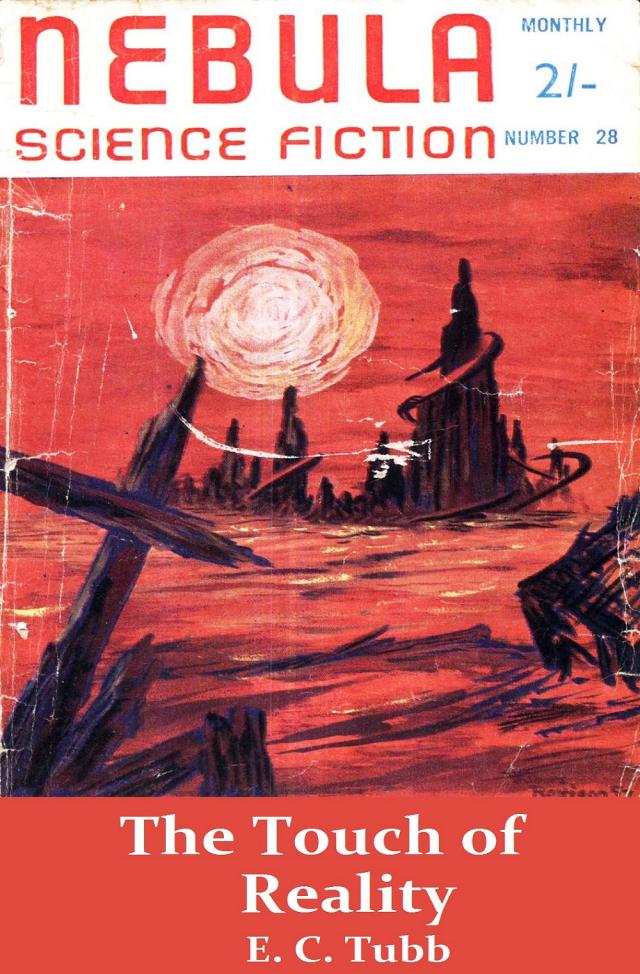


The Touch of Reality
by E. C. Tubb
From : Nebula Science Fiction, Number 28 March 1958 - Novelette
Illustrated by Martin Frew
In his youth he had dreamt of the Moon and all it wonders—
but not of this nightmare journey stalked by death at every turn
Few dreams can stand the touch of reality. When he was young Mark Sturent had often stared through a quarter of a million miles of air and vacuum at the shining face of the moon. It had attracted him as it had all boys of imagination and he had built up a mental fantasy of brave adventure and heroic endeavour, picturing a tight little community of men facing, and surmounting, an almost hopeless challenge with himself, naturally, as one of the leaders. Now, twenty years later, reality had soured the dream.
Seen at close quarters the moon was not a pleasant place. It was too harsh, too sterile, too cold at night and too hot during the day. The craters were death traps of mist-fine dust; the mountains jagged and rotten like the crumbling teeth of a skull. It was too quiet, too lonely, too much like the ravaged face of a long dead woman who yearned for company in her dissolution. Even the earthlight did litde to soften the barren bleakness and the stars, bright and unwavering, hung like frozen snowdrops in the sky.
But if the brave adventure and heroic endeavour had vanished the challenge remained. It was a very simple challenge and a very personal one. It was the ability to stay alive. Mark, sprawled in his suit, sometimes wondered just how long he would be able to meet and defeat it. So far he had been lucky.
“ Coffee,” whispered a voice from the helmet radio. “Man! Could I use a cup of java!”
That would be Sam Levine, young, brash, supremely self-confident, cynical as only a man who has never evaluated life can be cynical. He knew the price of everything, the worth of nothing and adhered to the credo of self first, last and all the time. He was devoid of imagination and could stare at the beauty of Earth, compare it to the surface of the moon and his only thought would be for a hotdog, a cup of coffee and a cigarette thrown in for good measure.
“ Button it up,” said Mark into his microphone. “ No talking.”
” Hell, Cap, why not?” Sam sounded aggrieved. “ Just staying out here doing nothing, saying nothing, is giving me the willies.”
“ You heard what I said.” Mark squinted at the luminous face of the chronometer set among an array of instruments just above his viewport. “ Melkin?”
“ Here, Captain.” Carl sounded disapproving. Mark guessed that had he been in charge of the patrol he would have blasted Sam for breaking radio silence—and probably done more harm by his tirade than that caused by the original fault.
“ How are you feeling?” Mark smiled to himself at what Carl must be thinking. He, the Captain, breaking his own firm injunction against any but routine radio contact.
“ I’m fine, Captain.” The note of disapproval was now more in evidence.
” Not too cold?”
“No, sir.”
“ Levine?”
“ I’m freezing.” Sam made his teeth chatter to accentuate his complaint. “ How much longer we got to stay out here, Cap?”
“ Not much longer.” Mark glanced again at the chronometer. “ Relax, Sam, that coffee will taste all the better for having had to wait for it.”
“ Maybe.” Sam didn’t sound convinced. He would have said mote but Mark forestalled him.
“ No more talking. Keep your eyes peeled and your mouth shut.”
It was the old injunction repeated, Mark didn’t know how often, but as important now as it had ever been. Watch, don’t talk! For talking, via radio, could be picked up and a directional fix taken. And betrayal of their position could mean a bullet-punctured suit or worse. For, in this strangest of all wars, neither side was playing.
It was a war which was officially unrecognised, a struggle which was not apparent on Earth or more than suspected by other than the interested parties. It was a war with peculiar rules and a specific code which had nothing to do with chivalry but everything to do with survival. To bomb the main bases would have been simple but would have led to immediate retaliation and global conflict. To destroy the ships prior to landing would not have been too difficult but would have been tantamount to suicide. It was a war with an unwritten agreement that neither side would destroy inexpendable material. But men were not inexpendable.
Which was why Captain Mark Sturent rested on the Luna dust in the Luna night, eyes staring towards the enemy sector and a mark IV machine rifle at his side.
Waiting is hard at the best of times and waiting in the narrow confines of a space unit is the hardest of all. Bodily functions have to be suspended or, if not, the discomfort increases. The limbs are hampered by the tight fitting plastic, the head enclosed in the great, globular helmet, and life balances on the ability of the bodily heat, plus electrical battery power to combat heat loss by radiation so that survival is possible at - 240 F.
Lying in his suit Mark wondered, not for the first time, just what had ever made him think of the moon as a place of romance. Coupled with the fear that his power would fail and leave him to freeze in the cold of the Luna night was the uneasy knowledge that his life depended on the smooth functioning of his air unit. If it failed then he would die. If it continued to function then he would draw breath as long as he could live. The closed cycle algae system had been the greatest weapon in the battle against the environment. But even with air and heat the psychological factor posed a problem. “ Cap.’* It was Sam again. “ I think I’ve spotted something.” “ Where?” Mark was instantly alert.
“ Over by the triple peak. About one-fifteen. See it?”
“ Melkin?” Mark wasted no time. From his own position he had a bad view of the named position but Carl would have it in his field of vision. *
“ Nothing.” Melkin was very positive. “ Sam just wants to hear the sound of his own voice.”
“ I don’t want to hear the sound of yours,” said Mark sharply. “ Keep watching, you too Sam, and report only if you’ve anything definite.”
Cautiously he wriggled to a point of better vantage, rolling his body so that his viewport pointed in the right direction. He blinked, stared and was not too surprised to find that he saw no signs of anything suspicious. But he didn’t allow himself to relax.
It might be a false alarm, probably was, or, even, it was as Carl had suggested and Sam wanted to hear the sound of human voices. Locked in a suit, away from even the sight of a companion, it wasn’t too hard for a man to slip into the illusion that he was wholly alone. It was natural for such a man to want to hear that others were alive and around him. Natural enough for him to even have a hallucination to justify his breaking radio silence.
Or maybe he had actually seen something and was telling the simple truth.
Mark had never actually met the enemy. He had seen signs of their presence, examined their footsteps in the dust and made abortive attempts to track them to their base, but that was all. As far as he knew the enemy had never seen him either, the fact of his existence was proof of that, but there was always a first time for everything and, for all Mark knew, this could be his first time. He wanted to make certain that it wouldn’t be his last.
Movement, in the pressure suit, was not easy. Even with the one-sixth Luna gravity strengthening his muscles the journey was no pleasant stroll. Care had to be taken not to slip into a dust-filled pocket or fall from the sudden yielding of rotten stone. It took a long time for Mark to rise from his place of concealment, work his way along in the shadows until he had reached the suspected area, and assure himself that nothing lurked where Sam had said.
“ Cap.” Sam’s voice echoed from the radio, again.”
“ I can sec it
“ How many?”
“ One.”
“ What’s he doing?” Mark raised his arms as far as they would go, which was a little above his shoulders. “ Well?”
“ Surrendering, I think.” Sam sounded doubtful. His doubt was registered in the little metallic sounds coming from the radio, the transmitted sounds of something being lifted into position and tapping against the air unit and helmet. “ Should I let him have it?” “ You’re looking at me, you dope,” said Mark quickly. “ See? I’m lowering my arms.”
“ Can you spot any footprints, Captain?” Carl was practical.
“ No.” Mark stared at the landscape, brilliantly lit in the earth-light, sombrely dark in the shadow. “ Not a sign.”
“ I knew it.” Carl sounded disgusted. “ Sam got scared and wanted someone to hold his hand.” It was, thought Mark, a good diagnosis. Sam was quickly defensive.
“ I’ll hold your hand, you squarehead,” he snapped. “ You trying to get me into trouble, or something? I tell you I saw something out there.”
“Sure.” Carl was sarcastic. “ A Moonman, maybe?”
“ Skip it.” Mark felt that the argument was getting out of hand. “ Maybe you did see something, Sam, and maybe you only thought that you did, but one thing is for sure. When we get back to camp you’re going to spend a few hours rubbing up on recognition. You should have spotted who I was by my suit.”
“ At that distance?”
“ You are close enough to see the movements of my arms,” reminded Mark. He glanced at his instruments, the investigation had taken longer than he thought. “ Better get over to Carl’s position. I’ll rendezvous with you there. It’s time we headed back.” The best part of any patrol was, to Mark, the return to c amp. It wasn’t much, the camp, but it was a place where it was possible to relax. Gouged out of the side of a mountain, a combination of natural fissure and artificial cave, sealed, insulated, studded with U.V. lamps and with pine-scented air it was the acme of comfort to a man just back from patrol.
Comfort is relative. To those fortunate enough to be in Main Base the intermediate bases were places of hardship devoid of swimming pools, live theatres, shopping centres and the transported luxury of modem life. To the residents of the intermediate base the advance camps were little more than glorified jails. To the mer who were attached to them they were home.
The others were together when Mark reached the rendezvous point. They touched helmets and spoke by conduction, switching of the suit radios.
“ Do we return by the same route, Cap?” Sam was eager t< get back to his animal comforts, he had a heap of glossy girly magazines and a deadline to make before he passed them on.
“ That wouldn’t be wise,” said Carl before Mark could answer “ For all we know they could be waiting for us.”
“ I wasn’t asking you,” said Sam. He was still annoyed at Carl “ How about it, Cap? A quick trip for a change?”
“ A safe trip,” said Mark. He glanced at the chronometer “ We’ve got plenty of time. We’ll take it slow and easy and arrive all in one piece. I’ll lead, Sam will take second and Carl will cover the rear. Keep well away from the dust and stay in shadow. N< talking unless you have to.” He stepped away, breaking the contact before the others could argue.
Return to camp was simple and yet, in some ways, more dangerous than any other event during patrol. They were heading toward! safety and that, in itself, tended to lead to carelessness. And then was more need on the return journey for watchful caution than at any other time.
The camps and intermediate bases were disguised and camouflaged for a very good reason. They were expendable targets. It was always possible that an enemy patrol had spotted them, were waiting their chance and, rather than make a quick but minor victory, gambled on hitting the jackpot, the total destruction of the advance camp. So it was vital that any returning patrol made quite certain that it wasn’t being followed. Elementary caution dictated taking a different route inward than outward, but breaking new ground on the moon is always hazardous.
Mark led the way, testing spots of shadow, keeping to naked rock, taking a swinging path which would, eventually, end at the camp. Behind him, waiting until he was well ahead, came Sam. Carl waited, watching to make sure nothing was wrong, then he too advanced. It was slow going, careful going but essential.
As always, and despite his trained caution, Mark’s thoughts flew ahead to their homecoming. They would group and advance to give the recognition signals. A man would come out to meet them and, if satisfied, would escort them to the disguised air-lock. Once inside the camp helpers would divest them of their suits. Mark would make his report to Colonel Westerlain and then head for the spray showers. Then food, hot coffee, a taped show, books or a quiet, friendly game of chess with Latimer or Blanchard. Then rest followed by a spell of camp duty, outside guard duty, escort duty and patrol duty again.
He stumbled as rock yielded beneath his foot and caught his balance with a painful twisting of his body. The near-fall jerked him back to full awareness of his immediate surroundings and he halted, resting as he searched the landscape with his eyes. Nothing. Nothing but the inevitable dust, the jagged mountains, the broken and shattered foothills. He twisted, watched as first Sam and then Carl headed towards him and, when they had assembled, gestured for contact.
“Anything wrong?” Carl’s breath sounded laboured.
“No. Just a routine check. Air units O.K.?”
“ Mine is.” Sam grinned through his viewport, Mark could just see his pale features grimacing behind the plastic.
“Good. Carl?”
“ No trouble, Captain.”
“ Sure? You seem to be having trouble with your breathing.”
“ I almost fell, back there. Then I had to hurry to catch up.”
Carl sounded grieved, as if Mark should have known better than to doubt his word.
“ All right. Sam, you take the lead. Carl, you take second and I’ll cover.” Mark gestured towards a low ridge of rock some little distance ahead. “ We haven’t far to go now. Once over that ridge and we’ll be in sighting distance of camp. Don’t break your neck running.”
“ Coffee,” said Sam. “ I can taste it now.” Then he was off, machine rifle at his side, his bloated torso and slender limbs giving him the appearance of some ungainly insect as he headed towards the ridge. Mark waited until he was well away, then clapped Carl on the shoulder. Alone, he turned and stared back the way they had come.
Nothing, of course, he hadn’t expected anything. Sometimes he wondered, at times like this, what he would do if he did happen to spot a shape in an unfamiliar suit. Would he lurk in ambush ready and eager to kill? Would he try to take a prisoner? Would he be subtle and wait and follow so as to wipe out a thriving fleck of life on the barren moon, stamp out a tiny community of planetary brothers? It was easy for others to talk, to tell him what he should do, where his duty lay, but, secretly, Mark hoped that he would never have to make the decision. He turned a second before his radio screamed into life.
“ Cap.” It was Sam, his voice thin with hysteria. “ Cap, for God’s sake!”
“No talking!” Mark lunged forward, safety almost forgotten in the emergency. “ Save it until I reach you.”
“ But “ Shut your mouth!” Mark felt a helpless anger at the other man. He could order but that was all, obedience was something else. “ Talk again and I’ll shoot you on sight. I mean it!”
The threat worked. Mark raced forward, catching up with Carl just before they both reached the top of the ridge where Sam was standing. Mark reached him, knocked him over the lip of the ridge and flung himself to the ground, his helmet clanging against that of the other man.
“ Fool! What’s the idea of standing like a target at a shooting gallery?. Mark’s ears rang as Carl thrust his helmet into contact.
“ Captain!”
“ I’m talking to Sam.” At that moment Mark hated them both. “ To pull a stupid trick like that so near to the camp. .”
“ Never mind that,” yelled Carl. “ Captain, have you seen it?”
“ Seen what?”
“What I was trying to tell you.” Sam swore with helpless anger. “ You didn’t give me no chance to tell you, no chance at all. Look!”
He lifted his arm and pointed towards a rolling cloud of dust.
Sometimes, when tragedy comes, it is so overwhelming that it brings its own anaesthetic. Mark stared at the new-made crater, raw and angry in the earthlight, tilted his head to stare at the last traces of the dust cloud and felt as if he were living in a dream, that none of this was real.
“ It must have been recent,” said Carl. His voice was strained as it echoed from the radio. “ The dust hadn’t even settled.”
“It wouldn’t.” Mark kicked at a shattered scrap of debris, watching the dust plume and hover. There was no air to support it but there wasn’t much gravity to pull it down again either. “ From the looks of things there was an explosion and a big one at that. Anything with the force necessary to smash the camp would have thrown the dust really high. It could have happened just after we’d left.” “ Gone! ” Sam sounded as if he still couldn’t believe it. “ Just a hole in the ground.”
“ The enemy.” Carl sounded convinced. “ They must have done it.” Despite his conviction he didn’t bother to keep radio silence and Mark couldn’t blame him. They all needed the comfort •f conversation now as never before.
“ They could still be out there, watching us, just waiting to let us have it.” Sam’s voice rose towards hysteria. “ Cap, we just can’t stand here, we’ve got to do something!”
“ Take it easy.” Mark took a deep breath, feeling the numbness of shock dissipate beneath the need for action. He switched off his radio, gestured and they touched helmets. “ No need to take chances,” he said. “ We can’t be sure that the enemy were responsible for this, it could have been due to an accident or natural causes.” “ It wasn’t an accident,” insisted Carl doggedly. “ If it wasn’t the enemy then where are the guards?”