

The dragon lensman, p.2
The Dragon Lensman, page 2
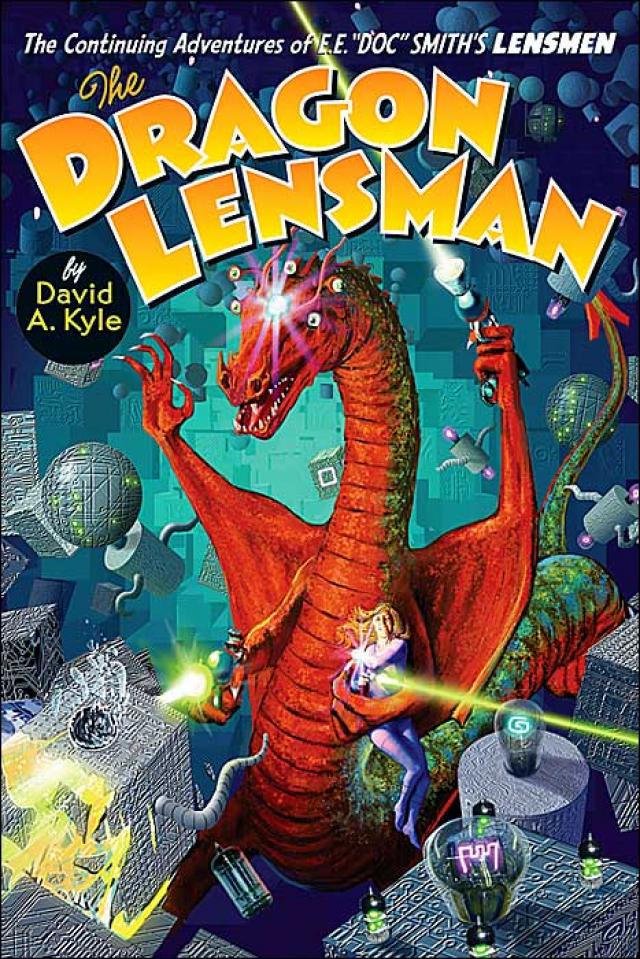


The angular, dureum-alloy vault of The Great Hall of the Machines disappeared into the haze of the far distance, the lines of suspended security lights marking the boundaries of the main corridor. Spread out around him was a maze of transparent walls, like shimmering three-dimensional ghosts. The silence was absolute when he was still, but now the noises of the clumping of his large feet, and the whispering of the leather toe-sheaths which padded his claws as they brushed the gleaming floor, echoed and re-echoed from wall to wall and reverberated like distant thunder in the high vastness of the ceiling's emptiness.
He had walked past armies of machines, each and every one different, through a succession of partitioned areas over long hours. Only the mechanical humanoid fighter which he had just examined had given him a real taste of excitement. So far his survey would have been a bore, except for the fascination of the shapes he had seen, simple and complex, plain and grotesque, spidery, squat, bizarre and baroque, vicious and beautiful.
The new room into which he had just come, the standard 300-foot square, was brightly lighted and filled with compuautomates. This was the section, the final section, which he had been aiming for, the place he expected to find the reason for the pervading uneasiness, and where he would determine if there were really a problem to solve.
Within its limited yet large space there were thousands of lifeless shapes in serried ranks, innocuous devices of technological cultures, large and small, angular and curved, shiny and dull, knobbly and smooth, metallic and plastic, some beautiful and some ugly.
Worsel was impressed by them because he knew that these were only a fraction of the creations from the minds and hands of the highest cultures of Civilization. The change in the scale of the collection since his last visit was enormous. The magnitude of the fabrications spread out before him would have intimidated or frightened a lesser person.
"Ah, my beauties!" Worsel said and coolly surveyed, from where he stood, their inanimate bodies, their inactive limbs, their mute visages. "Is there one among you who would like to greet a Lensman?" He said this aloud in his basic guttural Velantian, as it was physically impossible for him to speak Universal English. His tone was mocking, for he only half believed his mission. He was here on the Planetoid of Knowledge because, one of the theories went, a unique intelligence was suspected to exist, exceptionally strange and utterly alien in that its consciousness was artificial, mechanical, not alive.
Either it existed, or else those who reported it were psychologically disturbed. In either case his presence was justified. The services of Worsel, the eminent psychologist, had been properly requested.
"No greeting for me?" Worsel persisted. "No welcome for Worsel of Velantia?" He popped out a number of eyes in various degrees of mock surprise. "Perhaps you sleep?" His jesting had that edge of seriousness which hinted at a set trap lying just below a scattering of leaves. "Perhaps you do not hear me?" He flicked his tongue casually, in the manner of an elaborate shrug as though inviting a response. "Or maybe you're just smart enough to play it this way?" These were more words than he had spoken in perhaps a year. He heard them physically through the vibrations from his chest, but he did not hear them through his ears because they had atrophied by disuse. It was characteristic of his race to interpret sound vibrations through sense organs in the skin around nose and throat.
Worsel knew that he had come to the most critical room. He was positive that something would happen here. This room on Level 97 wasn't overwhelmingly large, limited, as it was, to only the most sophisticated of items, but it contained all the "wits" and the "smarts" of the mech world.
They were all potentially in working order, a rather stupid situation he thought, ready to go into their dances and sing their songs of science or business, war or crime at the flick of a switch or the touch of a mind. Probably most of them could calculate, compute and make logical deductions as fast, maybe faster, than any Lensman, including himself.
Maybe they weren't creative thinkers, like their creators, but then again ... Maybe the magnitude of Pok was getting him down. It was no longer the small place he had helped establish years before. The sheer numbers of apparatuses now collected on the Planetoid of Knowledge was staggering, representing thousands of civilizations from which the Patrol had obtained the exhibits. Appreciation of this came only after he had walked through a half thousand rooms and skipped an equal number. It wasn't their sizes which were intimidating-considering that Worsel himself was thirty feet long and built like a piece of heavy-labor machinery covered with tough, flexible scales, he dwarfed most of the mechanisms. No, not their sizes, it was the extent of the alien collection which impressed him.
Pok, the Planetoid of Knowledge, was unique. It was an artificially constructed sphere eighteen miles in diameter, originally the project of The Velantian Council of Scientists before becoming a Galactic Patrol installation. When Velantia had discovered Civilization and had joined the Galactic Council, the planetoid had been established to collect the new knowledge available, and to make it possible for the Velantians to become quickly one of the foremost interstellar communities. Worsel, the hero of the hour, undertook the project and, with the Patrol's extensive help in collecting and furnishing material, soon had an extensive library and museum. Then, within one year, he had left to establish his own Institute.
0At first the satellite had been in close orbit, but as Pok became a source of research for the galaxy, it was moved outward, beyond the original network of guardian satellites, the picket line that defended the former isolation of the mother planet. Velantia still claimed its territorial space within the encircling boundaries of the small guardian globes, but now Pok was technically in deep space, available for the use of all without trespassing.
Constructed massively to match the huge size of the Velantians, Pok at first was strictly a collection of mechanisms and machines, kept in the vacuum of space as a sort of deepfreeze, without maintenance necessary. Only a Velantian living-quarters was pressurized. As a GP establishment, it was soon extensively improved and continued rapidly to grow in size and contents. Sectional wedges built and sent by a multitude of races were fitted together for maximum expansion in minimum time. At right angles to each other, three huge egress shafts ran centrally from surface to surface through the planetoid, large enough to admit giant freighters. Every level had docking platforms. Each section had its own gravity and-atmosphere, to match its source. Additionally, central control could alter each section to permit the most varied of research personnel to work comfortably, simulating almost any planetary condition.
Whereas the Velantians had been more interested in mind power and abstract science, they had, by the success of their original Pok, become equally outstanding in technological and mechanical application. They proved that it was easy for such a talented race as theirs to go from pure mathematics to applied mechanics. Though they weren't quite the center of power of muscles, machines, and the military that Tellus was, Velantia had certainly become a center of power for mental and psychological sciences.
Pok, at this moment of Worsel's appearance, was technically not operational. Its latest phase of construction was complete, but the Patrol staff was still a small housekeeping contingent, preparing for the researchers who were waiting to begin their individual projects.
Only a handful of Patrolmen not on leave of absence, therefore, now lived on it and managed it. The staff was much too small, Worsel thought. Not for the work, but for psychological reasons. The presence of all those machines, despite their inoperation, clinically suggested a stressful situation conducive to unpleasant complexes. No wonder they began hearing and imagining things. No wonder they had asked for a house-call by the eminent psychologist Worsel who lived next door. It was up to him to seek out the subtle disturbance. Were they just stir-crazy? Or was a machine consciousness alive in Pok?
Worsel had been scanning the room meticulously with his sense of perception. Now, suddenly, his scales were crawling, up his backbone and down his arms. Intuition was telling him that something strange was happening in this room. He knew at once, beyond any doubt, that this place was where discoveries would be made. His search was near an end. The time to commence identification and analysis had come. This was the time to call upon Bluebell.
Bluebelt, administrative assistant since the early days when Worsel was promoted to Unattached status, was the antithesis of the winged snake he served, both physically and mentally. Bluebelt was relatively tiny, thirty-eight inches high, a mammal with long, golden fur. Because he looked like a guinea pig, with atrophied short wings which draped him like a dress jacket, and moved upright with little hops, he made strangers smile and turned them quickly into friends. On his four hand-like feet, however, he could move smoothly and swiftly. As for his intelligence, it was simple and logical, having none of the complexity of a Velantian; he was always warm, forthright, and intensely serious. Worsel found him invaluable and at every opportunity involving paperwork he perched Bluebelt on his broad shoulder to advise and consult.
The hairy one was now thirty millions of miles away in the Worsel Institute on Velantia, and Worsel projected his thought to him. The etheric connection, by mechanical thought enhancers, was instantaneous. It was far easier to communicate with Bluebelt-and to use him as a message center-than to do so with Pok's staff of six men scattered less than ten miles from him.
"I want a punch-up, Blue," Worsel said without preamble. The name Bluebelt, so often shortened to just plain Blue, had been hung on the creature by no less a personage than Kimball Kinnison himself, when they had all met and briefly worked together on a Patrol ship. What the full name, Bluebuebelthner-Bru, meant, nobody knew or asked.
"Yes, Worsel."
"Punch up slide series Pok RR-97." Pause. "Now start scanning. Stop. Go back three.
Hold it." The entire contents of the miniaturized chart imprinted itself on Worsel's brain as clearly as if he himself had one of his "tight-focus-eyes" zeroed in on it. There were some 120,000 listings, and Worsel rapidly ran through all of them. The archives-and-museum directorship had done well; the organization was flawless as far as the facts were concerned. There was no speculation, however. There was no indication about whether or not Civilization had created inorganic beings, nor any judgment about the mech-things as slaves, equals, or even potential masters of the multitude of races comprising Civilization kind. The records showed that, unlike all the previous rooms, every one of the machines on Level 97 had a sentient or potential-sentient rating. And every one which had an I.Q.Q. rating of any significance was identified as being in Room 97-1 of The Great Hall of the Machines on the Planetoid of Knowledge. They had all been re-programmed to respond to both the English and Velantian languages. They numbered about twenty-three hundred and forty; many were interdependent or mechanically interlocked, so he couldn't be precise.
"Give me the floor plan-Pok RRP-97-1, I believe ... QX. Give me the close-up of sections one through ten ... QX." Worsel now had them displayed on the visual screen in his brain for immediate reference, in a form more easily managed than the actual material on file.
"Thanks, Bluebelt. Clear ether."
The row of machines to his immediate left was rudimentary compared to the sophisticated ones telepathically activated in the sixties section in the middle of the room, but he would start right at Section One. His examination was pre-planned, and first came his personal physiological and psychological preparation. Worsel loosened all his eyes, swelled out his ear membranes, turned up his receptors, fluttered his wings, fanned his fins, and protruded the tip of his tongue from just under his beaked snout. Then came the first real action in his research plan, activation of his first machine. One would follow the other, each in turn being asked the blunt question he had so carefully considered as his opening gambit.
A small office file clerk, no bigger than Worsel's travel kit, was first at hand. He glanced at the I.D. plate, snapped in the power supply, flipped the circuit closed. The machine hummed into life. Worsel touched no buttons, twirled no knobs, and patiently waited.
Through a glass plate he could see a surprisingly complex activity. There was much self adjustment, with oiling and cleaning and substituting of parts, and tidying up of what were obviously consumable supplies. Outside, levers and appendages moved, lights blinked, and signals buzzed for more supplies and major maintenance. When Worsel did nothing, the machine lapsed into inactivity.
Then Worsel tapped out his question. It appeared on the light emitting diode screen: "Are you happy?"
Nothing happened, so Worsel waited. After fifteen GP seconds, when the red letters had flickered out, he typed out the question again. Again a quarter of a minute passed with no response. This time Worsel type out, "Answer the question." The red letters on the screen, after a moment, began to blink rapidly, on and off, on and off. Worsel immediately typed, "Are you nervous because you are confused?"
The machine with no delay replied, "No. The input is aberrant. The input is rejected." When nothing further appeared, Worsel tapped, "Did you understand the questions?"
The machine said, "Yes. I am happy when I am playing games. I am not unhappy when I am not playing games. If this is a game, please give me instructions. If this is not a game, please turn this machine off. If there is no work to be done, please disconnect the power."
"What game would you like to play?" Worsel asked.
There was the longest pause so far before the words flashed up slowly one by one.
"This machine is a machine. This machine may reflect from time to time the personalities of the many people who have programmed it. This machine is not a person. This machine is a machine. That is all."
Worsel repeated the basic question, "Are you happy?," but after a more than sufficient period of repetitious ambiguities he ended the inquisition. He reached two conclusions; one serious, that the very first machine in that roomful was both as smart and as sentient as some races in the Galactic Union, without their egotistical spirit-and one whimsical conclusion, that the answer to that impudent question "Are you happy?" was, for Worsel, a definite "yes." He had found a "mechanical intelligence." Perhaps he would find more.
And what this all meant remained to be seen.
Slightly impatient now, Worsel made a dozen more mechanistic contacts before his large main meal, and two dozen more before he coiled himself in a defensive. position on the bare floor with some of the typical Velantian heat bulbs focussed on himself. His head was pointed down the aisle, the vibrant Lens in his forehead aimed at Section 60; his eyes were retracted, but only half closed. He promptly went into a doze.
For a long time Room 97-1 of The Great Hall of the Machines seemed dead except for Worsel. There was no sound save the movement of the conditioned atmosphere around corners, and the gentle snores of the big dragon.
Behind the front rows of the assorted boxes and cylinders of Section 60 a metal arm extended itself and its rubber tip pressed a silent switch on the back of the larger machine in front of it. Like Worsel's Lens and half-shut eyes, the enemy now had an observer, an infra-red sensor soaking up the scene before it. The smaller machine snaked out a connector and attached itself to the larger; it took nothing but the infra-red reading from its companion. For a long time the smaller machine watched Worsel through the eye of the larger. No gears clicked, no levers moved, but as it squatted there on its many jointed legs, it thought. Slowly it sent out another rod to fasten itself on a neighbor.
And another. And another. None were activated, all remained dead, but all were interlocked now within the immediate area of the small one.
For no apparent reason, Worsel awoke. All the actions had been completely screened from his limited awareness, and he could not see the little machine. Not the tiniest sound nor the slightest movement had registered with him, yet he was awake. He swept the room with his sense of perception, like an X-ray scan which could not be blocked. There was absolutely nothing suspicious. Worsel needed his sleep, so he went back to it.
When he was once again at his minimum sensitivity, something new happened: a plate imbedded in the dureum front of the little machine glowed a message, Medonian Securi-Guard Model 2200. Extremely Dangerous When Activated. In larger letters, pulsing on and off, was the single word, ACTIVATED. When the small Securi-Guard had made as many silent moves as possible, it hazarded one small, tiny click. Worsel stopped snoring and stirred, the tip of his tail quivering. The machine waited, uncertain of its next move. Then, with the advantage of the patience which most machines considered theirs for limitless time, the little black machine, much like Worsel, went back to sleep itself.
Hours passed, and when Worsel's regular sleep period was over he began his task again in Section Eight.
It was on his fiftieth-odd machine that he had an exceptional result. The screen printout read, "Faulty input. Faulty input. Rejected. Rejected. Operator is reminded that stupid information can be harmful to circuits. Be respectful. Not harmful. Harmful. Stupid. Stupid.
Stupidstupidstupid ..." And Worsel whacked the top of the machine with his tail, which made it stop. Worsel was surprised by the symptom. A neurosis or psychosis, so evidenced in this behavior, should not have been expected in this low-level machine. He checked its history record within its service lid, but it showed no aberration, merely cessation of function, which is why it ended up out of service in a museum. Worsel asked the initial question once more, "Are you happy?" All the machine could print was "Too late for correction. Too late" which it kept repeating even after several more blows of Worsel's tail. He bent down and pulled its plug.
When Worsel straightened up, he stretched extra tall, going up on his tail, which needed some muscle flexing after those rather hard raps on the metal casing. His head was some twenty feet in the air, double the height of his former line of sight, with a sharply increased angle of view. That was how Worsel happened to see the remarkable performance of a certain machine in Section 27. He visually caught it in the act of plugging itself into another, completely different machine. Instantaneous application of his sense of perception revealed the alarming consequence: power was bringing the other machine to life!


