The collected tales of e.., p.1
The Collected Tales of E.M. Forster, page 1


Jerry eBooks
No copyright 2015 by Jerry eBooks
No rights reserved. All parts of this book may be reproduced in any form and by any means for any purpose without any prior written consent of anyone.
THE COLLECTED TALES
of E.M. FORSTER
Two of E.M. Forster’s Novels
HOWARDS END
and
WHERE ANGELS FEAR TO TREAD
are Borzoi Books
published by Alfred A. Knopf
Copyright 1928 by Harcourt, Brace and Company, Inc. Copyright 1947
by Alfred A. Knopf, Inc. All rights reserved. No part of this book may
be reproduced in any form without permission in writing from the pub-
lisher, except by a reviewer who may quote brief passages in a review to
be printed in a magazine or newspaper. Manufactured in the United
States of America.
THIS COLLECTION PUBLISHED JULY 10, 1947
FIRST EDITION
The Collected Tales
of E.M. Forster
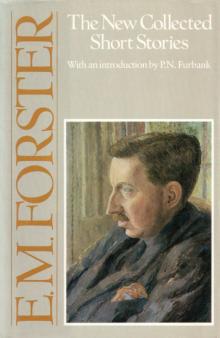
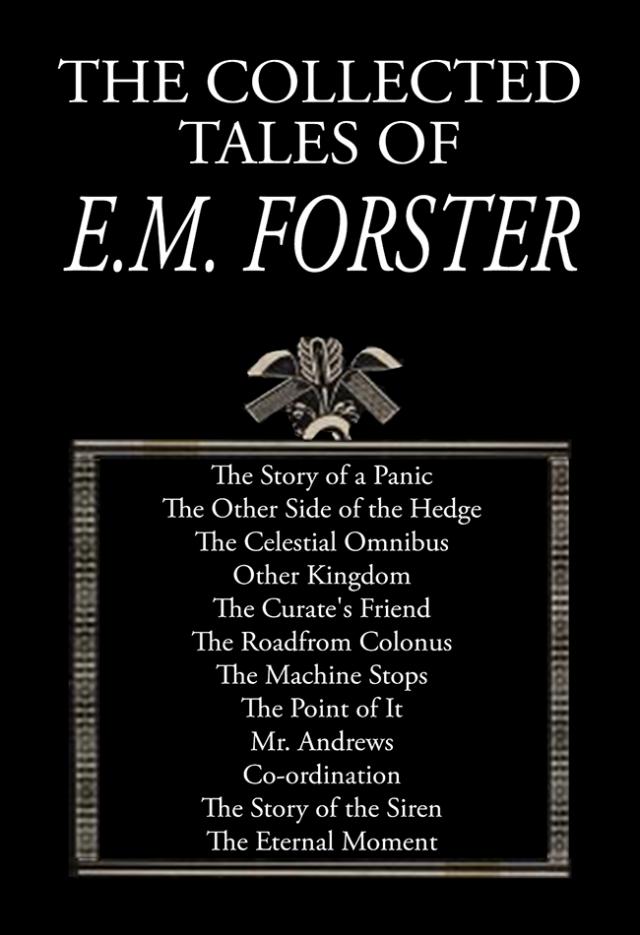
(book cover)
Title Page
Copyright
Introduction
THE STORY OF A PANIC
THE OTHER SIDE OF THE HEDGE
THE CELESTIAL OMNIBUS
OTHER KINGDOM
THE CURATE’S FRIEND
THE ROAD FROM COLONUS
THE MACHINE STOPS
THE POINT OF IT
MR. ANDREWS
CO-ORDINATION
THE STORY OF THE SIREN
THE ETERNAL MOMENT
INTRODUCTION
THESE fantasies were written at various dates previous to the first world-war, and represent all that I have accomplished in a particular line. Much has happened since: transport has been disorganised, frontiers rectified on the map and in the spirit, there has been a second world-war, there are preparations for a third, and Fantasy now tends to retreat, or to dig herself in, or to become apocalyptic out of deference to the atom. She can be caught in the open in this book, by those who care to catch her. She flits over the scenes of Italian and English holidays, or wings her way with even less justification towards the countries of the future. She or he. For Fantasy, though often female, sometimes resembles a man, and even functions for Hermes, who used to do the smaller behests of the gods—messenger, machine-breaker, and conductor of souls to a not-too-terrible hereafter.
The opening story is the first I ever wrote, and the attendant circumstances remain with me and seem worth recalling. After I came down in my boyhood from Cambridge—the place to which I have lately returned as an old man—I travelled in Italy for a year, and I think it was in the May of 1902 that I took a walk near Ravello. I sat down in a valley, a few miles above the town, and suddenly the first chapter of The Story of a Panic rushed into my mind as if it had waited for me up there. I wrote it out as soon as I returned to the hotel, and thought it was complete. A few days later I added some more to it until it was three times as long—its present length.
Of these two processes, the first—that of sitting down on the theme as if it were an anthill—has been rare. I achieved it again next year in Greece, where the whole of The Road from Colonus hung ready for me in a hollow tree near Olympia. And I achieved it a third time, though with sorry results, in Cornwall, at the Gurnard’s Head. Here, in exactly the same way, a story met me in the open air, and since the Panic and Colonus had now been published and admired, I embraced the new comer as a masterpiece. It was about a man who was saved from drowning by some fishermen, and knew not how to reward them. What is your life worth? £5? £5000? He ended by giving nothing, because nothing is absolute, he lived on amongst them, misunderstood and despised. As the theme swarmed over me, I put my hand into my purse, drew out a golden sovereign—they existed then—and inserted it into a collecting box of the Royal Lifeboat Institution which had been erected upon the Gurnard’s Head for such situations as this. I could well afford it. I was bound to make the money over and over again.
Calm sea, flat submerged rock whereon my hero was to stagger, village whence his rescuers should sally—I carried off the lot, and only had to improvise his wife, a very understanding woman. The Rock was the title of this unfortunate effort. Not an editor would look at it. It was a complete flop. My inspiration had been genuine but worthless, like so much inspiration, and I have never sat down on a theme since.
One of my novels, The Longest Journey, does indeed depend from an encounter with the genius loci, but indirectly, complicatedly, not here to be considered. Directly, the genius loci has only inspired me thrice, and on the third occasion it deprived me of a sovereign. As a rule, I am set going by my own arguments or memories, or by the mere motion of the pen, and these contradictory methods do not necessarily produce a discordant result. If the reader will compare the first chapter of The Story of a Panic, caught straight off the spot it describes, with the two subsequent chapters, in which I set myself to wonder what would happen afterwards, I do not think he will notice that a fresh hemisphere has swung into action. All a writer’s faculties, including the valuable faculty of faking, do conspire together thus for the creative act, and often do achieve an even surface.
The other stories demand little comment. The Machine Stops is a counterblast to one of the heavens of H. G. Wells. The Eternal Moment, though almost an honest-to-God yarn, is a meditation on Cortina di Ampezzo. As for The Point of It, it was ill-liked by my Bloomsbury friends when it came out. ‘What is the point of it?’ they queried thinly, nor did I know what to reply.
The stories were collected in two volumes. The first was named after The Celestial Omnibus, and was dedicated ‘To the Memory of the Independent Review.’ This was a monthly controlled by an editorial board of friends, who had encouraged me to start writing; another friend, Roger Fry, designed the book an allusive end-paper. The second volume came out some years later. It was called The Eternal Moment and was dedicated ‘To T. E. in the absence of anything else’; i.e., to Lawrence of Arabia. Now that all are gathered together into a single cover, and are sailing still farther into a world they never foresaw, should they be dedicated anew? Perhaps, and perhaps to a god. Hermes Psychopompus suggests himself, who came to my mind at the beginning of this introduction. Lightly built, he can anyhow stand in the prow and watch the disintegrating sea, the twisted sky.
E.M. FORSTER
Cambridge, England
1946
THE COLLECTED TALES
of E.M. FORSTER
THE STORY OF A PANIC
I
EUTACE’s career—if career it can be called—certainly dates from that afternoon in the chestnut woods above Ravello. I confess at once that I am a plain, simple man, with no pretensions to literary style. Still, I do flatter myself that I can tell a story without exaggerating, and I have therefore decided to give an unbiassed account of the extraordinary events of eight years ago.
Ravello is a delightful place with a delightful little hotel in which we met some charming people. There were the two Miss Robinsons, who had been there for six weeks with Eustace, their nephew, then a boy of about fourteen. Mr. Sandbach had also been there some time. He had held a curacy in the north of England, which he had been compelled to resign on account of ill-health, and while he was recruiting at Ravello he had taken in hand Eustace’s education—which was then sadly deficient—and was endeavouring to fit him for one of our great public schools. Then there was Mr. Leyland, a would-be artist, and, finally, there was the nice landlady, Signora Scafetti, and the nice English-speaking waiter, Emmanuele—though at the time of which I am speaking Emmanuele was away, visiting a sick father.
To this little circle, I, my wife, and my two daughters made, I venture to think, a not unwelcome addition. But though I liked most of the company well enough, there were two of them to whom I did not take at all. They were the artist, Leyland, and the Miss Robinsons’ nephew, Eustace.
Leyland was simply conceited and odious, and, as those qualities will be amply illustrated in my narrative, I need not enlarge upon them here. But Eustace was something besides: he was indescribably repellent.
I am fond of boys as a rule, and was quite disposed to be friendly. I and my daughters offered to take him out—‘No, walking was such a fag.’ Then I asked him to come and bathe—‘No, he could not swim.’
“Every English boy should be able to swim,” I said, “I will teach you myself.”
“There, Eustace dear,” said Miss Robinson; “here is a chance for you.”
But he said he was afraid of the water!—a boy afraid!—and of course I said no more.
I would not have minded so much if he had been a really studious boy, but he neither played hard nor worked hard. His favourite occupations were lounging on the terrace in an easy chair and loafing along the high road, with his feet shuffling up the dust and his shoulders stooping forward. Naturally enough, his features were pale, his chest contracted, and his muscles undeveloped. His aunts thought him delicate; what he really needed was discipline.
That memorable day we all arranged to go for a picnic up in the chestnut woods—all, that is, except Janet, who stopped behind to finish her watercolour of the Cathedral—not a very successful attempt, I am afraid.
I wander off into these irrelevant details, because in my mind I cannot separate them from an account of the day; and it is the same with the conversation during the picnic: all is imprinted on my brain together. After a coupl e of hours’ ascent, we left the donkeys that had carried the Miss Robinsons and my wife, and all proceeded on foot to the head of the valley—Vallone Fontana Caroso is its proper name, I find.
I have visited a good deal of fine scenery before and since, but have found little that has pleased me more. The valley ended in a vast hollow, shaped like a cup, into which radiated ravines from the precipitous hills around. Both the valley and the ravines and the ribs of hill that divided the ravines were covered with leafy chestnut, so that the general appearance was that of a many-fingered green hand, palm upwards, which was clutching convulsively to keep us in its grasp. Far down the valley we could see Ravello and the sea, but that was the only sign of another world.
“Oh, what a perfectly lovely place,” said my daughter Rose. “What a picture it would make!”
“Yes,” said Mr. Sandbach. “Many a famous European gallery would be proud to have a landscape a tithe as beautiful as this upon its walls.”
“On the contrary,” said Leyland, “it would make a very poor picture. Indeed, it is not paintable at all.”
“And why is that?” said Rose, with far more deference than he deserved.
“Look, in the first place,” he replied, “how intolerably straight against the sky is the line of the hill. It would need breaking up and diversifying. And where we are standing the whole thing is out of perspective. Besides, all the colouring is monotonous and crude.”
“I do not know anything about pictures,” I put in, “and I do not pretend to know: but I know what is beautiful when I see it, and I am thoroughly content with this.”
“Indeed, who could help being contented!” said the elder Miss Robinson; and Mr. Sandbach said the same.
“Ah!” said Leyland, “you all confuse the artistic view of Nature with the photographic.”
Poor Rose had brought her camera with her, so I thought this positively rude. I did not wish any unpleasantness; so I merely turned away and assisted my wife and Miss Mary Robinson to put out the lunch—not a very nice lunch.
“Eustace, dear,” said his aunt, “come and help us here.”
He was in a particularly bad temper that morning. He had, as usual, not wanted to come, and his aunts had nearly allowed him to stop at the hotel to vex Janet. But I, with their permission, spoke to him rather sharply on the subject of exercise; and the result was that he had come, but was even more taciturn and moody than usual.
Obedience was not his strong point. He invariably questioned every command, and only executed it grumbling. I should always insist on prompt and cheerful obedience, if I had a son.
“I’m—coming—Aunt—Mary,” he at last replied, and dawdled to cut a piece of wood to make a whistle, taking care not to arrive till we had finished.
“Well, well, sir!” said I, “you stroll in at the end and profit by our labours.” He sighed, for he could not endure being chaffed. Miss Mary, very unwisely, insisted on giving him the wing of the chicken, in spite of all my attempts to prevent her. I remember that I had a moment’s vexation when I thought that, instead of enjoying the sun, and the air, and the woods, we were all engaged in wrangling over the diet of a spoilt boy.
But, after lunch, he was a little less in evidence. He withdrew to a tree trunk, and began to loosen the bark from his whistle. I was thankful to see him employed, for once in a way. We reclined, and took a dolce far niente.
Those sweet chestnuts of the South are puny striplings compared with our robust Northerners. But they clothed the contours of the hills and valleys in a most pleasing way, their veil being only broken by two clearings, in one of which we were sitting.
And because these few trees were cut down, Leyland burst into a petty indictment of the proprietor.
“All the poetry is going from Nature,” he cried, “her lakes and marshes are drained, her seas banked up, her forests cut down. Everywhere we see the vulgarity of desolation spreading.”
I have had some experience of estates, and answered that cutting was very necessary for the health of the larger trees. Besides, it was unreasonable to expect the proprietor to derive no income from his lands.
“If you take the commercial side of landscape, you may feel pleasure in the owner’s activity. But to me the mere thought that a tree is convertible into cash is disgusting.”
“I see no reason,” I observed politely, “to despise the gifts of Nature because they are of value.”
It did not stop him. “It is no matter,” he went on, “we are all hopelessly steeped in vulgarity. I do not except myself. It is through us, and to our shame, that the Nereids have left the waters and the Oreads the mountains, that the woods no longer give shelter to Pan.”
“Pan!” cried Mr. Sandbach, his mellow voice filling the valley as if it had been a great green church, “Pan is dead. That is why the woods do not shelter him.” And he began to tell the striking story of the mariners who were sailing near the coast at the time of the birth of Christ, and three times heard a loud voice saying: “The great God Pan is dead.”
“Yes. The great God Pan is dead,” said Leyland. And he abandoned himself to that mock misery in which artistic people are so fond of indulging. His cigar went out, and he had to ask me for a match.
“How very interesting,” said Rose. “I do wish I knew some ancient history.”
“It is not worth your notice,” said Mr. Sandbach. “Eh, Eustace?”
Eustace was finishing his whistle. He looked up, with the irritable frown in which his aunts allowed him to indulge, and made no reply.
The conversation turned to various topics and then died out. It was a cloudless afternoon in May, and the pale green of the young chestnut leaves made a pretty contrast with the dark blue of the sky. We were all sitting at the edge of the small clearing for the sake of the view, and the shade of the chestnut saplings behind us was manifestly insufficient. All sounds died away—at least that is my account: Miss Robinson says that the clamour of the birds was the first sign of uneasiness that she discerned. All sounds died away, except that, far in the distance, I could hear two boughs of a great chestnut grinding together as the tree swayed. The grinds grew shorter and shorter, and finally that sound stopped also. As I looked over the green fingers of the valley, everything was absolutely motionless and still; and that feeling of suspense which one so often experiences when Nature is in repose, began to steal over me.
Suddenly, we were all electrified by the excruciating noise of Eustace’s whistle. I never heard any instrument give forth so ear-splitting and discordant a sound.
“Eustace, dear,” said Miss Mary Robinson, “you might have thought of your poor Aunt Julia’s head.”
Leyland who had apparently been asleep, sat up.
“It is astonishing how blind a boy is to anything that is elevating or beautiful,” he observed. “I should not have thought he could have found the wherewithal out here to spoil our pleasure like this.”
Then the terrible silence fell upon us again. I was now standing up and watching a catspaw of wind that was running down one of the ridges opposite, turning the light green to dark as it travelled. A fanciful feeling of foreboding came over me; so I turned away, to find to my amazement, that all the others were also on their feet, watching it too.
It is not possible to describe coherently what happened next: but I, for one, am not ashamed to confess that, though the fair blue sky was above me, and the green spring woods beneath me, and the kindest of friends around me, yet I became terribly frightened, more frightened than I ever wish to become again, frightened in a way I never have known either before or after. And in the eyes of the others, too, I saw blank, expressionless fear, while their mouths strove in vain to speak and their hands to gesticulate. Yet, all around us were prosperity, beauty, and peace, and all was motionless, save the catspaw of wind, now travelling up the ridge on which we stood.
Who moved first has never been settled. It is enough to say that in one second we were tearing away along the hill-side. Leyland was in front, then Mr. Sandbach, then my wife. But I only saw for a brief moment; for I ran across the little clearing and through the woods and over the undergrowth and the rocks and down the dry torrent beds into the valley below. The sky might have been black as I ran, and the trees short grass, and the hillside a level road; for I saw nothing and heard nothing and felt nothing, since all the channels of sense and reason were blocked. It was not the spiritual fear that one has known at other times, but brutal overmastering physical fear, stopping up the ears, and dropping clouds before the eyes, and filling the mouth with foul tastes. And it was no ordinary humiliation that survived; for I had been afraid, not as a man, but as a beast.