

Unquiet, p.1
Unquiet, page 1


Contents
Cover
Title Page
Leave us a Review
Copyright
Dedication
Tuesday
Wednesday
Thursday
Friday
Saturday
Sunday
Monday
Tuesday
Wednesday
Acknowledgements
About the Author
‘Unquiet deceptively presents itself like a frozen lake: The further one treads across E. Saxey’s haunting, delicate text, the closer to cracking the ice one gets. I fell through this gorgeously gothic novel and still haven’t come up for air.’
CLAY MCLEOD CHAPMAN, AUTHOR OF GHOST EATERS
‘A wonderful gothic novel rife with mystery and unease; perfect for fans of Shirley Jackson.’
A.C. WISE, AWARD-WINNING AUTHOR OF WENDY, DARLING AND HOOKED
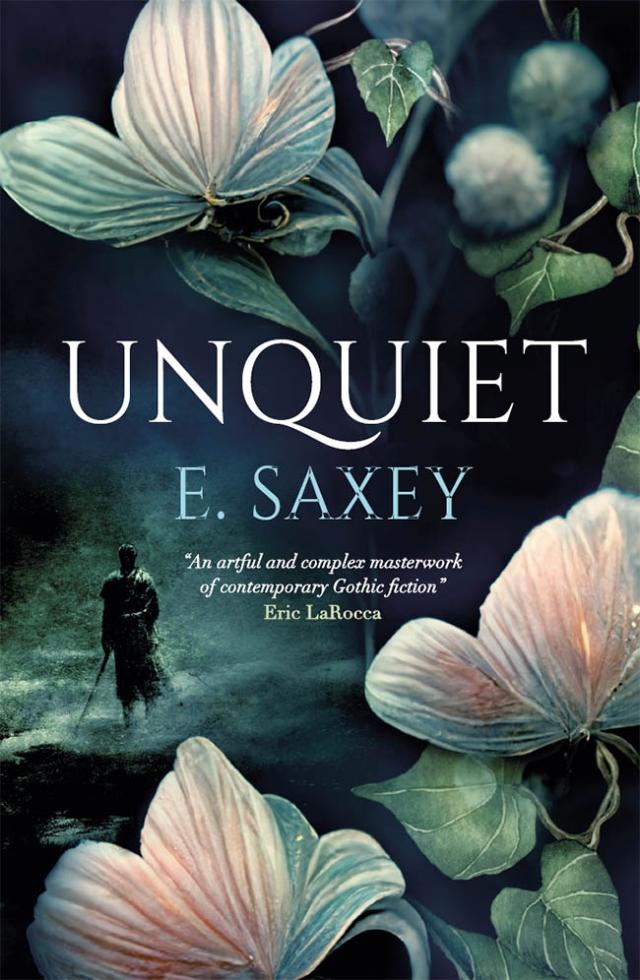
‘Told with beguiling lyricism and compelling intensity, E. Saxey’s novel Unquiet is an artful and complex masterwork of contemporary Gothic fiction that will leave readers unsettled and clamoring for more written by such an exciting and unique voice in horror.’
ERIC LAROCCA, AUTHOR OF THINGS HAVE GOTTEN WORSE SINCE WE LAST SPOKE AND OTHER MISFORTUNES
‘An exquisite gothic piece. Wrap yourself up and try and decide whether it’s warm like bedsheets or cold like a shroud.’
KIERON GILLEN, HUGO-NOMINATED AUTHOR OF THE WICKED + THE DIVINE, DIE AND ONCE & FUTURE
‘A brooding psychological gothic mystery, steeped in the darkest realms of folklore. Literally dripping with grief, desire, and guilt.’
ESSIE FOX, BESTSELLING AUTHOR OF THE SONAMBULIST
‘Unquiet is a sly, enigmatic incantation of a book, full of mysteries and half-truths. E. Saxey creates something unique, both Gothic and quietly folk-horror-inflected, in their tale of grief, loss, unquiet spirits and outsiders.’
ALLY WILKES, BRAM STOKER AWARD®-NOMINATED AUTHOR OF ALL THE WHITE SPACES
‘Beautifully written, dark, subtle and curious, Unquiet is one to savour and savour again. I loved it.’
A.J. ELWOOD, AUTHOR OF THE COTTINGLEY CUCKOO AND THE OTHER LIVES OF MISS EMILY WHITE
‘An engrossing, delicately atmospheric mystery.’
KIT WHITFIELD, AUTHOR OF BENIGHTED AND IN THE HEART OF HIDDEN THINGS
‘With its deft prose, vivid characters and compelling plot, Unquiet really got under my skin. Tense, haunting and evocative, this is a gothic tale that won’t let you rest until you’ve unearthed every last one of its secrets.’
LOUISE CAREY, CO-AUTHOR OF THE STEEL SERAGLIO
‘Dreamlike happenings, unexplained footsteps, and muddy trails: suffused with dread, and very elegantly written, Unquiet is a Gothic mystery to become mired in.’
ALIYA WHITELEY, AUTHOR OF THE BEAUTY AND SKYWARD INN
‘Disquieting, atmospheric – a novel that will keep you on edge throughout.’
MARIE O’REGAN, AUTHOR OF BEST-SELLING NOVEL CELESTE, EDITOR OF TWICE CURSED AND THE OTHER SIDE OF NEVER
‘I loved this glimpse into Judith’s interior world of loneliness and secrets. The ghostly scenery and mesmeric prose make this one of my favourite books of the year so far.’
VERITY M. HOLLOWAY, AUTHOR OF THE OTHERS OF EDENWELL
LEAVE US A REVIEW
We hope you enjoy this book – if you did we would really appreciate it if you can write a short review. Your ratings really make a difference for the authors, helping the books you love reach more people.
You can rate this book, or leave a short review here:
Amazon.com,
Amazon.co.uk,
Goodreads,
Barnes & Noble,
Waterstones,
or your preferred retailer.
Unquiet
Print edition ISBN: 9781803364469
E-book edition ISBN: 9781803364476
Published by Titan Books
A division of Titan Publishing Group Ltd
144 Southwark Street, London SE1 0UP
www.titanbooks.com
First edition: July 2023
10 9 8 7 6 5 4 3 2 1
This is a work of fiction. All of the characters, organizations, and events portrayed in this novel are either products of the author’s imagination or are used fictitiously. Any resemblance to actual persons, living or dead (except for satirical purposes), is entirely coincidental.
© E. Saxey 2023
E. Saxey asserts the moral right to be identified as the author of this work.
No part of this publication may be reproduced, stored in a retrieval system, or transmitted, in any form or by any means without the prior written permission of the publisher, nor be otherwise circulated in any form of binding or cover other than that in which it is published and without a similar condition being imposed on the subsequent purchaser.
A CIP catalogue record for this title is available from the British Library.
To Amy Levy and her luminous writing.
TUESDAY
I needed my charms to ward off madness. Scrabbling around in the cold scullery, I hauled out every drawer in the dresser to find myself a jam jar, a candle stub, a wineglass. I’d gathered them before but the maid had tidied them away. It was vital to bring them back together, and to open a new bottle of wine.
I had been alone in the house for almost four months. I didn’t regret ridding myself of my family. But it was odd to live alone, unseen and unheard, and easy to feel untethered. Impossible to recreate the family routines which had dropped away – Friday night dinner, brushing my sister’s hair, trips to take tea at Whiteleys. Instead, I had made routines of my own: rising at eight, art class at nine. I had invented rituals. Between them, I kept myself steady.
So tonight, I poured myself a glass of red wine. I intended to carry it down the long, narrow garden. Our home wasn’t large, having only six bedchambers, but Father had chosen it for its luxurious touches. It was the end house of a smart modern terrace, had fine rooms on the ground floor for visitors, and pillars at the front in an envious echo of nearby Kensington Palace Gardens. At the foot of the garden lay an ornamental lake. When I reached the lake, I’d spill some wine into the water, and drink the rest.
Lighting the candle wick, I dropped it into the jam jar, singeing my fingers. I was suddenly conscious that Mama would see this as a parody, in bad taste. Tonight was the first evening of Hanukkah; as I’d walked home, around sunset, I’d seen the candles in my neighbours’ windows. But I didn’t feel able to light our own, now Mama and my sister weren’t here.
As I carried the jar over to the kitchen door, the flame jumped up (a neighbour has gossip) and sparked (you will receive a letter soon). Outside the night was dark and bitingly cold. The moonlit silver treetops thrashed in the wind, and I loved it, because inside the house, so little moved if I didn’t move it. The maid, Lucy, could have helped, but she made it worse. She passed me in the hall without meeting my eyes, and everything I disturbed she put back in its place, so that it appeared nobody lived in my house at all.
The gravel path didn’t crunch under my feet. Had I become weightless? No, the gravel had frozen in place. This year, December had been unusually harsh.
After a minute of walking, the path gave out into lawn. My feet crushed prints into the frozen grass. I grasped my wine and my candle. I wouldn’t be sent away for a rest cure, like the classmate of mine with bad nerves.
In our childhood, my sister, Ruth, and I had performed all kinds of elaborate ceremonies in this garden. It was large enough to get lost in, or at least evade observation. I made a fine witch, with my unruly hair and my bony face. I’d cast spells, and blight every tree. Ruth, with her orderly ringlets, had played the princess. What did princesses do? Were they imprisoned in branches? Did they scry in the lake for true love? If only Ruth were here to remind me.
It was foolish to wish for Ruth because I let myself miss her. That pang multiplied, and I missed Mama, too. And – most painful, and most pointless – I missed Sam. His restless footsteps in our hall at the foot of the big staircase, his voice calling us to join him. I was hollow because he wasn’t here.
Panic rattled me. I was a candle flame, wick snipped, flickering away into the night sky.
Walk the path, I told myself. Reach the lake. Drink the wine. Go back to your room and bury yourself in your bed.
But there was an uncanny glow to the garden ahead of me, a whiteness beyond the dark trees. I pushed branches aside to reach it.
The lake had been transformed: where dark water should have rippled, there was flat pale ice. It was fantastical. Pure white at the edges, where the lake met its border of marble kerb stones. Grey towards the centre, where the ice thinned. Dark scrapes crossed the surface – from birds, trying to land on it?
How would I draw the ice? Layers of pale pastels, scraped through to dark paper? I could imagine my oily fingertips, a blunt blade.
It put me in mind of magical changes in ballads where boulders melt or a gate opens in a hill. Your love turns in your arms into red-hot metal, or a stranger. When had the lake last frozen? I recalled Mama snapping a warning as I ran towards it, in her mother tongue of Yiddish, then explaining in English that I’d drown if I set foot on it. I must have been very young.
A movement, on the far side of the white lake, and a rustling in the bushes. Probably a fox, wanting to drink and startled by the frost. I moved closer to the edge, with my wine and candle, and waited for it to emerge.
It wasn’t a fox. It was Sam.
He stood just twenty fe et from me. The moon was bright. The absolute familiarity of him stamped itself on my eyes.
He waved, then he beckoned. I couldn’t move, so he walked towards me, one foot onto the white ice, and then another. Walking with complete confidence, not looking down, he trusted the ice to be thick enough to bear him.
Or, no – he hadn’t trusted anything. He’d mistaken the lake for a solid surface. His foot slipped and he paused, looking down in puzzlement.
I shouted a warning.
He dropped straight down in a barrage of cracking. A fountain of moon-white water shot up from where he’d stood.
Then there was nothing left but a foaming dark hole, and jostling plates of broken ice.
I ran round the edge of the lake, as close as I could get to the hole where Sam had vanished. I threw myself down at the pool’s edge, and kicked my toes into the earth to anchor myself. Stretching half my body onto the ice, I reached my arm out even further.
‘Sam!’
Water pulsed out of the hole, dark green, and sucked back, and there was no sign of him.
I screamed for help, but was anyone in earshot? Lucy would be cloistered in her attic bedroom. The cold would sink Sam and the ice would trap him. He was drowned. No refusing it, no haggling.
Sam’s head broke the surface. He made a great wheezing moan, dragging breath into his lungs. His arms punched out, and sliced through air and water. White foam flew everywhere around him. But his crashing was frantic, failing. He was going to sink again.
I yelled his name, stretching so far that the muscles under my arm burned.
Sam heaved himself forwards. He raised a dripping arm and reached out his hand to me.
I grabbed him. He didn’t feel human. His skin was slimy and his hand slipped from my grasp. I seized the sleeve of his jacket instead. I found purchase, and I felt his icy fingers clamp around my wrist.
I tensed my agonised body and dragged him in, hearing the ice crack with every pull.
He let go, abruptly. Released, I tumbled onto the grass. Sam didn’t fall back, though. He grabbed at clumps of reeds to haul himself up onto the marble kerb stones and out of the water.
On all fours on the grass, he started retching. I crawled until I was near him, but what should I do? Beat on his back? He drove the heel of one hand into his own chest, gave a horrible grating cough and then spat. His barking shaking head, his black slicked hair like fur, made him wolf-like in the moonlight.
Finally he lifted his face up to me, almost unrecognisable. I knew I must be just as smeared with filth, as open-mouthed and disgusting. One stain on his forehead looked more like blood than mud. Ruth would have reached out to it, tended it. I recoiled.
Sam’s hand, strong and cold, closed around my shoulder. When he pulled, I braced myself again, but he wasn’t trying to drag me closer. He was using me as a prop, swinging awkwardly round into a sitting position. When he managed to sit, he still kept hold of me.
For a long while we only breathed, both of us in ragged rasps. My lungs felt like I’d inhaled hot ashes. My arm, and my whole side where I’d thrown myself onto the ground, throbbed in pain.
But the disbelief was sharper. It couldn’t be him. It couldn’t be.
‘Sam?’
He met my eyes. ‘Judith!’
His voice was weak but it was warm. It was him.
He was back.
* * *
We hobbled up to the house together. Sam hung off me, a dead weight, his arm a vice around my shoulders. Trails of icy lake water poured from him, running down my scalp and sliding under my collar. My shoes had come off. It was so hard to trudge onwards when the gravel stabbed the soles of my feet.
As we reached the house I steered us off the main path.
‘Where are we going?’ he asked.
‘To the conservatory.’
I yanked open the glass-panelled door and shoved him through it. The big room was chilly, but dry and out of the wind.
Sam slumped onto a wrought-iron bench. Water streamed off him and pooled on the tiled floor.
‘Judith?’
‘Yes?’
‘Good.’ His tone was relieved, even though he’d asked nothing and I’d given him no answer. He covered his face with his hands, smearing the stain on his forehead, the ooze from the broken skin. It needed to be cleaned off, but everything I could reach was covered in dirt. ‘This is a mess,’ he murmured. He started to shiver, so hard that the bench jittered.
I sat down on a wicker chair and studied him. The light was dim, but he was certainly Sam. His familiarity was reassuring, now, rather than shocking. But it wasn’t a joyful sight, yet. I was too afraid: what if he was injured, frostbitten, waterlogged? What if he died, and this time it was my fault?
‘You need clothes. Dry clothes, that is.’ I didn’t know where I’d find them, but it gave me a task to perform, and a reason to run away.
* * *
I peeled off my stockings in the hallway, although they clung like weeds. My legs were yellow and green with old bruises – I had developed a habit of falling – and I would have fresh marks in the morning. I pattered on clammy feet down to the kitchen. Lucy wasn’t there. I’d been right: she’d retreated up to her attic for the night, thank goodness. In a cupboard I discovered old blankets, only fit for horses. I made a stack of them so high that I had to wedge it between my hands and my chin to carry it.
Back in the conservatory, I dropped the blankets beside Sam and left the room again.
He needed to be close to a fire. I was shuddering, and I’d not even been drenched, as Sam had. Our library would heat up the quickest. The large fireplace had been one reason Ruth and I had laid claim to the room, after Father had died. Entering it now, preparing it for Sam, I was conscious of how eccentric we had made the room look. We’d decorated the sober bookcases with fronds of pine, glossy holly and the heads of teasels, stencilled the walls, and hung up embroideries. And since I’d rid myself of my family, I’d been spending all my time here, covering the desk with paintbrushes and rags.
Which meant that in the big grate, under the coals, yesterday’s embers would still be glowing. I screwed up paper, stacked coals and blew life into the pyramid. My wing-backed chair was already next to the fire. I dragged another, Ruth’s favourite, to face it. Ruth’s chair was draped with patchwork quilts that she had made, and I flung them off to keep Sam from dripping on them.
I moved back through the hall, and called through the conservatory door to Sam: ‘Are you ready? May I come in?’ I meant ‘are you covered up’, but that was an indecent question. Opening the door, I stood by it, waiting. ‘I’ve lit a fire in the library.’
He lurched towards me. He’d wrapped the blankets round himself, and scrubbed his hair with one of them. Now he resembled a scruffy robed patriarch.
Halting at the threshold, he raised an eyebrow. He was still dabbed with slime, and my reluctance – my revulsion – was probably obvious from my screwed-up mouth. So I held out my arm, and said: ‘Please do come in.’
Together we entered the house proper, and slowly crossed the hall. Sam had been our most frequent visitor, energetically pacing here under Father’s paintings as he waited for my sister to descend the stairs. Now it took him an age to limp over to the library door.
Inside, Sam moved into the fire’s radius and folded himself into Ruth’s chair. The firelight showed up his mud-matted hair, but his hands – emerging from the blankets – were cleaner, and his long fingers exactly as they’d always been. He had dark eyes in a long face, and long hands to match.
Good news, then. I finally started to feel joy at his return, kindling in me as the fire grew. Good news? The best news! When he went missing, it had wrecked Ruth, my sister, Sam’s betrothed. And it had struck Sam’s brother, Toby, as well, and even taken the heart out of Mama. Two small families twisted up with loss like crumpled paper. That could be undone, ironed out. And all the horrible things that had happened since, the hundred lesser sadnesses. Sam’s return would reverse all those, as well.
My sister had been so sad, for a year, that her own body had been a burden to her. Now she’d be freed. In a sense, she would never even have been bereaved.
I brought all this to mind, but I couldn’t yet feel it. My heart was as numb as my hands. I needed to heat myself, then I’d feel glad.


