

Master flea, p.3
Master Flea, page 3
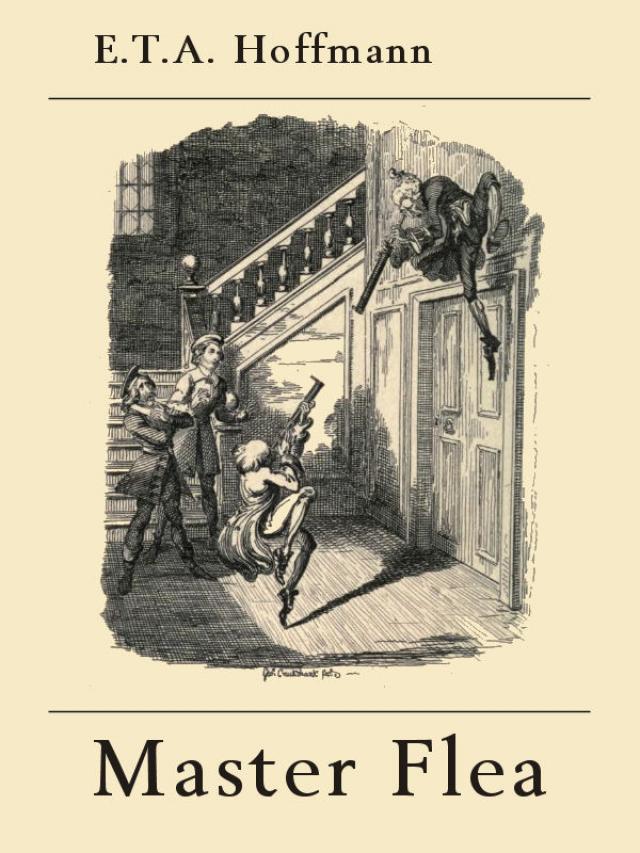


Scarcely had they gone a few steps, when the maiden began to complain softly, and soon burst out into loud lamentations, that she was freezing with the cold. Peregrine, whose blood glowed through his veins, who had therefore been insensible to the weather, and never thought of her being so lightly clad, without even a shawl or a tucker, now on a sudden saw his folly, and would have wrapt her in his cloak. This, however, she rejected, exclaiming piteously, "No, my dear Peregrine, that avails me nothing: my feet!—Ah, my feet! I shall die with the dreadful agony."
And she was about to drop, half senseless, as she cried out with a faint voice, "Carry me, carry me, my sweet friend!"
Without more ado, Peregrine took up the light little creature in his arms like a child, and wrapt her in his cloak. But he had not gone far with his burthen, before the wild intoxication of desire took more and more possession of him, and, as he hurried half way through the streets, he covered the neck and bosom of the lovely creature, who had nestled closely to him with burning kisses. At last he felt as if waking with a sudden jerk out of a dream: he found himself at a house-door, and, looking up, recognised his own house, in the Horse-market, when, for the first time, it occurred to him that he had not asked the maiden where she lived; he collected himself therefore with effort, and said, "Lady—sweet, angelic creature where is your abode?"
"Here, my dear Peregrine," she replied, lifting up her head; "here, in this house: I am your Alina; I live with you; but get the door open quickly."
"No——never!" cried Peregrine, in horror, and let her sink down.
"How!" exclaimed the stranger—"how! Peregrine, you would reject me? and yet know my dreadful fate,—and yet know that, child of misfortune as I am, I have no refuge, and must perish here miserably if you will not take me in as usual! But perhaps you wish that I should perish? Be it so then! Only carry me to the fountain, that my corse may not be found before your door. Ha!—the stone dolphins may, perchance, have more pity than you have. Woe is me!—woe is me!—The bitter cold!"
She sank down in a swoon; Peregrine was seized with despair, and exclaiming wildly, "Let it be as it will, I cannot do otherwise—" he lifted up the lifeless little thing, took her in his arms, and rang violently at the bell. No sooner was the door opened than he rushed by the servant, and instead of waiting, according to his usual custom, till he got to the top of the stairs, and then tapping gently, he shouted out, "Alina! Alina! light!" and, indeed, so loudly, that the whole floor re-echoed it.
"How!—what!—what's this?—what does this mean?" exclaimed the old woman, opening her eyes widely as Peregrine unfolded the maiden from his cloak, and laid her with great care upon the sofa.
"Quick, Alina, quick! Fire in the grate!—salts!—punch!—beds here!"
Alina, however, did not stir from the place, but remained, staring at the stranger, with her "How!—what!—what's this?—what does this mean?"
Hereupon Peregrine began to tell of a countess, perhaps a princess, whom he had met at the bookbinder's, who had fainted in the streets, whom he had been forced to carry home; and, as Alina still remained immoveable, he cried out, stamping with his feet, "Fire, I tell you, in the devil's name!—tea!—salts!"
At this, the old woman's eyes glared like a cat's, and her nose was lit up with a brighter phosphorus. She pulled out her huge black snuff-box, opened it with a tap that sounded again, and took a mighty pinch. Then, planting an arm in either side, she said with a scoffing tone, "Oh yes, to be sure, a countess!—a princess! who is found at a poor bookseller's, who faints in the street! Ho! ho! I know well where such tricked-out madams are fetched from in the night-time. Here are fine tricks! here's pretty behaviour! to bring a loose girl into an honest house; and, that the measure of sin may be quite full, to invoke the devil on a Christmas night!—and I, too, in my old days am to be abetting! No, Mr. Tyss—you are mistaken in your person; I am not of that sort: to-morrow I leave your service."
With this she left the room, and banged the door after her with a violence that made all clatter again. Peregrine wrung his hands in despair. No sign of life showed itself in the stranger; but at the moment when, in his dreadful distress, he had found a bottle of Cologne water, and was about to rub her temples with it, she jumped up from the sofa quite fresh and sound, exclaiming, "At last we are alone! At last I may explain why I followed you to the bookbinder's—why I could not leave you to-night! Peregrine! give up to me the prisoner whom you have confined in this room. I know that you are not at all bound to do so; I know that it only depends upon your goodness; but I know, too, your kind affectionate heart; therefore, my good, dear Peregrine, give him up—give up the prisoner!"
"What prisoner?" asked Peregrine, in the greatest surprise. "Who do you suppose is a prisoner with me?"
"Yes," continued the stranger, seizing Peregrine's hand, and pressing it tenderly to her breast—"yes, I must confess that only a noble mind can abandon the advantages which a lucky chance puts into his hands, and it is true that you resign many things which it would be easy for you to obtain if you did not give up the prisoner; but—think, that Alina's destiny, her life, depends upon the possession of this prisoner, that——"
"Angelic creature!" interrupted Peregrine, "if you don't wish that I should take it all for a delirious dream, or perhaps become delirious on the spot myself, tell me at once of whom you are speaking,—who is this prisoner?"
"How!" replied the maiden—"I do not understand you; would you deny that he is in your custody? Was I not present when you bought the hunting-set?"
"Who," cried Peregrine, quite beside himself, "who is this HE? For the first time in my life I see you, lady, and who are YOU? who is this HE?"
Dissolving in grief, the stranger threw herself at Peregrine's feet, while the tears poured down in abundant streams from her eyes: "Be humane, be merciful—give him back to me!"—and at the same time her exclamations were mingled with those of Peregrine, "I shall lose my senses! I shall go mad! I shall be frantic!"
On a sudden the maiden started up. She seemed much larger than before; her eyes flashed fire, her lips quivered, and she exclaimed, with furious gestures, "Ha, barbarian! no human heart dwells in you! You are inexorable! You wish my death, my destruction! You won't give him up! No—never, never! Wretched me!—Lost! lost!"
And with this she rushed out of the room. Peregrine heard her clattering down the stairs, while her lamentations filled the whole house, till at last a door below was flung to with violence.
Second Adventure.
The Flea-tamer.—Melancholy fate of the Princess Gamaheh, in Famagusta.—Awkwardness of the Genius, Thetel, and remarkable microscopic experiments and recreations.—The beautiful Hollandress, and singular adventure of the young Mr. George Pepusch, a student of Jena.
At this time there was a man in Frankfort, who practised the strangest art possible. He was called the flea-tamer, from having succeeded—and certainly not without much trouble and exertion—in educating these little creatures, and teaching them to execute all sorts of pretty tricks. You saw with the greatest astonishment a troop of fleas upon a slab of highly-polished marble, who drew along little cannons, ammunition-waggons, and baggage-carts, while others leaped along by them with muskets in their arms, cartouch-boxes on their backs, and sabres at their sides. At the word of command from the artist, they performed the most difficult evolutions, and all seemed fuller of life and mirth than if they had been real soldiers; for the marching consisted in the neatest entrechats and capers, and the faces about, right and left, in the most graceful pirouettes. The whole troop had a wonderful a-plomb, and the general seemed to be at the same time a most admirable ballet-master. But even more handsome and more wonderful were the little gold coaches, which were drawn by four, six, or eight fleas. Coachmen and servants were little gold flies, of the smallest kind and almost invisible; while that, which sate within, could not be well distinguished. One was involuntarily reminded of the equipage of Queen Mab, so admirably described by Shakspeare's Mercutio, that it is easy to perceive she must often have travelled athwart his own nose.
But it was not till you overlooked the table with a good magnifying glass that the art of the flea-tamer developed itself in its full extent; for then first appeared the splendour and grace of the vessels, the fine workmanship of the arms, the glitter and neatness of the uniforms, all of which excited the profoundest admiration. It was quite impossible to imagine what instruments the flea-tamer could have used in making neatly and proportionately certain little collaterals, such as spurs and buttons, compared to which that matter seemed to be a very trifling task, which else had passed for a master-piece of the tailor, namely, the fitting a flea with a pair of breeches; though, indeed, in this the most difficult part must have been the measuring.
The flea-tamer had abundance of visitors. Throughout the whole day the hall was never free from the curious, who were not deterred by the high price of admission. In the evening, too, the company was numerous, nay almost more numerous, as then even those people, who cared little about such trickeries, came to admire a work which gave the flea-tamer quite another character, and acquired for him the real esteem of the philosopher. This work was a night-microscope, that, as the sun-microscope by day, like a magic lantern, flung the object, brightly lit up, upon a white ground, with a sharpness and distinctness which left nothing more to be wished. Moreover, the flea-tamer carried on a traffic with the finest microscopes that could be, and which were readily bought at a great price.
It chanced that a young man, called George Pepusch,—the kind reader will soon be better acquainted with him,—took a fancy to visit the flea-tamer late in the evening. Already, upon the stairs, he heard the clamour of a dispute, that grew louder and louder with every moment, and at last became a perfect tempest. Just as he was about to enter, the door of the hall was violently flung open, and the multitude rushed out in a heap upon him, their faces pale with terror.
"The cursed wizard!—the Satan's-brood! I'll denounce him to the supreme court!—He shall out of the city, the false juggler!"
Such were the confused cries of the multitude, as, urged by fear and terror, they sought to get out of the house as quickly as possible.
A glance into the hall at once betrayed to the young Pepusch the cause of this horror, which had driven away the people. All within was alive, and a loathsome medley of the most hideous creatures filled the whole room. The race of beetles, spiders, leeches, gnats, magnified to excess, stretched out their probosces, crawled upon their long hairy legs, or fluttered their long wings. A more hideous spectacle Pepusch had never seen. He was even beginning to be sensible himself of horror, when something rough suddenly flew in his face, and he saw himself enveloped in a thick cloud of meal dust. His terror immediately left him, for he at once perceived that the rough thing could be nothing else than the round powdered wig of the flea-tamer—which, in fact, it was.
By the time Pepusch had rubbed the powder from his eyes, the disgusting population of insects had vanished. The flea-tamer sate in his arm-chair quite exhausted.
"Leuwenhock!"—exclaimed Pepusch to him—"Leuwenhock, do you see now what comes of your trickeries? You have again been forced to have recourse to your vassals to keep the people's hands off you—Is it not so?"
"Is it you?" said the naturalist, in a faint voice—"Is it you, good Pepusch?—Ah! it is all over with me—clean over with me—I am a lost man! Pepusch, I begin to believe that you really meant it well with me, and that I have not done wisely in making light of your warnings."
Upon Pepusch's quietly asking what had happened, the flea-tamer turned himself round with his arm-chair to the wall, held both his hands before his face, and cried out piteously to Pepusch to take up a glass and examine the marble slab. Already, with the naked eye, Pepusch observed that the little soldiers, &c. lay there as if dead,—that nothing stirred any longer. The dexterous fleas appeared also to have taken another shape. But now, by means of the glass, Pepusch soon discovered that not a single flea was there, but what he had taken for them were nothing more than black pepper-corns and fruit-seeds that stood in their uniforms.
"I know not," began the flea-tamer, quite melancholy and overwhelmed,— "I know not what evil spirit struck me with blindness, that I did not perceive the desertion of my army till the people were at the table and prepared for the spectacle. You may imagine, Pepusch, how, on seeing themselves deceived, the visitors first murmured, and then blazed out into fury. They accused me of the vilest deceit, and, as they grew hotter and hotter, and would no longer listen to any excuses, they were falling upon me to take their own revenge. What could I do better, to shun a load of blows, than immediately set the great microscope into motion, and envelope the people in a cloud of insects, at which they were terrified, as is natural to them?"
"But," said Pepusch, "tell me how it could possibly happen that your well-disciplined troop, which had shown so much fidelity to you, could so suddenly take themselves off, without your perceiving it at once?"
"Oh!" cried the flea-tamer, "O, Pepusch! HE has deserted me!—He by whom alone I was master—He it is to whose treachery I ascribe all my blindness, all my misery!"
"Have I not," said Pepusch, "have I not long ago warned you not to place your reliance upon tricks which you cannot execute without the possession of the MASTER? and on how ticklish a point rests that possession, notwithstanding all your care, you have just now experienced."
Pepusch farther gave the flea-tamer to understand, that he could not at all comprehend how his being forced to give up these tricks could so much disturb his life, as the invention of the microscope, and his general dexterity in the preparation of microscopic glasses, had long ago established him. But the flea-tamer, on the other hand, maintained, that very different things lay hid in these subtleties, and that he could not give them up without giving up his whole existence. Pepusch interrupted him by asking, "Where is Dörtje Elverdink?"
"Where is she?" screamed Leuwenhock, wringing his hands—"where is Dörtje Elverdink?—Gone!—gone into the wide world!—vanished!—But strike me dead at once, Pepusch, for I see your wrath growing: make short work of it with me!"
"There you see now," said Pepusch, with a gloomy look—"you see now what comes of your folly, of your absurd proceedings. Who gave you a right to confine the poor Dörtje like a slave, and then again, merely for the sake of alluring people, to make a show of her like some wonder of natural history? Why did you put a force upon her inclinations, and not allow her to give me her hand, when you must have seen how dearly we loved each other?—Fled, is she? Well then, she is no longer in your power; and although I do not at this moment know where to seek for her, yet am I convinced that I shall find her. There, Leuwenhock, put on your wig again, and submit to your destiny; that is the best thing you can do."
The flea-tamer arranged his wig on his bald head with his left hand, while with his right he caught Pepusch by the arm, exclaiming—
"Pepusch, you are my real friend, for you are the only man in the whole city of Frankfort, who know that I lie buried in the old church at Delft, since the year seventeen hundred and twenty-five, and yet have not betrayed it to any one,—even when you were angry with me on account of Dörtje Elverdink. If at times I cannot exactly get it into my head that I am actually that Anton van Leuwenhock, who lies buried at Delft, yet again I must believe it, when I consider my works, and reflect upon my life; and on that account it is very agreeable to me that it is not at all spoken of. I now see, my dear Pepusch, that, in regard to Dörtje Elverdink, I have not acted rightly, although in a very different way from what you may well imagine—that is, I was right in pronouncing your suit to be an idle struggle,—wrong, in not being open with you, in not telling you the real circumstances of Dörtje Elverdink; you would then have seen how praiseworthy it was to talk you out of wishes, the accomplishment of which could not be other than destructive. Pepusch, sit down by me, and hear a wonderful history."
"That I am likely to do," replied Pepusch with a malicious glance, sitting down in an armchair, opposite the flea-tamer, who thus began:
"As you are well versed, my dear friend, in history, you know, beyond doubt, that King Sekakis lived for many years in intimate intercourse with the Flower-Queen, and that the beautiful Princess Gamaheh was the fruit of this passion. But it is not so well known, nor can I tell you, in what way the Princess Gamaheh came to Famagusta. Many maintain, and not without reason, that the princess wished to conceal herself there from the odious Leech-Prince, the sworn enemy of the Flower-Queen. Be this as it may,—it happened once in Famagusta, that the princess was walking in the cool freshness of the evening, and chanced upon a pleasant cypress-grove. Allured by the delightful sighings of the evening breeze, the murmurs of a brook, and the soft music of the birds, she stretched herself upon the moss, and quickly fell into a sound slumber. At this moment, the very enemy whom she had been so anxious to escape lifted his head out of the marshes, beheld the princess, and became so violently enamoured of the fair sleeper, that he could not resist an inclination to kiss her; and, creeping forward, he kissed her under the left ear. Now you know, friend Pepusch, that, when the Leech-Prince sets about kissing a fair one, she is lost, for he is the vilest bloodsucker in the world. So it happened on this occasion: the Leech-Prince kissed the poor Gamaheh so long, that all life left her, when he fell back gorged and intoxicated upon the moss, and was forced to be carried home by his servants, who hastily rolled out of their marshes. In vain the root mandragora toiled out of the earth, and laid itself upon the wound inflicted by the treacherous kisses of the Leech-Prince; in vain all the other flowers arose and joined in his lamentations: she was dead. Just then it happened that the genius, Thetel, was passing, and he too was deeply moved by Gamaheh's beauty and her unlucky end. He took her in his arms, pressed her to his breast, and endeavoured to breathe new life into her; but still she awoke not from the sleep of death. Now, too, the genius perceived the odious prince,—who was so drunk and unwieldly that his servants had not been able to get him into his palace,—fell into a violent rage, and threw a whole handful of rock-salt upon him, at which he poured forth again all the purple blood which he had drawn from the princess, and then gave up his spirit in a wretched manner, amidst the most violent convulsions. All the flowers that stood around dipped their vestments in this ichor, and stained them, in perpetual remembrance of the murdered princess, with so bright a purple, that no painter on earth can imitate it. You know, Pepusch, that the most beautiful pinks and hyacinths grow in that cypress-grove where the Leech-Prince kissed to death the fair Gamaheh.


_preview.jpg)
_preview.jpg)


