

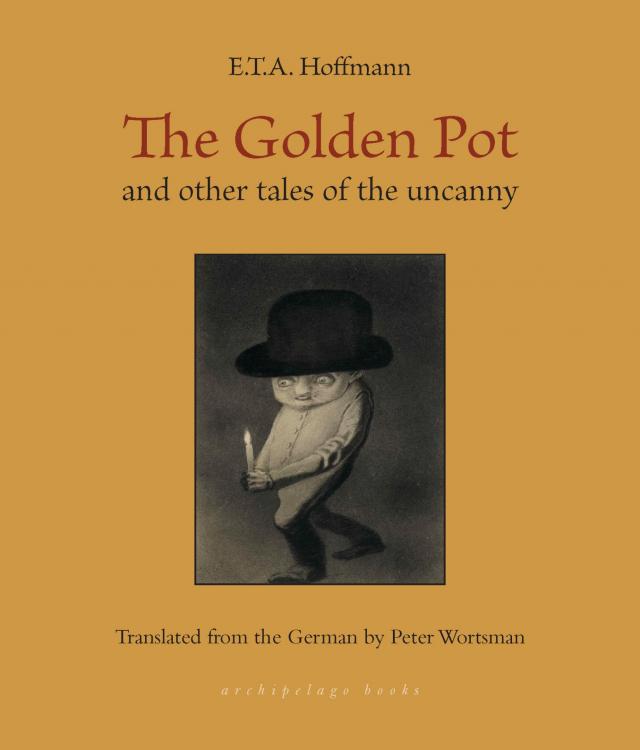
The golden pot, p.38
The Golden Pot, page 38


Krespel, it turns out, has a perfectly rational reason for preventing his daughter from singing. The story was inspired by the actual case of the sickly seventeen-year-old singer Minna Brandes, whom Hoffmann had heard sing in Königsberg; having been forbidden to sing on doctor’s orders as a strain on her fragile health, she declined to follow the medical advice and died of consumption six years later.
* * *
—
Like Krespel, Hoffmann had a rational, pragmatic side counterbalancing the erratic bent of his wild emotional swings and imaginative frenzies. He summed up his attitude and aesthetic in a line from The Serapion Brethren,[*] the epistolary narrative frame of a collection of his tales:
I believe that the bottom of the heavenly ladder, upon which we seek to clamber to reach the higher regions of consciousness, must be grounded in real life, so that our readers can clamber up after us. If the reader who climbs higher and higher finds himself in a fantastic magical realm, he will be more likely to believe that this realm still belongs as an integral part of his life, and is, in fact, the most wondrous and splendid part of that life.
Another notable German-speaking author likewise trained in the law, Franz Kafka, who also juggled the responsibilities of a mundane day job with nightly reverie, and is in many ways a kindred spirit with Hoffmann, took up a similar ladder metaphor, albeit with a Kafkaesque twist, in a diary notation:
…all things that occur to me to describe don’t strike me from the root, but rather from somewhere in the middle. Just try to grab it, try to embrace a blade of grass that grows out from the middle of the stalk. A select few can do it, so for instance, Japanese jugglers balanced on a ladder not resting on firm ground, but rather on the uplifted soles of a half-reclining partner, a ladder not propped up against any wall either, but rather just rising in the air.
It might not be all that far-fetched to perceive a link of influence between Hoffmann’s automaton, the cause of the protagonist’s violent demise in “The Sandman,” and the insidious device in Kafka’s dark fantasy “In the Penal Colony” that inscribes the body of the condemned with his crime and immediately thereafter implodes.
Like Kafka, Hoffmann, too, kept a firm foothold in the sober reality of the law. Having studied law, he pursued a professional career as a mid-level bureaucrat in the judicial administration of the Prussian state. Prussia at the time extended well beyond the borders of the present-day German state of Brandenburg, encompassing large swathes of present-day Poland, including Posen (Poznań) and the cosmopolitan metropolis of Warsaw. Hoffmann started out as a probationary court judge in Posen and rose to the rank of judge in Berlin’s prestigious court of appeal. By most accounts, he faithfully and diligently carried out his legal responsibilities, oftentimes going out of his way to promote justice and freedom of expression in an absolutist state.
In Posen, he met and married Maria Thekla Michaline Rohrer-Trzcińska and lived happily, if not ever after, then at least for a while. But time and again, the disparate strands of his character unraveled and his pen got him into trouble. An accomplished draughtsman, among his many creative talents, Hoffmann was fond of drawing caricatures of individuals of his acquaintance. In 1802 his caricatures of major-generals and other high-ranking officers in the Prussian military and local landed gentry found their way onto satirical masks at a carnival celebration. Discovered as the artistic trickster behind the lark, Hoffmann, who had been anticipating promotion to state councillor and transfer to the capital city of Berlin, was indeed promoted, but as a sanction for his insubordinate antics was shunted off to the onomatopoeic sounding backwater hamlet of Płock.
Two years later, Hoffmann managed to get himself transferred to Warsaw, where he reveled in the cosmopolitan atmosphere and the plenitude of cultural activities. His family life was also enriched by the birth of a daughter whom he named Cäcilia, after St. Cecilia, the patron saint of musicians. In Warsaw he met and befriended a fellow jurist, Julius Eduard Hitzig, who would become a lifelong ally and his first biographer. Born Isaac Elias Itzig, Hitzig added an H to camouflage his identity as the cultivated scion of a well-to-do Jewish family, and he later converted to Christianity. Neighbors as well as professional colleagues, the two men flung open their windows on warm summer nights, and Hitzig was fond of leaning out to listen to the music Hoffmann played. Well-read and well-connected in literary circles, Hitzig introduced his friend to the Romantic literature of the day, and later to many of the leading German Romantics writers.
His friendship with Hitzig notwithstanding, Hoffmann’s attitude to Jews has been studied by scholars, some going so far as to suspect a Jewish caricature in his portrayal of the villainous character who threatened to pluck out the child’s eyes in “The Sandman.” Certain insidious antisemitic clichés crept into such tales as “The Selection of a Bride.” It should be noted, however, that in harboring such prejudices, Hoffmann was no different from most of his contemporaries.
Among his administrative duties in Warsaw, the man who had changed his own middle name from Theodor to Amadeus was tasked with the assignment of surnames to Warsaw’s Jewish community, who as per Jewish tradition, had heretofore gone by patronymics. According to Norman Davies, in his Heart of Europe: The Past in Poland’s Present (Oxford University Press, 2001), Hoffmann undertook the task with a capricious whimsy: “Before dinner, or on an empty stomach, he issues serious or melancholy surnames, after dinner more amusing ones.” On one occasion, apparently following a prolonged bout of drinking with a military man of his acquaintance, Hoffmann hastily dubbed unsuspecting individuals of Jewish provenance with military names, such as Festung (Fortress), Pistolet (Pistol), Szyspulver (gunpowder), Trommel (drum), etc.
* * *
Like so many other creative artists, Hoffmann was surely a bundle of contradictions. His prickly personality did not always sit well with those who knew him. Contemporary assessments by his fellow German Romantics vary. Unfailingly defending him, Hitzig remained a devoted friend, lauding Hoffmann in the biography he wrote after his death. Wilhelm Grimm, on the other hand, considered Hoffmann brilliant, “but unsavory.” Jean Paul held him to be an out-and-out madman. A friend and frequent dinner partner in Berlin, author Adelbert von Chamisso dubbed him “the king of tomfoolery.” Poet Clemens Brentano called him “an eccentric, but honest chum.” Writer and journalist August Varnhagen von Ense held him to be “an honest friend, without guile and malice, whose sense of humor nevertheless proved brash and disquieting, and could be equally insightful and fatuous.”
Hoffmann offers a veiled fictionalized self-appraisal in his novel The Devil’s Elixir, written in 1814:
I am what I appear to be, and don’t appear to be what I am, an inexplicable riddle to myself, I am a divided self.
Whether out of restless temperament or necessity, he changed locales with some frequency, from Posen to Płock, to Warsaw, to Berlin, to Bamberg, where he landed a position as theater director, from which he was fired soon thereafter, compelling him for a time to eke out his existence as a piano teacher.
In one profoundly embarrassing and socially devastating instance, Hoffmann’s infatuation with an underage piano student in Bamberg, Julia Mark, led to a scene, compelling him to skip town. Next stops Leipzig and Dresden. Marriage did not keep his excesses in check. Always a heavy drinker and carouser, back in Posen he is rumored to have been the author of an anonymous sado-masochistic novel, Sister Monica, issued by a book dealer-publisher of his acquaintance. In one of his many extra-marital involvements he contracted the syphilis that would first cripple him, then do him in.
And when it was not his own shenanigans that got him into trouble, history played a hand. Prussia’s provisional military alliance with Russia against France led Napoleon to occupy Warsaw. Refusing to swear allegiance to the Gallic emperor and the newly installed French puppet administration, Hoffmann was again obliged to decamp.
* * *
Hoffmann’s allegiance to his native Prussia did not, however, keep him from speaking and reading French, and admiring French culture and literature. French influence found its way into his work, notably in one of his most accomplished and successful works, “Mademoiselle de Scudéry,” inspired by Voltaire’s Le Siècle de Louis XIV, and other books which he borrowed from a Berlin lending library in 1818. In Voltaire’s text, Hoffmann found the historic inspiration for one of his only female protagonists, Madeleine de Scudéry (1607–1701), aka Mademoiselle de Scudéry, a poet and writer of popular novels, a favorite of Louis XIV and his mistress and later wife, Madame de Maintenon. Hoffmann wove an intricate murder mystery from historic threads, which was published in the fall of 1819 in the popular almanac Taschenbuch für das Jahr 1820. The narrative, in which Hoffmann combined his legal expertise with his imaginative prowess, proved an immediate sensation, stirring interest in all of Hoffmann’s writing. The publisher was so pleased that, to foster future contributions, he gifted the author fifty bottles of wine.
According to literary scholar Richard Alewyn, “Mademoiselle de Scudéry” is the earliest prototype of the detective genre, a clear influence on Edgar Allan Poe’s “The Murders in the Rue Morgue.” Against the backdrop of a series of unsolved murders plaguing Paris, the plot revolves around the inexplicable actions of a young journeyman goldsmith in love with his master’s daughter, wrongfully accused of murdering the master, and yet refusing to defend himself. After the young man has already been found guilty and condemned to death, Mlle. de Scudéry manages, against all odds, to ascertain and prove his innocence and gain clemency from the king. Unlike the uncanny tales for which Hoffmann is most famous, this story is an astounding intertwining of irrational actions and clearheaded, rational thinking. De Scudéry may well be the first, and surely one of the most astute female sleuths, a model for Agatha Christie’s Miss Marple, among others. And in his characterization of the master goldsmith, a certain René Cardillac, at once an artist and a madman, Hoffmann gives us one of the great criminal masterminds in world literature whose heirs must surely include Robert Louis Stevenson’s Dr. Jekyll, Sir Arthur Conan Doyle’s Professor Moriarty, and Ian Fleming’s Goldfinger.
Whereas historical sources provided the seed, and rational thought is adroitly employed to tie loose knots, the twists of the imagination are always Hoffmann’s primary compass. A character named Theodor (coincidentally also the author’s original second middle name) in the story “Die Serapionsbrüder” espouses Hoffmann’s literary aesthetic:
Nothing is more distasteful to me in a story, in a novel on the floor of which the fantastic world has wiggled its way, than that it be swept so clean with an historic broom so that not a kernel, not a grain of dust remains, when you return home, so resigned that you feel no more longing to look behind the curtains. In contrast to which, many a fragment of a spirited story sinks deep into my soul and affords me a lasting pleasure, since fantasy stirs its own vibrations.
* * *
The defeat of Napoleon permitted a penniless Hoffmann to return to the Prussian civil service. He moved back to Berlin in 1814 to accept an initially unpaid position, and then a permanent appointment as judge in the court of appeal. Yet again he got himself into trouble by parodying a sometime superior and mocking the court system in his satirical novel Master Flea. But Hoffmann agreed to make cuts and weathered the crisis.
It was here in Berlin, from 1814 until his death in 1822, juggling administrative responsibilities with creative drive, that he finally achieved success and celebrity. In Berlin, he reconnected with Hitzig, who had also been transferred there. Hitzig introduced Hoffmann to the Romantic writers Adelbert von Chamisso, Ludwig Tieck, and Friedrich de la Motte Fouqué, the latter also a publisher.
Throughout his life, despite all the ups and downs, personal scandals and professional pitfalls, Hoffmann kept creating.
His greatest musical triumph, the opera Undine – for which he composed the music based on a libretto by Friedrich de la Motte Fouqué, and the noted architect, city planner, and painter Karl Friedrich Schinkel designed the set – premiered at the Königliches Schauspielhaus in Berlin in 1817, and proved a critical and popular hit talked about all over town. In retrospect, viewed by some musicologists as the first Romantic opera, the combined effect of the music, text, set, and costumes, was among the influences on Richard Wagner’s notion of the Gesamtkunstwerk. Alas, after fourteen sold-out performances, a fire burned the theater to the ground, also destroying the set and costumes. Hoffmann himself witnessed the fire from his window across the way, at his last place of residence, Taubenstraße 31. The flames threatened to leap across the way and consume his building. He later described the scene in a letter to a friend:
I was seated at my desk, when my wife came rushing in from the room next door, her face pale as a sheet, and said: ‘My God, the theater is burning!’ – Neither she nor I for a moment lost our heads. When firemen, including some whom I counted among my friends, knocked on the door, we had already, with the aid of our cook, transported curtains, bed and other furniture to safety in a room to the rear, thus diminishing the risk of their catching fire. […] In the front rooms, all the windowpanes shattered and the oil paint on the window frames and doors melted and dripped down in the heat.
* * *
It was here at this same window overlooking the marketplace, between the months of February and April 1822, in between acute spasms of pain, and almost completely paralyzed in the late stage of syphilis, that Hoffmann dictated his last completed narrative, “My Cousin’s Corner Window.” It appeared shortly thereafter in several installments in the journal Der Zuschauer, weeks before the author’s death.
The aforementioned text is included in this collection, not because it is among the author’s best or most representative pieces of writing – far from it; Walter Benjamin derided its descriptions as “backward-looking Biedermeier,” in contrast to Baudelaire’s and Poe’s progressive modes of presentation – but precisely because it is his last published account, and because it reveals the wheels of his keen faculty for observation still turning, albeit without plot, with no other narrative end than to take in the world around him until his last conscious blink.
Translating that last completed story into English felt to me at times like eavesdropping on the privacy of a fading mind. But Hoffmann put the words out there, so he must have welcomed the prospect of eyes from the future peering in. Celebrating seeing and telling till the end, this text reads like his last will and testament, bequeathing his disintegrating consciousness and its last fruits to posterity. Perched at his corner window overlooking the marketplace, scanning the open book of the crowd, harvesting impressions, Hoffmann kept compulsively secreting a narrative thread, spinning fiction out of life, forever enticing posterity in the web of his imaginings. According to Hitzig, he was still spinning a yarn, dictating another unfinished tale, “The Enemy” with his dying breath – before finally facing the music.
Peter Wortsman
New York, August 2020
Skip Notes
* The Serapion Brethren was also the name of a Berlin literary and social circle to which he belonged.
Acknowledgments
My translation of “The Sandman” originally appeared in Tales of the German Imagination, from the Brothers Grimm to Ingeborg Bachmann, an anthology selected and translated by Peter Wortsman, Penguin Classics, UK, 2012; was reissued as a stand-alone volume by Penguin Little Black Classics, Penguin Classics, UK, 2016; and as a bilingual Chinese-English edition, Penguin Little Black Classics, 2019.
archipelago books
is a not-for-profit literary press devoted to promoting cross-cultural exchange through innovative classic and contemporary international literature www.archipelagobooks.org
E. T. A. Hoffmann, The Golden Pot


_preview.jpg)
_preview.jpg)


