

The clockwork man, p.7
The Clockwork Man, page 7


“Alright,” Arthur nodded, “buck up.”
He walked a few yards up the road, and then turned through a wicket gate and mounted the hump of a meadow. The narrow path swerved slightly to right and left. Arthur fell to meditating upon paths in general and how they came into existence. Obviously, it was because people always walked in the same way. Countless footsteps, following the same line until the grass wore away. That was very odd when you came to think about it. Why didn’t people choose different ways of crossing that particular meadow? Then there would be innumerable paths, representing a variety of choice. It would be interesting to start a path of your own, and see how many people would follow you, even though you deliberately chose a circuitous or not obviously direct route. You could come every day until the path was made.
He climbed over the top of the meadow, descended again into a valley, and stopped before a stile with hedges running away on either side. He decided to wait here for Rose. It would be pleasant to see her coming over the hill.
It was gloaming now. The few visible stars shone with a peculiar individual brightness, and looked strangely pendulous in the fading blue sky. He leaned back and gazed at the depths above him. This time of the day was always puzzling. You could never tell exactly at what moment the sky really changed into the aspect of evening, and then, night. Yet there must be some subtle moment when each star was born. Perhaps by looking hard enough it would be possible to become aware of these things. It would be like watching a bud unfold. Slow change was an impenetrable mystery, for actually things seemed to happen too quickly for you to notice them. Or rather, you were too busy to notice them. Spring was like that. Every year you made up your mind to notice the first blossoming, the initial tinge of green; but always it happened that you awoke one morning and found that some vast change had taken place, so that it really seemed like a miracle.
He sat there, dangling an empty pipe between his teeth. He was not conscious of a desire to smoke, and he felt strangely tolerant of Rose’s delay. She would come presently.
Presently his reverie was abruptly disturbed by a faint noise, strangely familiar although remote. It seemed to reach him from the right, as though something crept slowly along the hedge line, hidden from his view. It was a soft, purring sound, very regular and sustained. At first he thought it was the cry of a pheasant, but decided that it was much too persistent. It was something that made a noise in the process of walking along.
He held his breath and turned his head slowly to the right. For a long time the sound increased only very slightly. And then, there broke upon the general stillness a series of abrupt explosions.
Pfft—Pfft—Pfft—Pfft—Pfft—
And the other noise, the purring and whirring, resumed this time so close to Arthur that he instinctively, and half in fear, arose from the stile and looked around him. But the tall hedges sweeping away on either side made it difficult to see anyone who might be approaching under their cover. There was a pause. Then a different sound.
Click—click—clickerty click—clicker clicker—clicker—And so on, becoming louder and louder until at last it stopped, and its place was taken by the dull pitter-patter of footsteps coming nearer and nearer. There was a little harsh snort that might have been intended for a sigh, and then a voice.
“Oh dear, it is trying. It really is most dreadfully trying—”
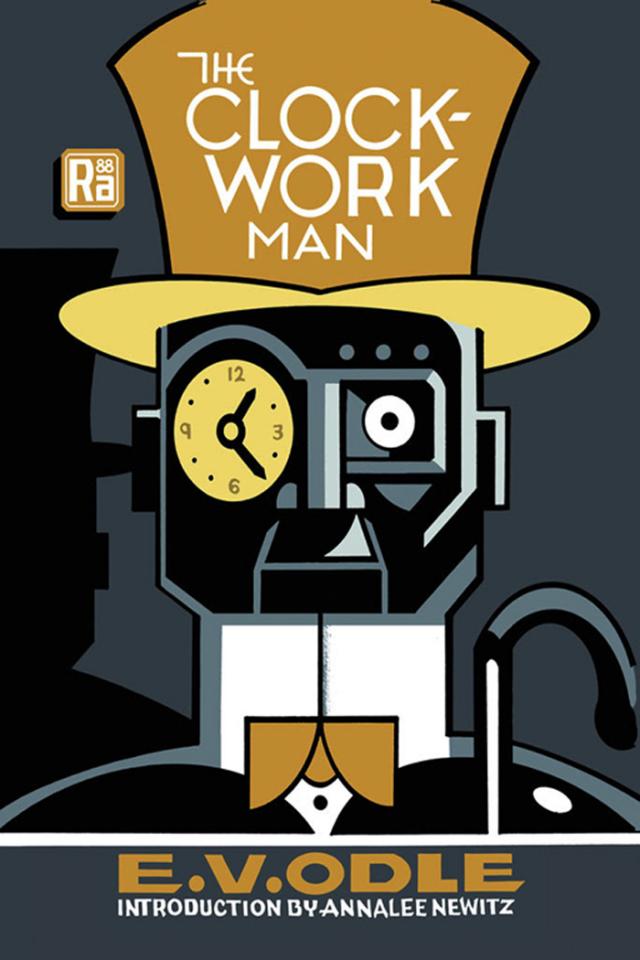
The next moment the Clockwork man came into full view round the corner of the hedge. He was swaying slightly from side to side, in his usual fashion, and his eyes stared straight ahead of him. He did not appear to notice Arthur, and did not stop until the latter politely stepped aside in order to allow him to pass. Then the Clockwork man screwed his head slowly round and appeared to become faintly apprehensive of the presence of another being. After a preliminary ear-flapping, he opened his mouth very wide.
“You haven’t,” he began, with great difficulty, “seen a hat and wig?”
“No,” said Arthur, and he glanced at the Clockwork man’s bald forehead and noticed something peculiar about the construction of the back of his head; there seemed to be some object there which he could not see because they were facing each other. “I’m sorry,” he continued, looking rather hopelessly around him, “perhaps we could find them somewhere.”
“Somewhere!” echoed the Clockwork man, “that’s what seems to me so extraordinary! Everybody says that. The idea of a thing being somewhere, you know. Elsewhere than where you expect it to be. It’s so confusing.”
Arthur consulted his common sense. “Can’t you remember the place where you lost them,” he suggested.
A faint wrinkle of perplexity appeared on the other’s forehead. He shook his head once. “Place. There, again, I can’t grasp that idea. What is a place? And how does a thing come to be in one place and not in another?” He jerked a hand up as though to emphasise the point. “A thing either is or it isn’t. It can’t be in a place.”
“But it must be somewhere,” objected Arthur, “that’s obvious.”
The Clockwork man looked vaguely distressed. “Theoretically,” he agreed, “what you say is correct. I can conceive it as a mathematical problem. But actually, you know, it isn’t at all obvious.”
He jerked his head slowly round and gazed at the surrounding objects. “It’s such an extraordinary world. I can’t get used to it at all. One keeps on bumping into things and falling into things—things that ought not to be there, you know.”
Arthur could hardly control an eager curiosity to know what the thing was, round and shiny, that looked like a sort of halo at the back of the Clockwork man’s head. He kept on dodging from one side to the other in an effort to see it clearly.
“Are you looking at my clock?” enquired the Clockwork man, without altering his tone of speech. “I must apologise. I feel quite indecent.”
“But what is it for?” gasped Arthur.
“It’s the regulating mechanism,” said the other, monotonously, “I keep on forgetting that you can’t know these things. You see, it controls me. But, of course, it’s out of order. That’s how I came to be here, in this absurd world. There can’t be any other reason, I’m sure.” He looked so childishly perplexed that Arthur’s sense of pity was again aroused, and he listened in respectful silence.
“You see,” the mechanical voice went on, “only about half the clock is in action. That accounts for my present situation.” There was a pause, broken only by obscure tickings, regular but thin in sound. “I had been feeling very run down, and went to have myself attended to. Then some careless mechanic blundered, and of course I went all wrong.” He turned swiftly and looked hard at Arthur. “All wrong. Absolutely all wrong. And of course, I—I—lapsed, you see.”
“Lapsed!” queried Arthur.
“Yes, I lapsed. Slipped, if you like that better—slipped back about eight thousand years, so far as I can make out. And, of course, everything is different.” His arms shot up both together in an abrupt gesture of despair. “And now I am confronted with all these old problems of Time and Space.”
Arthur’s recent reflections returned to him, and produced a little glow in his mind. “Is there a world,” he questioned, “where the problems of Time and Space are different?”
“Of course,” replied the Clockwork man, clicking slightly, “quite different. The clock, you see, made man independent of Time and Space. It solved everything.”
“But what happens,” Arthur wanted to know, “when the clock works properly?”
“Everything happens,” said the other, “exactly as you want it to happen.”
“Awfully convenient,” Arthur murmured.
“Exceedingly.” The Clockwork man’s head nodded up and down with a regular rhythm. “The whole aim of man is convenience.” He jerked himself forward a few paces, as though impelled against his will. “But my present situation, you know, is extremely inconvenient.”
He waddled swiftly along, and, to Arthur’s great disappointment, disappeared round the corner of the hedge, so that it was impossible to get more than a fleeting glimpse of that fascinating object at the back of his head. But he was still speaking.
“I don’t know what I shall do, I’m sure,” Arthur heard him say, as though to himself.
IV
Rose Lomas came slowly over the top of the hill. She was hatless, and her short, curly hair blew about her face, for a slight breeze had sprung up in the wake of the sunset. She wore a navy blue jacket over a white muslin blouse with a deep V at the breast. There was a fair stretch of plump leg, stockinged in black cashmere, between the edge of her dark skirt and the beginning of the tall boots that had taken so long to button up. She walked with her chin tilted upwards and her eyes half closed, and her hands were thrust into the slanting pockets of her jacket.
“Whoever was that person you were talking to?” she enquired, as soon as they stood together.
“Oh, someone who had lost his way,” said Arthur, carelessly. He felt curiously disinclined to explain matters just at present. The Clockwork man was disconcerting. He was a rather terrifying side-issue. Arthur had a feeling that Rose would probably be frightened by him, for she was a timid girl. He half hoped now that this strange being would turn out to be some kind of monstrous hoax.
And so he said nothing. They remained by the stile, courting each other and the silent on-coming of night. They were very ordinary lovers, and behaved just exactly in the same way as other people in the same condition. They kissed at intervals and examined each other’s faces with portentous gravity and microscopic care. Leaning against the stile, they were frequently interrupted by pedestrians, some of whom took special care to light their pipes as they passed. But the disturbance scarcely affected them. Being lovers, they belonged to each other; and the world about them also belonged to them, and seemed to fashion its laws in accordance with their desires. They would not have offered you twopence for a reformed House of Commons or an enlightened civilisation.
“Oh, Arthur,” said Rose, suddenly, “I want to be like this always, don’t you?”
“Yes,” murmured Arthur, and then caught his breath sharply. For his ear had detected a faint throbbing and palpitation in the distance. It seemed to echo from the far-off hills, a sort of “chew chew,” constantly repeated. And presently, another and more familiar sound aroused his attention. It was the “toot-toot” of an automobile and the jerk of a brake. And then the steady whine of the engine as the car ascended a hill. Perhaps they were pursuing the Clockwork man. Arthur hoped not. It seemed to him the troubles of that strange being were bad enough without there being added to them the persecutions suffered by those to whom existence represents an endless puzzle, full of snares and surprises.
5
The Clockwork Man Investigates Matters
I
Whatever inconveniences the Clockwork man suffered as a result of having lapsed into a world of strange laws and manifestations, he enjoyed at least one advantage. His power of travelling over the earth at an enormous speed rendered the question of pursuit almost farcical. While Allingham’s car sped over the neighbouring hills, the object of the chase returned by a circuitous route to Great Wymering, slowed down, and began to walk up and down the High Street. It was now quite dark, and very few people seemed to have noticed that odd figure ambling along, stopping now and again to examine some object that aroused his interest or got in his way. There is no doubt that during these lesser perambulations he contrived somehow to get the silencer under better control, so that his progress was now muted. It is possible also that his faculties began to adjust themselves a little to his strange surroundings, and that he now definitely tried to grasp his environment. But he still suffered relapses. And the fact that he again wore a hat and wig, although not his own, requires a word of explanation.
It was this circumstance that accounted for the Vicar’s late arrival at the entertainment given in aid of the church funds that night. He had lingered over his sermon until the last moment, and then hurried off with only a slight pause in which to glance at himself in the hall mirror. He walked swiftly along the dark streets in the direction of the Templars’ Hall, which was situated at the lower end of the town. Perhaps it was because of his own desperate hurry that he scarcely noticed that other figure approaching him, and in a straight line. He swerved slightly in order to allow the figure to pass, and continued on his way.
And then he stopped abruptly, aware of a cool sensation on the top of his head. His hat and wig had gone! Aghast, he retraced his steps, but there was no sign of the articles on the pavement. It seemed utterly incredible, for there was only a slight breeze and he did not remember knocking into anything. He had certainly not collided with the stranger. Just for a moment he wondered.
But duty to his parishioners remained uppermost in the conscientious Vicar’s mind, and it was not fair to them that he should catch his death of cold. He hurried back to the vicarage. For a quarter of an hour he pulled open drawers, ransacked cupboards, searching everywhere for an old wig that had been discarded and a new hat that had never been worn. He found them at last and arrived, breathless and out of temper, in the middle of the cinematograph display which constituted the first part of the performance.
“My dear,” he gasped, as he slid into the seat reserved for him next to his wife, “I couldn’t help it. Someone stole my hat and wig.”
“Stole them, Herbert,” she expostulated. “Not stole them.”
“Yes, stole them. I’ll tell you afterwards. Is this the Palestine picture? Oh, yes—”
II
And so the Clockwork man was able to conceal his clock from the gaze of a curious world, and the grotesqueness of his appearance was heightened by the addition of a neatly trimmed chestnut wig and a soft round clerical hat. His perceptions must have been extraordinarily rapid, and he must have acted upon the instant. Nor did it seem to occur to him that in this world there are laws which forbid theft. Probably, in the world from which he came such restrictions are unnecessary, and the exigency would not have arisen, every individual being provided by parliamentary statute with a suitable covering for that blatant and too obvious sign of the modus operandi in the posterior region of their craniums.
It was shortly after this episode that the Clockwork man experienced his first moment of vivid illumination about the world of brief mortal span.
He had become entangled with a lamp-post. There is no other way of describing his predicament. He came to rest with his forehead pressed against the post, and all his efforts to get round it ended in dismal failure. His legs kicked spasmodically and his arms revolved irregularly. There were intermittent explosions, like the back-firing of a petrol engine. The only person who witnessed these peculiar antics was P.C. Hawkins, who had been indulging in a quiet smoke beneath the shelter of a neighbouring archway.
At first it did not occur to the constable that the noise proceeded from the figure. He craned his head forward, expecting every moment to see a motor bicycle come along. The noise stopped abruptly, and he decided that the machine must have gone up a side street. Then he stepped out of his retreat and tapped the Clockwork man on the shoulder. The latter was quite motionless now and merely leaning against the lamp-post.
“You go ’ome,” suggested the constable, “I don’t want to have to take you in. This is one of my lenient nights, lucky for you.”
“Wallabaloo,” said the Clockwork man, faintly, “Wum—Wum—”
“Yes, we know all about that,” said the constable, “but you take my tip and go ’ome. And I don’t want any back answers neither.”
The Clockwork man emitted a soft whistling sound from between his teeth, and rubbed his nose thoughtfully against the post.
“What is this?” he enquired, presently.
“Lamp-post,” rejoined the other, clicking his teeth, “L.A.M.P.-P.O.S.T. Lamp-post.”
“I see—curious, only one lamp-post, though. In my country they grow like trees, you know—whole forests of them—galaxy of lights—necessary—illuminate multiform world.”
The constable laughed gently and stroked his moustache. His theory about the condition of the individual before him slowly developed.
“You get along,” he persuaded, “before there’s trouble. I don’t want to be ’arsh with you.”
“Wait,” said the Clockwork man, without altering his position, “moment of lucidity—see things as they are—begin to understand—finite world—only one thing at a time. Now we’ve got it—a place for everything and everything in its place.”
“Just what I’m always telling my missus,” reflected the constable.
The Clockwork man shifted his head very slightly, and one eye screwed slowly round.
“I want to grasp things,” he resumed, “I want to grasp you. So far as I can judge, I see before me—a constable—minion of the law—curious relic—primitive stage of civilisation—order people about finite world—lock people up—finite cell.”
“That’s my job,” agreed the other, with a warning glint in his red eye.
“Finite world,” proceeded the Clockwork man, “fixed laws—limited dimensions—essentially limited. Now, when I’m working properly, I can move about in all dimensions. That is to say, in addition to moving backwards and forwards, and this way and that, I can also move X and Y, and X2 and Y2.”
The corners of the constable’s eyes wrinkled a little. “Of course,” he ruminated, “if you’re going to drag algebra into the discussion I shall ’ave to cry off. I never got beyond decimals.”
“Let me explain,” urged the Clockwork man, who was gaining in verbal ease and intellectual elasticity every moment. “Supposing I was to hit you hard. You would fall down. You would become supine. You would assume a horizontal position at right angles to your present perpendicularity.” He gazed upwards at the tall figure of the constable. “But if you were to hit me, I should have an alternative. I could, for example, fall into the middle of next week.”
He walked a few yards up the road, and then turned through a wicket gate and mounted the hump of a meadow. The narrow path swerved slightly to right and left. Arthur fell to meditating upon paths in general and how they came into existence. Obviously, it was because people always walked in the same way. Countless footsteps, following the same line until the grass wore away. That was very odd when you came to think about it. Why didn’t people choose different ways of crossing that particular meadow? Then there would be innumerable paths, representing a variety of choice. It would be interesting to start a path of your own, and see how many people would follow you, even though you deliberately chose a circuitous or not obviously direct route. You could come every day until the path was made.
He climbed over the top of the meadow, descended again into a valley, and stopped before a stile with hedges running away on either side. He decided to wait here for Rose. It would be pleasant to see her coming over the hill.
It was gloaming now. The few visible stars shone with a peculiar individual brightness, and looked strangely pendulous in the fading blue sky. He leaned back and gazed at the depths above him. This time of the day was always puzzling. You could never tell exactly at what moment the sky really changed into the aspect of evening, and then, night. Yet there must be some subtle moment when each star was born. Perhaps by looking hard enough it would be possible to become aware of these things. It would be like watching a bud unfold. Slow change was an impenetrable mystery, for actually things seemed to happen too quickly for you to notice them. Or rather, you were too busy to notice them. Spring was like that. Every year you made up your mind to notice the first blossoming, the initial tinge of green; but always it happened that you awoke one morning and found that some vast change had taken place, so that it really seemed like a miracle.
He sat there, dangling an empty pipe between his teeth. He was not conscious of a desire to smoke, and he felt strangely tolerant of Rose’s delay. She would come presently.
Presently his reverie was abruptly disturbed by a faint noise, strangely familiar although remote. It seemed to reach him from the right, as though something crept slowly along the hedge line, hidden from his view. It was a soft, purring sound, very regular and sustained. At first he thought it was the cry of a pheasant, but decided that it was much too persistent. It was something that made a noise in the process of walking along.
He held his breath and turned his head slowly to the right. For a long time the sound increased only very slightly. And then, there broke upon the general stillness a series of abrupt explosions.
Pfft—Pfft—Pfft—Pfft—Pfft—
And the other noise, the purring and whirring, resumed this time so close to Arthur that he instinctively, and half in fear, arose from the stile and looked around him. But the tall hedges sweeping away on either side made it difficult to see anyone who might be approaching under their cover. There was a pause. Then a different sound.
Click—click—clickerty click—clicker clicker—clicker—And so on, becoming louder and louder until at last it stopped, and its place was taken by the dull pitter-patter of footsteps coming nearer and nearer. There was a little harsh snort that might have been intended for a sigh, and then a voice.
“Oh dear, it is trying. It really is most dreadfully trying—”
The next moment the Clockwork man came into full view round the corner of the hedge. He was swaying slightly from side to side, in his usual fashion, and his eyes stared straight ahead of him. He did not appear to notice Arthur, and did not stop until the latter politely stepped aside in order to allow him to pass. Then the Clockwork man screwed his head slowly round and appeared to become faintly apprehensive of the presence of another being. After a preliminary ear-flapping, he opened his mouth very wide.
“You haven’t,” he began, with great difficulty, “seen a hat and wig?”
“No,” said Arthur, and he glanced at the Clockwork man’s bald forehead and noticed something peculiar about the construction of the back of his head; there seemed to be some object there which he could not see because they were facing each other. “I’m sorry,” he continued, looking rather hopelessly around him, “perhaps we could find them somewhere.”
“Somewhere!” echoed the Clockwork man, “that’s what seems to me so extraordinary! Everybody says that. The idea of a thing being somewhere, you know. Elsewhere than where you expect it to be. It’s so confusing.”
Arthur consulted his common sense. “Can’t you remember the place where you lost them,” he suggested.
A faint wrinkle of perplexity appeared on the other’s forehead. He shook his head once. “Place. There, again, I can’t grasp that idea. What is a place? And how does a thing come to be in one place and not in another?” He jerked a hand up as though to emphasise the point. “A thing either is or it isn’t. It can’t be in a place.”
“But it must be somewhere,” objected Arthur, “that’s obvious.”
The Clockwork man looked vaguely distressed. “Theoretically,” he agreed, “what you say is correct. I can conceive it as a mathematical problem. But actually, you know, it isn’t at all obvious.”
He jerked his head slowly round and gazed at the surrounding objects. “It’s such an extraordinary world. I can’t get used to it at all. One keeps on bumping into things and falling into things—things that ought not to be there, you know.”
Arthur could hardly control an eager curiosity to know what the thing was, round and shiny, that looked like a sort of halo at the back of the Clockwork man’s head. He kept on dodging from one side to the other in an effort to see it clearly.
“Are you looking at my clock?” enquired the Clockwork man, without altering his tone of speech. “I must apologise. I feel quite indecent.”
“But what is it for?” gasped Arthur.
“It’s the regulating mechanism,” said the other, monotonously, “I keep on forgetting that you can’t know these things. You see, it controls me. But, of course, it’s out of order. That’s how I came to be here, in this absurd world. There can’t be any other reason, I’m sure.” He looked so childishly perplexed that Arthur’s sense of pity was again aroused, and he listened in respectful silence.
“You see,” the mechanical voice went on, “only about half the clock is in action. That accounts for my present situation.” There was a pause, broken only by obscure tickings, regular but thin in sound. “I had been feeling very run down, and went to have myself attended to. Then some careless mechanic blundered, and of course I went all wrong.” He turned swiftly and looked hard at Arthur. “All wrong. Absolutely all wrong. And of course, I—I—lapsed, you see.”
“Lapsed!” queried Arthur.
“Yes, I lapsed. Slipped, if you like that better—slipped back about eight thousand years, so far as I can make out. And, of course, everything is different.” His arms shot up both together in an abrupt gesture of despair. “And now I am confronted with all these old problems of Time and Space.”
Arthur’s recent reflections returned to him, and produced a little glow in his mind. “Is there a world,” he questioned, “where the problems of Time and Space are different?”
“Of course,” replied the Clockwork man, clicking slightly, “quite different. The clock, you see, made man independent of Time and Space. It solved everything.”
“But what happens,” Arthur wanted to know, “when the clock works properly?”
“Everything happens,” said the other, “exactly as you want it to happen.”
“Awfully convenient,” Arthur murmured.
“Exceedingly.” The Clockwork man’s head nodded up and down with a regular rhythm. “The whole aim of man is convenience.” He jerked himself forward a few paces, as though impelled against his will. “But my present situation, you know, is extremely inconvenient.”
He waddled swiftly along, and, to Arthur’s great disappointment, disappeared round the corner of the hedge, so that it was impossible to get more than a fleeting glimpse of that fascinating object at the back of his head. But he was still speaking.
“I don’t know what I shall do, I’m sure,” Arthur heard him say, as though to himself.
IV
Rose Lomas came slowly over the top of the hill. She was hatless, and her short, curly hair blew about her face, for a slight breeze had sprung up in the wake of the sunset. She wore a navy blue jacket over a white muslin blouse with a deep V at the breast. There was a fair stretch of plump leg, stockinged in black cashmere, between the edge of her dark skirt and the beginning of the tall boots that had taken so long to button up. She walked with her chin tilted upwards and her eyes half closed, and her hands were thrust into the slanting pockets of her jacket.
“Whoever was that person you were talking to?” she enquired, as soon as they stood together.
“Oh, someone who had lost his way,” said Arthur, carelessly. He felt curiously disinclined to explain matters just at present. The Clockwork man was disconcerting. He was a rather terrifying side-issue. Arthur had a feeling that Rose would probably be frightened by him, for she was a timid girl. He half hoped now that this strange being would turn out to be some kind of monstrous hoax.
And so he said nothing. They remained by the stile, courting each other and the silent on-coming of night. They were very ordinary lovers, and behaved just exactly in the same way as other people in the same condition. They kissed at intervals and examined each other’s faces with portentous gravity and microscopic care. Leaning against the stile, they were frequently interrupted by pedestrians, some of whom took special care to light their pipes as they passed. But the disturbance scarcely affected them. Being lovers, they belonged to each other; and the world about them also belonged to them, and seemed to fashion its laws in accordance with their desires. They would not have offered you twopence for a reformed House of Commons or an enlightened civilisation.
“Oh, Arthur,” said Rose, suddenly, “I want to be like this always, don’t you?”
“Yes,” murmured Arthur, and then caught his breath sharply. For his ear had detected a faint throbbing and palpitation in the distance. It seemed to echo from the far-off hills, a sort of “chew chew,” constantly repeated. And presently, another and more familiar sound aroused his attention. It was the “toot-toot” of an automobile and the jerk of a brake. And then the steady whine of the engine as the car ascended a hill. Perhaps they were pursuing the Clockwork man. Arthur hoped not. It seemed to him the troubles of that strange being were bad enough without there being added to them the persecutions suffered by those to whom existence represents an endless puzzle, full of snares and surprises.
5
The Clockwork Man Investigates Matters
I
Whatever inconveniences the Clockwork man suffered as a result of having lapsed into a world of strange laws and manifestations, he enjoyed at least one advantage. His power of travelling over the earth at an enormous speed rendered the question of pursuit almost farcical. While Allingham’s car sped over the neighbouring hills, the object of the chase returned by a circuitous route to Great Wymering, slowed down, and began to walk up and down the High Street. It was now quite dark, and very few people seemed to have noticed that odd figure ambling along, stopping now and again to examine some object that aroused his interest or got in his way. There is no doubt that during these lesser perambulations he contrived somehow to get the silencer under better control, so that his progress was now muted. It is possible also that his faculties began to adjust themselves a little to his strange surroundings, and that he now definitely tried to grasp his environment. But he still suffered relapses. And the fact that he again wore a hat and wig, although not his own, requires a word of explanation.
It was this circumstance that accounted for the Vicar’s late arrival at the entertainment given in aid of the church funds that night. He had lingered over his sermon until the last moment, and then hurried off with only a slight pause in which to glance at himself in the hall mirror. He walked swiftly along the dark streets in the direction of the Templars’ Hall, which was situated at the lower end of the town. Perhaps it was because of his own desperate hurry that he scarcely noticed that other figure approaching him, and in a straight line. He swerved slightly in order to allow the figure to pass, and continued on his way.
And then he stopped abruptly, aware of a cool sensation on the top of his head. His hat and wig had gone! Aghast, he retraced his steps, but there was no sign of the articles on the pavement. It seemed utterly incredible, for there was only a slight breeze and he did not remember knocking into anything. He had certainly not collided with the stranger. Just for a moment he wondered.
But duty to his parishioners remained uppermost in the conscientious Vicar’s mind, and it was not fair to them that he should catch his death of cold. He hurried back to the vicarage. For a quarter of an hour he pulled open drawers, ransacked cupboards, searching everywhere for an old wig that had been discarded and a new hat that had never been worn. He found them at last and arrived, breathless and out of temper, in the middle of the cinematograph display which constituted the first part of the performance.
“My dear,” he gasped, as he slid into the seat reserved for him next to his wife, “I couldn’t help it. Someone stole my hat and wig.”
“Stole them, Herbert,” she expostulated. “Not stole them.”
“Yes, stole them. I’ll tell you afterwards. Is this the Palestine picture? Oh, yes—”
II
And so the Clockwork man was able to conceal his clock from the gaze of a curious world, and the grotesqueness of his appearance was heightened by the addition of a neatly trimmed chestnut wig and a soft round clerical hat. His perceptions must have been extraordinarily rapid, and he must have acted upon the instant. Nor did it seem to occur to him that in this world there are laws which forbid theft. Probably, in the world from which he came such restrictions are unnecessary, and the exigency would not have arisen, every individual being provided by parliamentary statute with a suitable covering for that blatant and too obvious sign of the modus operandi in the posterior region of their craniums.
It was shortly after this episode that the Clockwork man experienced his first moment of vivid illumination about the world of brief mortal span.
He had become entangled with a lamp-post. There is no other way of describing his predicament. He came to rest with his forehead pressed against the post, and all his efforts to get round it ended in dismal failure. His legs kicked spasmodically and his arms revolved irregularly. There were intermittent explosions, like the back-firing of a petrol engine. The only person who witnessed these peculiar antics was P.C. Hawkins, who had been indulging in a quiet smoke beneath the shelter of a neighbouring archway.
At first it did not occur to the constable that the noise proceeded from the figure. He craned his head forward, expecting every moment to see a motor bicycle come along. The noise stopped abruptly, and he decided that the machine must have gone up a side street. Then he stepped out of his retreat and tapped the Clockwork man on the shoulder. The latter was quite motionless now and merely leaning against the lamp-post.
“You go ’ome,” suggested the constable, “I don’t want to have to take you in. This is one of my lenient nights, lucky for you.”
“Wallabaloo,” said the Clockwork man, faintly, “Wum—Wum—”
“Yes, we know all about that,” said the constable, “but you take my tip and go ’ome. And I don’t want any back answers neither.”
The Clockwork man emitted a soft whistling sound from between his teeth, and rubbed his nose thoughtfully against the post.
“What is this?” he enquired, presently.
“Lamp-post,” rejoined the other, clicking his teeth, “L.A.M.P.-P.O.S.T. Lamp-post.”
“I see—curious, only one lamp-post, though. In my country they grow like trees, you know—whole forests of them—galaxy of lights—necessary—illuminate multiform world.”
The constable laughed gently and stroked his moustache. His theory about the condition of the individual before him slowly developed.
“You get along,” he persuaded, “before there’s trouble. I don’t want to be ’arsh with you.”
“Wait,” said the Clockwork man, without altering his position, “moment of lucidity—see things as they are—begin to understand—finite world—only one thing at a time. Now we’ve got it—a place for everything and everything in its place.”
“Just what I’m always telling my missus,” reflected the constable.
The Clockwork man shifted his head very slightly, and one eye screwed slowly round.
“I want to grasp things,” he resumed, “I want to grasp you. So far as I can judge, I see before me—a constable—minion of the law—curious relic—primitive stage of civilisation—order people about finite world—lock people up—finite cell.”
“That’s my job,” agreed the other, with a warning glint in his red eye.
“Finite world,” proceeded the Clockwork man, “fixed laws—limited dimensions—essentially limited. Now, when I’m working properly, I can move about in all dimensions. That is to say, in addition to moving backwards and forwards, and this way and that, I can also move X and Y, and X2 and Y2.”
The corners of the constable’s eyes wrinkled a little. “Of course,” he ruminated, “if you’re going to drag algebra into the discussion I shall ’ave to cry off. I never got beyond decimals.”
“Let me explain,” urged the Clockwork man, who was gaining in verbal ease and intellectual elasticity every moment. “Supposing I was to hit you hard. You would fall down. You would become supine. You would assume a horizontal position at right angles to your present perpendicularity.” He gazed upwards at the tall figure of the constable. “But if you were to hit me, I should have an alternative. I could, for example, fall into the middle of next week.”


