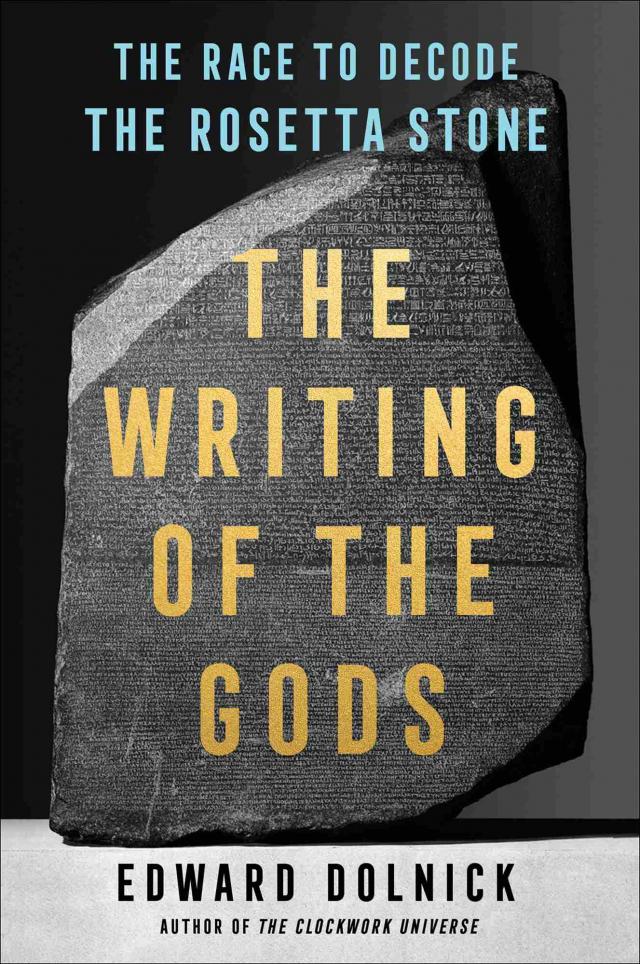
The writing of the gods, p.1
The Writing of the Gods, page 1


Thank you for downloading this Simon & Schuster ebook.
Get a FREE ebook when you join our mailing list. Plus, get updates on new releases, deals, recommended reads, and more from Simon & Schuster. Click below to sign up and see terms and conditions.
CLICK HERE TO SIGN UP
Already a subscriber? Provide your email again so we can register this ebook and send you more of what you like to read. You will continue to receive exclusive offers in your inbox.
For Lynn, and Sam and Ben
Here we are then, in Egypt, the land of the Pharaohs, the land of the Ptolemies, the kingdom of Cleopatra… with our heads shaven as clean as your knee, smoking long pipes and drinking our coffee lying on divans. What can I say? How can I write to you about it? I have scarcely recovered from my initial astonishment.
—Gustave Flaubert, 1850
Timeline
3100 BC – Earliest hieroglyphs
2686 BC–2181 BC – Old Kingdom 2600 BC – Great Sphinx; Great Pyramid
2040 BC–1782 BC – Middle Kingdom (golden age of Egyptian literature)
1570 BC–1070 BC – New Kingdom (wealthiest era in Egyptian history) 1334 BC–1325 BC – King Tut reigns
1279 BC–1213 BC – Ramesses II reigns (Egypt’s mightiest pharaoh)
332 BC – Alexander the Great conquers Egypt
196 BC – Rosetta Stone inscribed
30 BC – Rome conquers Egypt; Cleopatra commits suicide
394 AD – Last hieroglyphs inscribed
642 – Arabs conquer Egypt
1773 – Thomas Young born
1790 – Jean-François Champollion born
1798 – Napoleon invades Egypt
1799 – Rosetta Stone discovered
(All the ancient dates are historians’ and archaeologists’ best guesses)
Prologue
Imagine an archaeologist, thousands of years from now, whose trowel clangs against something solid and hard, hidden in the dirt. In this distant age, no one knows for sure whether there once was a United States or if the name only referred to a legendary place, like Atlantis. No one speaks English. A few scraps of writing in English have survived. No one can read them.
The stone beneath the trowel looks smooth along part of its length, but a glance reveals that it is only a broken fragment of what might once have been a large block. Still, the smoothness is enough to set the pulse racing; nature seldom works so tidily. A closer look holds still more promise. Those lines and curves gouged into the stone—could they be some sort of inscription?
Over weeks and months, teams of researchers painstakingly trace the carved and eroded marks. They will ponder them endlessly, trying to guess a meaning in the mysterious symbols. Some are too damaged or worn to make out, and others are missing altogether.
OUR SC E AN SEV
Some scholars believe the message should be read the other way around:
VES NA E CS RUO
How would the sleuths proceed? Not knowing English, not knowing American history, would they ever manage to see that once a stone temple had proclaimed a message that began, “Four score and seven years ago”?
CHAPTER ONE The Stakes
In 1799, the year of the Rosetta Stone’s discovery, Egypt was a sweltering, impoverished backwater. No matter. It was ancient Egypt that beguiled the West, and it had never lost its allure.
Herodotus, the “father of history,” was the first outsider to describe Egypt’s marvels. Writing in 440 BC, he entranced his readers with tales of a land whose every aspect was unfamiliar. Egypt boasted a “climate unlike any other” and a river “which shows a nature different from all other rivers.” Most important, the Egyptians themselves were a people whose “manners and customs were opposite to other men in almost all matters.”
Egypt was different from other countries because it was a slender strip of green surrounded by thousands of miles of desert on both sides. The Nile was different from other rivers because it flowed from south to north, which seemed contrary to nature, and, more important, because it flooded every year, even though Egypt almost never saw rain. When the floods receded, they left behind rich, black soil, perfect for farming.
The ancient world revolved around agriculture, but in all the world except Egypt, farming was a fickle business. In other lands the rains might come and bring prosperity for a season; they might fail, and then crops would wither and families starve.
Egypt, blessed by the gods, had few such worries. Despite skies that were perpetually clear, the flood had nearly always come, and it would always come, this year and next year and forever. Here was that rarest of gifts, a miracle with an eternal guarantee. With enemies walled off by deserts to the east and west, by the sea to the north and by wild rapids to the south, Egypt sat safe and prosperous, the envy of the world.
Above all, Egypt was rich beyond reckoning. “Gold is in Egypt like the sands of the desert,” a king of neighboring Assyria remarked enviously, in the era of King Tut. It was almost true. Tut was a nobody, the Millard Fillmore of pharaohs, and yet the riches buried with him dazzle museumgoers to this day. He was buried in a coffin inside a coffin inside a coffin, and the innermost of the three was solid gold and weighed 220 pounds. Inside lay Tut’s linen-wrapped mummy, his head and shoulders covered by an elegant, gleaming gold mask that rested unseen for three thousand years.
* * *
Egypt was the best-known and the longest-lived of all ancient cultures. The time span is almost inconceivable. The pharaohs reigned from roughly 3100 BC until 30 BC, the year of Cleopatra’s suicide. America’s history extends less than three centuries. Egypt’s run was thirty centuries.
To try to put markers on an Egyptian timeline is to risk vertigo. The Great Pyramid and the Sphinx, Egypt’s best-known monuments, are older than Stonehenge. Both date from around 2600 BC (in comparison with perhaps 2400 BC for Stonehenge). By the time they were built, Egypt was already five centuries old.I
From the time of the pyramids to the reign of Cleopatra was longer than from Cleopatra to the Wright brothers. And throughout nearly all that vast expanse of time, Egypt perched atop the world.
Through the next two thousand years, from the time of Cleopatra and Caesar to our own day, Egypt’s mystique would never fade. In that marvelous land, a Turkish traveler wrote in 1671, he had seen “wondrous and strange things by the hundreds of thousands…. Before each of them, we have been entirely beside ourselves with astonishment.”
No one today spares a thought for once-mighty kingdoms like Assyria and Babylon, but Egypt still sizzles with star power. So it has always been, and never more so than in the last years of the 1700s, when Napoleon led an army to Egypt.
Behind the diplomatic rationales for invading Egypt was a simpler motive—Napoleon’s heroes, Alexander the Great and Julius Caesar, had conquered Egypt, and therefore he would do the same. He brought with him a cadre of scientists and artists whose mission was to study Egypt and to bring it the blessings of French civilization. Their breathless accounts of the wonders they had seen would spur a frenzy that was dubbed Egyptomania.
For Europeans, Egypt conjured up a hodgepodge of beauty (Cleopatra!) and grandeur (the pyramids!) and mystery (the Sphinx!). All this was seasoned with a soupçon of shivery horror (mummies!) that amped up the excitement. (On his return to France, Napoleon presented his wife, Empress Josephine, with the gift of a mummy’s head.)
Early on, only the most daring Europeans had ventured to this far-off land. They marveled at sights that were, by local standards, as routine as the rising and setting of the sun. “I saw the Nile, upon my first coming, full, but not overflowing,” wrote an English traveler named William Bankes, in 1815. “I saw it a month afterwards spread as a sea over the whole face of Egypt, with villages as if swimming upon its surface, and men and cattle wading from place to place.”
To Western eyes, everything was astonishing—the thin green thread of the Nile against a vast tan canvas, of course, but also palm trees, mirages, locusts, the endless expanse of desert sand. “To a European,” wrote Bankes, “it is not another climate, it is another nature, that is before him.”
* * *
That awe extended to hieroglyphs, Egypt’s ancient and imposing system of writing.II Across the vast span of years before the Rosetta Stone yielded its secrets, the mystery of the hieroglyphs thrust itself in the face of every visitor to Egypt. Enticingly, maddeningly, Egypt’s monuments and tombs were covered with elaborate picture-writing—an “infinity of hieroglyphs,” in the words of one early explorer—that no one knew how to decipher.
Temple walls carried long messages, and so did every column and beam in those temples (and every surface, including ceilings and even the undersides of beams), and so did obelisks, and papyrus sheets beyond number, and the caskets that enclosed mummies, and even the mummies’ bandages. “There is hardly the space of an awl or needle-hole,” a traveler from Baghdad wrote in the year 1183, “which did not have an image, or engraving or some script which is not understood.”
Hieroglyphs from the Temple of Isis, Philae
Herodotus had stared uncomprehendingly at those inscriptions. Scholars who came after him—for a full two millennia—pored over inscriptions carved into obelisks that conquerors had brought home or that travelers had carefully copied. They came up empty, baffled by the mysterious zigzags and birds and snakes and semicircles.
Faced with symbols they could not decipher, they might have denigrated the mysterious markings as mere decoration. They did jus
Europe’s deepest thinkers proclaimed hieroglyphs a mystical form of writing, superior to all others. Hieroglyphs did not stand for letters or sounds, like the symbols in ordinary scripts, these scholars declared, but for ideas.
It was not simply that hieroglyphic symbols conveyed meaning without words, like the No smoking signs that show a cigarette with a red slash across it. The real point was that hieroglyphs conveyed not mundane messages but profound and universal truths.
Linguists and historians insisted that these strange symbols had nothing to do with the alphabets familiar in other cultures. Those workaday alphabets, like the ones used in Greece or Rome, might suffice for love letters or tax receipts, but hieroglyphs had a loftier purpose. In effect, scholars dismissed the possibility that hieroglyphs could be used for ordinary messages or lists—milk, butter, something the kids will eat—in the firm belief that every hieroglyphic text was a meditation on the nature of space and time.
The beauty of hieroglyphs might explain some of this misplaced reverence. The animal symbols especially look more like small works of art than like writing; the best examples look as if they came from a naturalist’s field notes.
When linguists first studied other, less imposing scripts, they tended to go wrong in exactly the opposite way—Surely these scrawls and scratches don’t depict letters or words. The scholar who coined the name cuneiform for one of the longest-lived and most important of all early scripts, for instance, never believed that it was writing at all. Thomas Hyde was an authority on ancient languages—he was an Oxford professor of Hebrew and Arabic—and in 1700 he published a thick book on ancient Persia. He waved aside the ornate wedge-shaped markings found on countless clay tablets throughout Persia. This was not writing, Hyde explained, despite what some scholars insisted, but merely an elaborate array of decorative wedges and arrows.
It turned out that cuneiform, in different forms, was used to write a variety of Middle Eastern languages for three thousand years. Hyde’s only lasting contribution to scholarship, in the judgment of one modern expert, was providing “an outstanding example of how wrong a professor, and in his case a double professor, can be.” (Cuneiform was the earliest script of all, by most scholars’ reckoning. It first appeared around 3100 BC. That was slightly before the earliest Egyptian hieroglyphs, which date from around 3000 BC. The earliest Chinese writing dates from around 1200 BC.)
Another hugely important archaeological find met the same sneering dismissal at first, for nearly the same reason. The script called Linear B, a forerunner of Greek, was discovered on the island of Crete, in the 1880s, carved into huge stone blocks. Crete was a land rich in myth and history. It was Crete where the king imprisoned Icarus and Daedalus in a tower, and where father and son escaped by launching themselves into the sky on feathered wings.
Linear B, which dates from around 1450 BC, would prove to be the earliest writing ever set down in Europe. It would have been forgivable if archaeologists, dazzled by possibility, read more meaning into those symbols than truly belonged there. They didn’t. When experts first examined the Linear B inscriptions they declared them to be “masons’ marks.”
But almost no one treated hieroglyphs with disdain. Carved into temple walls and obelisks, they were hailed as conveying peeks deep into the heart of nature. The modern counterpart would be truths like e = mc2 that are written (and understood) in the identical way by physicists in Shanghai and Chicago. For nearly two thousand years, European scholars thought of ancient Egyptian priests as we think of scientists today—these sages had devised an arcane code that disclosed crucial insights to those in the know, and nothing at all to those uninitiated in its secrets.
In the words of the third-century philosopher Plotinus, “[Egyptian scribes] did not go through the whole business of letters, words, and sentences.” Egypt’s wise men had found a far better approach—conveying ideas by drawing signs. “Each separate sign is in itself a piece of knowledge, a piece of wisdom, a piece of reality, immediately present.”
* * *
But this was guesswork, since not a single person in the world knew the meaning of a single hieroglyph. Egypt was covered with countless messages, and every one of them was mute.
It was the rise of Christianity that ensured the fall of hieroglyphs. In the early 300s, the Roman emperor Constantine converted to Christianity. That act spurred one of the most important course changes in world history. Later in the century, Christianity became the official religion of Rome. By century’s end the puny new faith had grown powerful enough to outlaw its rivals.
In 391 AD the Roman emperor Theodosius the Great ordered that all Egypt’s temples be torn down, as affronts to Christianity. (The penalty for worshipping the old pagan gods, even in the privacy of your own home, was death.) The last person who wrote an inscription in hieroglyphs carved it into a wall in a temple at Philae, an island far up the Nile, in 394 AD.
Edicts like the one laid down by Theodosius were new. Warfare and persecution were as old as humankind, but the issue was seldom that one side believed in the wrong gods. In the days when polytheism was all but universal, conquerors who took over new territory tended to take over the local gods, too. If you already worshipped several dozen gods, it was no problem to make room for a few more.
Then came monotheism and the belief in one true God, and everything shifted. “The Greeks and Romans had respected the old gods [before Constantine’s conversion]…,” writes the Egyptologist Barbara Mertz, “but monotheism is by its very nature intolerant.” Hieroglyphs, as emblems of the bad old ways, came in for special condemnation. Forbidden, they were soon forgotten.
Forgotten in Egypt, at any rate. In Europe and the Arab world, the attempts at decipherment never ceased and never made headway. Think of how long that veil of ignorance stayed in place. Rome rose and fell, and still the “infinity of hieroglyphs” retained their secrets. (Rome was so obsessed with Egypt that conquerors brought home thirteen immense hieroglyph-adorned obelisks. To this day there are more Egyptian obelisks in Rome than in Egypt.) The Middle Ages arrived, and sky-piercing cathedrals rose across Europe—they were the first man-made structures in four thousand years to stand taller than the pyramids—and through all those years there was no progress in deciphering hieroglyphs. The Renaissance came, and with it the Age of Science and the birth of the modern world, and still… nothing.
The cliché has it that an unknown subject is a closed book, but Egypt was different. Egypt was an open book, with illustrations on every page, that no one knew how to read.
I. A timeline of the world’s most renowned structures would include the Parthenon, built around 450 BC; the Roman Colosseum, around 100 AD; Angkor Wat, around 1100; the Great Wall of China, around 1400; St. Peter’s, around 1600; and the Taj Mahal, around 1650.
II. The symbols are hieroglyphs, not hieroglyphics. Egyptologists cringe at the misuse, though it is all but universal. Hieroglyphic is an adjective, they insist, like artistic or majestic.
CHAPTER TWO The Find
No one ever set out to find the Rosetta Stone. No one knew there was such a thing, though travelers and scholars had long dreamed there might be. The stone had lain unnoticed for nearly two thousand years. It might well have stayed lost forever.
It turned up in a pile of rubble in a prosperous but out-of-the-way Egyptian town called Rashid, on a sweltering July day in 1799. France had invaded Egypt the year before. At the head of the French army was a young general, Napoleon Bonaparte, just rising to fame. Soon he would be known around the world, his name invoked with awe or whispered in horror. (In England, small children were warned that if they did not go quietly to sleep, “Boney” would snatch them from their beds and devour them.)
A team of French soldiers had been assigned to rebuild a broken-down fort in Rashid, in the Nile delta. (The French called the town Rosetta.) The fortress had once stood squat but imposing, a square eighty yards on a side with turrets, and a tower at its center. But it had been neglected for centuries, and by the time the French arrived it urgently needed repair. “I expect to be attacked at any time,” the local commander wrote Napoleon, and he set his men urgently to work, converting this wreck into a proper fort with barracks and sturdy walls.