

Written on water, p.1
Written on Water, page 1


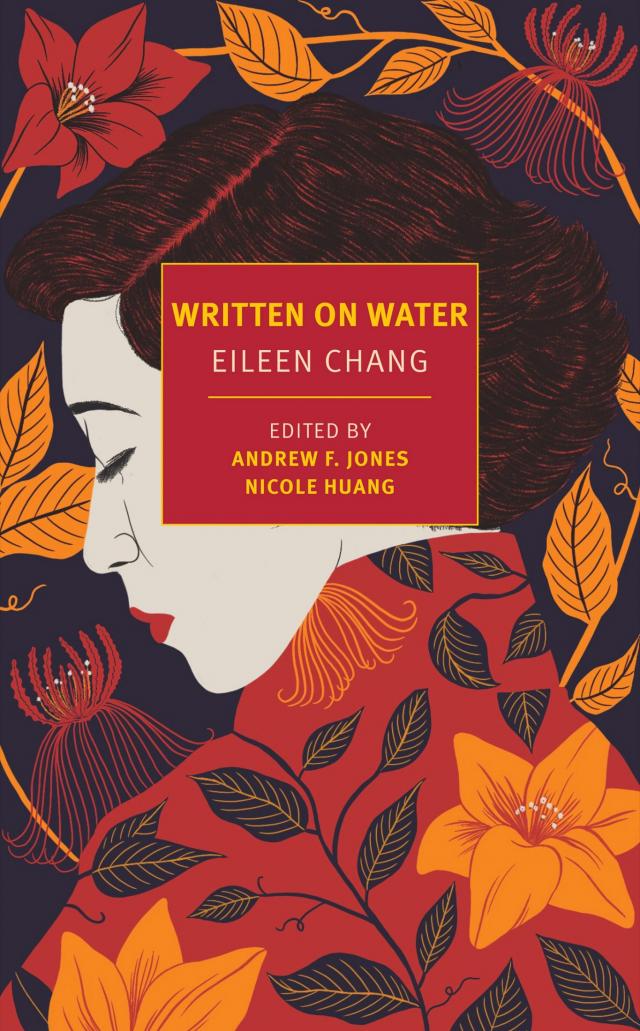
EILEEN CHANG (1920–1995) was born in Shanghai to an aristocratic family and educated in both Chinese and English from an early age. Her flamboyant mother spent extended periods in Europe, leaving her and her younger brother in the care of their opium-addicted father throughout much of their childhood. Chang attended the American Episcopal school for girls in Shanghai and was enrolled at the University of Hong Kong, studying English and history, when the bloody Battle of Hong Kong broke out in December 1941. By the next spring she was living in war-ravaged Shanghai and concentrating on writing. Two volumes published in 1944, when Chang was not yet twenty-five, established her as a literary sensation: Romances, a collection of short fiction, and Written on Water, a book of essays. In 1952, Chang returned to Hong Kong, where for three years she worked for the United States Information Agency, translating the likes of Ernest Hemingway, Washington Irving, and Ralph Waldo Emerson into Chinese and translating Chinese propaganda into English. During this period she also wrote two novels, The Rice Sprout Song and Naked Earth (in both Chinese and English versions). From 1955 on, Chang lived in the United States, dying quietly in her apartment in West Los Angeles in 1995. Although the books she published in her adopted country initially failed to find a broad audience, her work has remained the object of fervent admiration among Chinese-speaking communities, inspiring numerous theatrical, operatic, and cinematic adaptations. In recent years the publication of formerly unpublished manuscripts, among them novels, essays, letters, and notes, has encouraged a scholarly reevaluation of Chang as a bilingual writer. In addition to Written on Water, NYRB Classics publishes three books by her: Love in a Fallen City, Naked Earth, and Little Reunions. Time Tunnel, a new collection of her writing, translated by Karen Kingsbury and Jie Zhang, is forthcoming.
ANDREW F. JONES teaches modern Chinese literature and culture at the University of California, Berkeley. His books include Circuit Listening: Chinese Popular Music in the Global 1960s and Developmental Fairy Tales: Evolutionary Thinking and Modern Chinese Culture. He has also translated two volumes of fiction by Yu Hua.
NICOLE HUANG is a professor of comparative literature at the University of Hong Kong. She is the author of two monographs on Eileen Chang: Women, War, Domesticity: Shanghai Literature and Popular Culture of the 1940s and Hong Kong Connections: Eileen Chang and Worldmaking.
WRITTEN ON WATER
EILEEN CHANG
Translated from the Chinese by
ANDREW F. JONES
Edited by
ANDREW F. JONES and NICOLE HUANG
Afterword by
NICOLE HUANG
With illustrations by the author
NEW YORK REVIEW BOOKS
New York
THIS IS A NEW YORK REVIEW BOOK
PUBLISHED BY THE NEW YORK REVIEW OF BOOKS
435 Hudson Street, New York, NY 10014
www.nyrb.com
Copyright © 1968 by Eileen Chang
Translation copyright © 2005, 2023 by Andrew F. Jones
Afterword copyright © 2023 by Nicole Huang
All rights reserved.
Originally published in Chinese as Liuyan.
Originally published in Chinese by Crown Publishing Company Ltd., Taiwan
First published as a New York Review Books Classic in 2023.
Cover illustration by Stephanie Monohan
Cover design by Katy Homans
Library of Congress Cataloging-in-Publication Data
Names: Zhang, Ailing, author. | Jones, Andrew F., editor and translator | Huang, Nicole, editor.
Title: Written on water / by Eileen Chang; translated from the Chinese by Andrew F. Jones; edited by Andrew F. Jones and Nicole Huang.
Other titles: Liu yan. English
Description: New York: New York Review Books, [2023] | Series: New York Review Books
Identifiers: LCCN 2020058337 (print) | LCCN 2020058338 (ebook) | ISBN 9781681375762 (paperback) | ISBN 9781681375779 (ebook)
Subjects: LCSH: Zhang, Ailing—Translations into English. | LCGFT: Essays.
Classification: LCC PL2837.E35 L58613 2021 (print) | LCC PL2837.E35 (ebook) | DDC 895.14/52—dc23
LC record available at https://lccn.loc.gov/2020058337
LC ebook record available at https://lccn.loc.gov/2020058338
ISBN 978-1-68137-577-9
v1.1
For a complete list of titles, visit www.nyrb.com
CONTENTS
Cover
Biographical Notes
Title Page
Copyright and More Information
Editors’ Acknowledgments
WRITTEN ON WATER
From the Mouths of Babes
Writing of One’s Own
Notes on Apartment Life
Bugle Music from the Night Barracks
“What Is Essential Is That Names Be Right”
From the Ashes
Shanghainese, After All
Seeing with the Streets
A Chronicle of Changing Clothes
Love
Speaking of Women
By the Light of the Silver Lantern
Let’s Go! Let’s Go Upstairs
Schooling at the Silver Palace
Peking Opera Through Foreign Eyes
On Carrots
The Sayings of Yanying
Unpublished Manuscripts
What Are We to Write?
Making People
Beating People
Poetry and Nonsense
With the Women on the Tram
Whispers
Unforgettable Paintings
Under an Umbrella
On Dance
On Painting
On the Second Edition of Romances
On Music
Epilogue: Days and Nights of China
Afterword
Notes
Editors’ Acknowledgments
This translation of Written on Water has unfolded over the course of twenty years of friendship and collaboration. We would like once again to thank our many friends and colleagues who contributed in ways great and small to the publication of the first edition of Written on Water in 2005. We remain grateful for the steadfast support of Jennifer Crewe at Columbia University Press and Professor David Wang. Eileen Cheng, Louisa Chiang, Theodore Huters, Leo Ou-Fan Lee, Deborah Tze-Lan Sang, the anonymous reviewers for Columbia University Press, and many other friends and colleagues read, corrected, and helped to improve the initial drafts of the translation. One seldom gets a second chance in life, and we thank our editors at NYRB, Edwin Frank and Sara Kramer, for giving us the time and opportunity to revisit Eileen Chang’s essays with fresh eyes, and with the benefit of insights gleaned from nearly two decades of new scholarship in the field. James Brook was an astute and insightful reader of the revised manuscript. We are especially grateful to Silvano Zheng, whose incisive, thoughtful, and generous commentary set into motion an extensive revision of the original translation. We hope that this new and improved edition will allow even more readers to hear Eileen Chang’s inimitable voice, and enter into her literary world.
FROM THE MOUTHS OF BABES
It used to be that when people celebrated Chinese New Year, they would paste red strips of paper on the wall with maxims like Things are Looking Up and From the Mouths of Babes written across them. When I hark back in my title to the guileless discourse that emerges from the “mouths of babes,” I don’t mean to imply that I am about to spit out something that ought not to be said. It’s just that I would like to indulge in talking about myself for a while. When a child in grade school comes home after school and excitedly begins to narrate everything he’s seen and heard that day—how partial the teacher is to certain students and how Wang Debao was late to school and how the classmate who shares a bench with him was taken down a few points for being untidy—grown-ups, while disinclined to take him up on any of it, will let him talk on and on. I must have known the sorrow of this sort of situation when I was small for I’ve made it a taboo ever since to talk when no one is listening. Even now, I am happiest when someone else talks and I listen. When I’m talking and someone else is listening, I am invariably left with the uneasy suspicion that I’ve made myself quite tiresome. If one is really bursting with things to say and has no one to say them to, perhaps the only recourse is to go forth and accomplish earth-shattering deeds, so that when the time comes for an autobiography, one need no longer be concerned that no one will take any notice. This is a childish fantasy, of course, of which I have been disabused as I have slowly come to realize that I have scant hope of becoming a celebrated public figure worthy of a best-selling autobiography. Better, then, to write a little about myself and let off some steam, so that I don’t become an insufferable chatterbox when I get old.
Still, the kind of familiar writing that’s full of “me me me” from start to finish ought to be taken to task. I recently came across a couple of lines in an English book that might serve as a rather fitting jibe at authors excessively interested in themselves: “They not only spend a lifetime gazing at their own navels but also go in search of other people who might be interested in gazing along with them.” Unsure as to whether what follows constitutes a navel exhibition, I have chosen to write it all the same.
Money
I don’t know whether the custom of drawing “life lots” is common in other places besides here. When I was one year old, a group of objects were duly placed in front of me on a lacquer tray in order
I like money because I have never suffered on its account—certainly, I’ve experienced a few minor nuisances to do with money, but nothing compared to what others have suffered—and know nothing of its bad side and only the good.
When I lived at home, I did not have to worry about food and clothing, and my tuition, medical costs, and recreational expenses were all taken care of for me. But I never had any money of my own. There was the worry that children would spend any ready cash on snacks, so my father always made us give back the New Year’s coins that had been put under our pillows after the holidays were over, and we never thought to protest. I never bought anything for myself in a store until I turned sixteen. I never had a chance to buy anything, and without the habit, I never developed a desire to do so.
Coming out of the cinema, I felt like a child in custody at the gendarmerie as I stood on the curb waiting for the family chauffeur to find me and take me home. (I could never find him because I was never able to memorize the number on the license plate of our family car.) This is my only memory of what it feels like to live in luxury.
The first time I ever earned any money was during middle school, when I drew a cartoon and submitted it to the Shanghai Evening Post and Mercury.1 The newspaper office gave me five dollars, which I promptly used to buy a little tube of Tangee lipstick. My mother thought I should have saved the five-dollar bill as a souvenir, but I was not so sentimental. As far as I am concerned, money is merely money: it allows me to buy all the things I want.
There are some things I believe ought to belong to me simply because I am able to appreciate them better than anyone else, because they give me an incomparable delight. I dream night and day about a new outfit I have designed in my head, turning it over and over in my imagination, and when the time finally comes to buy the material, I stall, deliberating still more over the purchase to come. This is a process in which pain mingles with delight. If I had too much money, there would be no need for deliberation. Nor would deliberation be of any use if I hadn’t any money at all. The painful pleasure I derive from the exercise of restraint is characteristic of the petite bourgeoisie. Whenever I see the phrase “common city people,” I am promptly reminded of myself, as if I had a red silk placard hanging from my chest printed with these very words.
For the past year, I have been a self-supporting petite bourgeoise. Speaking of professional women, Su Qing once said: “I look around and see that I paid for every single thing in my apartment all by myself, down to the last nail. But where’s the happiness in that?”2 This declaration ought to be made into a maxim, but only after turning it over in one’s mind a few times does the bleakness of its message begin to strike home.
I once overheard a woman puffing up her chest and declaring: “I’ve been on my own since I was seventeen. Now I’m thirty-one, and I have yet to take any money from a man.” Might this statement that appears worthy of pride also border on resentment?
For the present, I still enjoy my self-sufficiency to the fullest, perhaps because it remains a novelty for me. I am unable to forget how I had to ask my father to pay my piano teacher’s salary when I was little. I stood in front of the wicker opium couch, waiting, waiting for ever so long, and still no reply came. Later, I left my father and went to live with my mother. At first, the act of asking my mother for money had an intimate charm. This was because I had always loved my mother with a passion bordering on the romantic. She was a beautiful and sensitive woman, and I had had very little opportunity to be with her because she had gone abroad when I was four, coming home only infrequently and going away again soon after each visit. Through a child’s eyes, she seemed a distant and mysterious figure. There were a couple of times she took me out when, merely by taking my hand in hers as we crossed the street, she would send an unfamiliar thrill through my body. But later, despite the straits in which she found herself, I had to press her for money every second or third day. The torments I suffered on account of her temper and my own ingratitude little by little extinguished my love for her in a stream of petty mortifications, until nothing was left of it.
To love someone enough that you are able to ask for spending money: that is a strict test, indeed.
Although the work can be grueling, I like my profession very much. “Skills civil and martial, sold for the emperors’ gold.” The literati of the past relied on the ruling class for their daily bread, but things are a little different nowadays. I am delighted that the guardians of my living are neither emperors nor kings but the magazine-reading masses. I don’t mean to butter them up, but I must say that the masses are a most lovable sort of boss. They are not nearly as fickle as the aristocracy (“heavenly power is inscrutable” as the saying goes), they do not put on airs, they will give you their sincere support, and, in return for a good turn or two, they will remember you for five, or even ten, years. Most important, the masses are abstract. If you must have a master, it stands to reason that an abstract one is much to be preferred.
Although I don’t make quite enough money to get by, I have managed to collect a little hoard of valuable things. Last year, I heard a friend of mine make a prediction to the effect that the georgette chiffon that has sold so poorly in recent years is bound to become fashionable again soon, because in today’s Shanghai there’s no way to come up with new variations on women’s fashions, and people must look instead for inspiration in the styles they remember from five years ago. So I saved a few hundred yuan and bought a bolt of georgette. I have held on to it ever since. Now, I see that georgette has indeed come back into vogue, so I have taken the fabric to a consignment shop. Yet I almost hope that they won’t be able to sell it, so that I can keep it for myself.
Hood.
Take a sweater halfway off and wrap it around your head. It makes a nice hood.
Full of such contradictions, I venture into the streets to buy groceries, perhaps with something of the romantic pathos of an aristocratic gentleman fallen on hard times. But recently, as an old vegetable vendor weighed my purchases and helped pack them for me, he held on to the handle of my mesh bag with his mouth to keep it open. As I lifted the now-dampened handle to carry my purchases away, I felt nothing out of the ordinary. And having discovered that something within me was different from before, I was happy: some real progress had been made, although I could not tell how or why.
Clothes
Zhang Henshui represents most people’s ideals in this regard.3 He likes a girl who wears a refreshingly plain, blue cotton coat, one that merely hints at the red silk cheongsam underneath. Amid modesty and innocence, a suggestion of seduction. But I have neither the qualifications nor the ambition to become a character in one of his novels.
Because my mother was inordinately fond of having new clothes made, my father once muttered under his breath, “People aren’t just clothes hangers!” One of my earliest memories is of my mother standing in front of a mirror, pinning a jadeite brooch onto a green, short-waisted jacket. Standing to one side, I looked up at her, awash with envy and unable to wait until I grew up. I once said: “When I’m eight, I want to wear my hair in a wave; at ten, I want to put on high heels; and when I’m sixteen, I’ll eat sticky rice wraps and sweet dumplings and everything else that’s hard to digest.” The more impatient I became, the more I felt that the days went by all too slowly. And thus the long days of childhood coursed sluggishly onward, like a warm sun shining on the thick, pink lining of an old cotton-padded shoe.


