

Cant we be friends, p.1
Can't We Be Friends, page 1


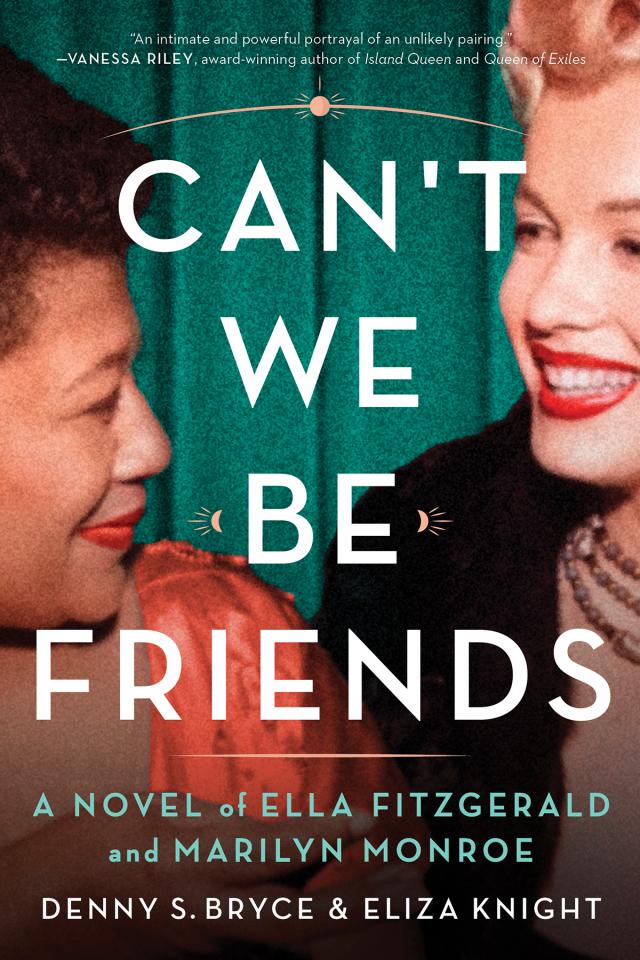
Dedication
For Ella and Marilyn
Epigraph
“Friendships between women, as any woman will tell you, are built of a thousand small kindnesses . . . swapped back and forth and over again.”
—Michelle Obama
Contents
Cover
Title Page
Dedication
Epigraph
Prologue
Part One: Improvisation Rough Ridin’
All about Eve
The Real Thing Comes Along
Gentlemen Prefer Blondes
The Man That Got Away
Oh, Lady Be Good
Crying in the Chapel
There’s No Business Like Show Business
Lullaby of Birdland
Part Two: Rhythm Someone to Watch Over Me
The Seven Year Itch
That Old Black Magic
River of No Return
People Will Say We’re in Love
Monkey Business
Sweet and Hot
As Young as You Feel
Asphalt Jungle
Pete Kelly’s Blues
Part Three: Harmony Niagara
The Man I Love
Don’t Bother to Knock
Hotta Chocolatta
Misty
Bus Stop
The Lady Is a Tramp
How to Marry a Millionaire
It Ain’t Necessarily So
The Prince and the Showgirl
Part Four: Melody Too Darn Hot
Mack the Knife
Some Like It Hot
Let’s Make Love
Between the Devil and the Deep Blue Sea
The Misfits
My Heart Belongs to Daddy
Somebody Loves Me
Something’s Gotta Give
Get Happy
Epilogue
Ms. Magazine
Authors’ Notes
Acknowledgments
Also by Denny S. Bryce
Also by Eliza Knight
Copyright
About the Publisher
Prologue
Ella
(Los Angeles, California, 1972)
Hit the high note—go for the C, then drop to the lower register and scat: beep-da-bop, dab-do-dee, ZING! When I do that, I disappear into the rhythm. I don’t think about what comes next. My body, my muscles, and my skin know what to expect. I don’t need to do anything special. I only need to be in that moment, in that zone. You know how it feels to be perfect. The same goes for a musical note, a tempo, or a chord, a song that swings forever.
Come on, girl. You’ve got this made in the shade.
Melodies and lyrics play through my mind as effortlessly as my next breath. I am lost in the magic of sound and music, but I don’t stay in my bubble as long as I’d like.
A breeze stirs. The tangy smell of my Imperial roses brushes the tip of my nose. I am in the backyard of my Beverly Hills home, sitting at the table on the patio in an iron chair with a red and white cushion beneath my bottom. It’s a sizable cushion. I have a sizable bottom, but that’s no nevermind.
I’m enjoying the flowers and the sunshine, but it’s hot for April. The patio table’s umbrella saves me from sunstroke but not from the sweat on my forehead.
“Ella, do you want to do this out here?” The sliding glass door opens, and Georgiana, my cousin, emerges. She’s a colorful dresser in her long red vest, flowery blouse beneath, and navy-blue slacks. Neither one of us are spring chickens—we’re closing in on our mid-fifties. But unlike me, Georgiana doesn’t suffer from swollen ankles or such a roller-coaster ride on the bathroom scale. She’s steady as they come and twice as agile, carrying a serving tray with a large glass pitcher of iced tea, a couple of matching 12-ounce tumblers, and long-handled spoons. She loves the groovy swirl pitcher set she bought at Gimbels, which she tells me repeatedly each time she pulls it out of the cabinet. But I’m more interested in how much sugar and lemon are on the tray and why she sliced the banana cake so thin.
“What’s all this for?”
“Don’t act like you don’t know,” Georgiana snips. “I told you about this interview two weeks ago.”
I knew about the interview. I just didn’t want to do it. “Interview? What kind of interview?”
“Same kind you’ve done a thousand times before.” She places the tray on the table with a loud thud. I expect broken glass, but nothing shatters.
“I don’t care how many interviews I’ve had, I never wanted to do a single one,” I say but am quickly resigned to my fate. “Who’s the interview for? What newspaper?”
“Ms. magazine, and I told you all this, Ella.”
“Tell me again.” My tone is harsher than I planned, which I can see by the shock in Georgiana’s eyes. “Pretty please, if you don’t mind.”
“This interview is different. It’s not about you.”
“Then why am I doing it?”
“It’s about Marilyn.”
My hand, which hovers over the banana cake, shakes. I lower it and glare at Georgiana, determined not to let on any more than I already have about what I am feeling. The idea of talking about Marilyn is upsetting. “Why can’t they let the dead rest in peace? Ten years in her grave, and her name is still on the tips of tongues in every corner of the globe.”
Georgiana sighs with impatience. “It’s a special issue commemorating the tenth anniversary of Marilyn’s death and what’s changed in America since, and what hasn’t. Particularly for women.”
“You mean for white women?”
“Of course, white women,” Georgiana says without missing a beat. “But one of the cofounders is Negro. Dorothy Pittman Hughes. I checked.”
“Why haven’t I seen this Ms. magazine on a newsstand?”
“You haven’t visited a newsstand in decades. Besides, didn’t I say it’s new?” She fills a glass with iced tea. “If I didn’t say it, it is—brand new. But Gloria Steinem is the other cofounder, and folks in New York publishing are saying it’s gonna be the feminist voice of America.” Georgiana wanders from the table toward the flowerbed closest to the sliding doors. But she isn’t leaving. She’s poking at the vines, fiddling with the Imperial roses, touching the leaves and the petals like the flowers won’t bloom without her help—which makes no sense since they’ve bloomed just fine every year since I planted them.
“It’s time women who have something to say have a place to say it,” Georgiana insists. She’s always trying to sound like a modern woman—while still bothering my roses. “Don’t you agree, Ella?”
I ignore her question. “We have a gardener who takes care of the flowers, Georgiana. You don’t need to meddle.”
My cousin gives me one of her sideways glances—which is damn hard to do when she’s not facing me. Even with her back turned, I can feel her withering glare. “Ms. is writing a huge spread in the August issue about Marilyn.”
Her hand drops to her side. “I’m not going to harm your precious flowers.” She grabs the sliding door handle and jerks it so roughly that I fear she’ll pull it out of the grooves. “The reporter will be here any moment.”
My stomach is in knots. “Don’t act as if it’s news that I dislike talking to reporters. I’ve never liked them.”
“I thought you wouldn’t mind as much this time,” she says.
“I am what I do, Georgiana. I sing. Drilling me about anything more than that is unnecessary. How I feel or felt about Marilyn is my business.”
“Uh-huh, sure,” Georgiana grumbles. “Gloria Steinem isn’t someone to play around with, Ella. I mean, she is the new generation. It wouldn’t hurt for you to have your name appear in a magazine read by these young people.”
I know she will not give in, but I refuse to give up.
“The magazine may or may not last.” She glances over her shoulder. “That’s what Norman implied, but what you say about Marilyn will be remembered.”
“When did you talk to Norman?”
“The other day. He heard about the article and mentioned it.”
Norman Granz had been my manager for decades and now lives in Switzerland, but he still keeps tabs on me. “So I guess I’d better come up with something to say.”
Georgiana rolls her eyes. “Don’t be like that, Ella.”
“Some things I can’t help.”
I watch her walk away, open the sliding door, and step inside the house, and then I start thinking about Marilyn and how we met: the highs and the lows.
Imagine you are in a race, driving a Jaguar at Le Mans, the Grand Prix of Speed and Endurance. To stay ahead of the pack, you turn corners fearlessly, accelerating on the curves, pedal to the metal, and a flat-out sprint on the straightaway. The past can’t catch up when you move that fast. When you are on the go because you know if you stop, you lose.
I don’t stop. Marilyn didn’t want to stop moving, either. Like me, she tried to leave the past on the fairway and the pain in her rearview. Like me, she wanted to keep beating back the memories we shared of lost mothers, evil stepfathers, orphanages, and early marriages that go bad so fast that you think they were a dream.
I never wanted to remember the past. It IS a struggle to let go of such a large part of yourself. When I met Marilyn, I was somewhere between the past and present. I was the Queen of Jazz, and she was the Queen of the Silver Screen, but like any successful entertainer, the girl we show outside vastly differs from the girl behind closed doors.
There was no reason for us to have met anywhere other than at the usual spots where the chosen of Hollywood and the music scene gathered—nightclubs, award shows, smoky back rooms where we let down our hair.
But that was not the scene for us. Our meeting was not an accident or a publicity stunt; it was because of a song.
It wasn’t roses and valentines at first. Not for me. I was too busy hanging on to a long-gone love and hiding my failure behind as many live performances or studio sessions as my manager could book. Still, somehow Marilyn found a way in. And I’m not easy. But that girl. Determination should’ve been her nickname. For I swear, she was something else. Reminded me of me. And I think, vice versa, until things, well, until things went haywire.
The doorbell rings. Georgiana opens the sliding glass door. “She’s here. Do you want me to stay?”
I shove my hand into my skirt pocket and remove a pack of gum. “No, I’m fine. I know what I’m going to say. You tell that reporter she can come on out. I’m as ready as I’ll ever be.”
Part One
Improvisation
(1952–1954)
Rough Ridin’
Ella
(1952)
“What are you doing, Ella?”
Georgiana stands in my bathroom doorway with a question I plan to answer in a moment, but it’s hard for me after the night I’ve had not to go overboard. Too many emotions, too many serious thoughts, too much concern about her feelings, my feelings, and my husband, rolling around in my exhausted mind. So, I need parameters.
Or perhaps, I should stop overthinking everything and answer her. “I am doing exactly what you see me doing, sitting on a stool in front of my vanity, putting on makeup.”
My voice is too shrill, judging by Georgiana’s sourpuss expression (she looks like she has a piece of peanut brittle caught in her teeth). So, I apologize. “Sorry. Sorry. Just give me a few moments.”
She waves a fistful of mail. “It’s high noon, and you’ve got letters to read and an appointment with a dress designer in Manhattan in two hours. Remember your new wardrobe? You can’t go to Europe looking like a ragamuffin.”
I stare at her reflection in my vanity’s three-sided mirror. She is fashionably attired in a Chanel navy-blue suit, her hair styled in a short poodle cut, and the oversized pearl clip-on earrings are an enviable touch. Always buttoned up on the outside, that’s Georgiana. However, inside, she is a different kind of mess from me.
She strolls farther into the bathroom, eyes peeled, searching for who knows what. “Are you going to keep staring at yourself in the mirror or get ready?”
“I just might,” I say defensively. With no performances to prepare for or recording sessions to rush to, I wouldn’t mind spending a day in my pink bathrobe with pink rollers in my hair. Honestly, I am too tired to move.
Late last night, I returned from California and my fourth Jazz at the Philharmonic, or JATP, US tour. Unhinged after a long flight, an argument with Ray, my husband, and a sleepless night, Georgiana’s noon is far too early for me to be bright-eyed and bushy-tailed.
I glare at my cousin. “Why are you always barging in on me? Bugging me. I don’t like it.”
“It’s my job as your assistant to bug you. Besides, you don’t mind it one bit,” she says. “I’ve been barging in on you for twenty years.”
“Doesn’t change the fact that I have a right to some privacy, Georgiana.”
“Don’t we all,” she drawls, her gaze still surveying the bathroom as if she’s never seen it before.
I had it redesigned a year ago after my husband and I split up for the umpteenth time. I count in my head quickly. It feels like the breakups happen every other week lately.
As I muse, Georgiana stands next to the extra stool in the bathroom I keep for Ray (or should I say kept for Ray). She is squinting at the shower stall with a not-in-the-least-bit-subtle tilt of the head.
Suddenly, I know what she’s up to. “Ray is not hiding behind the pink plastic curtain, Georgiana. So, you can stop searching,” I say with a voice as light as a feather. Unsurprisingly, I never sound as angry as I feel. I used to think I’d lose my gentle tone as I grew into womanhood. But it’s come in handy over the years, and now, at thirty-five, I can’t let it go.
Looming behind me, Georgiana bends her knees, and I think she is about to hug me. She must’ve noticed I am a bit out of sorts.
“What kind of lipstick is that?” She reaches over my shoulder, and I pass her the Revlon Raven Red. “Thanks.” She applies the color. “How do I look?”
“Like a more dressed-up version of me—but a little thinner.”
“Ella, please. Don’t start with that. It’s a beautiful day. Let’s not spoil it with your nonsense.”
“I’m fine. Just big-boned, but at least I’m famous. Isn’t that what the reporter wrote in the Jet magazine article with that damn title: ‘Famous Fat Women’? People act like the way it was written, I should be honored to be included. Right?”
Georgiana takes a seat on Ray’s stool. “Let’s not talk about that article again.”
I snap shut the lid to my compact. “Why do reporters come up with the most tiresome topics?”
Georgiana sighs loudly and drops the mail in her lap.
After a long pause, I decide to change the subject. “I like your hair. That’s a cute style.”
She shrugs. “Compliment me all you want. You still need to hurry.” She stacks the letters in her lap. “Are you feeling okay? I could hear you and Ray arguing in my room on the other side of the house.”
Goodness, gracious! Were we that loud? Her rooms are far away. As Ray calls it, my Tudor mansion is like most Tudor-style homes, with steeply pitched roofs, stonework, and a stucco facade. It also has many large rooms and long hallways. I needed the space for my family and extended family, not only for Georgiana, my mother’s sister Virginia Williams, and of course, my adopted son, Ray Jr., but also for visiting cousins, uncles, and aunts. I wanted everyone I loved under one sizable roof.
“I’m fine,” I say to Georgiana. “Sorry if we kept you up. We got into it about Ray Jr.” The frustration of the fight still holds my stomach in knots. I adore my son, but with my schedule, I scarcely see him. It drives me batty, and my husband knows it—and he also knows exactly where to poke.
“How is it that Ray is on the road with the JATP tour or the Oscar Peterson Trio every other weekend but wags his finger at me as the reason we aren’t a family?” My lower lip quivers, and I bite down to stop it. “He says now I’ll get a taste of what he’s been going through for the past two years—me being too busy for him or our child.” I face Georgiana. “Is that true? Am I to blame?”
“I’m sorry, Ella, but you do work a lot.”
“Work? Singing is not a job to me. It is who I am, Georgiana. Why can’t anyone understand that? Ray won’t stop doing what he does best. Why should I?”
“I don’t think he wants you to stop. Just slow down.”
“Are you on his side? Then tell me, who’s going to pay the bills around here? Huh? Everyone in this house works for me. If I’m not working, how are you gonna get paid?”
Georgiana rolls her eyes. “Okay. Take it easy. You’re mad at Ray. Don’t take it out on me.”
Why do I bother? No one understands. Not Georgiana and certainly not my husband.
“Forget it. Let’s talk about something else.” I turn to the mirror, pick up my powder puff, and pat my cheeks a little too roughly. “What’s in the mail?”
“Some bad news and some good news, or perhaps, I should say, interesting news.” Georgiana pulls a letter from the pile in her lap.
“We heard from the Mocambo Club.”
I freeze. The nightclub is the dream booking. The Los Angeles Sunset Strip is the new home of the hottest nightclub scene in America. But I can’t get a nibble. I square my shoulders, bracing myself for the news. “Go on, Georgiana. Rip off the Band-Aid.”
“They’re booked for the next season, according to their manager. I also tried some of the other spots on the Strip, Ella. They’re all booked.”
“As soon as they hear my name, I bet they are,” I say. “It would be easier to fight back if the reason was I’m Negro.” The catch in my throat is unplanned. “Dorothy, Sassy, Eartha, Lena. They’ve all played in those clubs. Singing jazz, blues, or show tunes, didn’t matter. What mattered is not one of them measured more than 36-24-36.”


