

The children left behind, p.1
The Children Left Behind, page 1


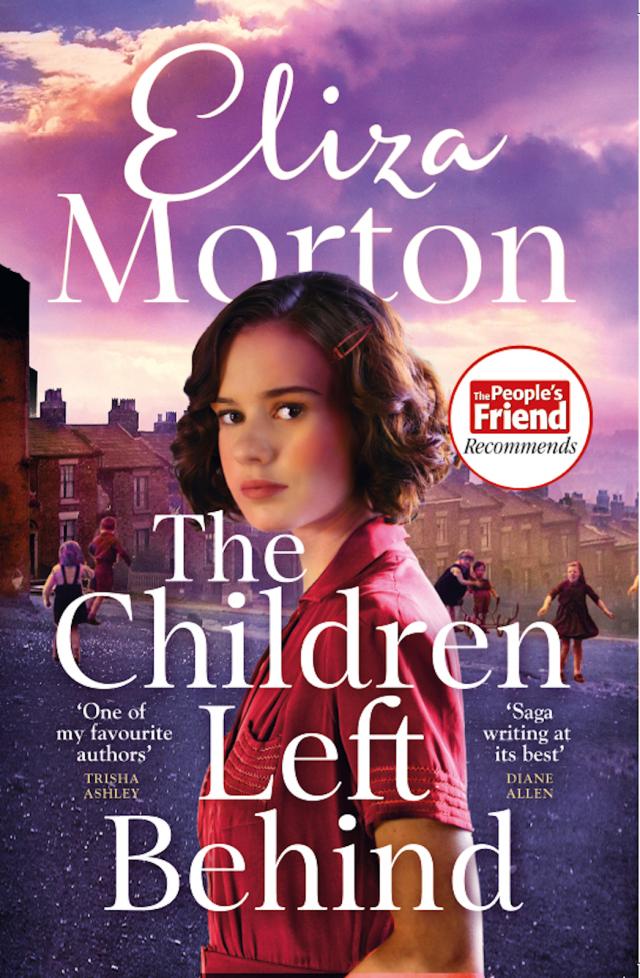
Eliza Morton
The Children Left Behind
Contents
Prologue
Chapter 1
Chapter 2
Chapter 3
Chapter 4
Chapter 5
Chapter 6
Chapter 7
Chapter 8
Chapter 9
Chapter 10
Chapter 11
Chapter 12
Chapter 13
Chapter 14
Chapter 15
Chapter 16
Chapter 17
Chapter 18
Chapter 19
Chapter 20
Chapter 21
Chapter 22
Chapter 23
Chapter 24
Chapter 25
Chapter 26
Chapter 27
Chapter 28
Chapter 29
Chapter 30
Chapter 31
Chapter 32
Chapter 33
Chapter 34
Chapter 35
Chapter 36
Chapter 37
Chapter 38
Chapter 39
Chapter 40
Chapter 41
Chapter 42
Chapter 43
Chapter 44
Chapter 45
Epilogue
Acknowledgements
The People’s Friend
For Alice
Prologue
November 1940
‘Bob! Matty! They’re coming, look – Jerry!’ gasped Alice Lacey, her eyes round with fear.
Crouched behind a low wall on the high, windy ridge of Everton Hill, the three children had a perfect view of the Luftwaffe swooping over the River Mersey. Two sharp cracks were followed quickly by flashes that splintered the dark and lit up the sky a vivid orange. Tipping her head, Alice heard the whistle followed by the soft thud of a bomb falling, and then another. And another. The air-raid sirens wailed as an unpleasant sulphurous smell wafted across the river, making their throats and nostrils itch. The Liver Birds on top of the Liver Building, with their outstretched wings, looked like Greek gods. Along the water, the squat silhouettes of the warehouses made them seem indestructible – and yet, the bright moon surely meant Liverpool was a sitting duck tonight.
Alice turned to the boys sitting either side of her, white-knuckled, their mouths gaping open. ‘Told you it’d be like nothing you’ve ever seen or heard,’ she said. ‘Me hairs are standing up on the back of me neck like knives. Are yours?’
‘Bloody Nora!’ said Bob, as another explosion came. The sky lit up again. He winced and instinctively ducked. Alice felt his hand find hers, their fingers threading together as the air around them hissed. There was a jolt, something that shot through her like electricity. And there it was again – the crack, the split in the sky. Was it getting closer? Were they coming right overhead, here to Everton Hill?
Matty had clamped his hands over his ears. ‘We should go to the shelter now,’ he said. He looked around him, chewing his lip. There was another small group of people standing a little way away, transfixed by the Heinkel planes, the night flares and a fallen power line that was jerking and spitting fire like a dragon.
Bob, with his scruffy shorts and a baggy jumper so scrappy it looked as if the cuffs and hem were edged with lace, leapt to his feet, excitement fizzing through him. ‘No, let’s stay. It’s the craic, isn’t it?’
The surface of the Mersey, in a sudden blaze of light, looked like it was covered in silver ruffles. Alice felt a fear like she had never felt before. Different from the fear she’d felt when her ma had scarlet fever and nearly died, or when Bob had almost drowned when he had fallen into an Emergency Water Supply oil drum. Worse? No. But different. What they were witnessing now was more deadly – an evil, unnatural force.
Matty leapt to his feet, picked up a stone and chucked it randomly. Alice continued to gaze, wide-eyed, across the Mersey.
‘Alice? Shall we go to the shelter?’ said Matty. But she just pushed her wild brown hair off her face, still transfixed by the sight of the planes that had looped back and were flying low again, roaring over the water.
‘Alice, answer me. If you want me to read your mind, give me something to work with. I can’t stand here waiting to get bombed. We’ve seen it now. Your great idea, but we could flippin’ die. You as well, Bobby. You daft or summat? Let’s go.’
Bob twisted his head. ‘I’m excited,’ he said, fidgeting and hopping about. They could feel the throb of the aircraft reverberating in the quivering earth beneath their feet. ‘The sky’s on fire. You can see every field out in Wales. Our Tommy’s there. Evacuated. He rides on a pig and eats Welsh cakes with treacle.’
‘I’m glad I’m not in Wales,’ said Alice.
‘Aye. Our mams don’t care enough about us to send us to a safe place, don’t care if we have bombs dropping on our heads. That were a loud one!’ Bob added, at the sound of another ear-splitting explosion.
Alice grinned. ‘Me cousins have gone with me auntie to Parbold, but Ma needs me to help with the house and the flaming coal scuttle. It would be too much for her if she was on her own. Da’s down at the docks all the time. She’s terrified it’ll be him and his pals who cop it next.’
‘I just want this war to go on long enough so that I’ll be old enough to join up. Pow-pow,’ Bob said, shooting his imaginary gun. ‘I wanna fly a Spitfire,’ he added, raking a hand through his mop of blond hair.
‘You’re only nine. You saying you want this war to go on for seven more years?’
‘The last one nearly did.’
‘That’ll never happen. It’ll be over by Christmas, me auntie reckons,’ said Matty.
‘No one knows anything,’ said Alice. She paused. ‘Look, there’s more coming! Horrible mechanical birds . . .’ she murmured.
‘Your da, Alice? Port Authority reservist, isn’t he? It’s the docks they’ll be going for again tonight. You worried?’ said Bob. There was another loud explosion, and the small fires dotted about on the hillside on the opposite side of the river began to lick into life.
‘Let’s go,’ said Matty seriously. ‘Your ma will flip her wig, Alice. She’ll be running from shelter to shelter looking for you.’
‘You chicken, Matty?’ asked Bob, hands jiggling the marbles in his pocket.
‘No. But if anyone knew we were here outside . . . They’ll be over our heads soon. Alice, come on.’
‘Don’t you worry about me, Matty. I can look after myself.’
But then she gasped. A figure was coming over the top of the hill, hurrying towards them. ‘Ma!’ Alice cried, leaping off the wall and losing her footing.
‘Alice, what the blazes are you doing out here with those two eejits?’ Ida Lacey cried. She was breathless, hair flying from under her paisley turban, with an expression on her face as though she was in actual physical pain. The sky flashed, red this time, full of fire and dust and ash. More whistling, followed by a terrifying roar.
‘But doesn’t it look beautiful, Ma? The sky. The colours. We came out to look.’
‘Beautiful? What the heck are you on about? That’s people’s lives being destroyed. Head in the clouds, Alice! I could wallop you, I could. You need a dose of this war to wake you up to the real world.’
‘How did you know I was here?’
‘Bob shouting his mouth off to Mrs Bannock down the grocer’s that he was going fire-watching. And these days, Alice, you don’t have to be a genius to work it out. Where Bob goes, you go. You two stick together like glue, more’s the pity. I would have thought better of you, though, Matthew.’
‘Ta very much, Mrs Lacey,’ said Bob.
‘He dared me,’ said Matty. ‘I didn’t want to come.’
‘Matty’s a chicken,’ retorted Bob, and started making clucking noises and flapping his arms.
‘Jesus, Mary and Joseph, if you were one of my own, I’d crown you. Go home, boys.’
‘Where’s Da? The docks? Them planes are heading for the docks,’ said Alice.
There was another whump-whump and the screeching of a plane. ‘Never mind Da. Come on!’ said her mother.
Alice hurried along, the boys following: Bob sturdy and strong, Matty so skinny he looked as if he might fall over if you were to blow on him. She could feel her heart pounding, thumping in her chest. They were halfway down Scottie Road, but there would be no trams running tonight.
‘Missus, you lot should be indoors,’ cried an ARP warden. An arc of water spilled out from the stirrup pump he was holding, and he looked down and frowned as though he were puzzled to see that his shoes were wet, even though he could surely feel water seeping across the soles of his feet. ‘You can’t go down there. Road’s blocked off.’
Ida stopped. ‘But how will we get back home?’
‘Where d’you live?’
‘Dryburgh Terrace. Far end of Liverpool Lane. By the overhead railway.’
‘You won’t make it. Come with me.’
He led them around the corner to a co-op store and banged on the door. When it was opened by a young woman, the smell hit them first – damp, musty and overpowering. Alice pinched the sides of her nostrils together. There was the sound of a hacking cough. A small oil lamp lit the cramped, low-ceilinged room. In the gloom she could see a couple playing cards, bodies hunched sitting on the edge of the beds, some lying under blankets trying to sleep, a young woman and a man dancing.
‘Any room?’ said the warden. ‘The shelte
The girl sitting at the desk took their names and let them in. Bob and Matty went down the stairs to the basement first, followed by Ida and Alice, taking care not to trip over a few people sitting on the bottom steps.
Peering further into the darkness, Alice could see two figures on a small camp bed wedged into an alcove. They seemed to be doing something unspeakable under a blanket.
‘Filthy beasts,’ said Ida, shocked. ‘Come on, Alice, don’t look.’ She grasped her daughter’s hand as they began making their way through the rows of beds.
‘Stand back!’ cried the ARP man when Ida and Alice got back to Dryburgh Terrace the next morning, exhausted. They had left early after the sound of the all-clear.
Nothing could have prepared them for the scene waiting for them. Opposite their house, where number eight used to be, there was now nothing but a gaping hole. Dwindling fires and plumes of smoke were everywhere. Windows were blown out and shattered. An ambulance was parked in the middle of the road. Their neighbour Miss Quick, clutching a photograph in a silver frame and a Bible to her chest, was picking her way through the rubble, stopping now and then to sort through the debris or pull a single shoe from under a lump of cement.
Two men stood nearby. One, heavy-featured and stiff-looking in an ill-fitting grey suit, was making notes with a clipboard. The other, in brown with a bowler hat, counted to himself as he walked from one heap of rubble to the next. ‘Three houses lost in Sidney Place. St Mary’s orphanage almost hit. Missed by a hair’s breadth. The outhouse damaged, though,’ he said.
The other man nodded seriously.
Alice tugged on her mother’s sleeve. ‘Ma, Miss Quick’s bloomers,’ she murmured. ‘Snagged on that washing line . . .’ Poor Miss Quick. How embarrassing, thought Alice as she clambered over a pile of bricks, reached out and unhooked the bloomers from the jagged post. It seemed like the final indignity. She rolled them up into a tight ball and slipped them into her pocket.
Ida was staring in disbelief at the devastation all around them. ‘This is just the beginning, isn’t it?’ she asked the man with the clipboard.
He nodded, looking pained. ‘Yes. A lot worse to come, I’d say.’
And yet, how could he know – how could anyone know – the extent of the trauma these terraces would experience over the coming year? That the washhouse would be hit by a bomb and the grocer’s shop would become a heap of rubble? Or that the SS Malakand would burn for two days down at the docks, the flames so fierce you could read a newspaper by their light all night long? And Alice’s father would be nicknamed ‘Lucky Lacey’ after crawling out half-dead from the wreckage, having sheltered under a wet tarpaulin? Who could know that an incendiary would whizz through Mrs Bannock’s front room while she was peeling a turnip, killing her instantly? Or that shrapnel would smash every window of every house in the terrace, and yet another bomb would mangle the overhead railway into twisted metal?
The man in grey frowned. ‘God willing, that fellow with the toothbrush moustache will come to his senses soon. We live in hope. And whatever happens, we’ll rebuild. We’ll rise from the ashes and we’ll be better for it. This city is resilient. And the people with it.’
‘Hard to imagine how, looking at the way their lives have been destroyed . . . their homes lost . . . Where are all these families going to live now?’ murmured the man in the bowler hat, poking the tip of his umbrella into the rubble.
‘We should see this as an opportunity to improve things for these people. This is what we’ve dreamed of. Slum clearance. The chance to bulldoze this whole street, as well as all the dreadful slums and tenements around here.’
‘What Hitler makes a good fist of, we might finish off properly, you mean?’
‘I suppose I do. Yes, I suppose I do . . . But that’s an awkward way to put it. Don’t let anyone around here catch you saying that. Hey, you, sir . . .’ he called out to a young man approaching one of the houses. ‘You can’t go in there.’
‘But I live here,’ the young man said, bewildered.
‘Sorry. It’s dangerous.’
‘Who are you to say we can’t go into our house?’ said a woman lurching along behind the young man.
‘We’re from the Corporation. Here to inspect the damage – and I’ve done just that, and it’s not fit for purpose. The beams. They’re shot to pieces.’
‘But we need to get our things . . .’
‘Stay back,’ he replied.
Ida’s neighbour, Miss Quick, looking thin and harried, approached them. ‘Sir, I need to find my cat . . . Pennywise . . .’ Her lip trembled.
‘I’m sorry, but next door has completely gone. Which means, without a buttress, these houses could collapse at any minute. The cat, I’m afraid—’
‘There she is, Miss Quick!’ Alice cried. Miss Quick turned with a gasp to where Alice was looking, then hurried over and scrambled under a rope barrier to scoop up the cat. It mewed faintly.
The man sighed. ‘Take the cat and wait over there. We’ll find you all somewhere else for tonight. Somewhere better, safer, warmer.’
‘But I want to stay here. My house. My home. Shove off,’ said the cantankerous first woman, jabbing a finger at him.
Alice winced as the wind blew hard and another pane of glass shattered. She saw another man running up the street towards them.
‘Excuse me,’ he said as he reached them, slightly out of breath. He was wearing oddly shaped spectacles and a jacket buttoned up with the buttons in the wrong buttonholes. Ida turned to face him. ‘Do you live here?’ he asked.
‘Yes – across the road and a few doors down.’
‘I’m looking for a boy. Brown hair? Heavy fringe? Nine years old.’
‘Ma!’ Ida turned to see Alice standing on a small heap of bricks, waving at someone far off. Everywhere around her was destruction. ‘Matty! Bob!’ she called, cupping her hands around her mouth, then shoving two fingers between her lips and whistling at them to get their attention. ‘We found Pennywise!’
Miss Quick was beaming, cradling her cat.
‘This lad a relative of yours?’ Ida asked the man, distractedly.
‘Relative? Well, he’s . . .’
‘Matty!’ yelled Alice.
The man didn’t finish the sentence, just turned and followed Alice’s gaze. ‘Ah . . . I think that’s the boy. That’s Matthew. That’s the lad.’ For a moment he just stared, watching Matty step gingerly from brick to brick. Then, in a sudden, surprising gesture, he scooped a chain out from under his shirt collar, unclasped it and took it off, pressing it into Ida’s hand. ‘Will you give the lad this?’ he said. ‘It’s a St Christopher medal. Some call it superstition, I know.’
If Ida hadn’t been agog at the wobbling chimney stack she had just noticed on top of the end house, she would have asked him why he wanted the boy to have it. It seemed odd that he didn’t want to give it to the lad himself. What’s he to you? she would have asked.
But before she had time to think about it, the man was moving away, picking his way through the rubble. He disappeared over the mound of bricks just as a fireman arrived and began to unravel a hose, shouting for everyone to move back as water began to splutter and gush from the end of it.
Ida said, ‘Tell Matty to come here. Fella in a fancy suit gave me this for him.’
‘Pretty,’ said Alice, taking it from her mother, threading the chain through her fingers and turning over the gold medal. It was engraved with a stooped figure carrying a lamb on his back. ‘Can I have it?’
‘You certainly cannot,’ said Ida. ‘Matty! Come over here before Alice gets her thieving hands on your necklace!’
And then in that same moment, there was a loud crash as the end house teetered and the smouldering roof gave way under the pressure of the fireman’s hose, collapsing in on itself.
‘What was that?’ said Alice, wide-eyed.
Ida sighed. ‘That was the sound of another person’s life going down the Swanee. But you know what they say – we survived yesterday, we’ll get through today, and we’ll do it all again tomorrow. Come on, let’s go and find your da, and then we can all have a nice cuppa.’
Chapter 1
June 1950
Ida Lacey stood with her sewing basket staring up at St Mary of the Blessed Angels orphanage, with its red-brick walls and Gothic windows. An alabaster statue of the Virgin Mary smiled down at her serenely from an alcove above the arched front door.


