

Fever, p.1
Fever, page 1


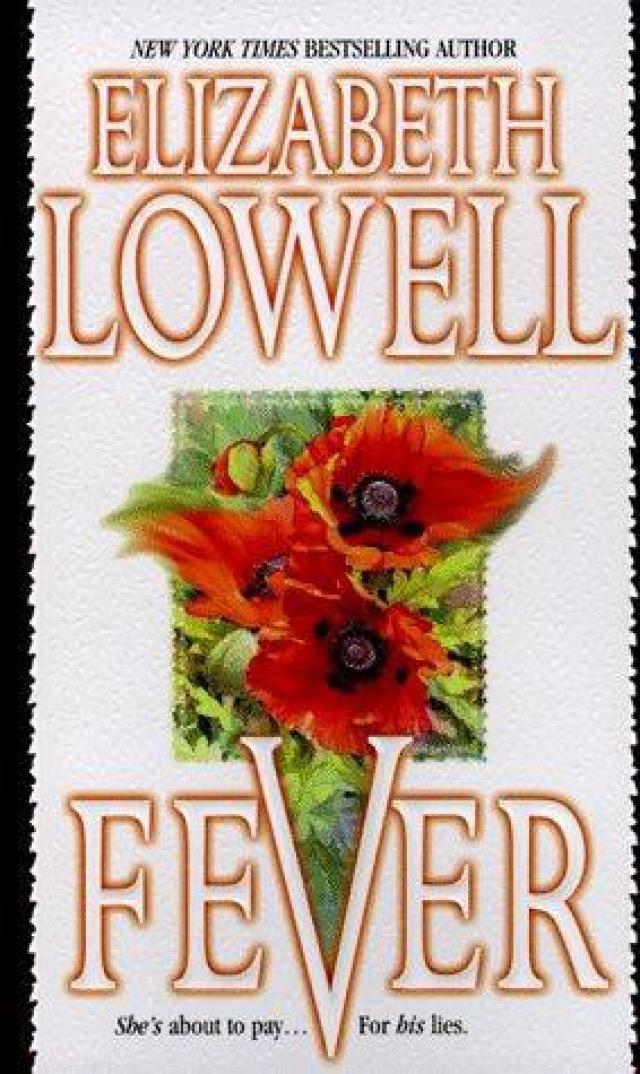
“You’ll need both hands for this.”
“When you swing the ax back, let your right one slip up the handle. But whatever you do, always hold on hard with your left, like this. Want to try it?” he asked.
When she took the ax, her fingers brushed over his.
Rye stepped back and reached around Lisa until his hands were positioned above and below hers on the long handle. Every time she breathed in, a blend of evergreen resin and warmth and man filled her senses. His skin was smooth against hers, hot, and the hair on his arms glistened beneath the sun in shades of sable and bronze.
With each motion Rye made, his chest brushed against Lisa’s back, telling her that barely a breath separated their bodies.
“Lisa?”
Helplessly she looked over her shoulder at Rye. His mouth was only inches away.
“Come closer,” he whispered, bending down to her. “Closer. Yes, like that.”
“I’ll buy any book with Elizabeth Lowell’s name on it!”
– -Jayne Ann Krentz
Also available from MIRA Books and ELIZABETH LOWELL
OUTLAW
GRANITE MAN
WARRIOR
TELL ME NO LIES
TOO HOT TO HANDLE
LOVE SONG FOR A RAVEN
FEVER
Coming soon
CHAIN LIGHTNING
October 1999
ELIZABETH
LOWELL
FEVER
If you purchased this book without a cover you should be aware that this book is stolen property. It was reported as “unsold and destroyed” to the publisher, and neither the author nor the publisher has received any payment for this “stripped book.”
ISBN 1-55.166-488-7
FEVER
Copyright © 1988 by Two of a Kind, Inc.
All rights reserved. Except for use in any review, the reproduction or utilization of this work in whole or in part in any form by any electronic, mechanical or other means, now known or hereafter invented, including xerography, photocopying und recording, or in any information storage or retrieval system, is forbidden without the written permission of the publisher, MIRA Books, 225 Duncan Mill Road, Don Mills, Ontario, Canada M3B 3K9.
All characters in this book have no existence outside me imagination of the author and have no relation whatsoever to anyone bearing die same name or names. They are not even distantly inspired by any individual known or unknown to the author, and all incidents are pure invention.
MIRA and die Star Colophon are trademarks used under license and registered in Australia, New Zealand, Philippines, United States Patent and Trademark Office and in omer countries.
Printed in U.S.A.
To Francis Ray, salt of the earth and sweetness, too.
Chapter 1
Ryan McCall climbed out of the battered ranch pickup and instantly began unbuttoning his city shirt. He had flown from Texas to a small local landing strip in Utah where he kept one of the few luxuries he had bought for himself – a plane that could get him in and out of his father’s life in nothing flat. From the airstrip he had driven in the pickup over increasingly primitive roads until he reached his home in the early afternoon. He had loved every rough inch of the way, because each rock and rut meant that he was farther removed from the father he loved and could not get along with for more than a few minutes at a time.
“It was worth it, though,” Rye told himself aloud as he stretched his long, powerful arms over his head. “That Angus bull of his is just what my herd needs.”
Unfortunately it had taken Rye two weeks to convince Edward McCall II that his son would not, repeat not, marry some useless Houston belle just to get his hands on the Angus bull. Once that was understood, the negotiations for the bull had gone quickly.
Rye turned his face up to the afternoon sun and smiled with sensual pleasure at the warmth pouring over him. The Texas sun had been hot. Too hot. He preferred the golden heat of Utah’s mountain country, where the lowland’s fierce sun was gentled by altitude and winds smelling of piiion and distant pines. The air was dry, brilliant in its clarity, and the small river that wound through the Rocking M was a cool, glittering rush of blue.
Eyes closed, shirt undone, Rye stood and let the peace he always felt on his own land steal over him. It had been a long two weeks. His father had just turned sixty. His lack of grandsons to carry on the family name had been duly noted – about six times an hour. Even his sister, who was normally a staunch ally, had told him sweetly that she would be bringing up a very special girl for the end-of-the-summer dance Rye always held at his ranch. Rye had ignored his sister, but he hadn’t been able to ignore the endless stream of moist-lipped debutantes or accomplished divorcees who were trembling with eagerness to get their perfectly manicured claws into the McCall pocket-book.
Rye’s mouth shifted into a sardonic smile. He could afford to be amused by the women’s transparent greed now; he was home, beyond their reach, and he thanked God for every instant of his freedom. Whistling softly, he pulled out his shirt-tails and leaped onto the porch without touching any of the three steps. The movement was catlike in its speed, grace and precision.
Since Rye had come into his mother’s small inheritance at twenty-one, he had spent his time digging postholes, felling trees and riding thousands of miles over his own ranch. The hard labor showed in his powerful body. The lithe flex and play of muscles beneath tanned skin had attracted more than one feminine glance. Rye discounted his appearance as any part of the reason women lined up at his door, however. He had seen his father and his younger brother fall prey to too many greedy women to believe that any woman would want him for any reason other than his bank account, which meant that he had very little use for women at all.
The instant Rye walked into his house, he knew that someone else was there. The room smelled of perfume rather than the sunshine and fresh air that he preferred. He turned and saw a woman standing in the dining room. She had pulled open a sideboard drawer and was looking at its utilitarian contents with a combination of curiosity and disbelief.
“Taking inventory?” Rye asked coolly.
The woman made a startled sound and spun to face him. The movement sent black hair flying. There was no shifting of cloth, however; the clothes she was wearing were too tight to float with any movement she made. Big, dark eyes took in every detail of Rye’s appearance. They widened at the breadth of his shoulders and the thick mat of hair that began at his collarbone and disappeared beneath the narrow waist of his pants. The speculation in the woman’s eyes increased as she approvingly inspected the fit of his slacks.
A single fast look told Rye that his father had gone all out this time. The woman was built like a particularly lush hourglass and had paid a tailor to prove it. Not a single ripe curve went unannounced. The blouse was too well made to strain at the buttons with each breath she took, but it was a near thing. Automatically Rye put her in the “experienced divorc6e” category.
“Hello,” she said, holding out her hand to him and smiling. “My name’s Cherry Larson.”
“Goodbye, Cherry Larson. Tell Dad you tried, but I threw you out so hard you bounced. He might feel sorry enough for you to buy you a trinket.” Rye’s words were clipped, as cold as the gray eyes staring through Cherry, dismissing her as he turned away.
“Dad?”
“Edward McCall II,” Rye said, heading for the staircase, pulling off his shirt. “The Texan who paid you to seduce me.”
“Oh.” She frowned. “He told you?”
“He didn’t have to. Overblown brunettes are his style, not mine.”
The bedroom door slammed, leaving Cherry Larson to examine the stainless steel flatware in peace.
A few moments later Rye emerged in boots, Levi’s and work shirt. Cherry was still standing in the dining room. He passed her without a look, lifted his hat from a peg by the kitchen door and said, “I’m going for a ride. When I get back, you won’t be here.”
“But – but how will I get into town?”
“Wait around for a silver-haired cowboy called Lassiter. He loves taking women like you for a ride.”
Rye walked to the barn with long, angry strides. The first thing he saw was Devil, his favorite mount. The big horse was tied to the corral fence, swishing flies with a long, black tail. Saddled, bridled, ready to go.
Instantly Rye knew that at least one of the cowhands had realized how he would react when he saw the woman lying in wait for him in his own home. He’d bet that the thoughtful cowhand had been Jim. He was happily married, yet he fully sympathized with his boss’s desire to stay single.
“Jim, you just earned yourself a bonus,” Rye muttered as he untied the reins and swung onto the big black horse.
Devil bunched his powerful haunches and tugged impatiently at the bit, demanding a run. He hadn’t been ridden by anyone during the weeks that Rye had been gone, and Devil was a horse that had been born to run.
There was no one in sight as Rye cantered out past the barn. For a moment he wondered about the fact that none of his men had turned out to say hello, then he realized that the hands were probably back in the barn somewhere, laughing at his reaction to the lushly baited trap set in his lair. The men could have warned him about Cherry’s presence, but that would have spoiled the joke, and there was nothing a cowboy loved better than a joke – no matter who it was on. So they had just made themselves scarce until the fun was over.
Reluctantly Rye smiled, then laughed out loud. He spun the big horse on its hocks just in time to see several men filing out of the
As the trail to McCalFs Meadow glided by under Devil’s long stride, Rye relaxed again, relishing his freedom. The high, small meadow was his favorite part of the ranch, his ultimate retreat from the frustrations of being Edward Ryan McCall III. Usually he was one of the first people to reach the mountain meadow after the snow melted in the pass, but the melt had come very late this year. He hadn’t had time to get to the meadow before he had gone to Houston to negotiate for the purchase of one of his father’s prize bulls.
Before Rye had bought the ranch, the various high meadows had been used as summer pasture for cattle and sheep. Most of the meadows still pastured cattle. The small, high bowl that had come to be called McCall’s Meadow hadn’t been touched for ten years. Dr. Thompson had been very eloquent in his plea that Rye, as one of the few ranchers who could afford it, should be the one to lead the way in allowing a small part of his land to return to what it had been before white men had come to the West. The resulting patterns of regrowth in the plants and the return of native animals would be studied in detail, and what was learned would be used to help reclaim other lands from overgrazing.
In truth, Rye hadn’t needed much persuading to participate in Dr. Thompson’s study. Rye might have been born in the city but he had never loved it. He loved the rugged land, though. He loved riding through sunlight and wind and silence, and seeing mountains rise above him, their flanks a magnificent patchwork of evergreen forest, blue-gray sage and quaking aspen that turned from green to shimmering silver under a caressing breeze. The land gave him peace.
And if a man took care of the land, unlike a woman, the land would take care of him in return.
That same afternoon Lisa Johansen sat by a mountain stream and slowly trailed her fingers through the cool, clean water. The sunlight that smoothed over her was as warm and sensual as her daydream, making a languid heat uncurl deep within her as she stretched to meet her dream. He will be like the mountains, strong and rugged and enduring. He will look at me and see not a pale outsider but the woman of his dreams. He will smile and hold out his hand and then he’ll gather me in his arms and…
Whether she was awake or asleep, the dream always ended there. Wryly Lisa acknowledged to herself that it was just as well; she had a thorough intellectual understanding of what came next, but her practical experience in a man’s arms was one zero followed by another and another, world without end, amen. Isolation from her peers had been the biggest drawback to the kind of life she had led with her parents, who were anthropologists. There had always been men about, but none of them were for her. They had been tribal men who were cultural light-years apart from herself and her parents.
With a sigh Lisa scooped up a palmful of water and drank, letting the shimmering coolness spread through her. After two weeks, she still didn’t take for granted the mountain water flowing clean and sweet and pure, day and night, a liquid miracle always within her reach. As she bent to drink again, the muted sound of hoofbeats came to her.
Lisa straightened and shaded her eyes with her hand. At the entrance to the high, small valley were two riders. She stood up, wiped her dripping hand on her worn jeans and mentally reviewed her meager supplies. When she had taken the job of watching over McCall’s Meadow through the brief, high-country summer, she hadn’t realized that she would need to buy so many supplies from her tiny food budget. But then, she hadn’t realized that Boss Mac’s cowboys would be such frequent visitors to the meadow. Since she had first met the cowboys ten days ago, they had been back almost every day, swearing that nobody made pan bread and bacon like she did.
The shorter of the two cowboys took off his hat and waved it in a wide arc. Lisa waved back, recognizing Lassiter, Boss Mac’s foreman. The man with him was Jim. If they had other names, the men hadn’t mentioned them and she would never ask. In many of the primitive tribes among which she had been raised, to ask someone for his full name – or for any name at all – was unspeakably rude.
“Morning, Miss Lisa,” Lassiter said, dismounting from his horse. “How’re them seeds doing? They slipped through that old fence and flown away yet?”
Lisa smiled and shook her head. Ever since she had told Lassiter that she was here to watch the grass seeds growing within the big meadow fence, he had teased her about runaway seeds that needed to be “hog-tied and throwed ‘fore they learned their rightful place.”
“I haven’t lost any seeds yet,” Lisa said gravely, “but I’m being real careful, just like you told me. I’m particularly watchful when the moon is up. That’s when all sorts of odd things take a notion to fly.”
Lassiter heard Lisa’s precise echoes of his earlier deadpan warnings and knew that she was gently pulling his leg. He laughed and slapped his hat against his jeans, releasing a small puff of trail dust that was almost as silver as his hair. “You’ll do, Miss Lisa. You’ll do just fine. Boss Mac won’t find one seed missing when he gets back from Houston. Good thing, too. He’s hell on wheels after a few weeks of having his pa parade eager fillies past him.”
Lisa smiled rather sadly. She knew what it was like to disagree with parents on the subject of marriage. Her parents had wanted to her to marry a man like themselves, a scholar with a taste for adventure. So they had sent her to the United States and their old friend Professor Thompson with instructions to find her a suitable mate. Lisa had come, but not to find a husband. She had come to see if the United States would be her home, if she would finally find a place that would hold the answer to the hot restlessness that burned like a fever in her dreams, in her blood.
“Hello, Miss Lisa,” the second man said, climbing down and standing almost shyly to the side. “This here mountain must agree with you. You’re pretty as a daisy.”
“Thank you,” Lisa said, smiling quickly at the lanky cowhand. “How’s the baby? Has he cut that tooth yet?”
Jim sighed. “Durn thing’s stubborn as a stump. He keeps a-chewin’ and a-chewin’ and nothin’ happens. But the missus says to thank you. She tried rubbing that oil you gave her on the gum and the baby was right soothed.”
The smile on Lisa’s face widened. Some things didn’t change, no matter the culture nor the country. Oil of cloves was an ancient remedy for gum troubles, yet it had been all but forgotten in America. It pleased Lisa that something she had learned half a world and cultural centuries distant from Utah’s mountains could help the fat-cheeked baby whose picture Jim proudly displayed at every opportunity.
“You and Lassiter are just in time for lunch,” Lisa said. “Why don’t you water your horses while I build up the fire?”
As one, Lassiter and Jim turned toward their mounts. Instead of leading the animals away, both men untied gunnysacks that had been secured behind the saddles.
“The missus said you must be getting right tired of bread and beans and bacon,” Jim said, holding out a sack. “Thought you might like some cookies and things for a change.”
Before Lisa could thank him, Lassiter held out two bulging sacks. “Cook said he had more food hanging around than he could set fire to ‘fore it went bad. You’d be doing us a favor if you took it off our hands.”
For a moment Lisa could say nothing. Then she blinked against the stinging in her eyes and thanked both men. It was very comforting to know that generosity, like a baby’s first tooth, was a part of human experience everywhere in the world.
While the men watered their horses, Lisa added a few more sticks to the fire from her dwindling supply of wood, mixed up a batch of dough and checked the soot-blackened kettle that served as a coffeepot. To her joy, a generous supply of coffee had been included in the supplies that the men had packed up the trail for her. There was also dried and fresh fruit, more flour, dried beef, fresh beef, rice, salt, oil and other packages she didn’t have time to investigate before the men came back from the stream. The sacks were a treasure trove to Lisa, who had been accustomed to seeing food measured out carefully except for the rare feast days.
Humming happily, Lisa planned meals that would have been impossible before Lassiter and Jim had come riding up the trail with their generous gifts. She had come to America with almost no cash. If there had been any money left over from the grants that supported her parents, it had always gone to help out the desperately poor among the natives. Nor did the job of being caretaker in McCall’s Meadow pay anything beyond a roof over her head, a fixed amount of money for supplies and a stipend so small it could only be called an allowance.


