

Deliver me, p.1
Deliver Me, page 1


Praise for Gag Reflex
“Nash’s ability is that she isn’t constrained to a subjective point of view at all, but may perhaps embody the omniscience of a daimon, trapped in a physical form insufficient to its capacities.” —Heavy Feather Review
“It’s more relevant than ever…Nash does not shy away from detailing the horrors of an eating disorder, though any such physical descriptions are eclipsed by the sharp articulations of its psychological impacts and the low self-esteem it engenders.”
—The Rumpus
“Elle Nash writes like she recently climbed out of a black hole, simply to invent the knife.”
—The Observer
Praise for Nudes
“The overall effect of Nash’s mastery of tension and efficiency is stories that compel you to read them, the way you might feel compelled to one more drink after you’ve had a few.” —Vagabond City
“Transgressive and immediate: you feel these stories shoot through and wrap around you.”
—Full Stop Magazine
“Never a dull moment, Nash succeeds in capturing the full attention of her reader with the finesse of the most popular girl in school sharing everyone’s secrets.”
—BOMB Magazine
Praise for Animals Eat Each Other
“Nash writes with psychological precision, capturing Lilith’s volatile shifts between directionless frustration, self-destructiveness, ambivalence, and vulnerable need. A complex, impressive exploration of obsession and desire.”
—Publishers Weekly (starred review)
“Strands of emotional confusion and self-loathing run through Animals Eat Each Other, and Nash writes brilliantly and viscerally about the connections between physical and emotional intimacy. There is a superbly tactile flow to her beautiful, stripped-down prose that absolutely sucks the reader in, making this a disturbing and deeply moving piece of modern storytelling. Brilliant stuff.”
—Doug Johnstone, The Big Issue
“Elle Nash’s Animals East Each Other is a desire map, a cartography of eros. Two women and a man weave their contradictions and obsessions and aches into one another until names, bodies, and selves dissolve and reconstitute in ways they could not have imagined. Mirrorings, doublings, triplings, and reproductions bring the right questions to the surface: who are we when we enter into love stories? Does anyone know? A heartbomb.”
—Lidia Yuknavitch, author of The Book of Joan
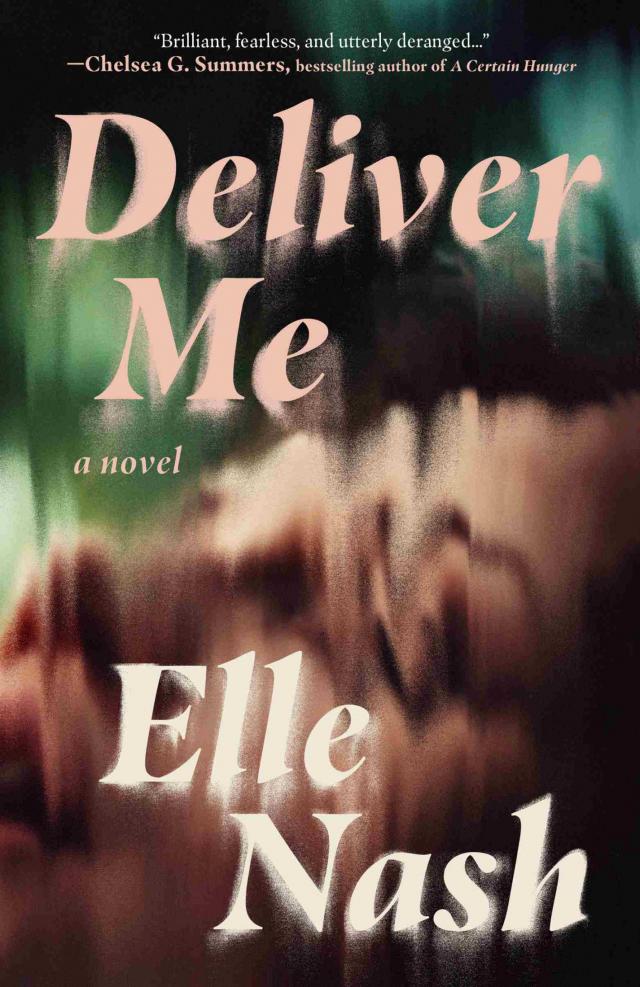
Deliver Me
a novel
Elle Nash
The Unnamed Press
Los Angeles, CA
AN UNNAMED PRESS BOOK
Copyright © 2023 by Elle Nash
All rights reserved, including the right to reproduce this book or portions thereof in any form whatsoever. Permissions inquiries may be directed to info@unnamedpress.com
Published in North America by the Unnamed Press.
www.unnamedpress.com
Unnamed Press, and the colophon, are registered trademarks of Unnamed Media LLC.
Hardcover ISBN: 978-1-951213-71-8
EBook ISBN: 978-1-951213-85-5
LCCN: 2023015315
This book is a work of fiction. Names, characters, places and incidents are wholly fictional or are used fictitiously. Any resemblance to actual events or persons, living or dead, is entirely coincidental.
Cover design and typeset by Jaya Nicely
Manufactured in the United States of America by Sheridan
Distributed by Publishers Group West
First Edition
For L
For B
For Baby and Me
O Lord, deliver me from evil men. Preserve me from the violent.
—Psalm 140:1
First Trimester
XXXX
The factory is a fertile body, each breast a beginning. I make geometry of the meat and that keeps my mind in line—calming, comforting tenders and perfect fingers, my pneumatic scissors make sense of the mess. It’s ten to four when I arrive on the floor in my sexless scrub top and Number Five is pissed. I slip on my disposable arm wraps, then tie my plastic apron behind my back. Everything that drops into our section is mostly peach with pale yellow lumps of fat. Thank God there is no blood. When I’m not at work, I remember moving the length of my fingers over each smooth breast, feeling for the catch of bone or a string of tendon against my latex glove. Number Five catches me missing a breast and shouts. I look up, then cut faster to catch up. Trembling flesh flops and tumbles down a conveyer belt at 140 birds or more a minute, and I cut, cut, throw the pieces into wide emerald vats to be sorted. It’s hard to focus, and sanitizer fogs my eye protection. This morning the sky was July clear, and as I walked through the glass doors glittering with dawn light, I knew something was different, couldn’t stop squeezing the skin of my stomach. In the locker room, I pressed my hands deep into my hips, searching for the nubs of my pelvis through the surrounding paunch of my sore, spongy fat.
During first break I swallow back the nausea worming up my throat. I step outside and walk past the rows of parked cars, the sun barely rising and the constellation fading out in the north. Momma calls it the Northern Cross. “God is watching over us,” she would say, but when I moved out and got the internet I looked it up. It’s not a cross but a swan in flight. The air outside is normally swollen with blood and animal waste, but today it smells earthy, like wild grass and fresh milk. The mild country across the highway is peppered with paste-colored double-wides, old barns, twined bundles of hay, our factory nestled neatly between that and a few acres of chicken farms—if you can call them that. Oblong, warehouse-sized huts with thousands of clucking broilers breathing in their shit. We’re the kill station. The biggest poultry supplier to Missouri, Arkansas, and Oklahoma.
When first break is over, workers sort into their sections like marbles rolling toward one uneven end. Number Three shows up next to me.
“Good morning, Number Four.”
I nod and cover my nose with my paper mask. My hunger prods, and pressure in the muscle of my jaw, below my tongue, makes me salivate. A bloat sits below my belly button, achy and full. I try to remember the last time I bled. Three weeks, maybe. It’s never been regular, sometimes it takes months, but always I’m thinking, She’s here again. Inside me. An alarm rings and the assembly line clunks on, first from the adjacent warehouse rooms, then ours. Air hisses through the hose of my scissors, and I ready the blades by schlicking them open and shut a few times. For the rest of the day I cut and cut and cut.
When I get home, Daddy is on the couch watching a show about women who undergo extreme plastic surgery and spend weeks in a hotel away from family, working with physical trainers to lose weight. Then they’re revealed in their new, authentic forms. These women have never been ugly, the announcer says, they were just hiding their good looks. The plastic surgeries helped them unfold, like teasing open a flower bud. The TV light catches in the light of Daddy’s whiskey. It’s the bottom-shelf stuff; I can smell the sweetness from where I am. When I lean over and kiss the side of his mouth, the taste of acetone moves into mine. I drift a weak finger down along his pockmarked jawbone and it speed-bumps over the gnarled scar on his cheek.
“Eaten yet?” I ask.
“No,” he says. “Texted Blake, no landscaping work today.”
I scrub my hands and forearms at the kitchen sink and notice an inflamed cut near my thumb. On day one Momma asked if I feared being injured or losing a finger. She lives an hour away on some wooded land alongside a tiny ravine and calls nearly every day. Momma loves to call me, now that she is all alone. A daughter has to listen to her momma. Isn’t that what the Bible says? Honoring your parents. It’s the child who always must be dutiful, responsible, especially now that Momma’s getting frail. And Momma has needs, and she doesn’t want to be alone anymore. Momma wants grandchildren, and I’m the only one who can give them to her. Once I passed into my thirties she began to ask with increasing intensity, “When are you going to get married and have children, Dee-Dee?” I understand, because I want children, too. More than anything, I want a daughter for myself. So I can teach what I have learned, so I have someone to relate to. Someone I can see myself in. I move through most of my days thinking of Momma and pregnancy and of my future daughter, obsessing over the fat at my thighs and waist, which is already large and soft and shapely, willing my torso to grow, grow more. All day my thoughts blunder forward like my momma, my momma, my momma.
If I told Momma about my blessing now she’d repeat my name in her soft, sprawling tongue as if I weren’t already yearning for her approval. Dee-Dee, she’d say, then pause and rewet her lips, until the church bells ring and that rice is raining down on you both, you shouldn’t even think about having a child. It’s not right. Not right now.
Right in the eyes of God, she means. At this point she only has to imply it. Everything in this town and the state of Missouri is about what is right in the eyes of God. It’s so hard to make her happy, and yet I know she’s right, because some assurance from Daddy would make the daily slog of work so much easier. If we were married I would know we were a team, that he was going to take care of me; that someday, the killing would end.
Momma would then cluck her tongue and switch the topic: Has he found a job yet?
At the kitchen sink, I put the sponge’s green side to my skin and scrub the scratch with antibacterial soap. There’s red around a scab of yellow.
“Did you pay rent?” I ask Daddy.
He eases back into the couch and shakes his head. “We have to kite the check,”
“I’ll ask for overtime,” I say.
I rip off three paper towels from the roll and pat my wrists dry, but my hands still smell like the caustic stink of sanitizer. I won’t tell Daddy about the baby, not yet. Not until I’m sure. I pick up a can of chili, but the muscles in my hand won’t grip, and it keeps slipping around the can opener. Not much longer, then I can give up the factory.
“Daddy,” I say.
He keeps his attention on the TV. A woman in a royal-blue dress stands onstage in front of a screen the size of a building. A shot of her Before face frowns next to a live feed of her After face as she glides down the runway. The Before face is round, the lips thinner, skin paler and pockmarked, eye bags mooning up as her mouth forms a flat line. The new face flashes veneered teeth so bright they appear blue, tight eyelids, the skin even tighter over her brow bones, all forming a waxy tension that’s pulled a decade from her face.
“Daddy,” I say again, “I need your help.”
His head turns. Even with the scar, he is the most beautiful man I’ll ever love. I’ve only ever been with one other person.
“What?” he says, annoyed. “What’s wrong with you?”
I walk into the living room, handing him the can with the opener affixed to it. I don’t say what’s wrong with me. He puts down his drink and takes the can. Daddy twists until the lid cracks in release and hands it back to me. The smell of cold meat permeates the air.
“Don’t forget to feed the bugs,” he says, turning back to the show.
“They’re your bugs,” I say.
Momma never allowed me to watch TV, and when I see Daddy’s eyes gloss over I understand why. He is gone, lost inside the fantasy of the woman in the sequined dress, who looks into a beveled mirror at her new self. She cries, and a group of people rush the stage to embrace her. A mother and father, a husband, and two children crowd around her and cry, too, as though the woman has just returned from a kidnapping or death. She’s been growing the new, better version of herself this entire time. The children, especially, are sobbing, twisting their faces to play to the camera and to the audience, all of whom stood up to applaud. Their mouths stretch in ecstasy, but you can see in their darting eyes: the kids are just mirroring what they think they’re supposed to feel. This is it, their eyes say. The mother we were meant to have.
1996
Revival season at Faithful Floods Temple of God. Service was usually held in church, a building that was essentially two double-wides attached either way to a circular brick room in the center. When it was revival season we moved to tents in large fields out by the Wal-Mart. In the tent I clasped my hands together, fingers joined into a fist. The stiff cotton of Momma’s dress brushed my arm as she stepped toward the stage, the scent of White Diamonds in her wake. Momma lived for this—she adored a deliverance, attended baptisms as often as sermons, to watch people sprawl on the carpet in tears for Christ.
My father touched her shoulder, and she shot him a look, pulling away. This was before the earth took him back, which is how I see it now. I don’t believe in angels anymore. I always wonder if Momma regrets anything about the way she treated him. Momma doesn’t talk about it. My father glanced at me and resumed clapping to the rhythm of the organ.
We had joined the congregation the first year we moved to Cassville, after my father got out of the army. For him, it was a renewed effort to make community, to please Momma, I’d always thought. Momma had been raised in the faith all her life. She craved the spectacle, like the rest of the congregation. A parishioner weeping and falling to the carpet. What they called the power of Christ. Wood stretched and popped as half the crowd stood from the antique folding chairs, their slew of hands and fingers stretched toward our sister Sloane onstage. Sloane, Sloane, I pushed my knuckles into my lower lip and pressed hard against my teeth. I don’t know how I hadn’t noticed her before. I was so young then, susceptible to the fears of God that settled inside good people and made them sick.
“Let’s put hands on our sister,” the pastor said. His open palms faced the light and the congregation’s did, too, everyone moving closer to the stage. The timbre of his voice was sultry, like a song booming into Sloane’s ears. She dropped to the ground, her shaggy hair set loose against the grass, light blue eyes sharpened by the stage lights. The women crowded around, touching her, praying, brunette victory rolls and floral skirts swaying to the reedy organ music. It was what the pastor wanted: No trousers, skirts only. No makeup, so you didn’t stink of pride. The crowd prayed together until their voices melded into a single rumble while a stray shriek or two punctuated the edges.
My father put his palm on the space between my shoulders and nudged me forward. I walked past the women with their plain hair up in buns, past the men with sweat beading on their shaved necks. The second I put my hand out, palm up like the pastor’s, Momma grabbed my wrist and pushed it toward the girl.
“Touch her,” she hissed. “There’s not much time left.” I placed my palm on her calf. Sloane smelled like stone fruit. Peach-colored flush feathered her cheeks.
The pastor began to speak faster, louder. “Your relationship should be with the Living Word,” he said. “Out there are the enemies. They prowl, try to keep us ignorant, control us, keep us from knowing the truth of this world.”
His fingers pressed on her forehead, then pushed her hair back, leaving wet snarls plastered to her skin. Our hands held her in place; Sloane kicked and waved her arms, and a throaty moan rattled from her chest. We locked eyes. Her mouth curled into a smile, and she licked her teeth and winked. I thought I might’ve made it up, created a lie, when in truth she had let me into hers.
I looked back at my father, then to Momma. Both were totally entranced in the moment. Everyone pushed against Sloane, their oily faces hungry for their own taste of her deliverance.
Sloane’s dress had bunched up around her hips, and the pastor held her waist down with his fingertips. Stray hairs glittered on her otherwise smooth knees. I played with the lace of her sock, tufted at her ankle, then released my hand from her leg, but something pushed me back toward her, jarring my head and neck forward, clattering my teeth. The pastor kept chanting, “Resist the adversary! There is not much time left!” I turned to see the pink membrane of Momma’s lips, her red Avon lipstick bleeding into its edges. “O the adversary!” her mouth repeated. “Our sister needs your help, O Lord!” The sea of sweating cheeks, all chanting, “Resist! Submit to the Lord!” The words grew indistinguishable until Sloane closed her eyes and began to shake and snarl. Suddenly our world was normal again, and the lie went on as Sloane shuddered once, twice, then collapsed into the sea of hands.
XXXX
Meat chickens are not bred to make life. The internal mechanisms are all there—ovaries with their tiny clusters of eggs, the hormonal drive—but meat chickens don’t live long enough to lay. They are bred to be eaten. Their breasts and bodies grow at an abnormal rate, tripling in weight in those first few days of life, and are sent to slaughter at five pounds. Each chicken on my line is only fifty days old. Every one must be processed by the end of the day. If even one person calls off work, the rest of us have to pick up the slack, we don’t get to leave until the work is finished.
In each section of the warehouse, a massive digital counter on the wall marks the processing of an entire bird. It counts up red, until we hit our death goal. I use it to keep track of the time. There’s no clock, and we have to keep our watches and phones in our lockers. A buzzer alerts everyone to breaks, lunch, and shift changes. If we manage to process 140 birds per minute, we know we’re near break time when the death counter approaches twenty-six thousand. At fifty thousand, first shift is over and my day is done.


