Violet and the bow stree.., p.1
Violet and the Bow Street Runner, page 1


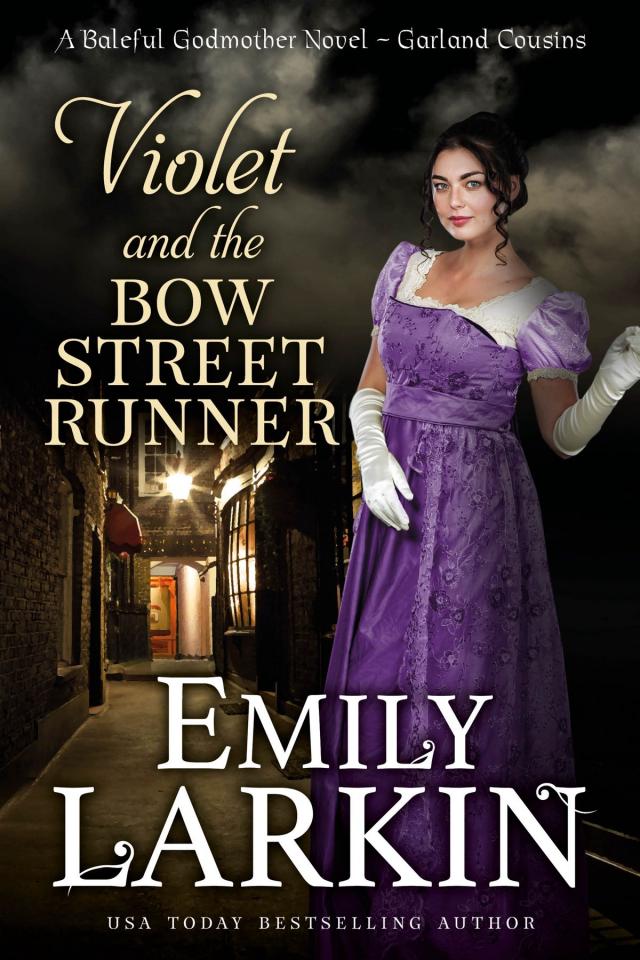
Violet and the Bow Street Runner
Garland Cousins #2
Emily Larkin
Contents
Chapter 1
Chapter 2
Chapter 3
Chapter 4
Chapter 5
Chapter 6
Chapter 7
Chapter 8
Chapter 9
Chapter 10
Chapter 11
Chapter 12
Chapter 13
Chapter 14
Chapter 15
Chapter 16
Chapter 17
Chapter 18
Chapter 19
Chapter 20
Chapter 21
Chapter 22
Chapter 23
Chapter 24
Chapter 25
Chapter 26
Chapter 27
Chapter 28
Chapter 29
Chapter 30
Chapter 31
Chapter 32
Chapter 33
Chapter 34
Chapter 35
Chapter 36
Chapter 37
Chapter 38
Chapter 39
Chapter 40
Chapter 41
Chapter 42
Chapter 43
Chapter 44
Chapter 45
Chapter 46
Chapter 47
Chapter 48
Chapter 49
Chapter 50
Chapter 51
Chapter 52
Chapter 53
Chapter 54
Chapter 55
Chapter 56
Afterwards
Author’s Note
Claim your free books
Thank You
Primrose and the Dreadful Duke
Octavius and the Perfect Governess
Acknowledgments
About the Author
Also by Emily Larkin
It is a truth universally acknowledged, that Faerie godmothers do not exist.
Chapter One
Violet Garland enjoyed the bustle and busyness of the Season—the evenings at Vauxhall, the routs and soirées, the performances at the opera and the theater, the balloon ascensions and the picnics, the multitude of entertainments that London had to offer.
Two of the pastimes she particularly enjoyed were dancing and flirting. She was dancing now, performing a reel with a rather dashing duke’s grandson. They went through the figures energetically, enjoyed an extravagant flirtation, and parted ways happy in the knowledge that they didn’t wish to marry one another. The duke’s grandson preferred wealthy young widows and while he was rather dashing, Violet wanted someone even more dashing. Someone with an adventurous spirit. Someone who liked to ride fast and dance fast and live fast. Someone exciting.
Someone quite unlike the gentleman standing in the nearest corner, who was so nondescript as to be almost invisible. Violet eyed him while she sipped a glass of orgeat. The man was blandness personified, everything about him unremarkable, from his brown hair to his navy-blue tailcoat to the tips of his black shoes. It wasn’t that he was unattractive, more that he was profoundly uninteresting to the eye. If he wished to catch an heiress, he needed to exert himself rather more.
But it appeared that the bland man had no wish to catch an heiress. Violet glimpsed him several times during the course of the evening, and each time he was standing in a corner, observing the other guests, as unexciting as a piece of furniture.
Violet danced and flirted with an earl’s son, a marquis’s son, two fortune hunters, and a rather rakish viscount. Her dashing and adventurous husband-to-be would stroll into a ballroom one evening, she was certain of it, but tonight wasn’t the night. She danced one more set and left the ball early, along with her brother, Rhodes, and her younger sister, Aster. Rhodes left early because he didn’t much care for balls now that he was a widower. Aster left early because she liked peace and quiet more than she liked noise and crowds. But Violet left early because as much as she enjoyed dancing and flirting, there was something she enjoyed doing far more. Something secret and thrilling that she could only do in the dead of night.
Accordingly, she allowed her maid to remove the delicate ball gown, with its pretty silk rosebuds and its spangled gauze. The pearl necklace and matching earbobs went back in their case. Her hair was unpinned, brushed out, and plaited in a tidy braid.
Violet climbed into bed—and once the maid had gone, she climbed out again and latched her door. She danced across to her dresser and unlocked the bottom drawer. The clothes Rhodes had bought for her lay folded there: long pantaloons, half a dozen shirts, neckcloths, a snug coat, a pair of sturdy shoes.
Everything was black, even the neckcloths.
Violet dressed quickly—shirt, stockings, pantaloons, shoes. The coat had a clever little pocket into which Rhodes had tucked a house key and a penknife. Just in case, he’d said, but there’d never yet been a just in case.
Violet wrapped one of the unstarched neckcloths around her throat like a muffler, tucked the ends down the front of the coat, and put on the mask she’d sewn. It wasn’t the sort of mask one wore to a masquerade; it was the sort of mask a hangman wore, covering her face completely.
She tied the mask tightly so it couldn’t blow off, wiggled her fingers into a pair of black kidskin gloves, and examined herself in the mirror. Not one scrap of pale skin showed.
As well as men’s clothes, Rhodes had bought her a dark lantern. Violet lit it and set it on the hearth, adjusting the metal shades so that only the merest glimmer of light showed. Then she blew out her candles. Her bedroom became almost, but not quite, pitch black.
She parted her curtains, opened her window, and climbed up onto the broad sill, high above the ground. At her back was her bedchamber, quiet and safe. In front of her was . . . adventure.
Violet leaped off the windowsill—and flew, diving up into the night sky. High, higher, even higher. When the lights of London were no bigger than the merest pinpricks, she halted, hovering above the city. The air was thin and chilly. An almost-full moon hung overhead, as bright as mother-of-pearl. London looked beautiful from this vantage point, mysterious and otherworldly, a place of secretive dark spaces and twinkling golden lights.
A familiar medley of emotions swelled in Violet’s breast, wonder and awe and elation, tempered by a faint feeling of loneliness.
She was the only person who would ever see this view.
Violet’s Faerie godmother was a closely guarded secret. No one outside the family knew of Baletongue’s existence, just as no one outside the family received her grudging wishes. Violet was the only person in England who could do this, the only person in the world, and it was exciting and thrilling and she loved it, but sometimes she did wish she could share it with someone else.
But Violet wasn’t prone to melancholy, she preferred action to contemplation, so she gave a loud whoop, high above the city where no one could hear her, and arrowed down again.
Faster and faster she went, exulting in the speed. Wind tore at her clothes and whipped her laughter away as fast as she uttered it. London’s rooftops came closer and closer—closer—and then she soared up again, tracing a vast, exuberant somersault in the sky.
When she was tired of soaring and plummeting, Violet drifted, a furlong above the rooftops. Contentment hummed in her veins. She loved these nighttime excursions for the thrill of flying, the unrestrained freedom, the exhilarating speed, but she also loved them for the silence and the solitude, the sense of being apart from the rest of the world.
London was hustle and bustle, it was noise and crowds, carriages and pedestrians. But not up here. It was a different world, high above the rooftops. Here, she was alone. Here, she saw things that no one ordinarily saw.
Here, she saw London’s secrets.
Grosvenor Square lay beneath her. In fact, she was drifting above the very house where she’d danced earlier that evening.
Violet glided lower, until she could see the house clearly: the tall façade with its glittering rows of windows, the flambeaux flaring in their brackets, the guests descending the stairs to the flagway, the carriage that had just pulled away.
But tall townhouses in Grosvenor Square weren’t very interesting, even if balls were taking place inside them. In fact, Mayfair as a whole wasn’t very interesting. Violet preferred to explore further afield. There were so many unexpected places in London, so many curious sights.
One of her favorite things to do was to follow people and see where they led her—and there, descending the marble steps below her, was a man. She’d follow him and see where he took her.
Most likely, he’d lead her to one of the clubs where gentlemen liked to spend their time, drinking and playing at cards, but he might take her to his home or to a gaming hell or to one of the brothels near Covent Garden.
Not that she actually knew that the buildings men visited near Covent Gardens were brothels. She’d never looked in windows to check.
Which wasn’t to say that she hadn’t been tempted. She had. But Violet had standards. She was a duke’s daughter, and dukes’ daughters didn’t peek in windows.
They did follow people, though. And this man was headed briskly in the direction of Piccadilly, the soles of his shoes making faint slapping sounds on the flagway. He turned onto Charles Street and then Mount Street. As he passed beneath a streetlamp, Violet saw that he was the earl’s son she’d danced with earlier. Freddy Stanhope
She paused in midair. She didn’t like to follow people she knew. It made her feel like a snoop.
Someone else walked along the street below. His shoes didn’t make the slapping sounds that Freddy’s did. He moved as silently as a shadow.
Freddy Stanhope turned into Berkeley Square. So did the man behind him.
Violet drifted after them.
Ahead of her, Stanhope crossed the top of the square and turned into Bruton Street. Violet decided to follow the man who walked so silently, except that he turned into Bruton Street, too.
In fact, every turn that Freddy Stanhope made for the next ten minutes, the silent and shadowy man made, too.
Was Freddy being followed?
Was he about to be robbed?
Violet picked up her pace, drawing ahead of the silent man. She flew low, much lower than she ordinarily did, and landed on a colonnaded portico and crouched there. As the man passed under a streetlamp, she glimpsed his face.
It was the bland man from the ball. The man who had as much presence as a stick of furniture.
Violet stared after him in astonishment.
Mr. Bland was following Freddy Stanhope?
It was so inconceivable that she flew ahead for another look at his face.
Yes, it was Mr. Bland.
Mr. Bland followed Freddy Stanhope all the way to a house on Soho Square.
Violet had seen men enter that particular house before. It was either a gaming hell or an upmarket brothel, she wasn’t certain which—and she wasn’t going to peek in the upstairs windows to find out.
Freddy Stanhope was admitted into the building.
Mr. Bland didn’t follow him inside. He paused in the mouth of an alleyway where shadows gathered deeply. Violet could barely see him.
Two men crossed the square. They were loud and laughing, steadying one another as they walked.
Violet had seen many drunken men in her nighttime explorations. They held no interest for her. She returned her attention to Mr. Bland in his patch of shadows—and discovered that he’d vanished.
She sped along the square at rooftop level, searching for him, afraid that she’d lost the most interesting person she’d ever followed—and caught movement out of the corner of her eye. It was Mr. Bland. He ducked into Frith Street, hugging the shadows, walking briskly and silently.
Violet darted hastily after him.
Usually when she followed someone, she stayed above the rooftops, but Mr. Bland was so determined not to be noticed that Violet had to fly lower. She almost lost him when he navigated a series of alleyways, and again when he ducked into Newport Street. He kept checking over his shoulder as if he thought he was being followed, but she couldn’t see anyone behind him.
Mr. Bland headed purposefully southeast. Violet hoped his destination wasn’t Covent Garden. If he set foot in a brothel—or worse, decided to take his pleasure in an alleyway with one of the cheaper ladies of the night—she would have to stop following him.
He turned into Hart Street, which meant that Covent Garden was his destination.
Violet used a word that Rhodes sometimes used when he thought he couldn’t be overheard: “Damnation.”
But Mr. Bland surprised her yet again. He continued along Hart Street to its end, where he left the shadows and strode up the steps of a building on Bow Street. A building that had a watchman at the door. A building that most definitely was not a brothel.
A building that was in fact the Bow Street Magistrates’ Court.
Violet watched open-mouthed as the watchman greeted Mr. Bland and opened the door for him. Mr. Bland went inside.
Half a minute later, lamplight flickered in one of the upstairs rooms. Violet flew closer than was prudent and peered in through the window. If the watchman looked up, he might possibly see her, but right now she didn’t care. She wanted to know what Mr. Bland was going to do next.
What Mr. Bland did next was peel off his gloves and set his hat on a desk. He sat. He opened a drawer and took out a notebook. He trimmed a quill, dipped it in ink, and began writing.
There was only one conclusion to be drawn. That was Mr. Bland’s desk, his chair, his notebook, his inkwell.
Violet stared at him through the windowpane. He looked so ordinary.
But he clearly wasn’t ordinary.
Magistrates didn’t follow suspects, and neither did law clerks or secretaries.
Which meant that Mr. Bland was a Bow Street Runner.
Chapter Two
Violet knew that she’d stumbled upon an adventure, but she didn’t know exactly what the adventure was or how to participate in it. Mr. Bland didn’t give her any clues. He wrote in his notebook for several minutes, returned it to its drawer, picked up his hat and gloves, and departed.
Violet followed, gliding forty feet above his head.
Mr. Bland walked for five minutes, glancing over his shoulder multiple times and pausing once to scan the street in every direction. Then, he turned into a lane behind High Holborn and let himself into a house with a latchkey. The house was tall and narrow, with dirty brickwork and lopsided shutters. Some of the windows were lit, most were not. Violet darted from window to window, trying to see inside. She caught glimpses through the crooked shutters, enough to tell her that it was a lodging house.
Candlelight bloomed in the attic window. Violet swooped upwards for a closer look.
The window stood open, allowing her to see into a cramped little room with a sloping ceiling. There was a bed, a washstand, and a wooden chair. The floorboards were scuffed and unpainted, the whitewash on the walls flaking, the ceiling water stained.
For the second time that evening, Violet watched Mr. Bland remove his hat and gloves. His tailcoat and breeches had looked plain at the ball; here in this shabby little room they were positively sumptuous.
Mr. Bland peeled out of his coat—and Violet abruptly felt uncomfortable. If she stayed any longer, she’d be a Peeping Tom.
She turned away from the window and sped towards St. James’s Square and home.
Why was a Bow Street Runner following Freddy Stanhope?
That question occupied Violet’s mind until she fell asleep and was the first thing she thought about when she woke. She pondered it while she dressed and ruminated on it while she ate a very late breakfast. Her parents, the Duke and Duchess of Sevenash, set off to visit friends in Surrey in the early afternoon. Violet stood on the marble steps with Aster and Rhodes and Rhodes’s children, three-year-old Hyacinth, five-year-old Jessamy, and seven-year-old Melrose. She waved her parents good-bye and wondered what on earth Freddy Stanhope had done to attract the attention of a Bow Street Runner. The traveling carriage clattered briskly across the square and disappeared from view. Hyacinth looked ready to cry, but Rhodes had brought a ball down from the nursery, so they trooped through the house and went out into the garden at the back to play a game with the children. Violet speculated about Bow Street Runners and earls’ sons while she caught the ball and dropped the ball and ran after the ball, and she cogitated on it further when they went indoors again. The children ran upstairs to the nursery where refreshments awaited. Violet changed from her morning dress to a carriage dress.
Her parents had gone into Surrey for a fortnight; Violet only went as far as Hyde Park with her sister, Aster, and her cousins Clematis and Daphne. Aster and Clem and Daffy discussed the latest fashion in bonnets while they took a turn around the park in the open-topped landaulet. Violet paid them no heed; she was too busy puzzling over earl’s sons and Bow Street Runners to have any interest in whether brims were getting shorter or longer. On their way back, the coachman took them to Berkeley Square, halting under the maple trees in the middle of the square so that they might partake of ices from Gunter’s Tea Shop. A waiter brought menus across to the carriage, but Violet was unable to concentrate on the delights described therein. The choice between neige de pistachio and glacé d’épine-vinette was inconsequential when one was on the edge of a mystery.