A springtide meeting, p.1
A Springtide Meeting, page 1


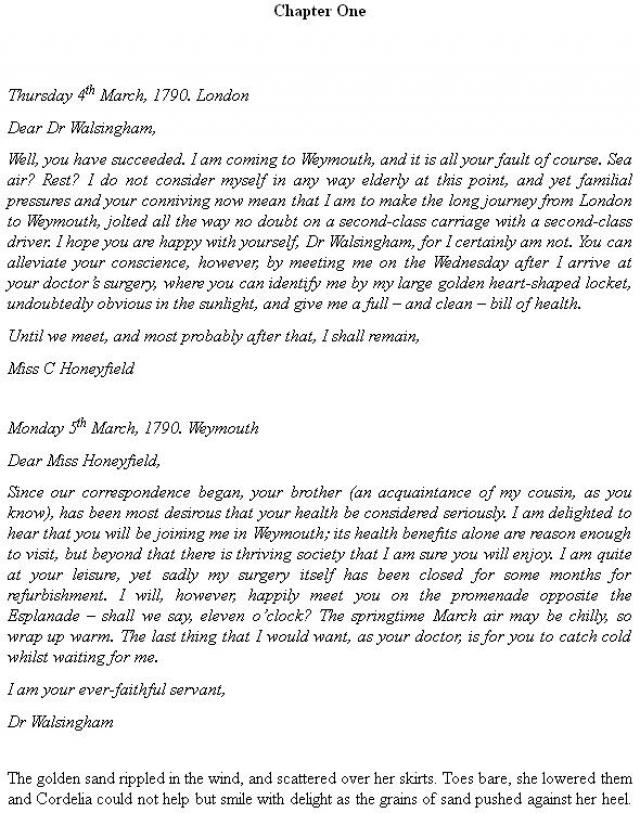
Chapter One
Thursday 4th March, 1790. London
Dear Dr Walsingham,
Well, you have succeeded. I am coming to Weymouth, and it is all your fault of course. Sea air? Rest? I do not consider myself in any way elderly at this point, and yet familial pressures and your conniving now mean that I am to make the long journey from London to Weymouth, jolted all the way no doubt on a second-class carriage with a second-class driver. I hope you are happy with yourself, Dr Walsingham, for I certainly am not. You can alleviate your conscience, however, by meeting me on the Wednesday after I arrive at your doctor’s surgery, where you can identify me by my large golden heart-shaped locket, undoubtedly obvious in the sunlight, and give me a full – and clean – bill of health.
Until we meet, and most probably after that, I shall remain,
Miss C Honeyfield
Monday 5th March, 1790. Weymouth
Dear Miss Honeyfield,
Since our correspondence began, your brother (an acquaintance of my cousin, as you know), has been most desirous that your health be considered seriously. I am delighted to hear that you will be joining me in Weymouth; its health benefits alone are reason enough to visit, but beyond that there is thriving society that I am sure you will enjoy. I am quite at your leisure, yet sadly my surgery itself has been closed for some months for refurbishment. I will, however, happily meet you on the promenade opposite the Esplanade – shall we say, eleven o’clock? The springtime March air may be chilly, so wrap up warm. The last thing that I would want, as your doctor, is for you to catch cold whilst waiting for me.
I am your ever-faithful servant,
Dr Walsingham
The golden sand rippled in the wind, and scattered over her skirts. Toes bare, she lowered them and Cordelia could not help but smile with delight as the grains of sand pushed against her heel. She had left her stockings behind, a risqué move but one that was surely more common here? A salty breeze tugged at the curls that had slipped from her pins, and her smooth skin pulled at the gloves keeping the breeze from her.
She had done it. She had made it to Weymouth.
“Weymouth,” Cordelia Honeyfield murmured under her breath, her thirsty eyes absorbing everything that was going on around her. Elegant couples dressed in the latest French fashions, bonnets rustling in the wind, were strolling arm in arm up and down the promenade. She was sitting on the edge of the walkway, legs dangling down to the sand, and gulls with dark heads were bobbing along the lapping tide.
Admittedly, Cordelia had not done it alone.
“Wrap that shawl a little closer around your shoulders, Cordelia,” came the sharp tones of Mrs Chambers. “And mind you keep it there, this wind is biting. And where are your gloves?”
Cordelia had not noticed. She had almost forgot that Mrs Chambers, the indomitable chaperone, was standing behind her under a parasol almost stolen by the wind, and she had almost forgot about the odious Dr Walsingham. The disgust rose strongly here, but receded as she watched another small fishing boat pulling onto the shore.
“Look, Mrs Chambers, another one!” She flung out a finger as she spoke excitedly, but there was no answer from her companion, who shook her head at her young impetuous charge.
Three men jumped out of the small boat, and began to haul it further up the sands, sweat pouring from their brows despite the spring breeze that bit at uncovered flesh.
I could go anywhere, she thought. This is not London, or home – there is nowhere in Weymouth that I cannot go, any time that I wish. The mere possibility of such freedom was enough to get her pulse racing, and colour in her cheeks.
“. . . perhaps today.”
She caught the dribs and drabs of conversations that passed her along the promenade.
“Today? Surely the King is in London, he would not bring his family down here so soon –”
“Nay, I swear it, that is what I read, and he is going to bring his . . .”
The pair of ladies, past the prime of life and greying at the edges, moved beyond Cordelia’s ears, but as her gaze followed them it rested on a gentleman.
He was not moving along the promenade; he was standing, perhaps ten feet from her, staring out to the ocean. Dressed in all the finery that one would expect from a gentleman, he was not doing anything as far as she could tell. Just standing there.
Cordelia turned back to watch the fishermen complete their journey, but they had already taken their spoils further inland, and now that she was aware of the young man out of the corner of her eye, she found that she was uncomfortably conscious of him. Was he watching her? If she turned her head to see, was she watching him?
A flush that had nothing to do with the liberty before her started to creep up her neck. This was as bad as waiting around for the last half an hour for Dr Walsingham – was he ever to arrive? Thinking of him again made her irritation with him rise like bile, and she quashed it.
“Mrs Chambers, I wonder if –” Cordelia began, turning around to speak to her chaperone; but she had gone. The only person standing behind her now was the young man, and his eyes, previously vague in their focus, had found something to lock onto. Her.
He should not be staring at her – certainly not now that she had noticed, though his expression was surely blatant enough for her to feel discomfort. But Dr Timothy Walsingham could not help it. A young lady, seated alone at Weymouth was enough to draw the eye regardless of her personal charm, and this woman had more than enough.
Perhaps it was her chestnut hair that drew the eye; the way that the struggling springtime sunshine glinted off it, as it did the waves from the sea. Perhaps it was her figure, slender and small. Perhaps it was the way that her shoes lay carelessly forgotten beside her. But more than anything else, it was probably the way that her eyes seemed to have flecks of gold in them as the sun sparkled in them. He had only seen them for an instant before she turned to gaze back out to sea, but they seemed to be constantly altering their colour, at once a light brown and at others a hazel. Had he imagined flecks of shimmering gold?
And to top all that, Timothy could see that she had followed the latest fashions in beachwear, and underneath the woollen shawl wrapped tightly around her neck and shoulders, was wearing a dress that was several inches shorter than the urban style, displaying pale ankles and half of her calves to the world as they swung down to the sand.
This is ridiculous, he chided himself. You are a doctor, not some young whelp of a boy coming up to Oxford! Should a few inches of bare flesh really turn you into such a – an animal?
The answer, unbidden and mercifully unspoken, came back to him immediately: yes. This was not a young woman that you came across often.
But this was not the time to stare down unaccompanied young women who could have come to Weymouth for the delights of the coming season. He was here to find the elderly lady whom he had been advising by letter, and poor old Miss Honeyfield seemed, if the letters be true, in dire need of a little medical attention. He had waited here at least thirty minutes, but none of the more mature ladies who had strolled up or down the promenade before him had been wearing a golden heart-shaped locket matching the one she had described in her last letter.
Something golden did catch his eye though, and he was drawn as though by a magnet back to the young woman, her back resolutely turned to him. The sea air, gusty as it was this spring, lifted a curl of hair and the lock glinted golden in the sunlight.
Timothy realised that his mouth was open.
“Catching flies?”
At first, he did not understand who had spoken, but by process of elimination if it had not been he to speak first, then it must have been –
The woman’s eyes, no longer fixed out to sea, were staring at him filled with suspicion. Timothy closed his mouth slowly.
“Because I would have thought you would have more success with honey, if I were you.”
Timothy willed himself to speak, but for some reason, no sound came out. His lips did not even move. He was too busy drinking in that sharp look of interest he could see in her face.
She furrowed her brows as she beheld him. Then she turned around to watch the waves, now stronger as the tide turned.
“I was watching the ocean.” Relieved that he could speak again, Timothy took a step forward towards the young woman, gaze fixed upon her, and almost barrelled into a mother with a child either side of her. Muttered apologies were offered before he found himself on the other side of the promenade, standing beside the seated young woman.
“I love watching the tide,” was the reply from her, and Timothy smiled. “I have always loved the sea, rarely as we have visited it.”
“You have been here before then?”
She nodded slowly, not taking her eyes from the cresting waves that shone first blue, then silvery white. “When I was a girl, and before the Royal family had ever thought to come here – it was not a fashionable place to come to, then.”
It did not take long for Timothy to make a decision. Leaning down, he dropped to sit beside the young woman, leaving a respectable two feet between them as decorum would dictate. From here, he could see much more of her, and was surprised to see that there was a hint of sadness playing around her mouth, despite the smile.
“Some people just love the sea,” he said quietly.
She turned towards him, and the smile deepened to something more genuine. “It is as though salt runs through my veins, rather than blood.”
Timothy nodded. “That is an admirable way of putting it; many people seem to come alive when they arrive here. Something in the air, something in the water sparks them into life like nothing else.”
A gull, squawking into the gusty breeze, floated by them. The control was absolute, only needing to move its wings minutely to guide itself along the beach, calling out to its friends.
“It is funny though,” she said softly. “I seem to spend the majority of my time considering the ocean, and I have not yet set foot in it. I have a friend from home who has gone swimming in it! But that is a pastime far beyond me – I do not even know how to swim.”
He smiled. He caught a fleck of golden light dancing in her eyes as she spoke. “It is recommended here, of course, for its health benefits, but I must admit that there are plenty of us who live here in the town who swim for the pleasure of it.”
At his words, she turned to stare at him. “Swim – for pleasure?”
Intensity sparked through her, and Timothy’s smile broadened. This strange woman seemed to give her companions all her attention, or none of it. “Yes, for the sheer joy of it. There is nothing quite like being out in the water, completely lost in the elements. If you are not careful, you can forget that there is even a real world around you.”
She stared at him, and then smiled slowly. “To be perfectly honest with you, I shall be sad to leave here after a fortnight.”
An overwhelming feeling of disappointment washed over him. “Is your stay so short?”
“Short?” The young woman stared, puzzled. “How do you know that I only arrived but recently? I could have been here five weeks already.”
“Oh, I live here,” said Timothy quickly, “and I observe whenever there is a new person in Weymouth, and therefore I assumed that –”
“I have to go.” Before he could say anything more to reassure her that he had not, in fact, been following her as she undoubtedly seemed to think, she had pulled herself up and placed her sturdy shoes on her feet. “I must meet Mrs Chambers – goodness knows where she has got to, she was supposed to be my chaperone.”
No one had intrigued Timothy more than this woman, almost a mermaid in her devotion to the sea, and she was already stepping away from him. He did not even know her name.
“Miss – excuse me, Miss?” He scrambled to his feet, and waved an arm after her, knowing better than to follow her.
The breeze caught his words and flung them out to sea, far away from her ears. She had not heard him, and he was already losing sight of her in the crowded street that led on from the promenade.
Timothy sighed. Sometimes it was just not meant to be.
“. . . and why you considered it acceptable to simply leave me there, alone, I have no idea.” Cordelia had rattled off her speech and did not even pause to hear Mrs Chambers’ reply. Stalking upstairs, she went to her room, and sat, irritably fiddling with the quill on the wooden desk that had been provided for her.
Cordelia reached out for a sheet of paper, and there was a roughness to it; there were grains of sand under her fingertips as she brushed past it. She could not help but smile. There was sand in her shoes also, and every step reminded her that she was here, finally, in Weymouth. Now all she had to do was get this meeting with the odious Dr Walsingham over, and she would be free to do what she wanted here – father or no father.
The quill was dipped into the inkpot, and after dabbing it slightly to rid it of its excess, she began to write.
Wednesday 10th March, 1790. Weymouth
Dr Walsingham,
It is with the greatest of regret that I remind you that you did not fulfil our appointment this afternoon; honestly, it is too bad of you, when I have come all this way from London and you cannot even stir from your fireside chair. No matter, Dr W, I am sure that I will not hold it against you forever – and fortunately for you, there is an opportunity most providential to atone for your crime. I shall be in the same place tomorrow morning – that is Thursday morning, Dr W, so as to prevent you from wilfully misunderstanding – at eleven o’clock. Same place, same time, different people. After all, you did not bother to attend.
Do not disappoint me again, sir. There is much that I wish to do here, and I cannot spend the week waiting around for you. I am ever your patient patient,
Miss C Honeyfield
Chapter Two
Dr Timothy Walsingham tugged at his greatcoat, and pulled it closer around him as the biting spring wind attempted to wrench it open. A squall was coming in, and the whole of Weymouth could feel the icy wind. His top hat, usually proud upon his head, was grasped underneath his arm for fear of it being blown off. Turning a corner – and knowing that as it brought him to the beach, the wind would only increase – he braced himself.
And almost gasped audibly.
There she was. A day later, and there was the same young woman, this time standing, at the same place on the promenade.
Legs almost entangled themselves as Timothy tried to stop himself from going forward, desperate not to be seen by her, but it was too late. Her face had twitched up, and a look of surprise mingled with alarm covered it – an expression that was probably mirrored, he thought ruefully, on his own.
Why was she here again? It was too much to hope, and he smiled briefly, that she was here in the expectation of seeing him again. Their conversation the day before had been brief; it surely could not have sparked in her an interest.
But why not? It had done, within him.
Unsure what he was supposed to do with his hands and feeling an almost uncontrollable urge to whistle, Timothy stood still, allowing the gusting wind to buffet him slightly forwards and backwards as the cry of the seagulls made for a mournful melody.
As the seconds turned to minutes, Timothy gazed around him. The unsettled weather had driven many of Weymouth’s inhabitants and visitors inside, away from the gusting wind, and it could surely come as no surprise to him that Miss Honeyfield, the poor old dear, was staying safe inside. She had remarked in one of her letters, and he smiled to think of it, how clumsy she was, constantly tripping over her own feet and having to pass it off as the untidiness of the cobbles. No, Miss Honeyfield would not be venturing out today.
But she had. Another glance over at the elegant young woman, staring resolutely anywhere but where he stood, was enough to drive his impetuous nature.
“Good morning.”
His words were snatched away by the breeze but, unlike the day before, they were pushed towards her rather than away from her. She nodded, and Timothy took a step closer.
“I hope you are well, this fine morning, and not concerned about the wind.” The weather. He was talking about the weather? Cringing inside, he glanced over to her to see if his ineptitude and forwardness had made her wish to leave.
It seemed not.
“I love the wind, do not you?” Cordelia stretched out her arms and glorified in the way that the wind caught at her shawl, wrapped tightly around her neck and shoulders. “Does it not make you feel as though you could take off at any moment, and join the birds in the air?”
Closing her eyes, she turned, revelling in the sharp scent of the salty wind that rushed through her hair.
“It is certainly a day to feel alive.” The young gentleman who had appeared again seemed slightly concerned about her sanity, and Cordelia put down her arms and opened her eyes. The last thing she needed was word to get back to her father that she was unstable.
Cordelia smiled serenely. “Indeed, sir. There is nowhere one can feel alive quite like Weymouth.”
The man took another step closer to her and rather than take a step backwards herself, as she would have done in London when a man she did not know got too close, she stayed. Their brief meeting the day before somehow settled her spirits. There was something about this man that made her feel entirely safe; as though he were some sort of anchor, unmoveable and unshakeable despite the tugging of the world.
And his next words shocked her.
“I was wondering if you would enjoy taking a stroll down the promenade with me.” His words were quiet yet firm, and as far as Cordelia could tell, there was no mischief in them.
She turned around. Mrs Chambers had only run back to collect her own shawl from their lodgings, and she would surely panic if she returned to this spot to find Cordelia absent from it. And yet the promenade was not so very long, and she was desperate for a walk. All this lounging around for one’s health, there was nothing more likely to kill one off.