

On a chariot of fire, p.1
On a Chariot of Fire, page 1


For Moshe for everything
––Erica Lyons
For my ancient shipwrecked Bene Israel ancestors, to my mother Sophie (in character of Nani Penkar), and to my daughter Rachel (in character of Maya). May these stories be carried from generation to generation.
––Siona Benjamin
This is an Arthur A. Levine book
Published by Levine Querido
www.levinequerido.com ∙ info@levinequerido.com
Levine Querido is distributed by Chronicle Books, LLC
Text copyright © 2024 by Erica Lyons
Illustration copyright © 2024 by Siona Benjamin
All rights reserved
Library of Congress Control Number: 2023944020
Published October 2024
Hardcover ISBN: 978-1-64614-434-1
Ebook ISBN: 978-1-64614-435-8 (Reflowable epub)
Siona Benjamin began the process for illustrating this book by researching images from her own Indian Jewish family, community and background. After sketching with pencil, she applied layers or gouache paint, used brush pens, colored pencils and art markers to create the physical, final art, which was then scanned to create digital files for printing.
CONTENTS
Begin Reading
Author’s Note
Glossary of terms
Nani Penkar wore her finest sari. It was blue like the sea, with threads of gold woven in like memories. She and her grandaughter arranged fruits and flowers atop sweet flattened rice.
“Maya,” Nani Penkar asked, “Do you remember the story I’ve told you about a promise made to our ancestors, more than two thousand years ago?
It begins with the deep blue sea, which sparkled like it was spun from this silk.”
Her bangles jingled as she lifted the edge of her sari.
“A tiny ship sailed eastward alone, so far from land that the sky and the sea seemed to meet.
The people on the ship came from ancient Israel in the days when the Greek tyrant Antiochus ruled.
Some Jews joined a rebellion led by the Maccabees and fought. Others were forced to flee,
and with them they carried everything that was dear to them.Their holy scrolls. Their fringed garments. Their traditional foods. Their songs.
They knew it could be nearly a year before they would set foot on land again,
but staying and forfeiting their faith was never an option.
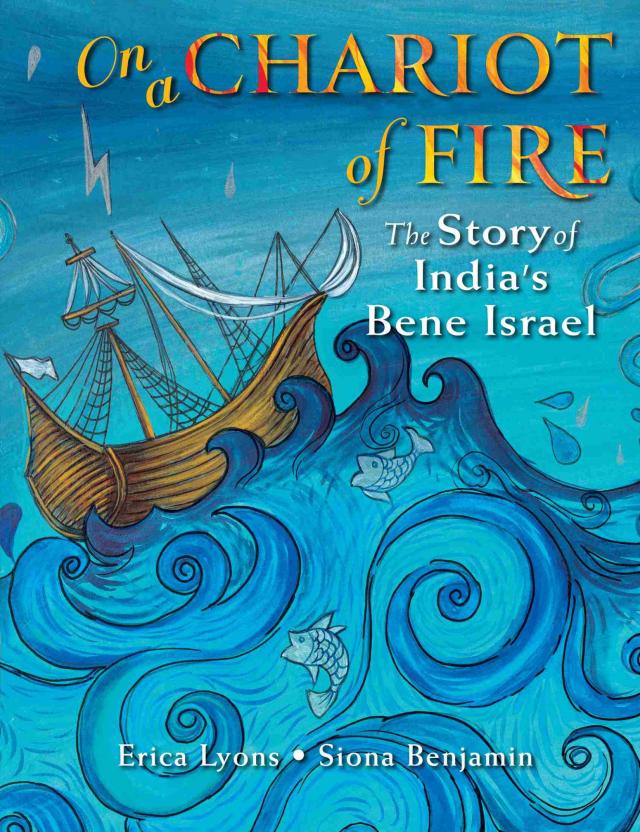
One day, the sky became black.
Thunder roared and winds screamed.
Waves grew to the height of Mount Sinai.
Their ship was tossed and thrown.
All the while, the people prayed towards the heavens and Eliyahu HaNavi was sent to help them.
The terrible storm ended suddenly and (only) seven men and seven women were washed ashore.
Though some say Eliyahu plucked them from the sea.
The ship and the things they carried were lost forever.
The local people welcomed them.
They had their own religions, but respected the new traditions brought from far away for they too had forbidden foods and holy days marked by the movement of the moon.
The people who came from the sea became known as the Bene Israel or Children of Israel And on the seventh day they kept the Sabbath for rest just as they had before.
As time passed, they learned to speak Marathi, and changed how they dressed.
No longer were they known as ben Moshe, ben Ephraim, or ben David, for they now named their families for the villages they belonged to, with names like Kolatkar, Gadkar, and Divekar.
But they never forgot where they came from.
One day, the earth shook.
The click of hooves and the neigh of horses were heard throughout the village of Alibag.
And a flaming chariot appeared led by giant fiery horses, with Eliyahu HaNavi at the reins.
There was thunder and there was lightning and a vast and mighty whirlwind carried the chariot to earth.
And because we hadn’t abandoned our faith, Eliyahu promised my people, that one day we would return to our home across the sea.
As Eliyahu began to lead the chariot back up to the heavens,
one of his horses slipped on a rock before galloping upwards
and his hooves made imprints deep in the stone.
So today, to celebrate the anniversary of this event, and on any happy occasion my people sometimes return to this spot,” Nani Penkar says.
“And we also make Malida,” Maya sings, adding the last of the sweet dates to the plate.
Many storytellers share stories of voyages and ships, but none of theirs taste like cardamom and coconut.
And leave listeners dreaming about a prophet who rode up to the heavens on a chariot of fire.
AUTHOR’S NOTE
The arrival of the Bene Israel in India is just one part of the story of the Jews of India. The three largest groups of Jews in India are the Bene Israel, the Cochin Jews, and the Baghdadi Jews. Each of these groups has their own histories as well as shared history on the subcontinent of India.
The descendants of the Bene Israel community to this day have retained many of their customs that are unique to them, including the narrative that tells of Eliyahu HaNavi’s connection to the community, and the Malida ceremony.
Many date the Bene Israel’s arrival in India to approximately 175 B.C.E. during the reign of Antiochus IV Epiphanes just prior to the Maccabean Revolt of 167 B.C.E. The Maccabean Revolt is better known as the story of Hanukkah, which tells of how King Antiochus sought to eliminate Judaism in his far reaching empire. The Maccabees prepared to fight while other Jews either relented or like, the Bene Israel, fled from the land of Israel in search of a home where they could freely practice Judaism. The Bene Israel found it on the shores of Alibag. While the majority of the Bene Israel left India in the twentieth century, some members of the community continue to live there mainly in the Mumbai area. Elijah Rock is still a place of great importance to the community.
The Jews of Cochin have an entirely different, but equally compelling, origin story that often connects their arrival in India’s Malabar coast to the voyages of King Solomon who reigned from 970-931 B.C.E. This would make them the oldest group of Jews in India. Others date their arrival closer to 70 C.E. when the Romans destroyed the Temple in Jerusalem. This group was said to have rescued silver trumpets from the Temple just before it was destroyed. They then used these trumpets in their own synagogues in Kerala, just as they had in the days of the Temple. The Cochin Jews, or Malabari Jews as they were also known, because of their contributions to the local community, were granted noble rights by a local Hindu ruler in approximately 1000 C.E. These rights were recorded on a set of copper plates that are still in existence today. Much later, Sephardi Jews escaping the Inquisition also settled in Kerala.
Lastly, there are the Baghdadi Jews. They are also sometimes referred to as the Iraqi Jews though the group includes Jews from other parts of the Middle East as well. They settled in India in the late eighteenth century driven both by persecution and by economic prospects. They developed large, tight-knit communities in Bombay and Calcutta and also lived in smaller communities in other areas of India. The Baghdadi Jews were often known to be successful traders in indigo and spices and other goods with mercantile interests that extended to Shanghai, Singapore, Hong Kong, the Middle East, and Europe.
GLOSSARY OF TERMS
Bene (as in Bene Israel) or b’nai: children of Ben (as in ben Ephraim): son of
Eliyahu HaNavi: Elijah the Prophet
Maccabees: A Jewish family that led a revolt against the Syrian-Greek occupiers of ancient Israel from 167-160 B.C.E. The story of the revolt is the Hanukkah story in Jewish tradition.
Malida: a Bene Israel ceremonial dish made of sweet flattened rice, coconut, and fruits
Nani: grandmother
Sari: a traditional garment worn by women in India and other parts of South Asia
Erica Lyons, On a Chariot of Fire
Thanks for reading the books on GrayCity.Net


