

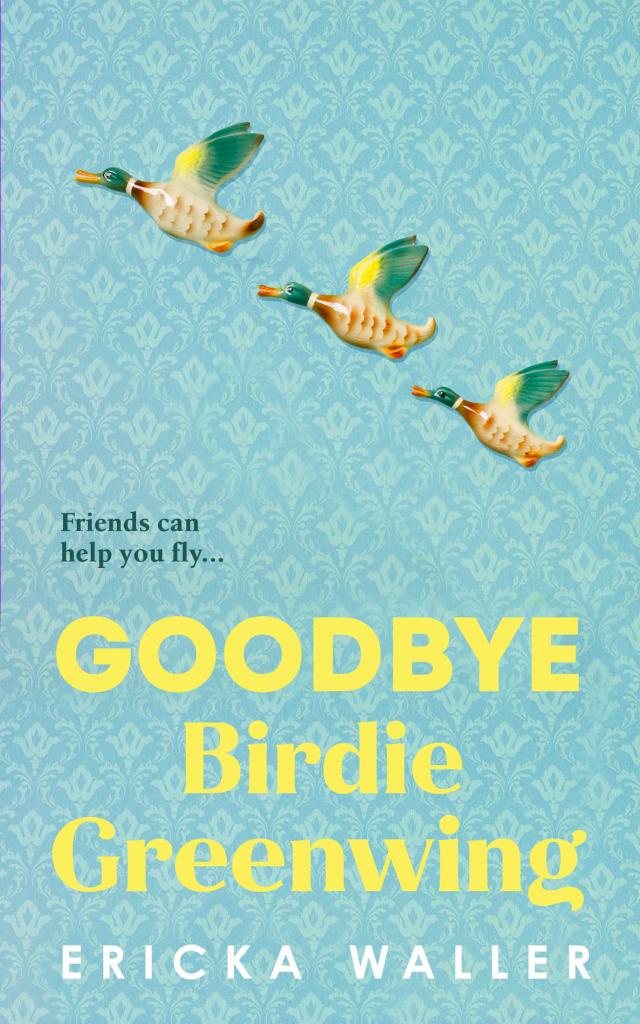
Goodbye birdie greenwing, p.1
Goodbye Birdie Greenwing, page 1


About the Author
ERICKA WALLER lives in Brighton with her husband, three daughters and dogs. Previously, she worked as a blogger and columnist. Her first novel, Dog Days, was widely praised by authors and reviewers alike. Goodbye Birdie Greenwing is her second novel.
Twitter/X: @erickawaller1
Instagram: @erickawaller1
Website: www.erickawaller.com
Also by Ericka Waller
Dog Days
Ericka Waller
* * *
GOODBYE BIRDIE GREENWING
For Aunt, for ever
So Eden sank to grief,
So dawn goes down to day.
Nothing gold can stay.
Robert Frost
Prologue
BRIGHTON IS AN ADVENT calendar; we are counting down the days. Behind each door, cardboard people are sleeping, unaware of how fragile their lives are, of what is coming. Birdie and Audrey snooze at number six Shrublands Road. Audrey’s snores are loud, but to Birdie, they are musical. Birdie dreams of Rose and Arthur, of days that have already passed and things that have already happened. Birdie has an appointment tomorrow that will kick her back into the present.
Next door, at number eight, Jane and Frankie Brown are doing the washing-up. Jane has one eye on her phone in case her sister, Suki, texts her. Her fingers, in the bowl, are crossed in hope. Frankie doesn’t want to go to school tomorrow. She is planning to stay up all night and watch documentaries about taxidermy. She misses her grandmother, Min, but doesn’t say so. There is dried porridge on the rim of the saucepan Jane hands her. Frankie hands it back.
Up in Bristol, Min Brown is awake too, clearing out her cupboard. It’s been on her mind. She wonders how Frankie and Jane are doing. She gave them her best milk pan and her second sharpest knife. She worries about their fridge, how full it is, when their bathroom was last bleached. Did the landlord make it nice for them? Min finishes polishing the doors and moves on to the sink. Maybe if she scrubs hard enough, she can clean the pipes all the way down to Brighton. A secret tunnel from her house to her daughter’s. If Min could, if Jane asked, she’d crawl down and scour the sewers all the way too. But she hasn’t been invited. All she can do is wait. They’ll need her soon enough.
At number twenty-two, Ada is reading a medical journal, scanning for the latest developments. Her white coat is on a hanger by the door, neatly ironed and ready for the next day. Ada is always ready, of course. Sometimes she looks out of her window and longs for someone to call for help, so that she can run outside, into the street, stethoscope round her neck, so that she can save the day.
Outside, the moon is on the move, the stars are all aligned. A breeze whispers through the leaves on the trees. Under their feet the Earth is turning. Sands are shifting in the deepest abyss beneath the sea. A change is coming. None of the people on Shrublands Road have any idea that tomorrow is hurtling towards them like a comet. Best let them get some rest while they still can.
1
Birdie
BIRDIE’S MOUTH IS COBWEB dry and her throat hurts. A crawling sense of fear, like spotting spiders in the corners of a garden shed, coats her tongue. She automatically reaches for Rose’s hand, but Rose is not beside her.
‘Did you hear what I said, Mrs Greenwing?’
Tears load like bullets behind Birdie’s eyes.
‘Yes,’ she croaks, blinking hard.
The doctor pushes a box of tissues across the desk towards her and says nothing.
Birdie holds her own hands tightly under the desk, an impossible knot of knuckles, focuses on her breathing. Her lungs are two rusty saws, cutting the air so it comes in jagged fragments. Her vision blurs, violet dots dance across the room, but Birdie refuses to pass out. She forces in a breath, thin as a straw, then out, then another and another, until she can no longer feel her heartbeat pounding in her chest. Until the fingers of panic remove themselves from her eyes. The world comes back, slowly colouring itself in.
And then Birdie can hear everything. The clock ticking, rubber-soled shoes squeaking in the corridor outside. The over-watered plant in the waiting room photosynthesizing.
Just for a single second, Birdie is aware of the whole world. Newborn babies on the top floor opening little mouths, like purse clasps, in the second before their first cry. The flop of a heavy breast as it is hoicked out of a flannel nightgown, leaking colostrum, like butter.
Birdie can feel the needles in the phlebotomy department, that sharp scratch inside the elbow, stormy-blue veins releasing an indecent shade of red. The pain of the amputees’ phantom limbs down in Skylark Ward. Birdie can sense arms she never had burning. The sole of someone else’s foot itching through her nylon pop-sock. The breathing apparatus in the critical-care ward, pumping like pistons. The crinkle of the prescription bags in the pharmacy, as they are handed over the counter. The release of a catheter being removed, the intrusion of the enema. Birdie’s body, a collection of stigmata. As if she’s not just been given her news, but the news of everybody else. Every wince, every cautious step on crutches. Each X-ray showing her bones. The hole where her sister should be.
‘I’m afraid there are no treatment options available.’
The oncologist, Dr Ada Kowalska, had laid out each word carefully, alongside a leaflet, like a garnish on a tray of sandwiches. Time ticks loudly in this quiet room. One second gone, and then another.
‘How long do I have left?’ Birdie asks finally. Her voice wobbles only slightly as she speaks, like a well-set trifle carried by steady hands. Meanwhile, underneath the table, bone-white fingers clutch the strap of her handbag.
‘Take as much time as you need,’ Dr Kowalska says, in her clipped accent, neatly sidestepping what Birdie is asking her. ‘You must have lots of questions. Would you like me to repeat anything?’
Birdie opens her beak, but nothing comes out, so she closes it again. When she used to take her sister Rose to the doctor, Birdie always brought along a list. What will these pills do and what side effects might they cause? What should we expect? How soon might they make a difference?
‘Do you have someone with you?’ Ada asks.
‘Yes, Audrey. My dog. Well, she’s at home waiting for me,’ Birdie babbles, as she does when she’s nervous. Rose would pinch her arm to make her stop.
She sees the doctor frown, a wrinkle sliding across her perfect forehead like a crease in silk.
‘Do you have anyone else at home, Mrs Greenwing?’
Birdie shakes her head hard, like a horse does when flies have settled on its eyelashes. Birdie’s flies are sadness, fear, the fact that she lives alone. She cannot make them leave. ‘How long?’ she asks again. ‘Tell me, please.’
The doctor shuffles a stack of papers. Clicks her mouse. She’s biding her time, but what about Birdie’s?
They are on the fifteenth floor of the hospital. Outside the window, the rusted green turrets of crumbling buildings pierce an Earl Grey sky smudged with clouds. Someone has wedged their attic window open with a shopping trolley. Unmatched trainers hang by their laces from sagging phone lines. Chimneys stripe the air with black smoke. Birdie sees the tops of red buses, of glass bus stops, seagull-splattered white vans. She sees tiny people scurrying busily, spreading through the city like spilled ink. Birdie flies above it all, as though she’s already left.
‘I really don’t—’ the doctor starts to say.
‘Three months? Six?’ Birdie interrupts.
The oncologist looks at her notes again and blinks. What a horrible question to know the answer to, Birdie thinks.
‘Well, we never know for sure, but … four months, maybe six,’ Dr Kowalska says finally. ‘But …’
Birdie nods. She understands. No promises are being made. What do you do when your life has been given an expiry date?
‘Just think what Princess Margaret would do,’ Rose would suggest, if she were here. Birdie and Rose adored Queen Elizabeth’s sister, were convinced that they were directly related to her. ‘We have her nose, her je ne sais quoi!’ Rose scoured the society pages for her heroine’s latest scandal, hooting in staunch approval at every turn. If Princess Margaret were sentenced to death in six months, she’d demand someone else die for her, then waltz out smelling of Chanel and fur coats. She’d buy herself a delightful new hat and wear it to the Ritz for a vodka pick-me-up.
The thought raises Birdie on to shaking legs. She belts her wool coat tightly, as though binding herself together. ‘Thank you for your time, Doctor.’
‘Mrs Greenwing, we have more things to go through. Please—’
But Birdie has heard enough. What else is there to say? Shutting the door behind her, Birdie keeps her head down as she passes back through the waiting room. She doesn’t want to see the expressions on expectant faces, as if she’s been in some exam and they can tell how hard it has been from looking at her. I failed, she thinks. Or passed, I suppose, depending on how you look at it.
As she walks on, Birdie wonders how many people have made this same stunned exit from the oncologist’s room, their lives forever altered from just half an hour earlier, everything in their existence boiled down to the result of a scan. Pearly ribs in grey soup. No extra points for good behaviour. For not speeding, for separating the recycling or washing clothes at thirty degrees.
I’m dying, Birdie thinks, wondering why she’s so surprised. Her body has always let her down, after all. In her mother’s womb it took too much, leaving her twin, Rose, with less. Then her own womb failed to reproduce
‘Well, hello again, Birdie Greenwing.’ The voice comes from a barely visible head, topped with a whip of white candyfloss hair. Both hair and voice belong to Connie, who runs the WRVS café in the centre of the hospital. ‘Long time no see.’
‘Connie!’ Birdie says. ‘You remember me?’
Connie is tiny. Even smaller than the last time Birdie saw her. She barely reaches above the high counter. Her black skin is paper thin, her arms are like twigs, but her eyes are bright, her gums pink when she smiles.
‘Of course I do,’ Connie says. ‘You and your sister – Rose, was it? – used to come here all the time.’
Connie makes the place sound like a restaurant, not a hospital. Birdie wants to answer but finds she can only nod.
‘Well,’ Connie says, ‘you look like you need a nice cup of tea. Go and sit down. I’ll bring it over to you.’
Birdie is in no rush to go home and tell Audrey the news. She slumps gratefully into a plastic seat at the back of the café by the window that overlooks the optimistically named ‘pleasure garden’. Seagulls peck at empty crisps packets. A man in a dressing-gown smokes a cigarette with one hand and holds his IV drip stand with the other. His gown is gaping open, like theatre curtains, and sagging nipples and a fluff-covered gut take a bow when he bends down to pick up his coffee. The bushes are bare and brown, the paths cracked and faded. Birdie struggles to spot any pleasure.
When Connie finally shuffles over, there is also a scone on the tray. ‘Fresh out of the oven,’ she says. ‘Tuck in.’
Rose and Birdie used to love scones, but were dreadful at making them. ‘How can such nice ingredients turn into something so horrible?’ Rose used to marvel, looking at their hard, bulbous creations, the raisins bitter and burned. ‘They could be served as a punishment,’ she said. ‘I sentence thee to four homemade scones and no water to wash them down with.’
‘No! I beg you, Your Honour, anything but death by scone!’
Birdie takes a small bite. It is warm, buttery, soft. Is this the last scone she’s ever going to eat? She loads on more butter, just in case. Another dollop of jam. It’s not a Princess Margaret level of debauchery, but she’s trying.
Plate empty, Birdie goes to take a sip of tea. As she swallows, she notices that the mug is emblazoned with the words ‘Cheer up! It might never happen.’ Birdie chokes. Raisins fly from her mouth and she sprays tea across the wonky tin table on to her hands, on to her wool coat. Her coughing fit is so loud that it scares off the seagulls outside in the pleasure garden. When the tears finally come, Birdie is not sure if she’s laughing or crying.
2
Jane
JANE’S ALARM CLOCK VIBRATES itself across the nightstand, as though it’s coming for her. She reaches blindly to turn it off, knocking over a framed picture of her and her sister Suki. Both have their mouths open in mock horror. The ghost train broke down halfway through the ride. A teenager who, like someone from a Dire Straits song, smelt like leather and diesel led them out through the back of the ride, shuffling past plastic skeletons missing limbs, a Frankenstein’s monster faded from green to puce. Suki has a copy of the photo, too, or did have. Jane sighs and gets up, her spine clicking into place. She pulls on her uniform, then plumps up her pillow. Just once, Jane would like someone else to make her bed for her.
‘Morning,’ Jane says, when she makes her way into the living room.
Her twelve-year-old daughter, Frankie, nods but doesn’t look up. Jane glances at the screen, where two women – Pat and Janet – stand in white coats and yellow gloves, trying to decide where to start de-cluttering a hoarder’s house. Collecting old hamster bedding is undoubtedly troubling, but even more so, surely, are people like Pat and Janet, who happily go into strangers’ homes and clean them for free. Is this what Pat and Janet dreamed of in their childhood beds? Jane wonders. Being on morning TV wearing a hairnet, armed with bleach and poking at old grey underpants with kitchen tongs?
‘Morning, Pat, howya, Janet,’ Jane says, giving the screen a wave with one hand as she twists up her long hair with the other. ‘Love that seashell necklace, Pat. Is it new?’
‘She can’t hear you,’ Frankie says flatly.
Jane notices Frankie has the phone to her ear. ‘Morning, Min!’ Jane says.
‘Min says shush,’ Frankie says. ‘We’re trying to watch Pat and Janet.’
Jane tries very hard not to picture her mother, alone in her spotless house in Bristol, her granddaughter reduced to a voice down the phone.
‘We’ll always have Britain’s Biggest Hoarders,’ Frankie had told Min as she was leaving, as though she were Humphrey Bogart telling Ingrid Bergman, ‘We’ll always have Paris.’ Bogart and Bergman’s romance had ended abruptly at the beginning of the Second World War with the Nazi invasion of France.
Jane had felt like a stormtrooper herself as she marshalled Frankie out of the house, the two of them laden with suitcases, Min’s happiness crammed into one, alongside Jane’s old knickers losing their elastic and Frankie’s retainer brace.
‘Right! Let’s tackle that kitchen!’ Pat cries on screen, rubbing her Marigolds together enthusiastically.
‘No, let’s get to the bathroom,’ says Janet, brandishing a plunger. ‘I can smell it from here.’
‘Hallway,’ Frankie says into the phone. ‘Start with the hallway – right, Min, clear a path first?’
Jane had hoped Frankie would make some actual friends when they moved to Brighton, but so far she just has Pat and Janet from the telly and phone calls to Min. That said, Jane is doing no better herself. She clicks on the kettle, pulls down a mug. Milk in first, two teabags and two big sugars added quickly before Frankie sees. Frankie calls salt and sugar ‘the deadly whites’. Jane imagines them like the Kray twins, a pair of gangsters. She spots a Tupperware box and knows that inside it she will find perfectly measured amounts of protein, carbs, grains and veg. Frankie’s focus is on calories and nutrition; flavour and variety are secondary.
Frankie is a worrier. She frets about Jane getting tired in the afternoons. Worries that she’ll forget to cling to the pole on the bus when it stops. That Jane’s cheap shoes will be slippery in wet weather. Life is an accident waiting to happen, according to Frankie. She wants her mother to live like an egg, padded in cotton wool, lest she crack. Jane secretly googles sky-diving and wing-walking with the furtiveness other people have when they search for porn.
Since leaving Min, Jane and Frankie have each wanted to mother the other. They argue over who pushes the shopping trolley, who opens the post, who pours the boiling pasta water down the drain, who takes out the bins, who answers the phone, and which one calls the final goodnight. Back in Bristol, Min used to do all these things. Without her around, their roles in the relationship, in anything, feel uncertain. Jane wants Frankie to be a happy, carefree child. Frankie wants Jane to take atmospheric pressure more seriously. Back in Bristol, Min calls and calls and calls.
‘Once more unto the breach,’ Jane says, as they zip up coats, check pockets for tissues and lip balms, and head out into the windy morning.
‘Don’t forget to drink plenty of water,’ Frankie says. ‘You don’t want another dehydration headache.’
‘Don’t eat your boiled eggs in class.’
‘Why not?’ Frankie pulls one from each pocket. ‘They serve a dual purpose. Excellent hand warmers until ten a.m. and then a healthy snack.’
‘But they smell,’ Jane says.
Frankie stops to look at her mother, a frown scrunching her eyebrows together. Jane wants to smooth them down, stroke them like two tiny shrews, but Frankie cannot be touched.
‘So what?’ Frankie says.


