Playing naomi, p.1
Playing Naomi, page 1


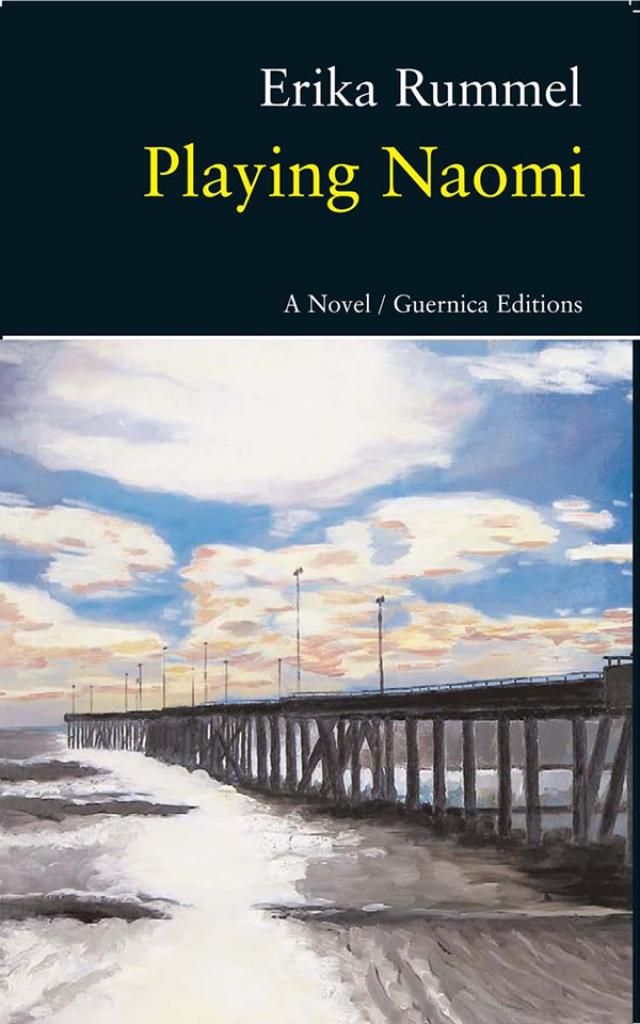
ERIKA RUMMEL
PLAYING NAOMI
PROSE SERIES 85
GUERNICA
Toronto – Buffalo – Lancaster (U.K.)
2009
PLAYING NAOMI
1
The house in Brentwood was a modernist cube, Lloyd Wright-inspired and paid for with royalties and studio contracts. It suited Naomi. From the curb, one could see only a glint of polished steel and tinted glass. There was no through-traffic on Holyoke. The road passing the house ended in a cul-de-sac. It was safe from intruders, enclosed by a stonewall, hidden from sight by the foliage of an old orange grove. Surveillance cameras were mounted above the gate, and a Bel Air Patrol sign threatened Armed Response.
The décor, once elegantly cool, had lost its crispness. Naomi did not mind the withered look. She wanted the house silent, bereft of illusion, with a stagnant air that didn’t disturb her thoughts, with furniture like ghosts, speechless and dead, a mood that encouraged sleep. Naomi wanted to close her eyes and slip away into sweet unconsciousness, sink to the bottom of her soul.
The curtains in the bedroom were drawn shut. It was mid-morning, and the darkness of the room had become transparent, but the black shag carpet was bottomless and made it easy to sink back into the void of profound sleep. The ebony headboard cast a shadow over Naomi, her body floating on the bed weightlessly, skeins of hair across her face softly blurring her vision. Reaching for nirvana, she stretched out her hand to the pillbox sitting on the side table. Her fingers rested on the lid for a moment, clasped it and let go again. She had promised herself to hold off and stay awake until the evening. She pulled away and sat up against the cushions, prepared to suffer consciousness. Her eyelids were drooping, heavy with ennui, but there was one more book to write: the story of her life. She had tried to tell the story once before, but it came out skewed. She couldn’t resist tweaking the facts to make them palatable. The story changed in the telling. She ended up writing about life as it should have been, the Hollywood formula that had brought her success – every word poignant, every action pre-ordained, survival guaranteed. The characters, evenly divided into heroes and villains, were familiar to her readers and worn thin by habit. The heroine of her own life, the woman she wanted to write about, remained a mysterious creature, unknown even to the author: forgotten, suffocated, buried under layers of time.
Naomi’s life was a Bildungsroman in reverse, a story of retreat from unacceptable truths. It made no sense. There was no moral, no lesson to be learned. The heroine’s name had been the first thing to go. Anna Darvo became Naomi Baum. The pseudonym cushioned the bedrock of her past. Next, she discarded love or, at any rate, exchanged one lover for another with diminishing returns, a streak of bad investments leaving her soul bankrupt. At last she hid in the house with the walled garden. She no longer wanted to be seen. She wanted to curl up, hide in a burrow. What was left now? Sleep, then death. But perhaps the retreat had started earlier, when she was a child, when she first visited Sol’s apartment.
Up close Sol smelled of Old Spice and solvent. He used to be a model, he said.
“A model?” she asked, incredulous. Weren’t models supposed to be glamorous?
Sol was avuncular, round faced with a hint of jowl and thinning hair, clothes rumpled as if he had just rolled out of bed.
“An artist’s model,” he said. “And sometimes I sat for a fashion photographer.”
He kept a shoebox of photos and newspaper clippings showing a man who may or may not have been Sol. It was hard to tell. The pictures were grainy, blurred. The captions were in Cyrillic script, but it did not matter that the words were unreadable. They were symbols. They stood for the life Sol had lived in the old country. In some of the photos he was nude, pale and hairy. In others he wore a tuxedo. Sometimes he read bits of the captions to the child. He sounded like a radio announcer pleading for donations, but the words meant “At the opening of the Vitosha Gallery” or “Nightlife in Sofia.” The photos were proof that Sol deserved a better place than a messy walkup.
Sol was unlike anyone in Naomi’s family. He did not go to an office. He did not stand behind a counter. He was an artist. He lived in a studio, a chaotic flat that contained the debris of his life: plates with half-eaten food, rags with caked-on oil paint, a week’s worth of newspapers spread over the table, a couple of books with warped covers. Sol’s clothes were carelessly piled up on a chair, layer upon layer, like geological strata. The walls had dabs of paint on them. Sol used them as his palette sometimes. His paintings, huge canvases propped up against the wall, were covered with writhing humanoid shapes, obscenely pink, with splayed fingers and toes, or tragically staring faces with mouths full of teeth.
“What do the pictures mean?” she asked him.
“Whatever you make of them, Starfish, that’s what they mean.” He called her Starfish when they were alone.
“But what do you want them to mean?”
He shrugged his shoulders. “Nothing in particular. I don’t think about what I’m painting. I follow the lead of the brush. It’s an urge. I can’t help it. I have to paint.” He said the same thing when he felt her up. It was an urge he could not resist. He smiled at her confidentially as if they understood each other, were made for each other. He offered her a candy bar. She accepted the sweet reluctantly, unwrapped it, chewed it morosely. She knew it was a bribe. She allowed the chocolate to dissolve on her tongue and the syrupy mess to gum up her mouth while Sol was watching her greedily. He laid her down on the bed and pressed his body against hers, and she turned her head away, resigned, closing her eyes tightly. As he nudged his way down her body, she furtively wadded the candy wrapper and stuffed it into her mouth, swallowing her screams.
That is when the lies began seeping into Naomi’s life, when she began disappearing little by little. The dream world, that ideal, perfect, buoyant world crowded out the real one with the defects and rough edges, the soiled world of Sol’s walkup, the furtive groping on his disheveled bed, the painfully probing fingers. The splendid world of fantasy opened up and took over then, a great production, the song-and-dance routine of a fake life, in which the predator hunts in vain, the guilty past falls away, the heroine is saved. Perhaps the new novel should start in a filthy apartment, with Sol pressing his body against a child’s.
There was a knock at the door. Erin came in with the tea tray. Her little idiot savant, her little slavey, her shield against the world.
“Oh, you’re awake,” Erin said. She put the tray with the two mugs on the table, opened the curtains, and sat down on the edge of the bed. “Why didn’t you call me?”
Naomi reached for Erin’s hands. “Your fingers are always cold,” she said and rubbed them between her palms.
Even wearing a bright yellow jacket, Erin looked washed out, as insubstantial as a speck of light on the wall. The elusiveness of her features gave her a vague, changeable quality. Her face was unlike the plastic cheerfulness of the maid and the gardener, their uncomprehending certainty, their mindless smiles, which made Naomi recoil.
“Erin,” she said, “remember when we first met? Have I changed much?”
Erin’s eyes were a deep pool, liquid blue with a dark rim. “For one thing, you’ve lost weight,” she said. She compressed her mouth into a wavy line of disapproval. “You should eat more,” she said. “You are just skin and bones. A skeleton. Pretty soon there’ll be nothing left of you.”
Those liquid eyes could see the future. “Maybe that’s what I want,” Naomi said. “To be nothing, to disappear.”
“I know,” Erin said evenly. “You’ve been trying to do that for a long time now. Hiding out in your bedroom. Refusing to see anyone. That’s as much as disappearing.” Right again. She was still holding Erin’s hands between her own. “If I ever wanted to disappear completely,” she said, “would you help me, Erin?”
Erin looked at her, unblinking. “How?” she said.
“By doing nothing.”
Moistness rose to the surface of Erin’s eyes and sank again, but she made no objection. She understood. Erin loved to obey. She was keen on instruction.
“Do nothing when it comes to it,” Naomi said again.
“But I thought you were feeling better,” Erin said. She withdrew her hands as if to reprimand Naomi. “I thought talking to Liz Morgan was a start, a step in the right direction. At least you were getting dressed and talking to someone other than me. ”
“No, Erin. Liz doesn’t count. She is nobody.”
“She is your dog walker. You picked her.”
“She is a washed-up actress. I picked her because she is nobody. She has no personality. She responds to cues. That’s all she does. If I treat her like a shrink, she responds like a shrink. She asks me little probing questions and says ‘I see.’ If I treat her like a confidante, she gets all chummy. She pats my arm and puts on a toothy smile. It’s really quite amusing. She is like putty, a character taking shape under my hands. I think I’ll stick her into my next novel.”
Erin brightened. “Once you get going on a new novel, you’ll be okay,” she said. “So have you got a plot line?”
“It’s going to be a surreal novel. I’m thinking of Pirandello. Or Unamuno. It’s a story in which the character meets the author.”
“Kills the author? Takes over from the author? Replaces the author? You want me to take notes?” Erin said eagerly.
2
It was one of those enigmatic spring days that could go either way, drizzle or sunshine. When Liz Morgan started out jogging, the beach was s
Liz crossed Atlantic Avenue and danced up the steps of her bungalow, trying to feel light. In the living room, half a dozen birthday cards were lined up on the bookshelf, flashing “40” at her in garish spits of color, flaming red and school bus yellow. The display was supposed to be a joke, but the whole thing had turned into an act of penance, like wearing a hair shirt. Kenny ’s card rankled the most. “Hang in there, kid,” he wrote. “The great role is just around the corner.”
Sure, Liz thought, and in the meantime someone else is playing the lead in your life, Kenny, someone with fewer birthdays. Liz was becoming squeamish about her age, as if turning forty was an unsavory business. It was the age of cover up. She no longer dared to wear short shorts and tank tops. Her legs were beginning to look stringy. An ironic curve had appeared over one eyebrow, and shadows were lingering in the corners of her mouth. Perhaps none of that mattered if you were an accountant or a cashier at Savon Drugs, but it mattered if you were in a lineup at auditions, waiting for that iconic role to bewitch the masses.
The acting jobs were drying up. Liz could barely pay the rent on the faded clapboard cottage, a toy house fit for surf bums and unemployed actresses. It was laughably small and crowded, even after Kenny moved out and took his gear with him. He was a cad, but she missed him anyway. It wasn’t easy to find a new lover. Or someone to share the rent.
Liz went into the windowless kitchen, blinked on the fluorescent lights, and opened the fridge. The motor came on with a hum. With Kenny gone, there were only diet-wise choices. No ice cream, no bacon bits, no mayo. She sat down at the table with a bowl of fruit salad, allowing herself to feel virtuous. She scanned the headlines of the L.A. Times and quickly moved on to the entertainment section. Break-ups, link-ups, parties, detox clinics: only the trivial was important in Hollywood. The motor of the fridge stopped with a shudder. She looked up at the wall clock, the red pointer hopping the seconds in regular jerks, and folded the paper. Time to walk Naomi Baum’s dogs.
For a while she had supplemented her income with pet photography, but the owners were hard to please. Liz wanted to capture pet personalities. She produced images of foreshortened dog faces licking their chops with tongues crowding the camera, or cockatiels preening, self-absorbed and withdrawn from the viewer, amorphous feathery balls. The owners wanted prancing pet models in the epicenter of the picture, dogs in red Santa Claus hats and kittens in bassinettes. She gave up photography and switched to dog walking. The clients were more congenial, they didn’t tell her how to walk the dogs or where, as long as they came back happy from their workout. Besides, dog walking was a job that didn’t keep her from acting. Liz treated it as rehearsal time. She took the dogs for a run on Westridge Trail, but she also tried to look the part: hitting the right stride, keeping a certain amount of tension in the arm holding the leash, putting that look of windblown concentration on her face.
Liz got into her red Honda and drove past the small shops and walk-up apartments, turning onto Ocean Boulevard. She stopped for the lights at Colorado and watched the bums hanging out in the park, waiting for the Salvation Army handout. They stood around silently, shoulders drooping. Their faces were motionless, except for one crazy woman, who had an animated air. Her shoulders were twitching, her lips jabbering. Waiting for the lights to turn, Liz watched the woman carefully and twitched her shoulder in imitation. She liked memorizing gestures, just in case they were needed one day.
On San Vicente, the branches of the old coral trees were still bare, but the fiery red blossoms glowed like signal lights. The low-rise apartment buildings gave way to baronial mansions. Beyond the treetops, Liz could see the mountains, velvety green from the recent rainfall. By noon she would be on the backbone trail with Buffy and Lane. Walking Naomi Baum’s terriers was definitely better than her last gig, hawking vitamin supplements on the shopping channel.
Liz turned into the driveway of Naomi’s house and parked the car. Erin Miller, Naomi’s secretary, buzzed her in. Through the open office door, she could see her talking on the phone, a tiny youthless woman with a waxy complexion. Erin paused in her conversation long enough to wave to Liz, mouthing “She’s in her study.”
Everything about the house had a dated look. Naomi refused to have painters and decorators disturb her peace. The drawing room was like a vintage movie set. The walls were beginning to look drab, and the geometric pattern of the curtains had faded from black to charcoal. Only the Lucite and silver ceiling retained its glamour. It was a house made for entertaining, but Naomi lived in a melancholy funk and shunned dinner parties. She had no reason to be morose. Naomi’s latest book, East West Connection, was topping the charts. It took readers straight to where they wanted to be: the entrepôt of danger and passion. How did a recluse like Naomi know about things like car chases and steamy hotel room sex? Watching TV? There was a fifty-inch flat screen in her bedroom, the only thing in the house that wasn’t vintage.
When Liz came into the study, Naomi was waiting for her. She was draped in black, a slim figure, mysterious and ageless like a goddess, more onyx than flesh. She stretched out her arms, and the folds of her loose gown undulated, as if moved by a heavenly breeze.
“Do I have bony hands?” she said, holding them up for inspection.
Liz took a perfunctory look. “Not really,” she said. Perhaps she should have feigned more interest. Was “not really” the right response? It depended on how you defined your role. As a confidante, she might have said more. As a dog walker, she kept comments to a minimum.
“Do you think there is a connection between physiognomy and character?” Naomi said.
“Never occurred to me.”
“Sol was convinced of it. Bony fingers betray an inclination to jealousy, he said. Or was it envy? I can’t remember which.” She pulled up her legs and arranged them becomingly on the sofa. It was a marvelous piece, lime green with gray fish swimming through a sea of orange and black donuts. The effect was psychedelic.
Who the hell is Sol? Liz thought.
Naomi fluttered her eyes. “What was I talking about?” she said. “My mind has suddenly gone blank.”
Liz wondered whether Naomi was losing her grip on reality. There was a character named Sol in East West Connection, a secret agent. Was Naomi mixing up fact with fiction? She was on a cocktail of drugs to control her mood swings, to lower her blood pressure, to help her sleep, to help her concentrate – a rainbow hued assortment of pills and capsules, obtained from a Hollywood doctor with a large clientele of self-medicating patients. The general effect was paranoid withdrawal. There had been no signs of delusion so far.
“You were talking about someone called Sol,” Liz reminded her.
“Oh, never mind him,” Naomi said.
It’s going to be a long morning, Liz thought. Her job was morphing into something she hadn’t applied for, a hybrid job: dog-walker cum therapist to Naomi Baum.
3
Ted Hillman handed the car keys to the valet and ignored the smile of recognition. He was used to attention. His talk show was popular, but popularity came at a price: humoring the fans. He was tired of small talk and requests for autographs.
Ted walked into the gallery and surveyed the collection of doorframes and the plastic body parts strewn on the floor, leaking acrylic blood. An usher encouraged the guests to interact with the installation. Ted had to enter the labyrinth of doors cobbled together from barn board and plywood before being allowed to collect a drink. He stepped briskly through one of the structures. The ramshackle display was at odds with the pristine walls of the gallery, the glistening pot lights, the haute couture crowd, the waiters serving canapés. The opening reception for Miro Bogdan’s installation ENTRY/ EXIT was packed with A-list clients.