

Top of the heap, p.1
Top of the Heap, page 1


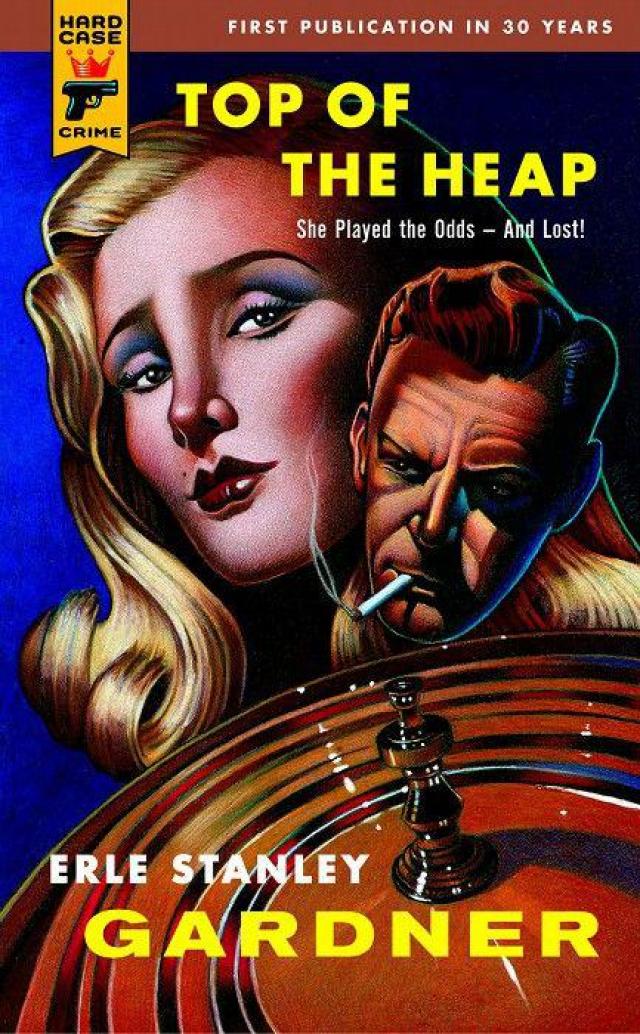
High Praise for ‘TOP of the HEAP’!
“An ingenious story.”
—Kirkus Reviews
“One of the best in the series... An illegal casino, bogus mines, former strippers and dead bodies abound... You can only love a book where everyone gets exactly what they deserve in triplicate.”
—Karen Ellington, The Mystery Read
“A fine elaborate business of stock manipulation and (to fit in with the current worries of us all) income tax deception.”
—Anthony Boucher, The New York Times
“It’s a neatly knotted puzzle and Donald unties it very neatly, too.”
—New York Herald Tribune Book Review
“A fast-paced, action-packed story.”
—Springfield Republican
Rave Reviews for Erle Stanley GARDNER!
“The best selling author of the century... a master storyteller.”
—The New York Times
“Gardner is humorous, astute, curious, inventive — who can top him? No one has yet.”
—Los Angeles Times
“A fast and fiery tough tale... very very slick.”
—Kirkus Reviews
“Erle Stanley Gardner is probably the most widely read of all... authors... His success... undoubtedly lies in the real-life quality of his characters and their problems... “
—The Atlantic
“A clean, economical writer of peerless ingenuity.”
—The New York Times
“One of the best selling writers of all time, and certainly one of the best-selling mystery authors ever.”
—Thrilling Detective
“Zing, zest and zow are the Gardner hallmark. He will keep you reading at a gallop until The End.”
—Dorothy B. Hughes,
Mystery Writers of America Grandmaster
The blonde nervously took a cigarette case from a black bag and tapped the cigarette on the side of the polished silver. I snapped a match into flame, and she leaned forward for the light. I could see the long curling eyelashes, the mischievous glint of saucy hazel eyes, as she looked me over.
“Thank you,” she said.
Abruptly the floor manager glided up to the table. His smile was reassuring. “I have been asked,” he said, “to invite you to step into the office, Miss Marvin, and the boss would like to see Mr. Lam, too.”
The floor manager escorted us deferentially to a big door marked Private. He didn’t come in. The door clicked shut behind us. I turned to look. There was no knob on the door.
Channing shook hands with both of us. “How are you, Lam?” he said.
“Fine,” I told him.
I didn’t see Channing give the signal, but abruptly the door from the outer office opened and a man in a tuxedo stood quietly on the threshold.
“Mr. Lam,” Channing said, “had a card when he entered the place. He doesn’t wish to produce that card. I’d like very much to look at it.”
The newcomer reached forward and grabbed my wrist. I tried to jerk the arm free. I might as well have tried to pull against a steel cable.
Swift, efficient fingers did things to the wrist. The other hand hit against my elbow. My arm doubled around, flew up against my back, the wrist doubled into a grip that pulled the tendons until it was all I could do to keep from screaming.
“The card,” Channing said...
SOME OTHER HARD CASE CRIME BOOKS YOU WILL ENJOY:
MONEY SHOT by Christa Faust
ZERO COOL by John Lange
SHOOTING STAR/SPIDERWEB by Robert Bloch
THE MURDERER VINE by Shepard Rifkin
SOMEBODY OWES ME MONEY by Donald E. Westlake
NO HOUSE LIMIT by Steve Fisher
BABY MOLL by John Farris
THE MAX by Ken Bruen and Jason Starr
THE FIRST QUARRY by Max Allan Collins
GUN WORK by David J. Schow
FIFTY-TO-ONE by Charles Ardai
KILLING CASTRO by Lawrence Block
THE DEAD MAN’S BROTHER by Roger Zelazny
THE CUTIE by Donald E. Westlake
HOUSE DICK by E. Howard Hunt
CASINO MOON by Peter Blauner
FAKE I.D. by Jason Starr
PASSPORT TO PERIL by Robert B. Parker
STOP THIS MAN! by Peter Rabe
LOSERS LIVE LONGER by Russell Atwood
HONEY IN HIS MOUTH by Lester Dent
QUARRY IN THE MIDDLE by Max Allan Collins
THE CORPSE WORE PASTIES by Jonny Porkpie
TOP of the HEAP
by Erle Stanley Gardner
WRITING UNDER THE NAME ‘A. A. FAIR’
A HARD CASE CRIME BOOK
(HCC-003)
First Hard Case Crime edition: October 2004
Published by
Titan Books
A division of Titan Publishing Group Ltd
144 Southwark Street
London
SE1 0UP
in collaboration with Winterfall LLC
Copyright © 1952 by William Morrow & Company, Inc.
Copyright renewed 1980 by Jean Bethell Gardner
Cover art copyright © 2004 by Bill Nelson
All rights reserved. No part of this book may be reproduced or transmitted in any form or by any electronic or mechanical means, including photocopying, recording or by any information storage and retrieval system, without the written permission of the publisher, except where permitted by law.
This book is a work of fiction. Names, characters, places, and incidents either are the products of the author’s imagination or are used fictitiously, and any resemblance to actual events or persons, living or dead, is entirely coincidental.
Print edition ISBN 978-0-85768-316-8
E-book ISBN 978-0-85768-381-6
Design direction by Max Phillips
www.maxphillips.net
The name “Hard Case Crime” and the Hard Case Crime logo are trademarks of Winterfall LLC. Hard Case Crime Books are selected and edited by Charles Ardai.
Visit us on the web at www.HardCaseCrime.com
TABLE OF CONTENTS
Chapter One
Chapter Two
Chapter Three
Chapter Four
Chapter Five
Chapter Six
Chapter Seven
Chapter Eight
Chapter Nine
Chapter Ten
Chapter Eleven
Chapter Twelve
Chapter Thirteen
Chapter Fourteen
Chapter Fifteen
Chapter Sixteen
Chapter Seventeen
Chapter Eighteen
Chapter Nineteen
Chapter Twenty
Chapter One
I was in the outer office, standing by the files, doing some research on a blackmailer, when he came in, all six feet of him.
He wore a plaid coat, carefully tailored, pleated slacks, and two-tone sport shoes. He was built like a secondhand soda straw, and I heard him say he wanted to see the senior partner. He said it with the air of a man who always demands the best, and then settles for what he can get.
The receptionist glanced at me hopefully, but I was deadpan. Bertha Cool was the “senior” partner.
“The senior partner?” she asked, still keeping an eye on me.
“That’s right. I believe it is B. Cool,” he announced, glancing toward the names painted on the frosted glass of the doorway to the reception room.
She nodded and plugged in to B. Cool’s phone. “The name?” she asked.
He drew himself up importantly, whipped an alligatorskin card case from his pocket, took out a card, and presented it to her with a flourish.
She puzzled over it for a moment as though having difficulty getting it interpreted. “Mr. Billings?”
“Mr. John Carver Billings the—”
Bertha Cool answered the phone just then, and the girl said, “A Mr. Billings. A Mr. John Carver Billings to see you.”
“The Second,” he interposed, tapping the card. “Can’t you read? The Second!”
“Oh, yes,” she said, “the Second.”
That evidently threw Bertha Cool for a loss. Apparently she wanted an explanation.
“The Second,” the girl repeated into the phone. “It’s on his card that way, and that’s the way he says it. His name is John Carver Billings, and then there are two straight lines after the Billings.”
The man frowned impatiently. “Send my card in,” he ordered.
The receptionist automatically ran her thumbnail over the engraving on the card and said, “Yes, Mrs. Cool,” into the telephone.
Then she hung up and said to Billings, “Mrs. Cool will see you now. You may go right in.”
“Mrs. Cool?” the man said.
“Yes.”
“That’s B. Cool?”
“Yes. B. for Bertha.”
He hesitated perceptibly, then straightened his plaid sport coat and walked in.
The receptionist waited until the door had closed, then looked up at me and said, “He wants a man.”
“No,” I told her, “he wants the senior partner.”
“When he asks for you what shall I tell him?”
I said, “You underestimate Bertha. She’ll find out how much dough he has, and if it’s a sizable chunk she’ll ask me in for a conference. If it isn’t a big wad and John Carver Billings the Second intimates he thinks a woman isn’t as good a detective as a man, you’ll see Mr. John Carver Billings the Second thr own out of here on his ear.”
She looked very demure. “You’re so careful with your anatomical distinctions, Mr. Lam,” she said without smiling.
I went back to my office.
In about ten minutes the phone rang.
Elsie Brand, my secretary, answered, then glanced up and said, “Mrs. Cool wants to know if you can come into her office for a conference.”
“Sure,” I said, and gave the receptionist a wink as I walked past and opened the door of Bertha’s private office.
One look at the expression on Bertha’s face and I knew everything was fine. Bertha’s little, greedy eyes were glittering. Her lips were all smiles. “Donald,” she said, “this is John Carver Billings.”
“The Second,” he amended.
“The Second,” she echoed. “And this is Mr. Donald Lam, my partner.”
We shook hands.
I knew from experience that it took cold, hard cash to get Bertha to assume that ingratiating manner and that cooing, kittenish voice.
“Mr. Billings,” she said, “has a problem. He feels that perhaps a man should work on that problem, that it might—”
“Be more conducive of results,” John Carver Billings the Second finished.
“Exactly,” Bertha agreed with a cash-inspired alacrity of good humor.
“What’s the problem?” I asked.
Bertha’s chair squeaked as she moved her hundred and sixtyfive pounds around so as to pick up the newspaper clipping on the far corner of her desk. She handed it to me without a word.
I read:
KNIGHT DAY’S COLUMN — DAY AND NIGHT
BLOND BEAUTY DISAPPEARS. FRIENDS
FEAR FOUL PLAY. POLICE SKEPTICAL.
Maurine Auburn, the blond beauty who was with “Gabby” Garvanza at the time he was shot, has mysteriously disappeared. “Friends” have asked police to make an investigation.
The police, however, who feel that the young woman was considerably less than cooperative during their investigation into the shooting of the mobster, are inclined to feel that Miss Auburn, who kept her own counsel so successfully a few nights ago, is about business of her own. So far as police are concerned, her failure to pick up milk bottles from the doorstep of her swank little bungalow in Laurel Canyon is a matter of official indifference. In fact, officers pointed out quite plainly that Miss Auburn resented having police “stick their noses” into her private life a few days ago, and the police intend to respect her desire for privacy whenever possible.
The story as given to police by “friends” is that three days ago Maurine Auburn, who was the life of the party at a well-known nitery, became peeved at her escort and walked out.
Nor did she walk out alone.
Her departure was prefaced by a few dances with a new acquaintance whom she had met for the first time at the night club. The fact that she left the place with this newfound friend, rather than with members of her own party, is a circumstance which police consider to be without especial significance. Friends of the young woman, however, regard it as a matter of the greatest importance. Detectives are frank to state they do not consider this occurrence unique in the life of the mysterious young woman who was so singularly unobservant when Gabby Garvanza was on the receiving end of two leaden slugs.
When milk bottles began to pile up on Miss Auburn’s doorstep, the peeved and jilted escort, whose name is being withheld by the police, felt that something should be done. He went to the police — perhaps for the first time in his life. Prior to that time, as one of the officers expressed it, the police had gone to him.
In the meantime, Garvanza, who has so far recovered that he has been definitely pronounced out of danger, continues to occupy a private room at a local hospital and, despite his convalescence, continues to employ three special nurses.
After coming out of an anesthetic at the hospital following the operation which resulted in removing two bullets from his body, Gabby Garvanza listened patiently to police inquiries, then, by way of helpful cooperation, said, “I reckon somebody who had it in for me must have taken a coupla shots at me.”
Police consider this a masterly understatement of fact and point out that as an aid to investigative work it is somewhat less than a valuable contribution. There was a distinct feeling at headquarters that both Gabby Garvanza and Miss Auburn could have been much more helpful.
I dropped the clipping back on Bertha’s desk and looked at John Carver Billings the Second.
“Honestly,” he said, “I never knew who she was.”
“You’re the pickup?” I asked.
He nodded.
“And Maurine left the nitery with you?”
“It really wasn’t a night club. This was late in the afternoon, a cocktail rendezvous, food and dancing.”
I said to Bertha, “We might not want to handle this one.”
Bertha’s greedy eyes flashed at me. Her jeweled hand surreptitiously strayed toward the cash drawer. “Mr. Billings has paid us a retainer,” she said.
“And I offer a fivehundred-dollar bonus,” Billings went on.
“I was coming to that,” Bertha interposed.
“A bonus for what?” I asked.
“If you can find the girls I was with afterward.”
“After what?”
“After the Auburn girl left me.”
“That same night?”
“Of course.”
“You seem to have covered a lot of territory,” I said.
“It was this way,” Bertha explained. “Mr. Billings was to have been joined for cocktails by a young woman. This young woman stood him up. He had been attracted to Maurine Auburn, and, when he caught her eye, asked her to dance. One of the men who was with her told Billings to go roll his hoop. Miss Auburn told the guy he didn’t own her, and he said he knew that; he was watching the premises for the man who did.
“It looked like the party might get rough so Billings, here, went back to his own table.
“A few minutes later Maurine Auburn came over to his table and said, ‘Well, you asked for a dance, didn’t you?’
“So they danced, and, as our client says, they clicked. He was nervous because her escorts looked like tough mugs. He suggested she shake them and have dinner with him. She told him about another place she liked. They went there. As far as Billings knows she’s still powdering her nose.”
“What did you do?” I asked Billings.
“I stuck around, feeling like a sap. Then I noticed two girls by themselves. I made a play for one of them and got the eye. We danced for a while. By that time I realized, of course, Maurine had stood me up. I wanted one of these girls to ditch the other one so we could go places. No dice. They were together and they were going to stay together. I moved over to their table, bought them a couple of drinks, danced with them, had dinner, paid the check, and took them to an auto court.”
“Then what?”
“I stayed all night.”
“Where?”
“In this motor court.”
“With both of them?”
“They were in bedrooms. I was on a couch in the front room.”
“Platonic?”
“We’d all had quite a bit to drink.”
“Then what?”
“About ten-thirty in the morning we had tomato juice. The girls cooked up a breakfast. They weren’t feeling too good and I was feeling like hell. I got away from there, went to my own motel, took a shower, and went down to a barbershop, got shaved and massaged and — Well, from there on I can account for my time.”
“Every minute of it?”
“Every minute of it.”
“Where was the motor court?”
“Out on Sepulveda.”
Bertha said, “You see, Donald, these were a couple of San Francisco babes on an auto tour. Mr. Billings thinks they knew each other pretty well, that they may have been relatives, or may have been working together in an office somewhere. Apparently they’d planned an auto tour of the country on their vacation. They wanted to see a Hollywood night spot and see if they could get a glimpse of a movie star. When Mr. Billings offered to dance with them they were willing to play along but they were playing the cards close to their chest and wouldn’t let the party split up.


