

The case of the restless.., p.1
The Case of the Restless Redhead, page 1
part #45 of Perry Mason Series


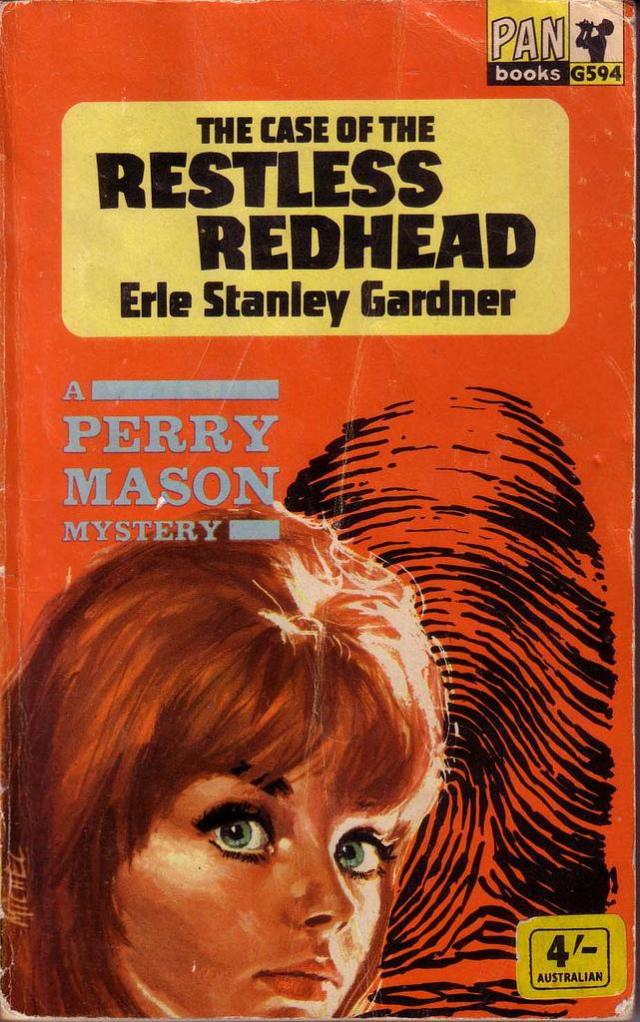
The Case of the
Restless Redhead
Erle Stanley Gardner
FOREWORD
Of all professional men, the doctor of medicine is called upon to do his work under the most adverse circumstances.
The lawyer may take days to look up an important problem on which he is called to give advice. The engineer figures stresses, strains and gradients with the aid of a slide rule and reference tables. But the doctor is called in the dead of night, aroused from a sound sleep and confronted with an emergency in which immediate action must be taken and highly specialized knowledge applied. The doctor has to carry his knowledge at his finger tips.
The doctor is always haunted by the knowledge that some patient may turn on him, magnifying any unforeseen Tesult, any complication which could not possibly have been anticipated, into the basis of a lawsuit.
It is hardly comforting to think that property which a doctor has acquired through years of effort may be snatched from him overnight by a designing patient who can tearfully appeal to the whims of a susceptible jury.
I have had doctors tell me that when they are driving and come upon the scene of an automobile accident they would like to stop and say, “I am a doctor. May I be of service?” They could then give immediate emergency treatment to the extent of their ability. They tell me they don’t dare to do it.
Some of the patients would be grateful, but probably one out of ten of the injured persons would see a heavensent opportunity. He would say, “This was not a doctor of my choosing. I didn’t call him. He gratuitously injected himself into the picture and started giving treatment without my consent.”
It is perhaps only one out of ten injured persons who would take this action, but experience shows that in something like eight or nine times out of ten the injured person would toss into the wastebasket any bill the doctor might send for professional services. He might perhaps be grateful but he would say, “I didn’t call this doctor. He just happened to be there. Why should I pay him anything?”
According to simple mathematics, therefore, a doctor treating ten patients would receive not more than ten dollars by way of compensation and would probably find himself faced with at least one lawsuit for malpractice in which the “aggrieved” person would ask for anywhere from one thousand to two hundred thousand dollars.
It doesn’t take a trained mathematician to figure those percentages. Reduce them to odds and it’s easy to see why so many doctors don’t dare to offer help.
I know some doctors who make it a point of professional honor to treat persons who are injured in automobile accidents, but when I asked one of these doctors what percentage of injured persons paid him, he looked at me in surprise and said, “I never even send them a bill. It’s a waste of postage.”
Now obviously this is not right. There needs to be a stronger bulwark between the reputable, conscientious members of the medical profession and the hazard of legal liabilities.
There are, of course, quacks and incompetents who make mistakes which are not honest mistakes but are the result of negligence, ignorance and incompetence. Those people should be weeded out of the medical profession. Medical associations are getting rid of those people quite rapidly. Another way to get rid of them is to make them pay for their mistakes.
But the honest, competent, conscientious doctor should have some assurance that as long as he is doing a competent job he is not going to be harassed by litigation, subjected to unpleasant notoriety, and forced to spend much of his time in court trying to keep from being penalized.
Obviously this is a field which needs the co-operation of the best legal and medical minds in the country. It is a field where, in all probability, there needs to be some legislative reform and there must be a great deal of clarification as to the rights and liabilities of the various parties.
It is, in short, an important and unfortunately a neglected area of legal medicine.
One of the outstanding authorities among the specialists in this field is my friend, Dr. Louis J. Regan. Dr. Regan is both a doctor and a lawyer. He has an analytical, keenly incisive mind, and a comprehensive knowledge of both his subjects. He is a past-president of the American Academy of Forensic Sciences, is one of the outstanding figures in legal medicine, and is the author of a book entitled Doctor and Patient and the Law. He is also the author of Medical Malpractice—both published by C. V. Mosby. In addition to these two authoritative books Dr. Regan is the author of more than 150 articles published in American journals. He is a past-president of the Los Angeles County Medical Association and of the Hollywood Academy of Medicine.
Quietly, unostentatiously and diligently he is working for a clarification of the law so that patients will be protected from the negligent, incompetent and unskillful practitioner while the honest, conscientious, capable doctor will in turn be protected from speculative lawsuits brought by chiseling patients in the hope that someone will settle for the “nuisance” value and they can make the down payment on a new car.
This branch of legal medicine calls for highly specialized knowledge both in law and in medicine. It also calls for patience, for understanding, vision and sound judgment.
Dr. Regan has made many valuable contributions in this field.
And so I dedicate this book to my friend:
LOUIS J. REGAN, M.D., LL.B.
Erle Stanley Gardner
Chapter 1
Since there had been less traffic than Perry Ma-son had anticipated, the lawyer parked his car in front of the big gray courthouse at Riverside a full thirty minutes before his noon appointment with Judge Dillard.
There was a chance that the case, which Judge Dillard had explained over the phone might occupy the entire morning and perhaps a part of the afternoon, would have been disposed of sooner than contemplated so that Judge Dillard would be free. Mason, therefore, walked down the wide corridor to the swinging mahogany doors with Judge Dillard’s name on them and entered the courtroom.
The trial was in progress. A young attorney, obviously self-conscious, was standing by the defense counsel table, apparently at a loss as to just what to say next.
The witness, seated at ease in the witness chair, waited for the next question.
The jury seemed slightly bored.
Mason eased his long frame into a seat at the rear of the courtroom.
“Now then, Mr. Boles,” the young attorney said, “it was dark, wasn’t it?”
The witness smiled at the lawyer. “What was dark?”
“Why, the night.”
“The night was dark, but the street was lighted.”
“What do you mean, it was lighted?”
“There was a light at the corner.”
“And that light gave you sufficient illumination?”
“It gave the street sufficient illumination.”
“So that you could see?”
“So that I could see.”
“Could see what?”
“I saw the defendant, Evelyn Bagby, taking a suitcase out of the back of that automobile. She put the suitcase down on the ground, bent over, opened the suitcase, took out something—”
“Yes, yes,” the attorney interrupted impatiently. “You’ve told us all that before.”
“Well, you asked me what I saw. I thought you wanted me to tell you again.”
“No, not what you surmised the defendant was doing. I want to know what you saw her doing.”
“I saw her open the compartment at the back of the car. I saw her take out a suitcase. I saw her put it on the ground. I saw her open the suitcase.”
“Her back was toward you?”
“Yes.”
“Then you couldn’t have seen her open the suitcase.”
“I saw her bend over the suitcase. I saw her hands on the lid of the suitcase. I saw the lid of the suitcase come up. I don’t know how else to describe it.”
“You couldn’t see what she took out?”
“That I couldn’t.”
The young lawyer lowered his eyes to the counsel table, bent over a file, thumbed aimlessly through notes, apparently trying to think of some question he could ask which wouldn’t make his case worse than it already was.
Members of the jury looked at each other, at the clock, let their attention wander around the courtroom.
Judge Dillard caught Mason’s eye, looked at the clock and nodded. Mason bowed his head, indicating that his time was entirely at the disposal of the court.
“At that time you didn’t know who owned the automobile, did you?” the attorney demanded of the witness.
“No, sir, I did not.”
“When did you find out who owned the automobile?”
“After the defendant had left I started wondering—”
“Never mind what you were wondering or what you thought,” the lawyer interrupted hastily. “Just tell us when you found out who owned the automobile.”
“When the police told me.”
“Did you go to the police, or did they come to you?”
“I went to them. I heard about the theft on the radio. As soon as I heard that—”
“Never mind what you heard. Just confine your answer to the question.”
“Very well.”
The lawyer sat down in the chair at the counsel table, turned to his client, a young woman somewhere in her twenties with red hair and clothes which somehow managed to sag in the wrong places. At one time her suit had been cut along stylish lines, but the cheap material couldn’t hold its shape and seemed to be as hopeless as the expression on the young woman’s face.
There was a brief, whispered conference.
The attorney once more looked through his notes.
“Any further questions on cross-examination?” Judge Dillard asked kindly.
The young lawyer glanced at the clock, then once more got to his feet.
“How do you know it was the defendant?” he asked the witness.
“I saw her.”
“What did you see?”
“I saw the way she was dressed. I saw her face.”
“Did you get a good look at her face?”
“Good enough.”
“What do you mean, good enough?”
“Good enough to recognize her.”
“How far were you from her?”
“I’ve told you over and over, at the time she took these things from the car I was about fifty or seventy-five feet away.”
“You never at any time were closer to her than that?”
“Not while she was opening the suitcase. Afterward, however, she turned and walked toward me.”
“What was she wearing?”
“As nearly as I can recall she was wearing the clothes she has on at the present time, plus a plaid coat with a fur collar.”
‘What kind of a coat?”
“A coat similar to that which has been introduced in evidence. To the best of my knowledge it was the same coat that’s hanging on the hanger over there.”
The witness pointed to a long, full-skirted coat hanging on a wire coat hanger from the edge of the blackboard. A tag on the coat indicated it had been introduced in evidence. The blackboard contained a diagram drawn in chalk, freehand, which had apparently been used to illustrate the testimony of a witness.
“What was the defendant doing when you first noticed her?”
“Opening the trunk compartment in the back of the car.”
“Did she have a key?”
“I don’t know.”
“You didn’t see her fumbling with the lock?”
“The first time I began really to notice her was when she raised the lid of the trunk compartment.”
“Then what?”
“Then she took out the suitcase, put it on the ground and bent over it.”
“What do you mean by saying she bent over it? Can you describe that action a little better? Suppose you illustrate what you mean.”
The witness wearily got up from the chair, bent over, stiff-legged, and extended his arms.
“Like that,” he said.
“Her back was toward you?”
“Yes.”
“And what did you notice?”
The witness settled himself back in the witness chair. He grinned. “To tell the truth, I noticed her legs.”
There was a titter in the courtroom. Even Judge Dillard smiled slightly.
“Good-looking legs?” the young lawyer asked, seeking to relieve the tension.
“Very good-looking legs.”
“And then what?”
“I saw her take something out of the suitcase, then she closed the lid of the suitcase, straightened and put the suitcase back in the trunk of the automobile.”
The lawyer glanced at the jury, then at the clock, worried his underlip with his teeth, seemed hopelessly undecided.
Judge Dillard came to his rescue. “I feel,” he said, “that it is evident the case will go to the jury today and the Court notices that Mr. Mason, an out-of-town lawyer, is waiting with some papers to be signed. It is now fifteen minutes before twelve, but if there is no objection we will take a recess until two o’clock this afternoon.”
The district attorney said wearily, “Could we perhaps conclude the cross-examination of this witness before recess, Your Honor?”
Judge Dillard glanced at the young lawyer.
“If the Court please,” the lawyer said, “I feel that I have only one or two more questions to ask this witness, but I would much prefer to confer with my client during the noon hour. The Court will remember that this is an assigned case, and I confess that I—”
“Very well,” Judge Dillard said. “The Court will take a recess until two o’clock this afternoon. During this recess the jury will remember the admonition heretofore given by the Court and will not discuss the case among yourselves or permit anyone to discuss it in your presence, nor will you form or express any opinion until the case is finally submitted to you. Court is adjourned.”
Judge Dillard arose and walked to his chambers.
The dozen or so spectators shuffled from the courtroom. The district attorney gathered up papers, dropped them into his brief case. The young lawyer paused for a few words with his client, then a deputy sheriff stepped forward to escort the dejected young woman to the jail.
A brunette with dark, smoldering eyes, tall, lithe, who had occupied an aisle seat, put her hands on the young lawyer’s arm.. “Oh, Frank,” she said in a low, vibrant voice, “you were wonderful!”
Mason, walking past the couple on his way to the judge’s chambers, saw the young lawyer flush.
Then Mason opened the door to the judge’s chambers to find Judge Dillard lighting a cigar.
“Hello, Mason,” the judge said. “Sorry to keep you waiting.”
“You didn’t,” Mason said. “I was early. What’s the case?”
The judge shook his head. “It bothers me.”
“Why?”
“Oh, it’s one of those open-and-shut things. I guess the defendant is guilty all right, but you—well, hang it, it bothers you when you’re on the bench.”
“An assigned case?”
“That’s rights I appointed Frank Neely. His father is a businessman here in town, and Frank is a good boy. I’ve known him for years and known his father nearly all of my life, Frank is a fine young lawyer, but there are some things a man learns only by experience—cross-examination for instance.”
“You have doubts about the identification made by the witness on the stand?” Mason asked.
Judge Dillard paused to weigh his answer. “I always have doubts about too pat an identification. In the present case there’s something irritating in the patronizing manner of that witness.
“As you know, in these assigned cases it’s a custom to appoint the young lawyers and let them get experience that way. The older lawyers are busy. They resent assigned cases. That’s the way the younger men get experience. Oh well, you have some papers you want signed in that Dalton case?”
“That’s right.”
Mason opened his brief case, pulled out a sheaf of papers. Judge Dillard sat at his desk, glanced hurriedly through the papers, affixed his signature.
“How about lunch?” Mason asked.
“I’m sorry, I have a lunch engagement,” Judge Dillard said. “I made it several days ago before you called up. I wish I’d known you were coming. How are things in the big city?”
“So-so.”
“I see that you still continue your meteoric career, pulling rabbits out of the hat at the last minute. How do you do it?”
Mason grinned. “I don’t know. I just reach in the hat. That’s my contribution. The rabbit jumps into my hand.”
Judge Dillard chuckled. “Lawyers around here think you must keep rabbits up your sleeves.”
“Well,” Mason said, “I try to believe in my cases and in my clients. That helps.”
Judge Dillard glanced at his watch, shook hands. “I certainly wish I were free. You don’t get up this way very often.”
“Not often,” Mason admitted. “They keep me busy in my own bailiwick.”
“I follow your cases in the newspapers,” Judge Dillard told him, “and get a terrific kick out of them.”
Mason thanked him and walked out to find the young lawyer sitting dejectedly at the defendant’s counsel table in the deserted courtroom, studying his notes.
He glanced up, caught Mason’s eye, nodded somewhat dubiously, looked away, then impulsively pushed his chair back and came toward Mason.
“Mr. Mason!”
The tall lawyer paused. “Yes?” he asked.
“My name’s Neely. Frank Neely. I just wanted to shake hands with you. I didn’t have any idea you were in court until Judge Dillard mentioned it, and then I recognized you from your photographs. I just wanted to tell you that I’ve always—well, I’ve admired you and thought many times of how—Well, I just wanted to shake hands, that’s all.”


