

The case of the runaway.., p.1
The Case of the Runaway Corpse, page 1


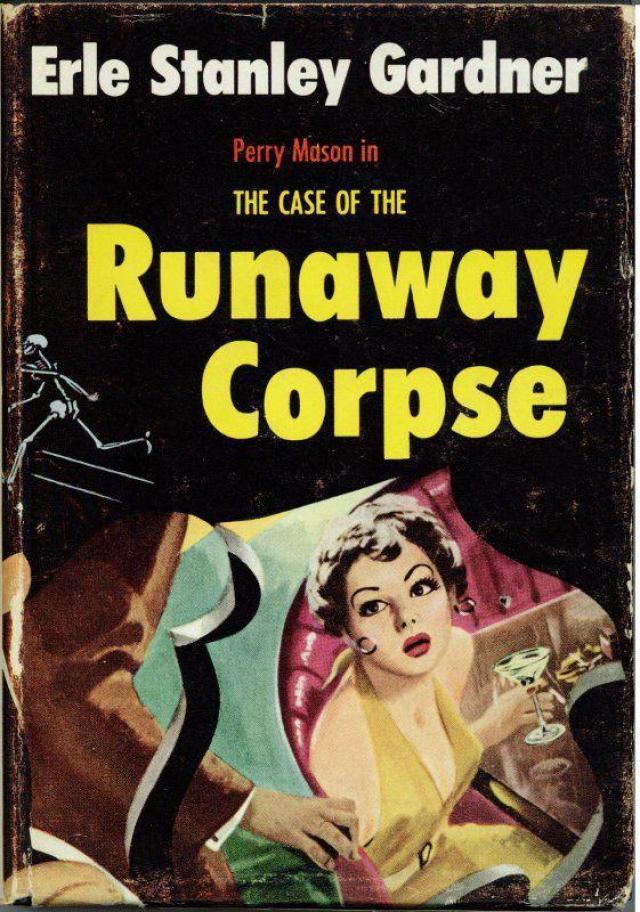
ERLE STANLEY
GARDNER
* * *
The Case of the
RUNAWAY CORPSE
© 1954, 2011 Erle Stanley Gardner. All rights reserved.
Contents
Foreword
Cast of Characters
Chapter 1
Chapter 2
Chapter 3
Chapter 4
Chapter 5
Chapter 6
Chapter 7
Chapter 8
Chapter 9
Chapter 10
Chapter 11
Chapter 12
Chapter 13
Chapter 14
Chapter 15
About the Author
Foreword
Few people have any idea of the duties, the responsibilities and the uncanny detective skill of an expert medical examiner.
Some time ago, in Los Angeles County, a six-year-old girl was murdered by a sex maniac. It was the sort of crime that aroused a surge of indignation, followed by a wave of fear.
The sex killer was still at large. No one knew who he was. The murder had been unbelievably vicious and depraved, and startled parents everywhere realized that no child was safe until the killer could be apprehended.
The battered, mutilated body was brought into the coroner’s office, where Dr. Frederick D. Newbarr went to work.
The police had searched for weapons. They had found an ax and a knife.
Dr. Newbarr examined the body, with its multiple wounds, then said to the police, “Go back and search until you have found an ice pick and a ball-peen hammer. It is my opinion that those weapons were also used.”
Then Dr. Newbarr did something no autopsy surgeon likes to do but which occasionally he is required to do under circumstances of stress and emergency. He dissected the tissue around the wounds and by a process of pathological deduction determined the sequence in which the wounds had been administered. Taking the four weapons in order, he determined which weapon had been used first, which second, which third and which fourth.
The police did splendid work in that case, but that work was sparked by the painstaking efforts of Dr. Newbarr. And when the killer was finally apprehended he made a detailed confession. That confession showed that the crime had been committed and that the weapon sequence was exactly as Dr. Newbarr had deduced in his laboratory.
Incidentally, we hear a great deal about crimes the police fail to solve. But how many times do we stop to think back and, as citizens, give thankful credit to cases of this sort where intensive, shrewd investigation runs down a sexual psychopath who is completely unable to control the distorted urges of his perverted emotions? Such a man will live quietly and unostentatiously, well known in his neighborhood as a mild-mannered, inoffensive neighbor, until some time when his surging emotions will take charge of him, independent of his own will, and transform him into a veritable maniac.
Dr. Frederick Newbarr is more than an expert pathologist, coroner’s physician and autopsy surgeon. He is a medical detective.
He has done a great deal of work in the field of distinctive pattern wounds, and has, so far as is known, been the first to employ some techniques in the field of criminal investigation which have heretofore been used only in England and in Europe.
Dr. Newbarr spent many long hours working on the baffling mystery of the famous Black Dahlia case.
Since the police have not as yet closed their books on that case, and never will close them until the killer is apprehended, there are certain things which cannot be disclosed at this time.
But there is one interesting incident which indicates the thoroughness with which Dr. Newbarr works, and shows the peculiar problems a medical examiner is apt to encounter.
In the stomach of the Black Dahlia, Dr. Newbarr found certain peculiar threadlike particles which he simply couldn’t account for. Apparently they were very small particles of wax which had entered the girl’s stomach some time before her death.
This was such an unusual finding that Dr. Newbarr spent hours trying to find some reason that would account for the presence of wax in the girl’s stomach.
Finally he solved the problem. The Black Dahlia had very bad teeth, and, according to her associates, when she was going out on a “heavy date” she would rub wax over her teeth so as to conceal some of the unsightly blemishes and cavities.
So this poor girl, thrilled at the prospect of a “heavy date,” had carefully waxed her teeth that night in order to make herself more attractive to a man who not only murdered her, but who perpetrated such a series of diabolical and revolting mutilations on the body that even hardened police officers became sickened at the sight.
One needs only to work on the investigation of some cases where an inept autopsy has been performed in order to appreciate the work that is being done by men like Dr. Newbarr—men who are highly specialized in a field which, for want of a better name, I refer to as criminal pathology.
A list of Dr. Newbarr’s activities indicates something of his background:
Clinical professor; head of the Department of Forensic Medicine at University of Southern California; guest lecturer at the College of the Medical Evangelists; Chairman of the Southwest Regional Committee of the Educational Committee of the American Academy of Forensic Sciences; member of the Sub-committee on Education of the Committee on Medicolegal Problems of the American Medical Association; and Chief Autopsy Surgeon of the Coroner’s Department of Los Angeles County.
Dr. Newbarr is a patient individual who starts on the trail of a criminal with dogged determination. There is a quiet, deadly persistence about him.
One of the best criteria to determine the efficiency of a medical examiner is reflected in the attitude of the criminal attorneys who specialize in defense work.
These attorneys are among the shrewdest practitioners at the bar. They learn to take a man’s measure rapidly and accurately, and if there is any weak point in his investigative reasoning or his characteristic reactions, they can bring out such weaknesses on cross-examination so as to cause a maximum of discomfiture to the unhappy witness.
On the other hand when an expert is well grounded in his field, and absolutely certain of the position he has taken because he has carefully thought out all of the factual ramifications, defense attorneys leave him strictly alone.
Dr. Newbarr is very seldom subjected to any extensive cross-examination these days. For the past few years attorneys have made it a point to ask him one or two routine questions and then quit.
I asked Dr. Newbarr about this and asked him how he accounted for it.
Dr. Newbarr’s answer was indicative of the man.
“If any cross-examining attorney can embarrass you on the witness stand it’s your own fault,” he said. “He’s dealing with you in your own field. If you aren’t sufficiently familiar with it so that an attorney can embarrass you, it means that you’ve been careless in your work. A man should never be careless in work involving life or liberties.”
Dr. Newbarr could carry that statement just a little further. Dr. Newbarr isn’t careless in anything—period.
Among the men who are broadening the field of forensic medicine so that it is becoming of ever-increasing significance, Dr. Frederick D. Newbarr is recognized everywhere as an important leader.
And so it gives me great pleasure to dedicate this book to my friend:
DR. FREDERICK D. NEWBARR
—Erle Stanley Gardner
Cast of Characters
Perry Mason—The famous lawyer-detective. His mousy looking client was wanted for murder in two counties
Della Street—Mason’s sharp-witted, well-built secretary. She wanted him to take the case to satisfy her own curiosity
Myrna Davenport—She said her passion was gardening, but her husband, Ed, claimed her real love was her poisonous plant sprays
Sara Ansel—Myrna’s aunt. She was fiercely devoted to her niece’s security and her niece’s money—but she stood to gain it all if Myrna was convicted
Mabel Norge—Ed Davenport’s willowy secretary. She had charge of his incriminating envelope—and also had access to his bank account
Paul Drake—In this case. Perry’s trusted private eye got an offbeat assignment: trailing another private eye
Jonathan Halder—The huffing and bluffing Butte County D.A. He thought Mason a remarkably cooperative witness until he found himself doing all the answering Pete Ingram—A light-fingered reporter with a hot tip. He wanted to swap it for a hot scoop
Talbert Vandling—The D.A. of Fresno County. He was so wary and dangerous a prosecutor that Perry feared he’d met his match
George Medford—A freckle-faced nine-year-old. He found a hole big enough to hold a body—and three days later it did
Judge Siler—He was supposed to preside at a preliminary hearing, but the battle looked full-scale from his vantage point
Dr. Milton Hoxie—The toxicologist. He stated without a shadow of doubt that the victim had died of cyanide poisoning, and certainly not from arsenic Dr. Herkimer C. Renault—The doctor who saw Ed Davenport die. He swore Davenport had symptoms of arsenic poisoning—of which he didn’t die—but ruled out cyanide absolutely
Chapter 1
Della Street, Perry Mason’s confidential secretary, entered the lawyer’s private office and said, “There are two women in the outer office who say they have to see you at once.”
“What about, Della?”
“Th
“Then simply say that I can’t see them.”
“They’re quite a team,” the secretary said.
“In what way?”
“They’re carrying suitcases, keep looking at their watches, apparently are catching a train or a plane and feel they simply must see you before they leave.”
“What do they look like?” Mason asked, his curiosity aroused.
“Mrs. Davenport is very, very mousy, a quiet, almost furtive, plain young woman.”
“How old?”
“Somewhere in the late twenties.”
“And very mousy?”
Della Street nodded.
“And the other?” Mason asked.
“If I describe Mrs. Davenport as being very, very mousy I’ll have to describe Mrs. Ansel as being very, very catty.”
“How old?”
“Fifty odd.”
“Mother and daughter?“
“Could be.”
Mason said, “The dear, devoted daughter has had to put up with too much from a brute of a husband. The daughter’s mother has come down to remonstrate and the husband called her a lot of vile names. She and her daughter are leaving him forever. They want their rights protected.”
“Probably,” Della said, “but they’re quite a team, any way.”
“Tell them I don’t take domestic relations cases,” Mason said, “and that they’d better hurry to see some other lawyer before their plane leaves.”
Della Street seemed reluctant.
Mason picked up several letters from the file marked “Urgent” which Della Street had placed on his desk. “You want me to see them,” he charged, “so that you can gratify your feminine curiosity. On your way, young woman.”
Della Street dutifully left the office, only to return within some thirty seconds.
“Well?” Mason asked.
“I told them,” she said, “that you didn’t take cases involving domestic relations.”
“And what did they say?”
“The mousy one said nothing.”
“And the catty one?” Mason asked.
“The catty one said that this was a murder case and she understood you liked murder cases.”
“And they’re still waiting?” Mason asked.
“That’s right. The catty one suggested I tell you they had a plane to catch.”
“That does it,” Mason said. “Send in the cat and the mouse with their murder case. My own curiosity has now been aroused.”
Della Street hurried from the office, returned in a few moments to hold the door open. Mason heard the sound of steps, of a suitcase bumping against a bookcase. Then a slender, demure-looking woman with downcast eyes entered the office carrying a suitcase. She looked up briefly, said, “Good morning,” then moved quietly along the wall and was lowering herself into a straight-backed chair when another suitcase banged vigorously against the door. An older woman pushed her way into the office, dropped the suitcase with a bang, looked at her wrist watch and said, “We have exactly twenty minutes, Mr. Mason.”
“Very well,” Mason said, smiling. “Please be seated. I take it you’re Mrs. Ansel.’
“That’s right.”
“And this is Mrs. Davenport?” Mason asked, indicating the young woman who sat with her hands folded on her lap.
“That’s right,” Sara Ansel said.
“Your daughter I take it.”
“No, indeed,” Sara Ansel said. “We never even saw each other until a few months ago. She’s been out of the country a lot—her husband’s a mining man—and I’ve been in the Orient, in Hong Kong. I’m sort of her aunt by marriage. My sister’s husband was her uncle.”
“My mistake,” Mason told her. “Do I understand that you want to see me about a murder case?”
“That’s right.”
Mason studied the two women thoughtfully.
“Did you ever hear the name of William C. Delano?”
Mrs. Ansel asked.
“Wasn’t he a big mining man?”
“That’s right.”
“He died, I believe”
“Six months ago. Well, my sister’s husband, John Delano, was his brother. John and my sister are both dead now. And Myrna here, that is Mrs. Ed Davenport, is a niece of John and William Delano.”
“I see. Now suppose you tell me what it’s all about and about the murder.”
“Myrna’s husband, Ed Davenport, has written a letter accusing Myrna of planning to kill him”
“And to whom did he send the letter?”
“He hasn’t sent it to anyone yet. He left it addressed to the district attorney or the police, we don’t know which, and it was to be delivered in the event of his death. It accuses his wife of poisoning Hortense Paxton, the niece who would have inherited the bulk of William’s money, and then Ed Davenport has the temerity, the unmitigated gall to state that Myrna suspects he knows what she’s done and may be planning to poison him, that in the event of his death he wants the whole thing investigated.”
Mason glanced curiously at Mrs. Davenport, who sat perfectly still. Once, as though sensing his gaze, she raised her eyes, then lowered the lids again and continued to regard her gloved hands.
“What in the world,” Mason asked, “gave him any such idea as that? Does he have any grounds for such accusations, Mrs. Davenport?”
“Of course not!” Sara Ansel said.
Mason continued to look at Mrs. Davenport.
She said, “I spend most of my time in my garden. I have some sprays, some pest controls. They’re highly poisonous. My husband has a besetting curiosity. Twice now I’ve had to warn him those sprays are not to be tampered with. That may have given him ideas. He’s very unreasonable. He gets ideas and they become fixed in his mind.”
“He’s neurotic,” Sara Ansel explained. “He broods. He drinks. He flies into rages, and then he gets strange ideas.”
“Apparently,” Mason said, “there’s rather a complicated picture here. I’ll have to know something more about it, and I take it you’re leaving on a plane.”
“That’s right. We have a taxicab waiting. The driver has given us a deadline. We’re going to have to make the airport in time for the 11:00 A.M. plane to Fresno.”
“Perhaps,” Mason said, “under the circumstances it would be better if you took a later plane and—”
“We can’t. Ed’s dying.”
“You mean Ed Davenport, this young woman’s husband?”
“That’s right.”
“And he’s left this letter to be delivered to the authorities in the event of his death?”
“That’s right.”
“That,” Mason said, “complicates the situation.”
“Doesn’t it?” Sara Ansel said impatiently.
“What is he dying from?” Mason asked.
“Dissipation!” Sara Ansel snapped.
“Perhaps,” Mason went on, “it would be better if you tried to give me a more complete outline of the background.”
Sara Ansel settled herself in the client’s big, overstuffed chair, giving a series of wiggling motions that expressed aggression rather than relaxation.
“Now you’ll have to listen carefully,” she warned, “because I’m not going to have time to repeat.”
Mason nodded. “My secretary, Miss Street, is taking notes. I can study those later.”
“William C. Delano was a very rich man and a very lonely man. During the past two years of his life his niece, Hortie—that’s Hortense Paxton—came to live with him. He was dying by inches and he knew it. His will left most everything to Hortie. She was nursing him. It was a terrific job. She wrote Myrna and Myrna and Ed came to help with the nursing.
“After they’d been there a short time Hortie became very ill. She died after a week’s sickness. Ed Davenport didn’t say anything at the time. Later on he told Myrna he thought Hortie had been poisoned. Where he got that idea no one knows. It’s typical of Ed Davenport—a neurotic, addlepated mass of selfish pigheadedness.”
“What was the cause of death?” Mason asked.
“Overwork. Her death was a terrible blow to William. She was his favorite niece. Under his will he had planned to leave her four-fifths of his estate and one-fifth to Myrna.”
“He left you nothing, Mrs. Ansel?”


