

The case of the calendar.., p.1
The Case of the Calendar Girl, page 1
part #57 of Perry Mason Series


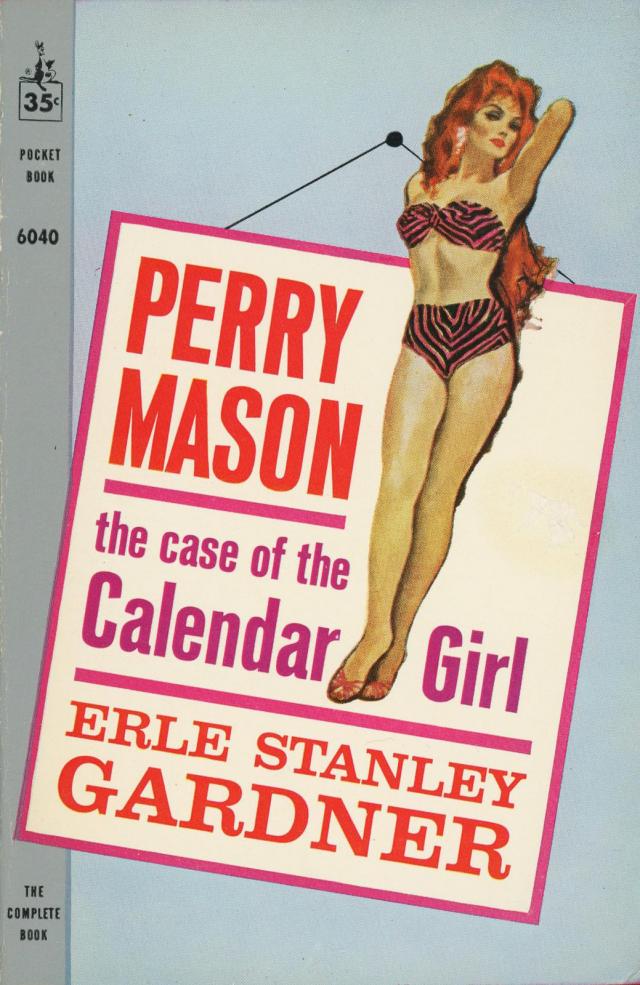
The Case of the
Calendar Girl
Erle Stanley Gardner
Foreword
I consider my friend, Dr. Hubert Winston Smith, one of the outstanding figures in the field of legal medicine, just as I consider legal medicine far more important than it is generally considered in the public mind.
Dr. Hubert Winston Smith is not only a doctor of medicine but an attorney at law as well. He is, moreover, a trial attorney of unusual ability.
Some years ago he was appointed special counsel to represent a veteran of World War II who had been convicted of homicide on circumstantial evidence and sentenced to the electric chair. Dr. Smith was able to bring out a mass of new evidence and present this evidence so convincingly that the conviction was reversed by the Louisiana Supreme Court.
Not only is Dr. Smith a professor of law, a teacher of evidence and of legal medicine at the Law School of the University of Texas, but he is also Professor of Legal Medicine in the Medical School of that University, and is Director of the Law Science Institute. In fact, it would take more space than is presently available simply to list Dr. Smith’s honors and academic distinctions.
It is under his guidance that legal medicine classes for doctors and trial lawyers are being held throughout the country. In these classes, members of both the medical and legal professions are given an opportunity to study the highly technical field of medical evidence as applied to law.
But what interests me most of all about Dr. Smith is his philosophical outlook on life. This trained scientist feels that the time has come when man should concentrate on what Dr. Smith refers to as “psychic income” rather than income on a dollars-and-cents basis.
Recently I had occasion to visit a young man who was confined in jail on a charge that was almost certain to result in a prison sentence. This young man was making a good-faith effort to analyze the reasons which had caused him to become a criminal. At length, he said, “I wish that while I was getting my education someone had pointed out to me a little more clearly the basic difference between right and wrong.” This was a simple statement, yet when we analyze it, it has far-reaching repercussions. It was a statement that came from a young man whose life had been blasted because he hadn’t stopped to think of the basic difference between right and wrong.
Dr. Hubert Winston Smith is a man at the other end of the human spectrum. He is as highly educated as any man can expect to be. He is a master of all branches of medicine, including that of psychiatry. He is a shrewd, ingenious, well-trained, capable trial attorney. He is one of the outstanding educators in the field of legal medicine, and his life is devoted to increasing the field of human knowledge.
And Dr. Smith feels that it is time for us as a nation to pay more attention to “psychic income.”
So I dedicate this book to my friend:
HUBERT WINSTON SMITH, A.B., M.B.A., LL.B., M.D.
-ERLE STANLEY GARDNER
Chapter One
George Ansley slowed his car, looking for Meridith Borden’s driveway. A cold, steady drizzle soaked up the illumination from his headlights. The windshield wipers beat a mechanical protest against the moisture which clung to the windshield with oily tenacity. The warm interior of the car caused a fogging of the glass, which Ansley wiped off from time to time with his handkerchief.
Meridith Borden’s estate was separated from the highway by a high brick wall, surmounted with jagged fragments of broken glass embedded in cement.
Abruptly the wall flared inward in a sweeping curve, and the gravel driveway showed white in Ansley’s headlights. The heavy iron gates were open. Ansley swung the wheel and followed the curving driveway for perhaps a quarter of a mile until he came to the stately, old-fashioned mansion, relic of an age of solid respectability.
For a moment Ansley sat in the automobile after he had shut off the motor and the headlights. It was hard to bring himself to do what he had to do, but try as he might, he could think of no other alternative.
He left the car, climbed the stone steps to the porch and pressed a button which jangled musical chimes in the deep interior of the house.
A moment later the porch was suffused with brilliance, and Ansley felt he was undergoing thorough, careful scrutiny. Then the door was opened by Meridith Borden himself.
“Ansley?” Borden asked.
“That’s right,” Ansley said, shaking hands. “I’m sorry to disturb you at night. I wouldn’t have telephoned unless it had been a matter of considerable importance—at least to me.”
“That’s all right, quite all right,” Borden said. “Come on in. I’m here alone this evening. Servants all off … Come on in. Tell me what’s the trouble.”
Ansley followed Borden into a room which had been fixed up into a combination den and office. Borden indicated a comfortable chair, crossed over to a portable bar, said, “How about a drink?”
“I could use one,” Ansley admitted. “Scotch and soda, please.”
Borden filled glasses. He handed one to Ansley, clinked the ice in his drink, and stood by the bar, looking down at Ansley from a position of advantage. He was tall, thick-chested, alert, virile and arrogant. There was a contemptuous attitude underlying the veneer of rough and ready cordiality which he assumed. It showed in his eyes, in his face and, at times, in his manner.
Ansley said, “I’m going broke.”
“Too bad,” Borden commented, without the slightest trace of sympathy. “How come?”
“I have the contract on this new school job out on 94th Street,” Ansley said.
“Bid too cheap?” Borden inquired.
“My bid was all right.”
“Labor troubles?”
“No. Inspector troubles.”
“How come?”
“They’re riding me all the time. They’re making me tear out and replace work as fast as I put it in.”
“What’s the matter? Aren’t you following specifications?”
“Of course I’m following specifications, but it isn’t a question of specifications. It’s a question of underlying hostility, of pouncing on every little technicality to make me do work over, to hamper me, to hold up the job, to delay the work.”
Borden made clucking noises of sympathy. His eyes, hard and appraising, remained fixed on Ansley.
“I protested to the inspector,” Ansley said. “He told me, ‘Why don’t you get smart and see Meridith Borden?’ “
“I don’t think I like that,” Borden said.
Ansley paid no attention to the comment. “A friend of mine told me, ‘You damn fool. Go see Borden.’ And … well, here I am.”
“What do you want me to do?”
“Call off your dogs.”
“They’re not my dogs.”
“I didn’t mean it that way.”
“You said it that way.”
There was a moment of silence.
“How much are you going to make on the job?” Borden asked.
“If they’ll let me alone and let me follow specifications according to any reasonable interpretation, I’ll have a fifty-thousand-dollar profit.”
“Too bad you’re having trouble,” Borden said. “I’d want a set of the specifications and a statement by you as to the type of trouble you’ve been having. If I decide you are being unjustly treated, I’ll threaten a full-scale investigation. I don’t think you’ll have any more trouble. I’d need money, of course.”
“Of course,” Ansley said dryly.
“And,” Borden went on, “after we start working together you won’t have any trouble with the inspectors. Just make your stuff so it’s good construction, so that it’ll stand up, and that’s all you need to worry about. Don’t measure the placement of your structural steel with too much accuracy. Make your mix contain just enough concrete to do the job, and don’t worry about having absolutely uniform percentages.”
“That isn’t what I wanted,” Ansley said. “I only wanted to have a reasonable break.”
“You’ll get it,” Borden promised. “Mail me a retainer of two thousand dollars tomorrow, pay five thousand from the next two progress payments you get, and give me five per cent of the final payment. Then we’ll talk things over on the next job. I understand you’re planning to bid on the overhead crossing on Telephone Avenue?”
“I’ve thought about it. I’d like to get cleaned up on this job and get my money out of it first.”
“Okay. See me about that overhead crossing before you put in your bid. We’ll talk it over. I can help you. A good public relations man who knows the ropes can do a lot on jobs of this kind.”
“I’m satisfied he can,” Ansley said bitterly.
“I wish you’d seen me before you took that school job,” Borden went on. “There might have been more in it for both of us. You didn’t have any public relations expert to represent your interests in connection with the bidding?”
“No. Why should I need a public relations expert just to submit a bid?”
Borden shrugged his shoulders. The gesture was eloquent.
Ansley finished his drink. “I’m sorry that I had to bother you at this hour of the night, but the inspector found two places in the wall where he claimed the steel was incorrectly spaced. It didn’t amount to more than a quarter of an inch, but he demanded I conform to specifications. I can’t tear out the whole wall, and to try to cut and patch now would be prohibitive.”
Borden said, “See that inspector tomorrow and tell him to take another me asurement. I think the steel’s all right. The rods may have been bent a little off center. Quit worrying about it. Tomorrow’s a new day.”
Ansley put down the drink, got up, hesitated, then said, “Well, I guess I’ll be getting on.”
“I’m glad you dropped in, Ansley,” Borden said, “and I’ll take care of you to the best of my ability. I feel quite certain you won’t have any more trouble with the inspectors. They don’t like adverse publicity any better than anyone else, and, after all, I’m a public relations expert.” Borden laughed and moved to accompany Ansley to the door.
“I can find my way out all right,” Ansley said.
“No, no, I’ll see you to the door. I’m all alone here tonight. Sorry.” He escorted Ansley to the door, said good night, and Ansley went down the steps into the cold rain.
He knew that his trouble with the inspectors was over, but he knew that the trouble with his self-respect had just begun.
They had told him at the start that it was foolish to try to build anything without getting in touch with Meridith Borden. Ansley had thought he could get by, by being scrupulously fair and conforming to the specifications. He was rapidly finding out how small a part fairness and specifications played in the kind of job he was getting into now.
Ansley sent his car crunching along the gravel driveway. His anger at himself and the conditions which had forced him to go to Meridith Borden made him resentful. He knew that he was driving too fast, knew that it wasn’t going to do him any good to try to hurry away from Meridith Borden’s palatial estate on the outskirts of the city,I knew that it wasn’t going to do him any good to try to get away from himself. He had lost something important in that interview; a part of him that he couldn’t afford to lose, but he had yielded to the inexorable pressure of economic necessity.
Ansley swung the wheel around the last curve in the driveway and slowed for the main highway as he saw the iron gates. It was at that moment that he saw the headlights on the road swinging toward him.
Apparently the driver of the oncoming car intended to turn in at the gate, and was cutting the corner before realizing a car was coming. The smooth, black surface of the road was slippery with an oily coating from the first rain in weeks.
For a brief moment headlights blazed into Ansley’s windshield, then the other car swirled through the gate into a sickening, skidding turn. The rear fender of the car brushed against the bumper of Ansley’s car.
In vain Ansley tried to bring his car to a stop. He felt the jar of impact, saw the careening car tilt upward, swerve from the driveway. He heard a crash, dimly saw the hedge sway under the impact, heard another jarring sound and then silence.
Ansley braked his car to a stop just outside the gates. Without bothering to shut off the motor or dim the headlights, he scrambled out from behind the wheel, leaving the front left-hand door swinging wide open.
He ran back through the soggy gravel to the gap in the hedge.
He could see the other car only as a dim, dark bulk. The motor was no longer running, the lights were off. He had the impression that the car was lying over on its side, but he couldn’t be certain. The machine had crashed through the hedge, but there remained enough broken twigs and jagged branches to make progress extremely difficult and hazardous.
“Is everyone all right?” Ansley asked, standing midway through the tangle of the jagged hedge.
There was no answer, only a dead silence.
Ansley’s eyes were gradually becoming more accustomed to the darkness. He plunged forward, pushing his way through the water-soaked leaves.
A projecting snag caught the leg of Ansley’s trousers, tripped him, threw him forward. He heard ripping cloth, felt a sharp pain along his shin. Then, as he threw out his hands to protect himself, his right hand was snagged by the sharp projection of a broken branch. The ground was sloping sharply, and Ansley found himself with his head lower than his feet. It was with difficulty that he got to his knees, and then once more to a standing position.
The car was directly in front of him now, only some twenty feet away.
By this time he could see plainly that the car was resting on the right-hand side of the top.
“Hello,” Ansley called. “Is everybody all right?”
Again there was no answer.
“Is anybody hurt?” Ansley asked.
The night silence was broken only by the gurgling noises of liquids draining from the car. There was the harsh odor of raw gasoline.
Ansley knew he didn’t dare to strike a match. He remembered then, belatedly, that he kept a small flashlight in the glove compartment of his car. He ran back, floundering through the hedge, opened the glove compartment of his car and returned with the flashlight.
This light, carried for emergencies, had been in the glove compartment for a long time. The battery was all but dead. The bulb furnished a fitful reddish glow which Ansley knew wouldn’t last long. In order to save the battery, he switched out the light and again floundered through the broken hedge in the dark. He approached the car, saw that one of the doors was swinging partially open. He thrust his arm inside the car and turned on the flashlight.
There was no one inside.
Ansley moved around the front of the car, holding the flashlight in front of him. What should have been a beam of bright light was now only a small cone of faint illumination. It was, however, sufficient to show the girl’s feet and ankles, feet which were eloquently motionless.
Ansley hurried around so that he could see the rest of the form which lay huddled there on the wet grass.
She had evidently been thrown to the ground and had skidded forward. The legs were smooth, shapely and well rounded. The momentum of the young woman’s slide had left her legs exposed to the thighs, her skirts rumpled into a twisted ball. Ansley raised the flashlight, saw one arm twisted up and over the face, and then the light failed completely.
Instinctively, and without thinking, Ansley threw the useless flashlight from him, bent over the young woman’s body and in the darkness groped for her wrist.
He found a pulse, a faint but regular heartbeat.
Ansley straightened and started groping his way across to the gravel driveway, only to find that the hedge barred his progress. He moved along parallel with the hedge, raised his voice and shouted, “Help!” at the top of his lungs.
The soggy darkness swallowed up the cry, and Ansley, annoyed at the thick hedge which kept him from the open gravel driveway, lowered his shoulder and prepared to crash through the intertwined branches.
It was then he heard the faint, moaning call from behind him.
Ansley paused and listened. This time he heard a tremulous cry of “Help! Help!”
Once more Ansley turned and groped his way back through the darkness to the overturned car.
The young woman was sitting up now, a vague figure in the darkness.
Ansley could see the blurred white oval of her face, her two hands and the lighter outline of flesh above her stockings.
“Are you hurt?” Ansley asked.
By way of answer she instinctively pulled down her skirt. “Where am I?” she asked.
“Are you hurt?”
“I don’t know.”
“Let’s find out,” Ansley said, dropping down beside her. “Any broken bones?”
“Who … who are you?”
“I was driving the car that you … ran into.”
“Oh.”
“Tell me, are you all right? Try moving your arms, your legs.”
“I’ve moved my arms,” she said. “My … my legs … Yes, I’m all right. Help me up, will you, please?”
She extended a hand and Ansley took it. After two abortive attempts, she managed to get to her feet. She stood, wobbling for a moment, then swayed against him. Ansley supported her with an arm around her waist, a hand under her armpit on the other side. “Take it easy,” he said.
“Where … where am I?”
“You were just turning in at the driveway of the Meridith Borden estate when you apparently lost control of your car,” Ansley said, choosing his words carefully, not wishing to accuse the shaken young woman of having hit him, but carefully avoiding any admission that his car had hit hers.
“Oh, yes,” she said, “I remember now … There was something in the road ahead, a dead cat or something. I didn’t know what it was. I swerved the car slightly and then all of a sudden I was dizzy, going around and around. I saw headlights and then there was a crash. I felt myself going over, and the next thing I knew, I was sitting here in the grass. I’m … I’m all right now. My head is clearing rapidly.”


