

The case of the worried.., p.1
The Case of the Worried Waitress, page 1
part #77 of Perry Mason Series


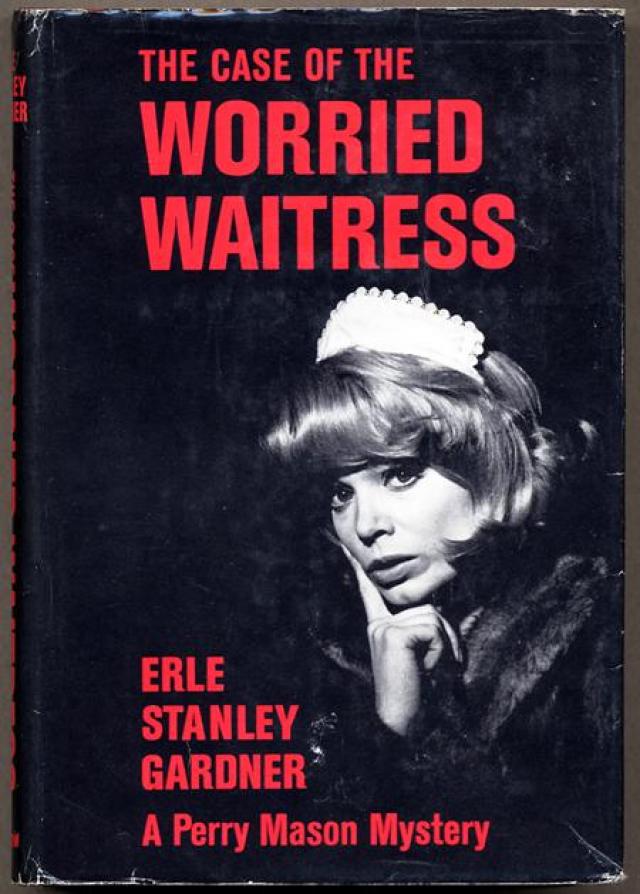
The Case of the
Worried Waitress
Erle Stanley Gardner
Chapter 1
Perry Mason and Della Street were having lunch at Madison’s Midtown Milestone.
Mason had just started lo say something to his secretary when he noticed a shadow across the table and looked up to see the smiling eyes of Kelsey Madison, the proprietor.
“How is everything, Mr. Mason?” Madison asked.
“Fine,” Mason said. “The food is up to your usual standard.”
“How’s the service?”
“Wonderful!”
Madison glanced quickly over his shoulder, then lowered his voice. “I mean that latter, Perry. How’s the service?”
Mason seemed mildly surprised. “Perfect!”
“The reason I asked,” Madison said, “is that I’ve just found out the waitress who is Waiting on you bought you from another waitress.”
“What do you mean?” Mason asked.
“You may have noticed,” Madison said, “that the girl who brought you your butter, water, knives and forks, and handed you the menus was not the same girl who returned to take the order.”
“I hadn’t noticed that,” Mason said. “As a matter of fact, Della and I were somewhat preoccupied.”
“So I noticed,” Madison said, “and I disliked to intrude, but we don’t encourage buying tables.”
“Just what do you mean by that?” Mason asked.
“It’s a custom in some of the restaurants,” Madison said. “The head waitress will assign a waitress to a table. If the diner happens to be a customer that is considered a liberal tipper, some other waitress may want to buy the table.
“For instance, if a man is a twenty percent tipper and his bill is going to come to five dollars or more— which means an almost certain dollar tip—one waitress will offer to buy the table for perhaps as much as fifty cents.
“The waitress who sells the table pockets the fifty cents, has a chance to rest her feet a bit. The girl who has bought the table takes on the extra work but makes fifty cents profit. It just depends on how much the girls happen to want money.”
“And I’m supposed to be a big tipper?” Mason asked.
“You quite frequently are, Perry. If a girl gives you good service, you’ll tip up to twenty-five per rent— sometimes more. But somehow I have an idea Kit was interested in something besides the tip, and that’s where I come in.”
“What do you mean?”
“If she should try to get some legal advice from you, I’d appreciate knowing about it. You know how it is with doctors and lawyers. They are constantly being beset by people who want special service without paying for it.”
“Give it no thought,” Mason said.
“It’s just the fact that Kit is new here and I wanted to see what she had in mind.”
“Kit?” Mason asked.
“Katherine Ellis. They call her ‘Kit,’ or sometimes ‘Kitten.’ She hasn’t been here very long and she’s not a thoroughly professional waitress. This is her first job as waitress.”
“Well, thanks for the warning,” Mason said.
“It’s more than a warning, Perry. If she tries to get anything out of you, will you let me know?”
Mason regarded the restaurant man speculatively for a few seconds, then suddenly smiled. “No,” he said.
“No?”
“No,” Mason said. “I am not an informer. I appreciate the warning, and forewarned is forearmed but if you want to find out if Kit is trying to get professional information from your customers, you’re going to have to get someone else to tell you.”
“Okay,” Madison said, “but I’ll be watching from the sidelines. Here she comes now with your order.”
Madison moved casually away, without seeming to devote the least attention to the young waitress who brought two corned beef sandwiches, a glass of milk and a cup of coffee.
She put the dishes down in front of Mason and Della Street. “Cream and sugar in the coffee?” she asked Della.
Della Street shook her head. “I’m taking it black.”
The waitress set the carton containing the milk and the glass in front of Mason, stood there for a moment looking the table over. “Is there anything else?” she asked.
“I think that’s it,” Mason said.
Again she hesitated.
Della Street flashed a meaning glance at Mason and looked back toward the kitchen where Madison was standing with his arms folded, apparently surveying the entire dining room, but actually keeping a close watch on the waitress.
“Everything’s fine,” Mason said.
“Thank you,” Kit muttered and turned away.
Mason turned to Della Street. “What do you say, Della?”
“Very definitely,” Della said. “She has something on her mind, but she doesn’t quite know how to make the approach.”
“Or else she was aware that Madison was standing back there giving her the eagle eye,” Mason said.
The lawyer passed the jar of special mustard to Della, then helped himself—spreading the condiment liberally over the corned beef.
“Got one of my cards handy?” Mason asked.
Della Street nodded, reached into her handbag, brought out her purse, extracted a card. “Why?” she asked.
Mason grinned and said, “I’m just following a hunch. Pass me the card under the table.”
The lawyer surreptitiously wrote on the card “My usual fee for an office consultation is ten dollars. The tip under the plate is eleven dollars.”
The lawyer slipped a ten-dollar bill and one dollar bill unobtrusively from his pocket and placed the eleven dollars and the card under the oval-shaped platter on which the sandwich had been served.
Della Street watched him with amusement.
“Suppose,” she asked, “this isn’t what the girl had in mind? Suppose she just wants an autograph?”
“In that case,” Mason said, “she has an autograph and the Bar Association will probably be in a position to accuse me of soliciting business.”
They laughed, went ahead with their lunch, finished their sandwiches, and almost instantly Kit was at the table. “Is there anything else?” she asked.
“That’s all,” Mason said.
Kit stood there apparently scribbling on a check which Mason noticed had already been made out.
“Would it be possible to ask you a question, Mr. Mason?” she asked.
“Yes,” Mason told her, “at my office,” and scraping back his chair, reached for Della’s chair. His smile was disarming.
Kit’s face fell. “Oh’ she said, and handed him the check.
“The tip,” Mason said, “is under the plate.”
“Thank you!” the girl responded icily.
Mason took Della Street’s elbow and piloted her toward the cashier’s cage. Della Street looked back over her shoulder.
“Mad?” Mason asked.
“Rebuffed,” Della Street said. “Oh, oh! Now she’s looked under the plate!”
“Reaction?” Mason asked.
“Can’t tell,” Della Street said. “She has her back to us now.”
“Well,” Mason said, “if Kelsey Madison was watching to see if one of his waitresses was trying to get free legal opinions, he can relax now. What was her name, Della?”
“Katherine Ellis,” Della said. “I’ve made a note of it.”
“If she comes to the office, let me know,” Mason said.
“You’ll see her?” Della Street asked.
“Any time,” Mason said. “And charge her ten dollars for the visit.”
Chapter 2
It was shortly after ten o’clock the next morning when Della Street relayed a phone call from the receptionist in the outer office and said, “Miss Ellis is here, Perry.”
“Ellis?” Mason asked, groping momentarily in his memory.
“Kit Ellis, the waitress.”
“Oh,” Mason said and smiled. “Bring her in, Della.” Della went to the outer office and a few moments later returned with a radiant Kit Ellis in tow.
“Mr. Mason, I don’t know how I can ever thank you! You’re so understanding.”
Mason smiled. “I trust the tip was adequate?” he asked.
Kit Ellis produced the ten dollars, handed it to Della Street and said, “I’m paying your secretary right now for a consultation. I can’t begin to tell you how much I appreciate the way you handled it. I’m afraid that Mr. Madison thought I was going to impose on you and … Well, it’s wonderful of you to handle it this way.”
Mason said, “Sit down, Miss Ellis, and tell me what’s bothering you.”
She said, “It’s my Aunt Sophia.”
“What about her?” Mason asked.
“She’s a mystery.”
“Many women are,” Mason said. “But I take it in this case, since you want to consult an attorney, you have some cause for alarm?”
“Not for alarm exactly,” she said, “but for worry.”
“Perhaps you’d better outline the facts.”
She said, “I’m twenty-two years old. We lived back East. My parents were both killed in an automobile accident six months ago. I had only seen my aunt once when I was a little girl, but I made it a point to write to her twice every month—nice newsy letters about what I was doing and all of that.”
“And what were you doing?” Mason asked.
“Attending school mostly. My father made a lot of mon ey and, as it turned out, was spending all he made. I had always wanted to be a lawyer and he wanted me to have a legal education. I was taking a pre-legal course at the university at the time of his death.
“Not only was his death a great shock but, when it came to finances, I was in for a still greater shock.
“It seems that Dad had a perfectly enormous income judged by ordinary standards, but it was the type of income that was cut off instantaneously upon his death. The house had a first mortgage, a second trust deed the new cars were being purchased on credit and installments were due on everything in the house. That was the way Dad lived—easy come, easy go! He was a real estate salesman and he could literally talk the birds out of the trees. But he not only spent his commissions as fast as he’d get them, he borrowed on commissions as soon as the deals were in escrow. … Well, anyway, when I examined the accounts I found I was penniless.”
“Your mother hadn’t salted anything away?” Mason asked.
She shook her head. “Mother just worshiped the ground Dad walked on. She let him make all the decisions and felt that he couldn’t be wrong. And I guess that’s right. The only thing he was wrong on was life insurance. He didn’t believe in that. He believed in living and letting live, was the way he expressed it.
“Anyway, that’s all more or less beside the point, Mr. Mason.”
“The point, I take it, is,” Mason said, “that your aunt Sophia asked you to come and stay with her and you decided to accept.”
Kit Ellis nodded.
“Why?” Mason asked. “Since it was quite evident you were going to have to go to work, I would have thought that you would have much preferred to have stayed in your home town, arranged to share an apartment with one or two women of your own age and … ”
She shook her head and said by way of interruption, “I just couldn’t face my friends, Mr. Mason. Dad had always been most generous with me. I’d had an allowance of my own, a car of my own, I had no financial worries, I was usually the hostess when girls in my sorority went out, and … Well, I just couldn’t bear the thought of such an abrupt change and … These things probably will seem minor within a couple of years but, right at the moment, they were the biggest problems in my life and they certainly loomed large.
“Above all, I didn’t want people to feel sorry for me. I couldn’t bear the thought of waiting tables, for instance, and having some of my sorority sisters smile sweetly at me and leave me a too generous tip because they were sorry for me.”
“Why wait tables?” Mason asked.
“Because,” she said, “it was all I could do. I tried to get a job. If I could have waited longer, I could have probably been able to get a fair job but I had absolutely no experience—not only in working, but in applying for a job. I’m afraid I said the wrong things at the wrong times.
“Anyhow, Aunt Sophia asked me to come out here and live with her, at least for a while. She was lonely and had a house with two spare bedrooms and said she’d be glad to have me living with her.”
“So you came out here?” Mason asked.
Kit Ellis nodded.
“And did you intend to go to work when you came out?”
“No, I didn’t. We had always thought that Aunt Sophia was well fixed. At one time she was, but she had her own tragedy and apparently her own financial disaster.”
“Go ahead,” Mason said, his voice showing his interest. “Tell me about what happened.”
“Well, I got out here and moved in with Aunt Sophia and thought that perhaps I could continue my college studies—either working my way through college or perhaps getting a job for a year and saving money and … Well, let’s not be hypocritical, Mr. Mason. I thought perhaps Aunt Sophia would suggest that she would pick up the tab for going ahead with my education.”
“She didn’t?” Mason asked.
“She didn’t. Instead, she … I hardly know how to tell it.”
“Did you,” Mason asked, “want to see me about your aunt?”
“In a way, yes.”
“What about her?”
“It’s a long story,” she said, “and it’s a difficult story to tell, but I’ll give you the highlights. My aunt was my father’s sister. She was a career woman. We all thought she was pretty well fixed, and I guess she was. She had this house and property that I generally considered was rather adequate.
“Gerald Atwood came into her life about two years ago, and I guess, if you want to look at it that way, it was a scandal.
“Atwood was married to Bernice but had separated from her. Bernice is one of those bitchy women, if you’ll pardon the expression cold-blooded and possessive, and a typical example of the statement that hell hath no fury like a woman scorned.
“When Atwood and his wife separated he gave her money to go to Nevada and get a divorce. Then Gerald met Sophia and wanted to marry her. He asked Bernice for the divorce papers. Bernice kept stalling, so finally Gerald and Aunt Sophia went to Mexico and reported that they had been married, but actually if there ever was any ceremony it wasn’t worth the paper it was written on.
“I guess Gerald Atwood was a big plunger. He and Bernice had lived in Palm Springs, and since he had an office in his house there, he kept the house and spent a lot of time there. It was about the only piece of property he hadn’t deeded to Bernice.
“Gerald went over to Palm Springs one weekend to straighten up some things. He expected to be there for a few days. It was rather late in the season and beginning to get warm. He went out to play golf, became overheated and died on the course.
“The old card records at the club showed that Bernice was his wife. Since she was living there in Palm Springs, the golf club found her telephone listing and notified her of Gerald’s death.
“Bernice did a very thorough job. She went down to the golf course and took immediate charge of the body. She made funeral arrangements, then she took the keys to the Palm Springs house, moved in there and apparently just ransacked everything.
“Aunt Sophia didn’t know anything about Gerald’s death until she became alarmed when he didn’t phone her, telephoned the house and Bernice answered the telephone. Bernice told her she was in charge, that she had made the funeral arrangements, and suggested that in the interests of the proprieties Sophia should not try to attend the funeral.”
“Hadn’t there been any divorce really?” Mason asked.
“Apparently not. Bernice had told him she was getting a divorce in Nevada, but apparently she hadn’t even filed the papers.”
“No property settlement?” Mason asked.
“Oh, sure, there was a property settlement, but it was all oral. You see, Bernice had just about everything in her own name, and she just kept it and left Gerald stripped of his property. He was planning to start over again.
“Aunt Sophia said to forget the property, that she’d give him a stake to get started again. Then she evidently cashed in just about everything she had and turned the money over to Gerald.”
“Can she get any of it back?” Mason asked.
“Apparently not—not now that Gerald is dead and Bernice is his widow. Aunt Sophia turned the money over to Gerald as an outright gift. He made the investments entirely in his own name, and Aunt Sophia becomes vague whenever one talks about a marriage.
“You see that at the time they were supposed to have been married, I think Gerald had begun to suspect that Bernice hadn’t really filed for divorce in Nevada. Therefore, any marriage they might have made would have been a bigamous marriage and Bernice could have had him arrested for that. So Gerald didn’t want to be vulnerable on that point.
“I think that he and Aunt Sophia just took a trip down to Mexico and came back and told friends they’d been married in Mexico, and everyone took the statement at its face value. But Aunt Sophia gets very, very vague whenever I have asked about the Mexican marriage. She has confessed to me that it probably wasn’t any good anyway. I don’t think there ever was any Mexican marriage.”
“In such circumstances,” Mason said, “it’s sometimes possible to show a joint venture in the nature of a partnership, and your aunt would be entitled to half of the property that Gerald had at the time of his death. It’s a tricky bit of legal business and depends entirely on how the money was turned over, whether it was an outright gift, whether it was deposited as part of a joint venture, or how it was handled. Do you know anything about the financial end of the case?”


