

The casebook of sidney z.., p.1
The Casebook of Sidney Zoom, page 1


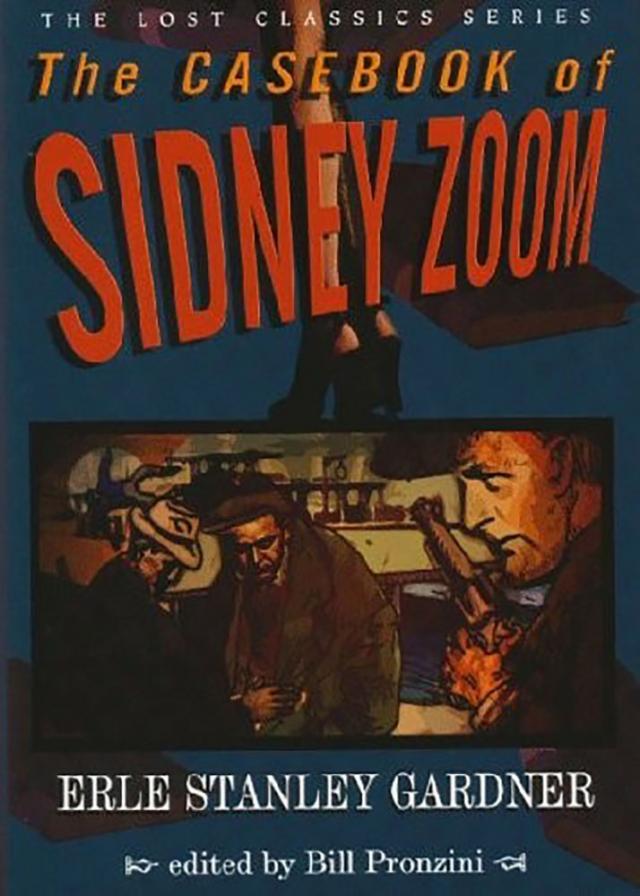
The Casebook of Sidney Zoom
By Erle Stanley Gardner
© Crippen & Landru Publishers, 2006
Contents
INTRODUCTION
ACKNOWLEDGMENTS
WILLIE THE WEEPER
MY NAME IS ZOOM!
BORROWED BULLETS
HIGHER UP
THE FIRST STONE
THE GREEN DOOR
CHEATING THE CHAIR
INSIDE JOB
LIFTED BAIT
STOLEN THUNDER
SUBSCRIPTIONS
INTRODUCTION
by Bill Pronzini
AMONG THE two-score series characters created by Erle Stanley Gardner for the pulp magazines of the 20s and 30s were such colorful and colorfully named individuals as Ed Migrane, the Headache Detective, Speed Dash, the Human Fly, Señor Lobo (whose exploits will appear in the next volume in this series), The Man in the Silver Mask, Go Get ’Em Garver, and Fish Mouth McGinnis. None, however were more unique, well-developed, or eccentric in name and nature than Sidney Zoom, the Master of Disguises.
Zoom is a strange, complex man, a true rugged individualist. Tall, slender, purposeful, cultured, independently wealthy, possessed of fierce hawk-like eyes and a dominant, aggressive personality, he lives on an expensive yacht, the Alberta F., with a tawny police dog named Rip and a devoted young secretary, Vera Thurmond. He is a loner by nature, adopting a hardboiled manner with women that borders on the rude—a pose, Vera Thurmond suspects, because he is secretly afraid of the female sex. He “hates civilization and all it stands for,” believing instead in the sanctity of the individual; “scoffs at laws which sought to curb crime and safeguard property rights” and has his own ideas of how to balance the scales of justice. His mission is to right wrongs, to “live for good” by rescuing would-be suicides and other downtrodden individuals and providing them with new leases on life. He refers to himself, in all seriousness, as a Doctor of Despair, a Collector of Lost Souls.
Disguises of one sort or another figure prominently in all of his adventures. He maintains a large closet filled with wigs, mustaches, spectacles, hats, coats, beards, grease paint, stains, and other methods of altering his identity. His reputation as a carefree man about town is another masquerade, carefully established and nurtured to conceal his mission and the fact that he once served in the intelligence departments of three nations.
The Zoom series, a total of sixteen short stories and novelettes, ran in Detective Fiction Weekly between March 1930 and May 1934. The ten collected here, all reprinted for the first time, represent the best of these tales. Each demonstrates Gardner’s remarkable skill at finding new twists on staple pulp storylines involving stolen jewelery and artworks, confidence swindles, hidden fortunes, missing wills, disappearing bodies, murder frames, and the like. The stories also make clever use of disguises as integral plot devices, and contain plenty of swift action as the pulp markets of the day required.
Eccentric though he may be, Sidney Zoom ranks as one of the most interesting early characters to come from Gardner’s fertile imagination. It’s a pleasure to introduce him to modern readers after three-quarters of a century of dusty and undeserved obscurity.
Petaluma, California
June 2005
ACKNOWLEDGMENTS
The editor and the publisher are grateful to Lawrence Hughes of Hughes and Hobson LLC, agents for the Erle Stanley Gardner literary rights, for permission to publish this book; and to Monte Herridge for copies of several of the Sidney Zoom stories that follow.
WILLIE THE WEEPER
IT HAD been known as “Lovers’ Lane” until a dejected sweetheart, jilted by his lady, had chosen to blow out his brains on the very bench where caresses had been exchanged.
He was rather artistic about it, too. He waited until the big clock at City Hall chimed the hour of midnight. The cough of the revolver merged with the last booming note of the clock.
The newspapers featured the story. The girl in the case cried and had her picture taken with a handkerchief at her eyes. She had pretty knees, so the newspapers put her on page one.
It was a good idea. Another rejected swain, lacking originality, but appreciating the publicity, committed suicide in the same place a week later. The hour was after midnight. Evidently he had almost lost his nerve and had battled the decision for some thirty minutes.
A newspaper made the mistake of calling the spot “Suicide Park.”
Now the psychology of suicide is subtle and but little understood. Police know that suicides run in epidemics. An account of one suicide inspires others to take the step. And this relates to places. Let a certain locality once become known as a spot for suicides and it can never live down the name. Morose persons with a suicide complex will see that the reputation is kept alive. Niagara Falls found this out. And there are other spots.
Hence the casual remark of a newspaper writer changed Lovers’ Lane overnight. Lovers no longer resorted to the place. The benches were grim, the shadows filled with stalking specters. Lone men came to the spot to brood over their troubles. Occasionally one of these men failed to leave the place. He would be found sprawled on a bench in the shadows, the cheap revolver at his side.
Then the newspapers would build up more hypnotic complexes.
An extra policeman was assigned to the park. The city government decided to erect a municipal building there and eliminate the shadow-filled stretches of midnight menace.
But all of these things take time, and, in the meantime, while architects labored over plans and specifications, while voters waited the issuance of bonds, the park continued to beckon the unfortunate. There was in its very silence a hint of rest. Its shadows became psychic vortexes in which a weak soul might spin down into oblivion.
For the most part men did not come to the park twice. They came to it at night, as though drawn by an invisible cord, sat upon the benches in silence, watching the patrolling forms of the special police officers. Then they departed in slinking, cringing silence.
One man alone came there regularly, night after night.
Tall, slender, purposeful, grimly silent, a tawny police dog trailing his steps, this man strode through the night shadows as though upon some gruesome sentry duty.
The police sought to find out more about him.
The man was courteous, but reserved. He gave them such information as they could have found out by other means. Beyond that he was as a clam.
His name was Sidney Zoom. He lived upon a small, expensively equipped yacht, which lay anchored in the harbor just beyond the park. The police dog was named Rip, and needed exercise.
The park was a convenient place to stroll. It was a lovely evening, and good night to you, officer.
And the grim, silent figure, walking, walking, always walking, became a midnight fixture of the park. At times the dog trailed behind, at times ran ahead. Sometimes the dog would revert to wolf habits, and come skulking through the shrubbery, a tawny shadow against the midnight black of the grass. Twice he had given one of the officers such a start that the minion of the law had tugged at his holstered weapon.
They had suggested to Sidney Zoom that dogs must be leashed and muzzled. And Sidney Zoom had shown them a clause in the old deed by which the park had been dedicated. That clause had made it a condition of the dedication that pets could run free within the confines of the park.
The officers yielded the point, but in such a manner that boded no good for the police dog, should he give the patrol any legitimate excuse to send a bullet crashing into his tawny body.
But Sidney Zoom and his dog seemed entirely oblivious of any danger. They continued their midnight pacings through the park.
The officers noticed that, at times, some unfortunate attracted the attention of Sidney Zoom. At such times there would be long conversations, then the unfortunate would leave the park, arm in arm with the well-dressed figure of Sidney Zoom, the police dog bringing up the rear.
That unfortunate never returned to the park.
II
IT WAS approaching midnight.
Suicide Park lay a blotch of shadow. The lighted boulevard terminated in a sweeping circle. The street lights caught the tower of City Hall, showed the hands of the big clock. Then the shade trees and grass patches of the park contrasted their blackness with the white illumination.
Beyond lay the lapping waters of the bay, black, mysterious broken occasionally by the drifting lights of some cruising craft.
Sidney Zoom walked the graveled walks with the mechanical step of one who knows his way through the constant repetition of thousands of similar steps. The police dog darted ahead, paused, slipped beneath a bit of shrubbery, and stood motionless as a statue.
The man on the bench held his right hand beneath his coat. He was listening, not to the lap of the water along the shore of the bay, not to the gentle whisper of faint wind in the trees, but listening for some sound which was not, yet which would be.
The clock on City Hall tower gave a preliminary click. Then the first stroke of midnight boomed forth upon the air.
The man upon the bench sighed.
Behind him, the trained police dog crouched, tense, eyes two glittering points of phosphorescent scrutiny.
—nine—ten—eleven—twel—
The man whipped his right hand out from beneath his coat. The trained police dog became a streak of blurred motion.
The light, reflected from the white tower of City Hall, glittered upon some metallic
A streak of hurtling motion terminated at the arm.
White fangs caught in the sleeve of the coat. A body that was as firmly muscled as the body of a timber wolf flung itself to one side and down.
The revolver clattered as it slid along the gravel. The man uttered a single sharp exclamation.
The dog barked, a swift, yapping, purposeful bark, then was quiet, haunched on the gravel the coat sleeve still in his teeth, gleaming eyes fastened upon the white face above them, in motionless appraisal.
Sidney Zoom came at once.
“That’s good, Rip. Down and quiet.”
The dog released his grip upon the sleeve of the coat, flattened his body upon the gravel.
Sidney Zoom kicked the revolver out of sight, sat down upon the bench, and turned to the astonished man at his side.
“Good evening,” he said.
The man sought to mutter something, but his voice refused to function. The white blur that was his face continued to point toward the form of the dog.
“You have nothing to fear from the dog,” said Sidney Zoom, “as long as you offer no resistance and come quietly.”
Emotional reaction had gripped the man on the bench.
His hands jerked and quivered. The corners of his mouth twitched. When he spoke his voice was husky.
“I—I’m under arrest?”
"No. Let us not use that term. You are being restrained for the present. You will come quietly?”
“Yes. I’ll come—I don’t know what possessed me—yet it’s the only way—Good God! Let me end it all! What’s the use of just prolonging the agony!”
Sidney Zoom linked his arm through the quivering elbow of the unfortunate. “Walk quietly,” he said.
Together they strode from the park. The dog brought up the rear, alert and watchful. It took them ten minutes to board the palatial yacht which Sidney Zoom kept in the sheltered anchorage. Another five minutes sufficed to find glasses, whisky, bring
a tinge of color to the face of the shivering man. Then they confronted each other in appraisal.
The man who had trembled upon the brink of eternity saw a tall man, lean, muscular, head thrust slightly forward. There was a suggestion of taut springs, steel wired muscles, panther energy. And the eyes dominated that face as though the other features had been nonexistent.
Hawk eyes they were, fierce, keen, but, more than that, they were untamed.
And Sidney Zoom saw a quivering huddle of humanity that was hardly more than a boy. The eyes were dazed. The flesh still quivered as though shrinking from the caress of the icy hands of death.
“Tell me about it,” said Zoom.
The young man opened his pale lips, closed them again, lowered his eyes, shook his head. Sidney Zoom fell to pacing the carpeted floor of the cabin.
“Come on. Don’t hesitate. No need for fear. No matter what it is I’m your friend. I hate civilization and all it stands for. Civilization is a vast machine. Men are mere cogs in the machine they have created. They spin frantically, are worn out and cast aside. There’s no longer room for an individual. Society wants cogs, parts that are uniform, interchangeable!”
He spat out the words with an intensity of feeling that tinged his tone, made his tongue whip out the words with the rattle of machine gun fire.
The dazed eyes of the young man followed him. The lips were half parted. Swiftly, almost fiercely, Sidney Zoom turned to him.
“You won’t confide in me. I frighten you. Bah! Cowards, all of you! You would plunge headlong into death, yet you fear me! But wait, I have my secretary coming. You’ll talk to her. They all do.”
As though the words had been an announcement, there sounded light steps on the half ladder that ran from the deck. The door swung noiselessly open. The dog wagged his tail in a series of violent thumpings.
Upon the threshold stood a young woman, a radiant vision of youthful beauty, sparkling with the sheer joy of life, yet maternally tender with it all. She had been dancing if one could judge by the filmy beauty of her evening clothes. Her cheeks were slightly flushed, red lips half parted, eyes starry.
“I saw your emergency light and came as quickly as I could,” she said, starry eyes fastened upon the hawk-like orbs of Sidney Zoom.
“My secretary, Vera Thurmond,” snapped Sidney Zoom. “You’ll talk to her. They all do.”
And, with that, he strode to a connecting door, jerked it open, motioned to the dog. For a moment they stood motionless, then man and dog blended into rippling motion. Noiselessly they slipped through the door into the adjoining cabin, wolf-dog and hawk-man, savages both, beneath the veneer of civilization.
III
THE GIRL crossed the room, sank to the floor by the side of the pallid, dazed mortal who had so recently gazed into the black mystery of death.
Her hands slid along an arm, possessed five cold fingers in a warm clasp, then she raised her eyes and spoke.
“You mustn’t fear him, ever. He lives for good. Less than two months ago I was like you. The world seemed hopeless. I jumped from a wharf. He saved me. And I told him my story.
“He started to right the wrongs that had been done me. I can’t tell you all about it, but you’ll find out for yourself. You must tell me your story.”
The young man nodded. It had needed but that touch of feminine tenderness to restore him to the psychology of living. The last touch of death’s fingers slipped from him, and he encircled the girl’s shoulders with an arm that was clinging, yet impersonal.
There were tears in his eyes as he talked. His voice choked at times, but he talked freely. His words did not seem words alone, but his speech was more the outpouring of a soul, a lonely, terrified soul that had found life too stern for it, yet had recoiled from the black abyss of mystery which comes after life.
“There’s no way out. It will kill the folks. The officers are looking for me now. But I didn’t do it. I couldn’t have done it—oh, why won’t they listen?
“It’s so foolish. Why should I go to all that trouble to steal a diamond necklace? I’d have simply skipped out, not returned with that miserable imitation.”
He halted for a moment, and the girl nodded, squeezed his hand. “Of course,” she said.
The calm faith of her tone heartened him, and he went on. His tale was more coherent now.
“I’m at Cremlin’s, you know, the jewelry house. They used me as messenger to take gems out for inspection. There was a Franklin T. Vane at the Westmoreland Hotel who wanted a diamond necklace. I took him two yesterday. Neither satisfied him. Today he telephoned and wanted the same two brought back for a second inspection.
“I took them. He had two men in his room. One was an expert appraiser. The appraiser examined the necklaces, advised against a purchase, and I had to take them both back.
“I’d swear they put the same necklaces back in the bag. I know they did. And then—well, then I did the thing that damns me. I didn’t go directly back to the store. “There’s a girl. She wanted to see me about something awfully important—we were going to be married—and she’d telephoned. I thought it’d be all right to run a little out of the way to see her.
“I wasn’t there over ten minutes, and only she and I were there. She didn’t even know what I had in the bag. But when I got back to the store—well, the genuine necklaces weren’t in the bag. There were two paste imitations, fairly good imitations, but not perfect.
“They telephoned for an officer, and they gave me two hours to restore the originals.
I told them the whole story, but they wouldn’t believe it.
“Franklin Vane was awfully bitter. He said I looked nervous when I was in his room at the hotel. And, of course, the others back him up in his statements about returning the originals to me. There was Cohen, the expert appraiser, and there was Purdy, from the bank. The word of those men can’t be doubted.”
The young man gave a dry, choking sob.
“She won’t believe me. She won’t even see me again. And the officers are looking for me. I got in a panic, knocked down the chap who was guarding me and bolted through the back door.





