

Y n, p.1
Y/N, page 1
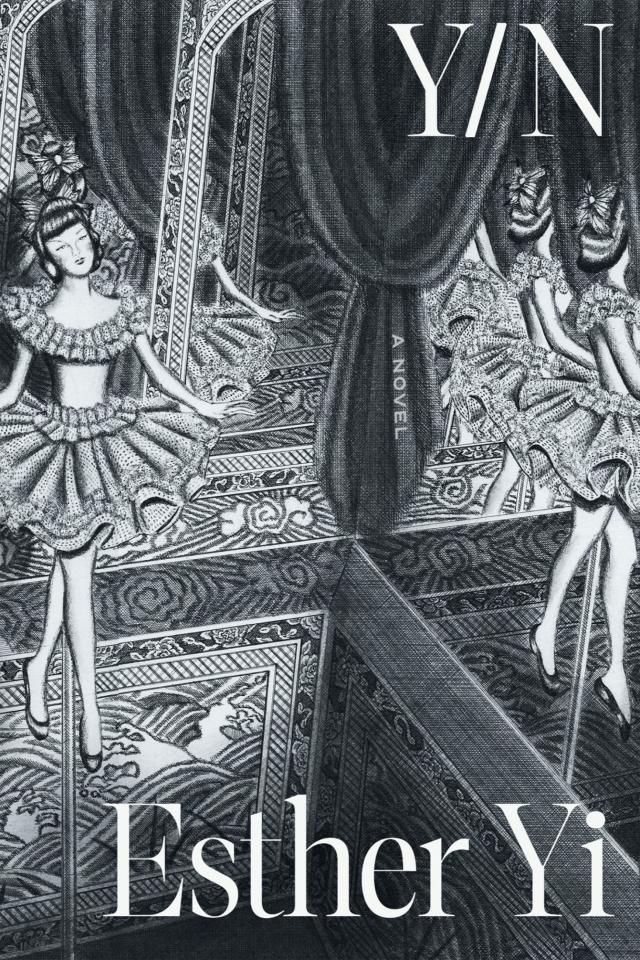


Copyright © 2023 by Esther Yi
All rights reserved. Copying or digitizing this book for storage, display, or distribution in any other medium is strictly prohibited. For information about permission to reproduce selections from this book, please contact permissions@astrahouse.com.
This is a work of fiction. Names, characters, places, and incidents are products of the author’s imagination or are used fictitiously. Any resemblance to actual events, locales, or persons, living or dead, is entirely coincidental.
Astra House
A Division of Astra Publishing House
astrahouse.com
Publisher’s Cataloging-in-Publication data
Names: Yi, Esther, author.
Title: Y/N : a novel / Esther Yi.
Description: New York, NY: Astra Publishing House, 2023.
Identifiers: LCCN: 2022915583 | ISBN: 9781662601538 (hardcover) | 9781662601545 (ebook)
Subjects: LCSH Popular music—Korea (South)—Fiction. | Fans (Persons)—Fiction. | Korean Americans—Fiction. | Berlin (Germany)—Fiction. | Seoul (Korea)—Fiction. | BISAC FICTION / General
Classification: LCC PS3626 .I4 Y6 2023 | DDC 813.6—dc23
First edition
Contents
1. A Pack of Boys
2. So Much Human
3. fleurfloor
4. Infinite in the Negative
5. Real Life
6. At the Center of the Universe
7. Moonchildren on Earth
8. Polygon Plaza
9. The Sanctuary
10. Kinship
11. The Repairman
12. Pure Future
About the Author
1. A Pack of Boys
THE PACK OF BOYS HAD released their first album in Seoul two years ago, and now they were selling out corporate arenas and Olympic stadiums all over the world. I was familiar with the staggering dimensions of their popularity, how the premiere of their latest music video had triggered a power outage across an entire Pacific island. I knew the boys were performers of supernatural charisma whose concerts could leave a fan permanently destabilized, unable to return to the spiritual attenuation of her daily life. I also knew about the boys’ exceptional profundity in matters of the heart, how they offered that same fan her only chance of survival in a world they’d exposed for the risible fraud that it was.
At least this was what I’d derived from hours of listening to Vavra. As her flatmate, I was subject to her constant efforts at proselytization. But the more she wanted me to love the boys, the more they repulsed me. The healthy communalism of feeling they inspired, almost certainly a strategy to expand the fandom, desecrated my basic notion of love. I could love only that which made me secretive, combative, severe—a moral disappointment to myself and an obstruction to others. So when Vavra knocked on my door to announce that her friend had fallen ill, freeing up a ticket to the boys’ first-ever concert in Berlin, I declined.
“But this concert will change your life,” she said. “I just know it.”
“I don’t want my life to change,” I said. “I want my life to stay in one place and be one thing as intensely as possible.”
Vavra widened her eyes in affected compassion. In the year since she’d let me, an online stranger, move into her apartment, her tireless overtures of care and my circumventions of them had come to form a texture of cohabitation that could almost be called a friendship. What I feared most wasn’t death or global cataclysm but the everyday capitulations that chipped away at the monument of seriousness that was a soul; my spiritual sphincter stayed clenched to keep out the cheap and stupid. Still, Vavra was inadvertently training me in the art of self-delimitation, and for that I couldn’t help but feel a bit grateful. I returned my gaze to the book open on the desk before me.
“You look like a scholar,” Vavra said. “But you aren’t one.”
“Thank you,” I said, gratified.
“What I mean is, you don’t do anything with what you read. What about teaching? You could be shaping young minds.”
“How? I can’t even shape my own.”
“If the boys were to think that way, they wouldn’t be where they are now,” Vavra said. “They’re unafraid to leave a mark on other lives, possessing as they do an unshakable faith in their own genius.”
She shut her eyes and disappeared into worship. When she opened them again, she smiled with condescension, as though she’d just been to a place beyond my understanding. But her return to normalcy, to our shared world of stultified passion, struck me as a failure of commitment. I realized then that if I’d yet to follow her to this other place, it was only because I knew I might never come back. It wasn’t revulsion I felt but fear that I would befoul myself beyond recognition. Irked by my cowardice and seized, too, by perverse curiosity, I wondered for the first time what it would be like to love the boys.
Two hours later I found myself following Vavra into a crowded arena. Our seats, located toward the rear, offered a meager view of the stage, forcing my attention onto a screen that served as the backdrop. This screen, as large as a Berlin apartment building lying on its side, reproduced the happenings onstage with astonishing clarity, so that when the five boys drifted in as if by accident, heads bowed and hands clasped over their stomachs, I couldn’t fathom how their real bodies, as small as grains of rice from where I stood, would survive an evening at the feet of their gigantic images. Thousands of women erupted into shrieks. I remembered Vavra telling me that incidents of shattered eardrums at the boys’ concerts were rising, prompting the entertainment company that managed them to recommend earplugs. But I saw none being worn by the fans around me. They were finally breathing the same air as the boys; now was not the time to be less of a body.
The boys stood in a line, their heads still bowed. They appeared freshly reprimanded. Their outfits began with black derby shoes and black trousers, blooming into tops that bespoke their individual personalities. Each boy was named after a celestial body; it went without saying that none of them was named Earth. I didn’t know which boy was called what. Vavra was shouting for all five again and again, taking care, on principle, not to say one name more than another.
But I was no egalitarian. I’d already decided that the boy on the far left bothered me most. He wore a pink silk button-down with oversize cuffs that obscured his hands save his fingertips, which gripped the hem with desperation, as if he might fly out of the shirt. His hair was a shade of blond that matched his complexion exactly; skin seemed to be growing out of his head. When he looked up, he revealed an unremarkable face, somehow flat, eyes narrow like the space between two slats of a window blind. But his plainness seemed a calculated strategy to foreground the intensity of his gaze, which discorded with the stony coolness of his pallor. The pose he held should have been impossible: his trunk was perfectly vertical, but his neck jutted forward at an angle so wide that his head, held erect, seemed to belong to another torso entirely. It was the neck that disturbed me. Long and smooth, it implied the snug containment of a fundamental muscle that ran down the body all the way to the groin, where, I imagined, it boldly flipped out as the penis.
The stage lights turned red and shuddered into a new constellation, casting long shadows down the boys’ faces. Music began—atonal synths encased in a rib cage of driving percussion—and the boys erupted into dance. They never used backup dancers, according to Vavra, because they considered it a cheap trick to pad themselves out with a horde of comparatively homely boys. So there they were, five lonely specks on a vast black stage. They faced each other in a circle and passed between them an invisible ball of energy. Upon the heady climax of the chorus, they turned around and flung out their arms, palms upturned, as if giving their prismatic harvest over to the surrounding emptiness.
The boys sang:
“What does it mean to die on this planet? Aloneness, despair, confusion. A human being is a particle of dust in a galaxy. And what does it mean to live on this planet? Creation, desire, collision. A human being is a galaxy in a particle of dust.”
I remembered Vavra saying that most nights the pack of boys, after the rigorous training of their bodies, washed up and then gathered in their living room to study the classics of art and literature. Like a civilization, the boys entered new eras, one for each album. In preparation for their current era, they’d pored over a Korean translation of Sophocles, troubled by Oedipus’s decision to blind himself. Yes, he’d been woefully ignorant of the truth—why not, then, gouge out two new holes on his face, for two more eyes, for double the sight? The album, a statement of protest against Oedipus’s capitulation to darkness, celebrated too much seeing, too much light.
My eyes kept returning to the boy with the disturbing neck. The others conveyed depth of feeling by exaggerating their movements or facial expressions; I had no trouble understanding the terms of their engagement with the world. But the boy with the disturbing neck followed an inscrutable logic. I could never predict his next move, yet once it came along, I experienced it as an absolute necessity. He seemed to control even the speed at which he fell from the air, his feet landing with aching tenderness, as if he didn’t want to wake up the stage. His movements: fluid, tragic, ancient. Every flick of a joint happened at the last possible moment. He never geared up. He was always already there.
Each boy stood at the head of a triangular formation in turn and sang a bar, prompting the screams in the arena to peak five times. When the boy with the disturbing neck surged forward to take the helm, my eyes filled with tears. Confronted by the tetanic twitching of his individuality und
His voice was a pink ribbon whipping in the wind:
“I used to stand still in one place to observe the world with care. Now I’m running as fast as possible, seeing as fast as possible, yet even this isn’t enough, for all I can see at any moment is the street ahead of me before it disappears over the horizon. Will you please flatten out the earth so that I can see ahead of me forever?”
I’d never been able to keep Vavra’s exhaustive profile of each boy tethered to a name or a face. But the body onstage extracted details from the depths of my memory, and they spun like thread around the spool of a particular name: Moon. I remembered that Moon, at twenty, was the youngest in the group. He’d been the child prodigy of a ballet company in Seoul, performing every lead role until the age of fourteen, when he was recruited by the entertainment company. Four years later, he’d almost failed to earn a place among the pack of boys because the company president, known as the Music Professor, had been skeptical of Moon’s ability to subordinate the idiosyncrasy of his dance to the needs of the group. Details that had been vivid without meaning, applicable to any one of the boys, were now indispensable to the evocation of Moon. It made perfect sense, what Vavra had once told me, how he ate heavy foods right before bed because he liked waking up to find his body slim and taut, proof of the metabolic intensity of his dream life.
I was being sent to the other side; I was having what Vavra had once described as my First Time. But unlike losing my virginity, which I’d anticipated with such buzzing awareness that I’d been more certain I would have sex than die someday, I’d never known to expect Moon. My First Time, experienced at the age of twenty-nine, made me wonder about all the other first times out there to be had. The world suddenly proliferated with secret avenues of devotion.
Several songs later, the boys returned to standing in a line. As Sun, the oldest member at twenty-four, spoke in Korean, translations in English and German trickled across the screen. The boys were halfway through their first world tour, he said, which had begun two months ago in Seoul, after which they’d traveled east to meet their fans in the Americas. Their journey had now taken them to Europe, he said, and they’d decided to surprise their families by flying them out to a continent that they, the boys included, had never visited before.
Each boy faced the camera that fed into the screen to deliver a statement of gratitude to his family. Only Moon, last to speak, walked to the edge of the stage, shielded his eyes from the lights, and peered directly into the crowd.
“Mom, Dad, Older Sister,” he said. “I can’t see you. I love you. Therefore, where are you?”
His use of “therefore” stunned me.
* * *
THE SOUND OF string instruments, melancholic and slow, filled the arena. Moon approached center stage and stood there alone. He was wearing a black blindfold. Everyone in the crowd raised their phones, situating thousands of Moons before me.
He sang that there had been a time when he couldn’t bear to cross a room in the presence of others. He didn’t want anyone to know the shape of his body, so he wore shirts that hung down to his knees. The fact that he had a face distressed him. If only it could remain hidden like the secret of his groin. But then he met me. Finally, he could bear to be seen. I looked at him so much, more than anyone ever had, that it left him no room to look at himself. That had been the problem, the looking at himself.
“Cock the gun of your eyes,” he sang. “I will make myself easy to shoot.”
In unison, everyone raised a hand and stretched their thumbs and index fingers apart into pistols aimed at Moon. I couldn’t follow along, as my arms were crossed in order to thwart any flare-ups of agency that might disturb my state of perfect passivity, which I needed to maintain so that Moon could act upon me as much as possible.
In the instrumentals, a pistol fired. Thousands of wrists spasmed. Moon, struck in the chest, stumbled backward. I thought he would fall over, but instead he began pivoting on one foot, submitting to the long stream of the crowd’s bullets. His head went first. His arms followed, then his torso, which, dense with organs, forced his other leg into swinging accompaniment. I finally understood that his shirt was the pink of a newborn’s tongue. He was tasting the air with his body. It would always be the first day of his life.
He came to a stop and tore off the blindfold. My eyes moved between the screen, where I could see the contours of a bead of sweat dangling from the tip of his nose, and the stage, where his whole body was a tiny blur. I didn’t know which I wanted more of, the precise reproduction or the imprecise actuality. He began to walk down a runway that extended from the main stage all the way to the center of the arena floor. On-screen, I saw the bead of sweat wobble, then fall off and disappear from view, likely splattering the floor. Moon tucked in his chin and gazed up at a sharp angle, as if seducing the same person he was threatening to fight. And this person was me. He was walking right in my direction.
I began pushing through the crowd. Angry strangers tried to block my way. I couldn’t blame them, I was being a very bad fan. But I felt no solidarity. I excised them from my perception of space. All went quiet in my mind. Moon and I were alone in the arena, headed for each other. I would jump onto the stage and force him to look into my eyes. For a single moment in time, I would be all that he saw. I knew I’d be condemned for imposing on him my individual humanity, divorced from the crowd, but I didn’t care, I was a person, I knew this if nothing else, that I was a person, however hapless, however void.
Moon grew from tiny to small, from small to less small. I begged him to become as large as I was to myself, but the closer he came to reaching the size of a normal person, the more I sensed he’d never get there. We stopped moving at the same time: he reached the end of the runway, while I couldn’t penetrate the crowd any further. He threw back his head in dreamy surrender, exposing a limestone column of neck almost as long as his face. The cartilage supporting his larynx protruded like a spine. Blue veins ran up the neck and branched off across his mandible. Life swarmed just under his skin. The neck’s language was of suppression, unlike that of his face, where the jungle inside his body oozed free through his eyes, nose, and mouth. Vavra’s mistake had been to draw rational strokes of narrative, compelling me to understand everything about Moon at once. But all I’d needed was to begin with the singularity of his neck.
A steel cord descended from the ceiling. Moon lowered his head, casting his neck back into shadow, and attached the cord to a buckle on his waist. Every light in the arena was pointed at him. He stood still and endured it. He was a gift forever in the moment of being handed over. But he couldn’t be had. Hunger pierced me. I wanted something, and I wanted all of it, but I didn’t dare want Moon, because if it was that simple, it was also that impossible.
“I will be you when I grow up,” he sang. “You will be me when you are born again.”
When the cord lifted him away into the dark firmament of the arena, I didn’t say goodbye. I knew I would see him again, that I was doomed to see him always. He had his eyes shut and his arms hanging at his sides, as if surrendering to the controls of a divine force. His hands were curled into loose balls. It made me sick to imagine just how moist his palms must be.
* * *
I WORKED FROM home as an English copywriter for an Australian expat’s business in canned artichoke hearts. My job required me to credibly infuse the vegetable with the ability to feel romantic love for its consumer. I’d always felt a kind of aristocratic apathy about the task, but in the days following the concert, I avoided my boss’s calls altogether, nauseated by the prospect of speaking seriously about such unserious work.
Instead, I spent hours copying a long note that Moon had written by hand for his fans on the occasion of his twentieth birthday. I coveted his handwriting: narrow and angular, flowing across the page with energy and spasming in its higher reaches. I had no Korean handwriting of my own, having grown up speaking the language but almost never writing in it. I cried out in Korean whenever I accidentally touched scalding water, but that slower pain of conducting the relationship I had with myself—this required English. “I like aging before your eyes,” Moon had written. “It makes me feel like a story you’ll never get sick of.” By the fifth time I copied the note, I could compose the text from memory. His hand, even his ideas, had begun to feel like my own.


