

The servant, p.1
The Servant, page 1


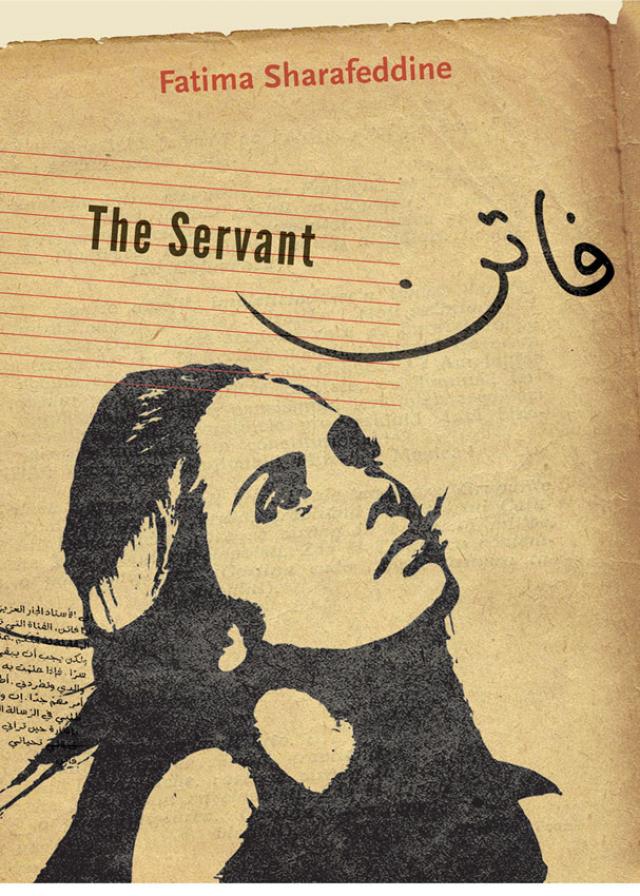
The Servant
Fatima Sharafeddine
Groundwood Books
House of Anansi Press
Toronto / Berkeley
Copyright © 2013 by Fatima Sharafeddine
First published in 2010 in Arabic as Faten by Kalimat, P.O. Box 21969 Sharjah, United Arab Emirates www.kalimat.ae. Copyright © 2010 by Fatima Sharafeddine.
First published in English in Canada and the USA in 2013 by Groundwood Books.
All rights reserved. No part of this publication may be reproduced or transmitted in any form or by any means, electronic or mechanical, including photocopying, recording, or any information storage and retrieval system, without permission in writing from the publisher.
Distribution of this electronic edition via the Internet or any other means without the permission of the publisher is illegal. Please do not participate in electronic piracy of copyrighted material; purchase only authorized electronic editions. We appreciate your support of the author’s rights.
This edition published in 2013 by
Groundwood Books / House of Anansi Press
110 Spadina Avenue, Suite 801, Toronto, Ontario M5V 2K4
or c/o Publishers Group West, 1700 Fourth Street, Berkeley, CA 94710
We acknowledge for their financial support of our publishing program the Canada Book Fund (CBF).
Library and Archives Canada Cataloguing in Publication
Sharafeddine, Fatima
The servant / written and translated by Fatima Sharafeddine.
Translation of: Faten.
Also issued in electronic format.
ISBN 978-1-55498-309-4
I. Title.
PZ7.S5285Ma 2013 j892.7’37 C2012-905836-x
Cover design by LimeDesign
To Bassem, my companion on the road of life.
To Talah and Tamir, the lights of my days.
1
Faten remembers the day her parents took her from the village to Beirut. To Television Street, in the Tallet El Khayyat area.
The taxi ride seemed endless. No talking in the car, no radio. As silent as the deep sea. That day, she was scared. Scared of the city, of street wars and bombs. Scared of the unknown, and of what awaited her in this new life.
The trip from the southern mountain village to the coast seemed to go on forever. Roads, bends, left, right … She kept gazing at the beauty of the mountains and valleys until the sea and its horizon appeared. The car drove downhill to the coast. It got closer … and closer … until it reached the road that ran along the shore.
Faten saw the sea for the first time. How big it was! How majestic!
What if she opened the car door and ran toward the sea? Ran barefoot on the sand. Would the sand be hot or cold? If she stood on it, would her feet completely sink in until she was planted there like a tree?
And the waves. Faten wanted to jump right into them. Would she be stronger than the waves? Or would they swallow her whole?
“Faten, stop crying! You’re acting like a child!” bellowed her father. His voice broke the icy silence as he turned around in the front seat to see her face wet with tears and her long dark locks sticking to her cheeks.
I am a child, she wanted to yell. I am only fifteen years old! Have you forgotten? I want to go back home. I want to stay there with all of you. I want to slip into Mother’s bed when I feel sick. I want her to take me in her arms when I’m sad, to brush my hair and sew my dresses. I want to meet my girlfriends and go for walks, chat and laugh for any or no reason. I want to pick walnuts from the tree and stain my lips with their skin. I want to fill jugs with water from the well. I am a child!
But Faten did not answer her father that day. Not even with a look of reproach. She kept silent, staring through the window as the car drove north toward Beirut.
She was lost in her memories. Memories from her early childhood, from the early hours of that very morning when she left her village.
That day, she kept her feelings buried.
They arrived in the city. Beirut. Tall buildings — many disfigured by bullet holes of all sizes.
“Look at what war has done to the city and its buildings,” said the taxi driver, eager to show the village family the city he knew so well. “The warring parties have not let any region escape their fierce fighting. May God be with the people of Beirut.”
“May God protect us all,” said Faten’s mother, as she gently stroked her daughter’s hair.
When the car stopped in front of a tall building, her mother said in a warm tone, “Do not disappoint us, my dearest. We have to raise your brothers and your sister. You know the situation. Be brave. Go to your new life now. We will call you and come and visit whenever we can.”
That was 1985. Two years have passed since Faten started working for the Zein family: Mrs. Samira, Mr. Hani and their two daughters, May and Sahar. She has only seen her mother three times since she started working. Twice during the Eid holidays and once when her mother brought Faten’s uncle to the hospital in Beirut.
Her father shows up on the first day of every month to collect her salary. Faten avoids him when he comes. She is mad at him. If she happens to open the door when he rings, she doesn’t kiss him. Her eyes do not even meet his. He takes her salary from Mr. or Mrs. Zein, and if he gets the chance, he gives her an icy stare before he leaves.
Faten feels that look penetrate her bones. It is as if he is saying, This money is our right. You have everything you need here.
Her mother calls once a month and talks to her for half an hour. She tells her the village news and talks about her little brothers and sister. When Faten complains that she misses them all so much and wants to go home for a visit, her mother answers, “Be patient, my dear. You know this is not possible now. Hopefully soon. Hopefully soon.”
If it weren’t for her mother’s love and encouragement, Faten would not have been able to endure her situation.
This afternoon, like most afternoons, Faten stands on the kitchen balcony after she finishes all of her duties. She watches the fast cars passing by, waiting impatiently for the dark blue Mercedes to slow down and drive into the parking lot of the building across the street.
She sees him and smiles. She’s happy to get a nod from him as he locks his car.
She hurries inside before Mrs. Samira sees her and yells the usual. “I’ve told you a hundred times I don’t want you standing on balconies! Don’t you understand?”
The truth is that as soon as this woman notices Faten enjoying herself, she finds a reason to scold her and sends her off to do more cleaning, ironing or any other chore she can think up at the moment.
Faten goes to her small room, happy to have caught a look and a nod from the young blond man. She doesn’t know his name. She noticed him a few months ago, the day he moved into the building across from hers. “Handsome man,” she whispered to herself.
One day, while she was cleaning the balcony, she noticed the sound of music close by. She followed the sound with her eyes until she caught it in the apartment across from hers.
It was the new neighbor, bent over his piano.
After that, Faten started to pay attention to his daily routine. He wakes up at seven, then has coffee and fruit with his mother. He leaves his apartment, carrying his briefcase, around eight. A few minutes later she sees him getting into his blue car. He quickly takes off, disappearing after he turns right at the end of Television Street.
The young man does not return at a specific time. It’s always in the afternoon, but at a different hour each day. That’s why Faten keeps going back to the kitchen balcony, as if she were tied to it by a bungee cord. She waits for his car to appear at the end of the street. She follows it with her eyes as it approaches, slows down … and finally enters the parking lot.
At first the young man did not notice her watching him or waiting for him. But once he happened to look up at the second-floor apartment and caught her gazing at him. He smiled. She was so embarrassed she didn’t know what to do. She rushed inside to hide.
Shortly after he goes into his building, the young man appears in his apartment. Faten follows his movements from the corner of the little window in her room. He appears here. Disappears. Reappears there. Sometimes he plays the piano, and Faten watches. Her heart jumps at every glimpse she gets of him.
She has decided that he is an only child who lives with his parents. His family is wealthy and he doesn’t work. He must be a university student, studying business. On the days when he forgets to close the curtains of his bedroom, she sees him sitting at his desk, surrounded by a mountain of books and sheets of paper.
The few glimpses of him are the highlights of her day. There is a kind of freedom in these moments. This young man is outside the walls that keep Faten feeling trapped. Just the possibility of seeing him helps her get up every morning to face a new day.
Is this love? Or is it a fantasy she has created to be able to bear her life here?
She lies down on her bed. It squeaks. She grabs the only book she owns. It’s a school book that she secretly brought with her the day she was forced to come here.
She opens it to her favorite page, a text about the nursing profession. There is nothing special about the text, but there’s an accompanying photograph.
In the photograph, a patient is looking at his nurse with a look full of love, gratitude and peace â €” things that are missing in Faten’s life here. She rarely hears anyone say thank you, please or well done. Orders echo in her ears. The only person who is sweet and appreciative is Sahar, the youngest girl in the house.
After examining this photograph time after time over the past two years, Faten has reached an important decision.
She will become a nurse. One day.
2
May walks into the apartment and slams the door behind her. Faten jumps at the sound, thinking it is another explosion. May tosses her backpack on the chair and throws her tall self on her favorite couch across from the TV in the living room.
“I hate school!” she complains. “They’re all stupid! Every teacher gives us homework assignments like his course is our life!”
Mrs. Samira, sunk in an armchair filing her nails, answers her daughter without lifting an eye. “We say hello first.”
Ignoring her mother, May continues, “Can you believe it? We have a history test and a math test on Thursday, and they tell us today! How can I study for all of this in just two days?”
The phone rings. May springs up to reach it before her mother.
“Hello? Hi, Majida … Yes, you can come. I’m home … What is it? You’re making me very curious … Okay, I’ll wait. Hurry, don’t be late.”
It seems that the important news can’t wait until tomorrow.
After May hangs up, she notices Faten with a damp towel hanging from her shoulder, moving between the rooms, busy with her dusting.
“Hey, Faten, I want a glass of water,” May yells.
Why don’t you get your own glass of water? Can’t you see I’m busy? You are lazy, rude and spoiled.
But she doesn’t say anything. Instead she brings a glass of cold water and holds out the tray, waiting for May to return the empty glass.
The way May treats Faten is inconsistent and confusing. Sometimes Faten feels that she treats her like a friend. She talks to her about personal things, she complains about her strict father, who never allows her to go out with friends at night, and she often asks about her life in the village before coming to Beirut.
At other times, May treats her arrogantly, as if she suddenly remembers that she is the boss and Faten is just her maid.
So Faten does not trust her. She will never tell her about the young man she likes, or about her dream of becoming a nurse one day. May would let the first secret out and make fun of the second.
Faten’s thoughts are distracted by the orders of Mrs. Samira.
“You girl, go buy some bread and a kilo of lemons, then set the table for lunch. Mr. Zein will arrive in a few minutes.”
You girl! Faten hates it when they call her that, as if they can’t even remember her name, as if they just want to humiliate her.
These thoughts swirl in Faten’s mind on her way to the shop. She hurries back to the apartment to prepare the table for lunch. She arranges the spinach pies neatly on a silver tray. Then she dishes the rice, the green bean stew and the salad into their appropriate serving plates. Feeling extremely hungry, she sneaks a piece of spinach pie and tosses it in her mouth.
She would never do this if one of the family members were in the kitchen. She has the feeling that they expect her to be the super maid, the maid who never feels hungry or thirsty or sleepy before they do. The maid who feeds them, then eats, who takes care of everything in the house before taking care of herself. The maid who stays up until everyone’s orders are fulfilled — from preparing dinner, to serving herbal tea, to finally washing the dishes. It’s only after completing these tasks that she can go to sleep.
Why isn’t she allowed to wake up one day and inform Mrs. Samira that she’s in a bad mood and doesn’t feel like working? Or tell her that she’s bored and feels like going out for a walk?
The lunch table is set in minutes, as Mr. Hani arrives, goes to wash, then installs himself at the head of the table. The mother calls May and Sahar, and each takes her usual place. To the left of the father sits the mother, to his right May and Sahar.
They start to eat, and for a moment orders stop raining down on Faten. She returns to the kitchen and eats whatever has been put on a plate for her. This doesn’t bother her. On the contrary, she’s used to eating alone since her move to Beirut. And if it happens that one of them enters the kitchen before she finishes her meal, she eats very slowly, and sometimes her hand hangs in the air, holding the spoon between the plate and her mouth. At such moments, Faten feels as though she is part of a scene in a film, where the director has slowed the motion of the camera to focus on the details. She feels as though she is being observed.
As she sits in the kitchen eating her meal, it is hard for her not to listen to the conversation going on in the dining room.
“You’d better eat your salad,” Mrs. Samira says.
“Salad is boring and stupid,” May shoots back.
Faten knows that May is rushing to finish her meal.
“Why are you in a hurry? Slow down. You’re swallowing without chewing. Are you that hungry?”
“No, but I have a lot to do, and Majida is coming so we can study together.”
“I am impressed by your sudden love for studying,” her mother says sarcastically.
A short moment later the bell rings.
“Open the door!” someone yells to Faten as she swallows the last of her lunch.
“I’ll get it!” yells Sahar, running to the front door.
It is Majida. She greets the family with a hi so rushed that she does not even wait for an answer. She goes with May straight to her bedroom, and through the crack in the door, Faten can hear bits of the girls’ conversation.
“What is it? Why are you so nervous? You’re scaring me,” says May.
“Nervous? What are you talking about? When you see what is in my backpack you will kiss my hand in gratitude!” answers Majida. “I’ll tell you after you get me some juice. I’m so thirsty. I ran all the way from our house.”
“Faten, we need two glasses of apple juice!” May yells.
Faten comes in with the two glasses and finds Sahar sitting next to Majida on the edge of the bed. Of course Sahar wants to know what this is all about. She loves to watch her older sister and her friends — the way they dress, the way they talk about school and boys. But her curiosity annoys her sister a lot.
“Sahar!” yells May. “Get out of my room. You have no business here.”
“I’m not bothering anyone. I want to stay,” Sahar replies in a matter-of-fact tone.
So May goes straight to her, holds her by the shoulders, directs her to the door, pushes her out of the room, then slams the door shut.
Sahar runs to her mother to complain, but Mrs. Samira and her husband are already in their room for their afternoon nap.
Sahar sits on the Persian carpet in the living room and starts her Arabic homework.
When Faten notices her sitting alone looking sad, she kneels down next to her.
“May is older than you,” she says, stroking Sahar’s long brown hair. “It’s normal that she doesn’t want you around all the time, especially when she’s with her friends.”
“I do not like it when she yells at me like that,” grumbles Sahar.
“Don’t interfere in her affairs, and she won’t yell at you. Now, finish your assignment, and I’ll go do my work.”
After finishing with the dishes and cleaning the kitchen floor, Faten arranges some chocolate chip cookies on a plate and goes to May’s room. Sahar has her ear glued to the door of her sister’s room as she tries to hear the conversation. She is determined to find out the reason behind Majida’s visit.
When Sahar hears footsteps approaching, she turns to run away.
“What are you up to, you nosy monkey?” Faten asks playfully, before she loses sight of her.
Sahar comes very close to Faten, stands on her tiptoes and whispers in her ear, “I want to tell you a secret.”
Faten knocks on the door before entering May’s room. She places the plate of cookies on the desk and goes back to the kitchen. Sahar is waiting for her.
“What is all the excitement about?” Faten asks. “What’s going on?”


