

A very cold winter, p.1
A Very Cold Winter, page 1


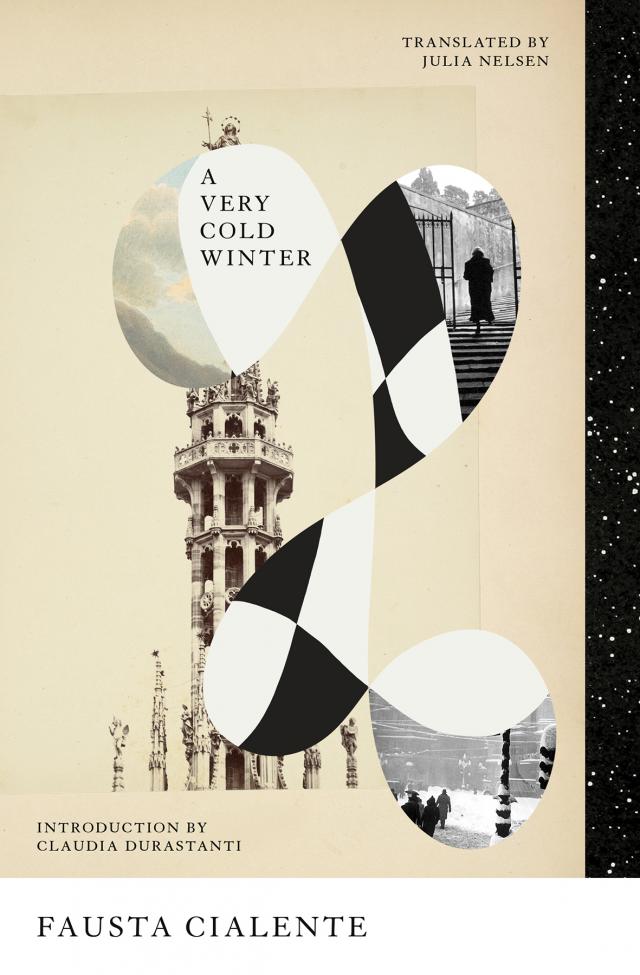
A VERY COLD
WINTER
Fausta Cialente
Translated from the Italian by
Julia Nelsen
Introduction by
Claudia Durastanti
Published by Transit Books
1250 Addison St #103, Berkeley, CA 94702
www.transitbooks.org
Copyright © Fausta Cialente, Feltrinelli, 1966, 1976
© Mondadori, 1974
© nottetempo, 2022
Rights arranged through the Vicki Satlow Agency
English translation copyright © Julia Nelsen, 2026
ISBN: 979-8-893380-23-1 (paperback)
Cover design by Jared Bartman | Typesetting by Transit Books
Printed in the United States of America
9 8 7 6 5 4 3 2 1
All rights reserved. This book or any portion thereof may not be reproduced or used in any manner whatsoever without the express written permission of the publisher except for the use of brief quotations in a book review.
Introduction
As World War II ended, Italian publishing houses found themselves flooded with memoirs and semi-fictional accounts of what had happened to the country. Neorealism quickly became the lens through which writers and directors were keen to represent the stories of the poor and the working class: most of these accounts were based on first-hand experience or inspired by conversations in bars and public spaces. Italian cities were now occupied by an army of storytellers writing novels they were never going to publish, but their contribution was essential in establishing a new artistic form. One of the storytellers that did publish a war novel was the young Italo Calvino: his debut, The Path to the Spiders’ Nests (published in 1947, when Calvino was twenty-three), is a typical product of that time. It’s a tale of the Italian Resistance seen, fable-like, through the eyes of a child. Almost twenty years later, when Einaudi reissued the novel, Calvino wrote a famous introduction to reconsider what neorealism had done to fiction. He now felt that his debut novel was born anonymously from the “general atmosphere of an era.” Part of him wished he hadn’t given away his memories of World War II so early; the war should have been kept safe for his final book. It seems that Calvino was wondering about a larger question: how does war age in the mind of the artist? And how long does it take for a war to get into a novel properly? Although neorealism might provide a coherent perspective of Italian literature in the aftermath of war, reading a literary map drawn around conflicts can be a fractured experience. One could assume that nothing and everything happened at the same time. This is true for our ancestors as much as for us—forgetfulness is not a privilege acquired with distance. The objectivity of war is blurred by one’s own perception of time and the wavering faith in what’s truly conveyable through language. Sometimes dreams and nightmares go undercover as useless spies until they resurface in times of peace. How long does it take for a war to get into a novel? The answer is usually too late, or too soon. This is why, perhaps, Calvino had his regrets. Declaring neorealism over, Calvino admitted that the true and important war novels came much later, especially Beppe Fenoglio’s Una questione privata (A Private Affair, 1963) and Il partigiano Johnny (Johnny the Partisan, 1968). His reasoning was straightforward: in order to fill the gap between the reality of war and its representation, a writer needed time and space to distill collective memories into something more sophisticated and unique.
But timing was more complicated than that: sometimes war novels could feel out of place simply because as the years went by, people wanted to move away from war altogether, maybe they wanted to forget. For Primo Levi, in fact, the question was less about when a book about war should be written and instead when it should be published. The manuscript for his memoir Se questo è un uomo (If This Is a Man), about his arrest and incarceration in Auschwitz, was turned down by both Natalia Ginzburg and Cesare Pavese for publication in 1947, with the thinking that it was still too close to the war for such an account. A small press took the book on instead, until it was finally reissued in 1958 with a larger house. Looking back at what happened, Natalia Ginzburg would later say, “We’ve been guilty imbeciles.”
Women writers were also trying to capture the collective experience of war. In 1949, Alba de Céspedes published Dalla parte di lei (Her Side of the Story, originally published in English in 1952 with a different title, Best of Husbands), an ingenious book about a woman’s recognition of life through the fascist and partisan years and what came next. In over five-hundred pages, later to be cut and re-edited by the author herself, de Céspedes played with the conventions of the coming of age, romance, and noir novel to deliver an entirely credible female character. For women writers, engaging with autobiography in the general context of neorealism could feel tricky and encourage literary critics to dismiss their work under the pretense that it was too personal, domestic, akin to a journal. This is why de Céspedes went for a bulky novel and a “parallel” autobiography, to prevent its content from being weaponized against her. No wonder, then, that it took Natalia Ginzburg quite some time to open herself to the possibilities of explicit autobiography: in her own words, she approached the genre with slow “wolf steps,” circling around it for a long time. After several first-person novels, Le piccole virtù (The Little Virtues, 1962) and Lessico famigliare (Family Lexicon, 1963) arrived: both are unforgettable lessons in how to use a family as a narrative device to enter a larger collectiveness. One feels this especially in Inverno in Abruzzo (Winter in the Abruzzi ), a wounded elegy on displacement and reinventing families after the death of her husband Leone Ginzburg. It might be the reason why Ginzburg’s first judgment on Primo Levi’s memoir had been too harsh: she’d recently lost her husband to the fascist regime, and Levi’s manuscript might have felt too raw. Looking back on the Neorealist period, it feels like women writing at the time were keener on going undercover or mixing different literary genres.
A Very Cold Winter is Fausta Cialente’s interpretation of war, family, and of womanhood.
The novel came out in 1966, after a five-year hiatus. Her previous book, Ballata levantina (The Levantines), lost the prestigious Strega Prize to Raffaele La Capria by a single vote in 1961. Cialente was careful to stay outside of literary society and took her time with the next project, which traded the crowded streets of Alexandria for an entirely new setting: an occupied attic in derelict Milan, in 1946.
The appearance of A Very Cold Winter must have been a very curious sight.
The avant-garde literary movement Gruppo 63 was waging an open battle against any form of writing that was sentimental: Umberto Eco, Edoardo Sanguineti, and Nanni Balestrini, among others, were trying to kill the novel just like the French (it didn’t go too well in either country). Everything revolving around intimate relationships was labeled as romance (and one could only wonder what Gruppo 63 would say about the pervasiveness of romance today). To them, even Elsa Morante was writing romance—her war novel, La storia (History), came out in 1974 and was massacred by intellectuals and beloved by readers—as well as Giorgio Bassani: it was not a gender-based critique, but it was powerfully misogynistic all the same. And yet, two years ahead of the counterculture movement and the revolution of radical feminism—Carla Lonzi and the Rivolta Femminile would come to the forefront in 1970—Fausta Cialente managed to write a postwar novel centered on a female character that didn’t feel like a throwback. How did she manage to achieve this? Cialente is agonizingly prophetical in her quietness. Her focus is on the narrative’s texture; her patterns are recognizable and dense with matter.
The book takes place in an attic in Milan, a year after the Liberation. In a city heavily bombed by the Nazis, war destroyed the traditional family nucleus that would reaggregate in larger and amorphous formations, where strangers or distant relatives were forced to live in close quarters. (In cities like Milan, where this practice is currently resurfacing among people in their forties and fifties in response to the expensive rent market, the setting of A Very Cold Winter is now fashionably called “co-living.”)
Camilla, the reluctant matriarch of the house, calls it albergo dei poveri, a poorhouse, where she lives with her three children—two daughters, Alba and Lalla, and a son, Guido—Regina, a young mother who just had a baby with Camilla’s late nephew Nicola; another spiritless nephew, Arrigo, married to a mannered French-speaking girl named Milena. And then two neighbors: Enzo, a young Italian anarchist born and raised in Egypt who already appeared in Ballata levantina, and Rosso, the country gentleman. (Cialente’s brother, Renato, was a very successful actor who died in a car crash after playing in Maxim Gorky’s The Lower Depths at the Teatro Argentina. She probably had this episode in mind when she visualized the attic).
Under the gray and filthy fog of Milan, we are immediately absorbed by Camilla’s attempts to become a new woman in a new life. She’s experiencing the uncanny state of being deserted by her husband Dario. She’s not widowed, he’s just disappeared. The idea of desertion can refer to an abandoned woman, but also to a voided space or the act of defecting from war: in Italian, disertare could refer both to dismissing a cause or dismissing a lover. Over the course of the novel, even the attic will be deserted and somehow acknowledges this, as if it were a sentient being. The word desertion is also close to one of Cialente’s favorite landscapes: many of her novels interact with the Egyptian desert; some of her characters live and die shoeless, with dusty feet. This is especially true of the colonial triptych Cortile a Cleopatra (1936), Ballata levantina (1961), and Il vento sulla sabbia (1972), set in Alexandria and in Africa, where Cialente lived for twenty years and witnessed the in-betweenness of being a foreigner in a new country.
In A Very Cold Winter, Camilla’s hot scorch of a husband, Dario, first appears while lying on the beach. Every time he is recalled by his wife or daughters, he’s placed in an exotic Mediterranean setting or maybe in Sudamerica. The sand is the precise counterpart of the run-down and leaking attic where Camilla lives: something apparently warm and desirable, but also open to the void, and with unstable patterns.
Acquaintances often described Fausta Cialente as a loner. In the novel, Camilla perceives the same kind of judgment, which feels surreal to her as she’s always taking care of someone or something. But as a recurring theme in her female characters, the act of living has its demands. While staying at her mother’s, whose cold behavior pushed Camilla and her late sister to be hyper-affectionate in their marriages, she has a one-night stand with an American soldier: “She’d gone there with maternal compassion and left with fire in her veins.” Here’s the freshness of it; the scene is genuinely felt, bodily perceived. Camilla’s not particularly faithful or unfaithful to her vanishing husband; it just happened.
Cialente draws many images from the idea of war: occupying a house, deserting a relationship, being deserted, conquering space, conceding space. The attic is made of scraps, and even its inhabitants feel like scraps. When Regina and Enzo collide into each other, these words are spoken: “I’ve always thought of us as two shipwrecks … It had to be this way.”
Enzo is the character with the clearest political function in the novel, embodying Cialente’s personal meditations on what it means to be truly and fully Italian: he speaks the language, Italy is the land of his ancestors, but he was raised and exposed to a very different culture for most of his lifetime. He’s unmistakably Levantine, and he wonders if he could achieve the right amount of “cunning” to adapt to Italy. This is the author speaking about herself and raising the question that haunted her whole life.
Fausta Cialente was truly the twentieth-century cosmopolitan nomad: born on an island, in the city of Cagliari in Sardinia, she spent her childhood in Trieste, among the decadent crumbles of the Austro-Hungarian Empire. This part of her life is magnificently evoked in Le quattro ragazze Wieselberger (The Four Wieselberger Girls, which did win the Premio Strega in 1976), centered on her wealthy mother and aunts, who once met Italo Svevo during a dance and later appeared in La coscienza di Zeno (Zeno’s Conscience). In 1921, Cialente married Enrico Terni and moved to Alexandria for twenty years. She experienced fascism abroad, among expats, colonizers, and people on the run. She embraced communism and became an activist: she worked for the dissident Radio Cairo and directed a magazine for Italian prisoners called Fronte unito.
With her 1930 debut novel, Natalia, a love story between two women, she witnessed the censorship of the regime firsthand. After she moved back to Italy, she divorced and later left for Kuwait with her daughter. After some time back in Rome, she moved permanently to England, where she died in 1994, after translating Henry James and Louisa May Alcott.
Like Enzo in A Very Cold Winter, Cialente was bitten by the fear of not having real access to Italian culture, although she wrote in that language. In 1946, she was not living in Milan, she never saw the city under siege, but she collected stories; she rebuilt a city through oral accounts and many conversations. Weren’t all writers doing the same to write their war novels?
In Calvino’s new introduction to The Path to the Spiders’ Nests in 1964, he stressed that most Neorealist novels were possible thanks to oral history, gossip, war folklore around the fire late at night. Cesare Pavese never fought in open battle—communist intellectuals like Giancarlo Pajetta accused him of being a “coward and deserter,” and yet he wrote beautiful novels on the aftermath of war.
Regardless of their experience, to turn the war into art these authors paid attention to memories played through dialects, mannerisms, class inflections, the intricacies and cacophonies of multiple languages in the same street.
This is why, perhaps, A Very Cold Winter is such a musical novel. It starts with recurring exclamation marks: they almost recall a bell on the counter of an old shop; every character rings the bell while walking by and falls into their inner monologue—the bell often signals surprising or intruding thoughts. In this rhythmical coming and going, Camilla stands out as the owner of the house, “managing” her extended family through her excellent listening skills.
Her daughters require different melodies: Lalla wants to become a writer, she mustn’t “get distracted by flashy details or seduced by form over content.” She wants to write, and she is written with fewer adjectives. Her older sister Alba, on the other hand, is beautifully sad like one of Cesare Pavese’s girls. A little ornamental, her gaze is mostly aesthetic but also tragic. No wonder, then, that she will be the first to leave the house. A less skillful author would describe a scene of Alba being undressed by calling the buttons on her dress “rosary beads”: Italian novels are full of girls with rosary beads all over them. But Cialente describes these buttons “popping open like peas under his fingers.” It’s a small detail, in a novel full of such visual brilliance.
A Very Cold Winter conveys the distinctive feelings of Vermiglio, Maura Delpero’s prize-winning independent film set in a small village in the Alps during World War II. It’s the tale of an extended family, dealing with the arrival of a foreigner, a Sicilian deserter. A war story taken from family lore. If Cialente’s novel is mostly musical, Vermiglio owes a lot to its enchanted and hazy light. Although there are several seasons in Cialente’s book and Delpero’s film, we seem to perceive only two: the lower depths of winter and the volatility of sunny days. In contemplating these works of art, the question is: what does it take to be atemporale ma non inattuale, timeless but never outdated? This is the mystery and balance which Fausta Cialente’s novel treads.
The Italian women writers that mean so much to us today—Ginzburg, de Céspedes, Lalla Romano, Fabrizia Ramondino—they are not modern because we wish them to be. The reason why their work, so easily dismissed and neglected at the time, is startlingly current is because they were not afraid to imagine womanhood fully on the page, with all its consequences.
—Claudia Durastanti
Rome, 2025
Cast of Characters
Camilla, head of the family
Lalla, Guido, and Alba, Camilla’s three children
Arrigo, Camilla’s nephew, orchestra violinist
Nicola, Arrigo’s late brother, Resistance fighter
Milena, Arrigo’s wife, originally from Paris
Regina, Nicola’s widow, mother of baby Nicoletta
Enzo, Camilla’s neighbor
Matelda, longtime friend of Camilla
Dario, Camilla’s estranged husband
Grandmother, Camilla’s mother
Rosso, Grandmother’s neighbor
Martina, Grandmother’s caretaker
Sandro, Alba’s lover
PART ONE
I
A faint glow on the sweeping horizon announced the autumn sun that was about to rise over the city, cloaked in rippling banks of fog. All night, the fog had stubbornly hidden the stars in the dark, impenetrable sky, but now the sliver of light widened little by little into a luminous band, a hazy phosphorescence that slowly spread and took over. As if on cue, a flock of mourning doves took off, gliding over the crumbling rooftops and run-down balconies, around the blackened chimneys where pale wisps of smoke had yet to rise, and traced jubilant circles around church spires and bell towers with their fast-beating wings. From up there, the doves could see the vast city’s aching wounds, the sooty remnants of doused fires marking the blazes of war, the rubble of burned and razed houses whose insides had caved in, where debris choked the street-level windows and sometimes reached the upper floors. The liveliness, the happiness of their flight tempered the sadness of the silent city, so grimly disfigured by disaster that it still seemed numb and dazed at having buried so much life, while the hungry doves were already looking for things to feed on as they fluttered across the pale, empty sky. As the last rusty leaves fell from the trees in the parks and historic piazzas, the birds swooped down, rummaging and pecking and shaking their feathers, then flew off again with quivers of delight.


