

Clouds over paris, p.1
Clouds Over Paris, page 1


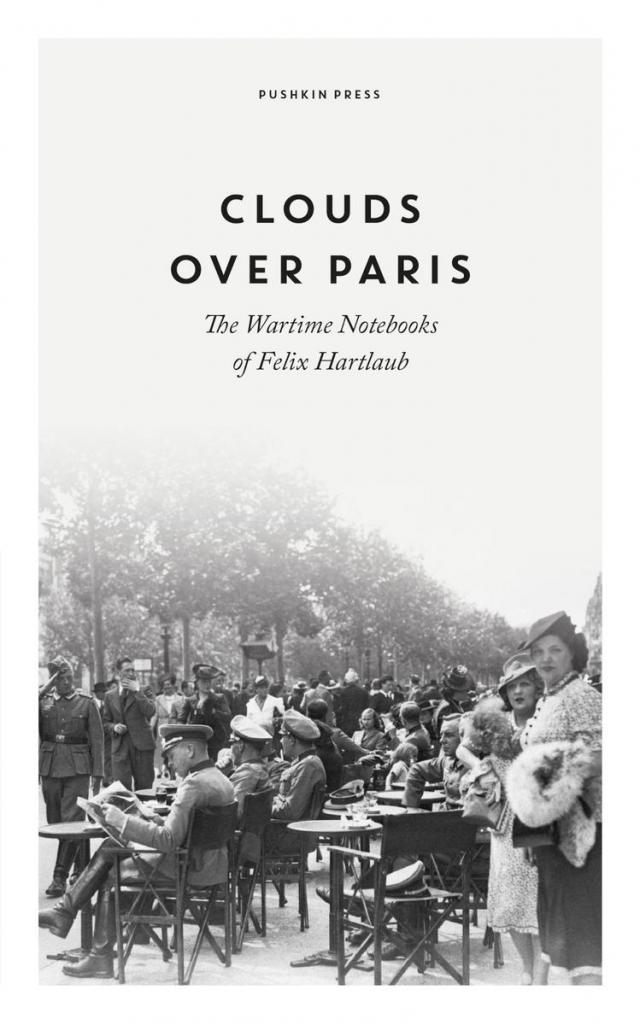
CLOUDS
OVER PARIS
The Wartime Notebooks
of Felix Hartlaub
Translated from the German by Simon Beattie
With an Introduction by Rüdiger Görner
PUSHKIN PRESS
Contents
Title Page
Introduction by Rüdiger Görner
CLOUDS OVER PARIS
MARCH 1941
APRIL 1941
MAY 1941
JUNE, JULY 1941
Appendix: Sketches from Paris
Available and Coming Soon from Pushkin Press
Copyright
Introduction
The Unhappy Occupier
I
“On the meaning of diaries. They can only refer to a certain layer of occurrences that happen in the intellectual and physical sphere. What concerns us most intimately resists communication if not our very own perception of it.” So wrote Ernst Jünger, the German officer and well-known writer of First World War memoirs, in his Paris Diary on 18th November 1941. Jünger wrote this about a year after the young unknown lance corporal Felix Hartlaub first prepared to be relocated to Paris, where he also would begin keeping a diary, one more impressionistic in style than that of literature’s most famous Wehrmacht officer. The two men’s paths could have easily crossed, though, on the German-occupied banks of the Seine or elsewhere. The one thing they shared was a sense of the surrealism of their situation, which the young soldier Hartlaub found oppressive. Jünger, the established author and high-ranking officer, was to receive a ticket from Jean Cocteau himself for a viewing of the surrealist film Le sang d’un poète (“The Blood of a Poet”).
But who, then, was Felix Hartlaub (1913–1945)? A Francophile loner in German-occupied Paris, where he worked for the German Ministry of Foreign Affairs from December 1940 to August 1941 as a historian at the Quai d’Orsay. Later, in a letter to his father, he called it the “Cabinet du Sinistre”. For after the French surrender to the Germans, the Quai d’Orsay appeared ghostlike, void of real life like most of occupied Paris, or so it seemed to Hartlaub, the diarist and detached observer, who was mostly embarrassed by his and his fellow Germans’ presence in the then half-deserted metropolis on the Seine, the old capital of the nineteenth century.
Literary history was Hartlaub’s vocation, but military history was his profession: he wrote his doctorate on the sea battle of Lepanto (1571) and the role of Don Juan d’Austria, a battle in which, incidentally, the future author of Don Quixote, Miguel de Cervantes, had fought, and in which he had lost the use of his left arm. In fact, this turned out to be Hartlaub’s only publication during his short life. It was not by choice but sheer destiny that he eventually found himself in a small circle of historians in the closest vicinity of the Führerhauptquartier recording the events of the war, before he vanished without a trace in the last days of April 1945, during the pointless defence of Berlin against the Soviets.
Hartlaub was a highly educated aspiring young writer who produced only notes and fragments. In fact, when reading his literary texts, including his Clouds over Paris, now available for the first time in English, one has the distinct impression that they were intended to serve as material for novels to be written later. But there was also Hartlaub the writer of fine letters, largely to his father Gustav Friedrich Hartlaub, the eminent art historian and former director of the Kunsthalle Mannheim, which was, thanks to him, until 1933 one of the foremost exhibitors of avant-garde art in Germany. Vilified by the Nazis of Mannheim, he ended up forced to live the life of a private, demonstratively non-political scholar in nearby Heidelberg. He was able to afford this way of life thanks to his second marriage to the daughter of a wealthy industrialist following the premature death of his first wife and Felix’s mother. During this time, Gustav was able to publish pieces on art history in the Frankfurter Zeitung, one of the few papers in Nazi Germany that managed to maintain some degree of independence from the official ideology. The art historian’s preoccupation with mirrors in art was something he passed on to his son, who was to reflect in his diaries on the meaning of mirrors as a tool of observation.
Certainly, Felix Hartlaub used the mirror for self-observational purposes, too, although they come to the fore mainly in his letters. For instance, on 15th January 1941 he writes to his father and stepmother:
My personal state is unfortunately but quite definitely below zero. Not sure whether this is still the aftermath of a bout of flu or whatever else. Every day is exactly the same sadness and inability to come to decisions by which I feel submerged, which can lead to an actual paralysis of my ability to think and speak. My face has lost any trace of intellectual imprint and is of a dullness that makes mirrors go blind.
Among his other main correspondents were his friends Irene Lessing, whose brother was to be the future husband of the writer Doris Lessing, and the man Irene would go on to marry, Klaus Gysi, a born survivor who formed part of the Communist resistance against Fascism and later became an influential figure in the cultural policy of the German Democratic Republic. Incidentally, Felix Hartlaub’s great love in his short life was Klaus’s sister, Erna Gysi, a Communist intellectual and friend of Alfred Döblin, who emigrated to France in 1938 but was later interned by the Vichy regime in Gurs (southern France).
This is not a who’s who of the members of Germany’s so-called “inner emigration”, with whom Felix Hartlaub was directly or indirectly in contact, not to mention the circle of scholars and intellectuals in Heidelberg that influenced him, from the philosopher Karl Jaspers to the eminent legal scholar Gustav Radbruch. The young Hartlaub found himself in a situation in which he had to navigate with increasing care a web of suspicion, prejudice, slander and betrayal, eventually in close vicinity to the highest rank of Nazi officials in Hitler’s entourage but with friends who were, in their majority, dedicated Communists. If ever there was a young eyewitness to the madness of his time, it was Felix Hartlaub, whose fragmentary oeuvre shows he had the potential to become a great writer, had he only survived the inferno of the final days of the war in Berlin.
II
Clouds over Paris is Hartlaub’s diaristic chronicle of Paris over the course of a few months in 1941, roughly from the beginning of March until the end of August. The diary, a curious combination of matter-of-fact accounts and impressionistic narratives, novelistic snapshots and stylistically daring depictions of Paris, has as its backdrop the “absolute silence” to which the Parisians seemed to have condemned themselves, as Hartlaub put it in the aforementioned letter to his father dated 15th January 1941.
This literary impressionist begins his diary with a stunning depiction of the sky over Paris:
The large patch of sky between the towers [of Saint-Sulpice]: bright, wet, juicy clouds en route north-east, proper clouds mostly, pot-bellied, with guts and heart, the odd simple scarf or banner among them. With necks bent, smoking brows, their chests, manes thrown forward. The sky between flushed a deep, fresh, purply-blue; inconceivably high, as if in another sky, thin cirrus starts to be spun, crossways to the cloud-drift. The west front, its back to the sun, deep black, blacker than soot, a wet, fragrant black. In certain places – column shafts, ledges – wind and water have scrubbed, etched something, and white, pale bone-white, has seeped out.
This passage should be included in any anthology of literary depictions of cloud formations. To a certain extent, the composition of this literary canvas is emblematic of what is to come, as his impressions of the city betray the draughtsman in Hartlaub, whose original diary contains numerous sketches of Parisian scenes (reproduced on p. 159).
This diarist would like to belong to the Parisians but he senses, unsurprisingly given the oppressive circumstances, that he is met with suspicion; he keeps overhearing hostile comments (“C’est abominable – ces Boches… ils savent tout, – ils ne savent rien, et ils savent pourtant tout”). The embarrassing pretence of the occupier is precisely what Hartlaub wishes to distance himself from.
Critics have remarked that Hartlaub’s diary suffers from a “complete lack of I and an absence of the warmth of life” (Katherine Roseau). This is undoubtedly correct, but one needs to add that this quality, what we could call the depersonalization of Hartlaub’s diaristic narrative, is the result of his uneasiness with his situation as a German soldier in Paris. This also applies to the piecemeal perception that he offers in his diary: it is the direct equivalent to the fragmented existence that he leads as a German historian in the deserted Quai d’Orsay, fulfilling an utterly superfluous task, namely, examining all too well-known papers that offer insights into the past of fraudulent Franco-German relations.
Hartlaub suffers from the ambiguity with which he is perceived. His ideologically perverted fellow Germans see “something suspiciously Jewish” in his physiognomy, while the Parisians recognize in him, with his lack of elegance and clumsy accent, the inevitable German. Given these circumstances, our diarist resorts to what one might call “aesthetic minute-taking” as he provides a list of fragmented observations that link the strange, or rather offensive, symbols of the occupier with natural phenomena:
The strands of rain slant down in confusion, buffeted by wind. The great swastika flag surges to the left, as if blown artificially with hot air, the pole flexing. […] Suddenly, the sheeting rain lessens; glittering, wafting sparks as the sun bursts through, hot and stinging. Flashing slate on one side of the corner pavilion; to the left, in the park, dazzling fresh green. A great lake of acid blue, its edges soft, appears. The ra
It is the urbanity of nature and the naturalness of the urbane that Hartlaub’s diary celebrates when he abandons, momentarily, the surreal reality of German occupation. Incidentally, almost “naturally”, it is the swastika flag that most often serves him for symbolic purposes. In this instance it stands for the self-inflated pretence of power; in the following sentence it foreshadows decline: “Half-eaten by the wind, the swastika flag on the top of the pediment flaps in constant ecstasy.” (The original word Hartlaub uses, knatternder, has another meaning: “crackling” or “rattling”. It is tempting to see in this acoustic image a variant of the famous final lines of Friedrich Hölderlin’s poem “Half of Life”, given Hartlaub’s familiarity with this poet – in David Constantine’s rendering: “The walls stand / Speechless and cold, the wind / Clatters the weathervanes.”)
While the diary avoids the first person singular, it does so in support of other voices – those of rustling leaves and those of the German military personnel with their rattling accents. There is something eerily atmospheric about the way Hartlaub presents his observations and impressions. Somewhat unusually for a young historian, he focuses on the present and only occasionally connects his surroundings with their historical significance. We encounter the familiar settings of the Faubourg Montmartre, the Place Pigalle, even Fontainebleau, but only in passing. They do not dominate the scene but provide the setting for particular themes, often with ironic twists such as “Moonlight idyll in Central Europe” at the time of the eleven-o’clock curfew for Parisians. He perceives “dusky brutes”, “blackouts” and the “sequestered ministry”, even an “international crisis at the knocking-shop” (Weltwende im Puff). Hartlaub does so with an alluring combination of sensory descriptions and restrained sensuality, as if he wanted to play with his prospective reader’s imagination – definitely the hallmark of a promising writer.
III
Nothing characterized Hartlaub’s position in Paris better – both as a diarist and an historian – than the phrase “unhappy occupier” (Katherine Roseau). Through his fragmentary reflections, he attempted to overcome the discomfort with which he moved through his ideal city. However, the diary only reaffirmed his alienation from his official task. He knew that his sheer existence in Paris as an occupier was nothing but an imposition. His and his comrades’ presence is a tall order for the city’s inhabitants. And yet, he seemed to have sensed that keeping this diary was the most important education yet on his path to becoming a writer. His model in terms of descriptive precision was Paul Valéry’s Monsieur Teste. But what he records is the “détresse” in Paris, the feeling of desolation, especially during the cold winter of 1940 with its shortage of coal and firewood. Hartlaub experiences “tristesse” and a sense of isolation, completely different from the life of the worldly Ernst Jünger, who found himself in better-heated hotels in the company of Cocteau, Céline, Guitry and Picasso, but also in the Musée de l’Homme where he meditated on ancient skulls and masks.
In one respect, though, they would have found common ground. The sense of despair and meaninglessness that became acute in the young Hartlaub is something that Jünger records from a letter he received from his mother at the time in which she observes, from the safe haven of the Alpine resort of Oberstorf, that the word “nothing” increasingly frustrates her in propagandistic phrases like “The people are everything – you yourself are nothing.” Jünger comments: “The game of the nihilists becomes more and more transparent.” Hartlaub, too, included a brief chapter on “propaganda” in his Paris diary, in light of the pathetic slogan that greeted Parisians in summer of 1941 on a large banner right across the Chambre des députés: “Germany wins on all fronts” – for Hartlaub a symbol of “pride comes before the fall”, as indeed it did.
Hartlaub was in the process of becoming a writer who would have mastered the art of the interior monologue and sudden shifts of perspective, a virtuoso of imitating voices in writing, and an advocate of the “stream of consciousness” in literature. But, as his biographer Matthias Weichelt rightly argues in his perceptive study The Absconded Witness, Hartlaub was also a writer who, alongside his role model Franz Kaf ka, regarded literature as a space in which he could stand trial over himself. Hartlaub, this writer who ended up lost without a trace, displaced by fate, remains eminently identifiable through his diaries and letters as an invaluable voice from a time that was determined to extinguish all dissent. The “unhappy occupier” became a vanished chronicler and writer, from then on “occupied” himself by an enigma.
—rüdiger görner
SOURCES
Felix Hartlaub: Kriegsaufzeichnungen aus Paris. Nachwort von Durs Grünbein. Mit Zeichnungen des Autors. Suhrkamp Verlag, Berlin 2011.
Felix Hartlaub: “In den eigenen Umriss gebannt”. Kriegsaufzeichnungen, literarische Fragmente und Briefe aus den Jahren 1939 bis 1945. 2 Vls. Ed. by Gabriele Lieselotte Ewenz. Suhrkamp Verlag, Frankfurt am Main 2007.
Katherine Roseau: “A Diary without the ‘I’: Embodiment and Self-construction in Felix Hartlaub’s Extrospective Second World War Paris Writings” in Textual Practice 34 (2020), No 7, pp. 1123–1139.
Matthias Weichelt: Der verschwundene Zeuge. Das kurze Leben des Felix Hartlaub. Suhrkamp Verlag, Berlin 2020.
CLOUDS
OVER PARIS
MARCH 1941
Ventre de Paris, 1 March
The colonnades around the Bourse de Commerce, looking past towards the west front of Saint-Eustache. One of the towers only got as far as the central pediment; the other is also stunted, a scrawny stump, splinted with pillars. The great gap between the two towers, the shallowness of the pediment: a wide seat for a wide rump, the towers posts for the arms to hang on to. Like Saint-Sulpice. The large patch of sky between the towers: bright, wet, juicy clouds en route north-east, proper clouds mostly, pot-bellied, with guts and heart, the odd simple scarf or banner among them. With necks bent, smoking brows, their crests, manes thrown forward. The sky between flushed a deep, fresh, purply-blue; inconceivably high, as if in another sky, thin cirrus begins to be spun, crossways to the cloud-drift. The west front, its back to the sun, deep black, blacker than soot, a wet, fragrant black. In certain places – column shafts, ledges – wind and water have scrubbed, etched something, and white, pale bone-white, has seeped out. – The sun, as always on the Left Bank, sees only the side of the street facing it. Banished no more, as on frosty days, far beyond the crystal west – where, frozen to the sky, its light was no longer its own – the sun roves about, low, across the domes, in among the clouds. Sometimes it stays away altogether, and the buildings grow dim, nipped, for a brief moment, by cooler air.
The noise of the market then seems to grow, to spill out into the void, and the dazzling, bright house fronts turn yellow, compress, extend, buildings with six floors or more; French doors, more than one can number (trebled by all the open shutters, at some of which people appear), have sucked in the fading light. Is it about to rain? Then, stripped bare and washed clean, the light pulses back.
People queue outside a butcher’s shop underneath the colonnade, pressed together along the wall. Beside them a somewhat remote policeman, to keep traffic flowing beneath the columns. No arms, his white truncheon poking out from under his cape the modest two centimetres or so prescribed, eyes (and ears) focused somewhere else entirely; some of the many queueing stare blankly at his back. The silence serves to amplify the echoing footsteps of passers-by and the yelping old-fashioned car horns; there is only the odd grumble from the queue. Their faces emptied, leached with waiting, defenceless in that stark, blinding light. Little eyes, whiskery women, brows unfurrowed, sweaty layers peeled off. The shadow of the columns falls across some of them. Their bodies apathetic beside each other. Apprentice girls with knitted brows, shaded by another’s broad back, read cheap paperback novels, which they hold up close to their face. A black sign appears by the shop door, written in chalk: “Plus de tripes”. A man, half-asphyxiated, his stomach pulled in, wriggles out past huge women, calling something over to a car. The sagging, empty, billowing shopping bags.


