

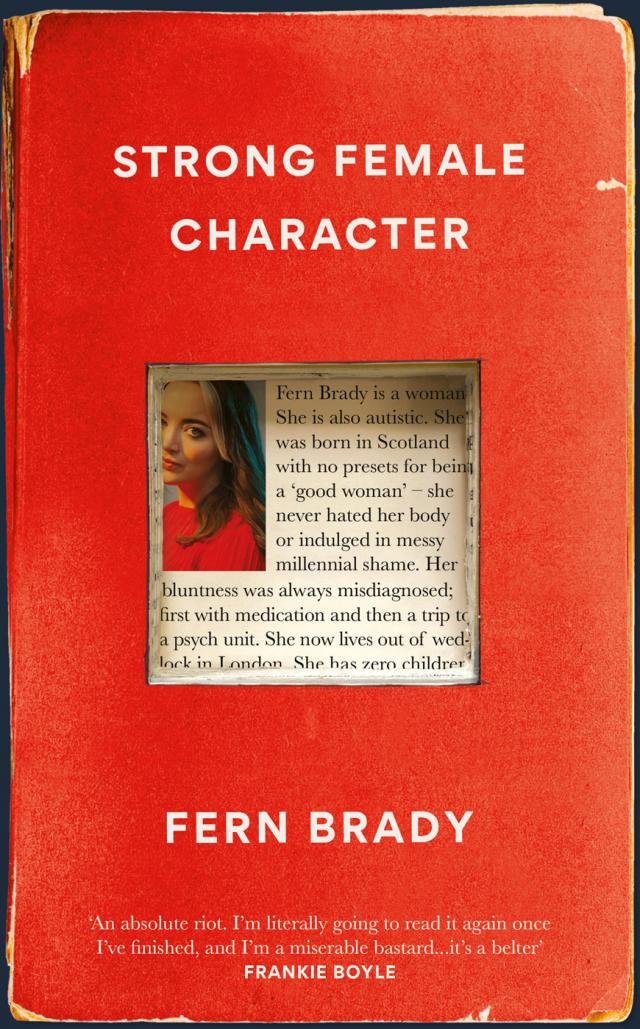
Strong female character, p.1
Strong Female Character, page 1


‘If you’ve ever been on a night out where you got blackout drunk and have laughed the next day as your friends tell you all the stupid stuff you said, that’s what being autistic feels like for me: one long blackout night of drinking, except there’s no socially sanctioned excuse for your gaffes and no one is laughing.’
Praise for Strong Female Character:
‘Fern’s book, like everything she does, is awesome. Incredibly funny, and so unapologetically frank that I feel genuinely sorry for her lawyers’
–Phil Wang
‘Of course it’s funny – it’s Fern Brady – but this book is also deeply moving and eye-opening’
–Adam Kay
‘It made me laugh out loud and broke my heart and made me weep...I hope absolutely everyone reads this, and it makes them kinder and more curious about the way we all live’
–Daisy Buchanan
‘Glorious. Frank but nuanced, a memoir that doesn’t sacrifice voice or self-awareness. And it has brilliant things to say about being autistic and being funny’
–Elle McNicoll
‘Fern Brady’s book is alive in your hands. Brave doesn’t cover it and I’m not sure what will. Fizzing with intelligence, it will hit you in the heart, lungs and liver. You’ll laugh, cry, be still and if you’re not autistic
– by god you’ll learn. If you are autistic you’ll be seen, heard, held, rocked and loved here. A set text for all of us in 2023’
–Deborah Frances-White
‘Fern is a brilliant, beautiful writer with a unique voice and even more unique story. Astute, honest and very, very funny’
–Lou Sanders
‘This book has the potential to truly change the way people think about people’
–Alex Horne
‘So funny and brilliant’
–Holly Smale
Dedicated to Conor
This memoir is my truth but to protect the privacy of others I have changed names and other identifying details throughout. If you think you recognize someone in here, trust me, you don’t.
Contents
Chapter One
Chapter Two
Chapter Three
Chapter Four
Chapter Five
Chapter Six
Chapter Seven
Chapter Eight
Chapter Nine
Chapter Ten
Chapter Eleven
Chapter Twelve
Chapter Thirteen
Chapter Fourteen
Acknowledgements
How to Use This Ebook
Select one of the chapters from the main contents list and you will be taken straight to that chapter.
Look out for linked text (which is in blue) throughout the ebook that you can select to help you navigate between related sections.
You can double tap images and tables to increase their size. To return to the original view, just tap the cross in the top left-hand corner of the screen.
‘What constitutes a problem is not the thing, or the environment where we find the thing, but the conjunction of the two; something unexpected in a usual place (our favourite aunt in our favourite poker parlour) or something usual in an unexpected place (our favourite poker in our favourite aunt).’
—Jeanette Winterson, Oranges Are Not the Only Fruit
Chapter One
A couple of times a week I’d have long phone chats with my dad as he commuted the two hours back home from his job in London. It was on one of these phone calls that I told him something I had dreaded bringing up since I’d found out a few days before.
‘So I got diagnosed with autism on Tuesday.’
‘Who told you that?’ His tone implied disbelief.
‘A doctor at the Lorna Wing Centre who specializes in diagnosing adult women with autism,’ I said, already irritated that he thought someone had just mentioned it in passing or that I’d done an online quiz.
‘Oh right. Traffic in London’s mental, eh?’
(One time my granda had had his leg amputated and Dad mentioned it as breezily as you would if you were making small talk about the weather: ‘Granda’s in hospital and we think he’s getting his leg cut off.’ This was followed by a call the next day with a matter-of-fact ‘Well, Granda’s deid.’)
I paced back and forth around the kitchen trying to keep my cool, my phone still pressed to my face.
‘You know, I actually had a dream where I told you about the diagnosis and you were so uncharacteristically compassionate and nice about it that I woke myself up laughing.’
‘Oh right. I had a dream that there weren’t enough blankets on the bed, and I asked Julie to put more on ’cause I was freezing.’
I began to load the dishwasher while he continued telling me about his dream, oblivious to my lack of interest. I waited for him to finish before I said: ‘Well, they say autism can be inherited from one parent, so I guess that’s answered the question of which one.’
‘Who? Your mother?’ he asked in earnest.
I slammed a knife into the dishwasher in frustration.
‘Are you kidding me? It’s you! It’s you, ya maniac! Have you ever noticed you’ve no ability to read social cues or people’s emotions?’
Dad and I were similar in that we’d both run into trouble at work for pointedly telling people when they were in the wrong. We both had odd ways of communicating.
I tried to picture his response. I knew he was driving calmly, glancing blankly at the satnav, totally unbothered by any of it.
Mildly, he added, ‘I dinnae even know what a fucking social cue is.’
‘Right. Well, it’d be like if your daughter phones you up and says she’s just been diagnosed with autism, a normal person would go, “Oh, and what’s prompted you to get diagnosed? How do you feel? Are you okay?” You know? Any kind of response like that?’
I was shouting now. I liked talking to my dad because whereas I had to tiptoe around my mum’s unpredictable moods, I could shout at him and his emotional response would still be flatlining.
‘Well, I hope they went up and arrested your mother.’
I didn’t know why I kept putting the same information into this computer and waiting for a different output. He wasn’t capable of it.
‘Why would they do that? Mum’s feeling guilty about it, about how yous never got me help when I was younger.’
‘She’s the bloody autistic one!’ Dad is now throwing the word around joyfully, like a child who’s discovered a new swear word.
‘I don’t think so. She’s had a pretty normal, human response about the whole thing and been dead helpful.’
‘Right,’ he said, sounding distracted. I could tell from the change in tone he was checking his texts.
Actually, Mum had been crying a lot since taking part in the assessment. She was full of guilt and had been going over and over how obvious my autistic traits were: like not wanting to be held or cuddled as a baby; or having special interests, such as teaching myself Danish when I was eight; or having violent meltdowns over the sensation of my own clothes on my skin. She felt bad the signs hadn’t just been missed but were viewed as me being deliberately difficult. Growing up, I’d been told repeatedly that I was very, very clever but also very, very bad – and yet neither of my parents understood why I now enjoyed doing a job that involved people alternately cheering or booing at me.
‘I’m still waiting for you to say one normal thing about this, Dad. There’s still time.’
I could hear the cogs turning in his brain on the other end of the phone while watching the satnav.
There was a pause.
‘. . . What did you have for dinner tonight?’ he offered.
I leaned my forehead on a kitchen cupboard, opening and closing a drawer I’d smashed repeatedly over the years and had never been right since.
‘Pad Thai.’
‘Never heard of it.’
When I’d first got depressed, at 15, Dad had found me crying hysterically one night and had shouted to Mum in a panic, ‘She’ll be put in bloody Carstairs!’ Carstairs was a high-security mental hospital in Scotland for serial killers, where they put away people who’d done stuff like skin people alive. Instead, I was given a half-arsed diagnosis of OCD and depression by my family GP after I’d asked him, ‘I have obsessive routines and feel bad if I can’t do them; is it OCD?’ The GP’s notes to the consultant psychiatrist in the referral read: ‘Says she’s always been strange.’
When I signed myself out of a teen psych unit shortly after my sixteenth birthday, I read the DSM manual* cover to cover and became an expert in psychiatry. I didn’t think I had OCD as I didn’t think I was going to die if I couldn’t wash my hands 15 times. Come to think of it, it was hard to remember to even wash myself anyway when I wanted to spend four hours doing French and Italian verb drills. The public perception of autistics is so heavily based on the stereotype of men who love trains or science that many women miss out on diagnosis and are thought of as studious instead.
In my binfire of a school, when teachers thought of problem kids they thought of disruptive behaviour. There was no such thing as someone who studied too much, even if they did give themselves a nervous breakdown in the process. It’s only now that increasing numbers of health professionals understand to look for intensity of interest rather than unusual interests when assessing girls.*
Unlike many OCD sufferers, I didn’t think not carrying out rituals would lead to my family being hurt – and anyway, I hated my family. They were so noisy I had
The following week, with my psychiatrist, I brought up the possibility I was autistic.
‘You can’t have it,’ he grinned, full of that jaunty misplaced confidence so many medical professionals have. ‘You’re making eye contact with me, aren’t you? And you said you have a boyfriend. So, no, you don’t fit the criteria.’
I now know that the diagnostic criteria for autism was almost entirely based on Hans Asperger’s research into autistic males – and funnily enough, none of them had boyfriends because they were eight-year-old boys in pre-war Vienna. I didn’t fit the criteria because I was making eye contact and anyway, I was a top student who’d just been accepted to Edinburgh University to study Arabic and Persian so what exactly was the problem?
At no point did anyone think to ask why I, with no prior interest in visiting or reading about the Middle East, had opted to study Arabic and Persian. No one thought it was weird when, after receiving my offer a year early, I self-transferred to a different school in sixth year to crash Higher Spanish and Advanced French ‘for fun’. If anyone had asked why I chose that degree subject I’d have explained I’d simply run out of interesting languages to learn at school so on my UCAS forms I’d applied to study Sanskrit, Arabic and Japanese. I didn’t want to visit any of these places; I just wanted to see if I could learn all the new verb drills. In fact, if anyone had asked, I’d have confessed I didn’t really want to travel at all and had been banned from family holidays for several years by this point as I ruined them. I now understand that an aversion to holidays is extremely common in autistic people – the disruption to routine, the unpredictable nature of travel, the lights and noise of the airport and the extreme temperature change on arrival creates a special kind of sensory hell. Sameness is what I thrived on. I’m told that the appeal of holidays for most people is the novelty and break from the humdrum of everyday life. My family concluded among themselves that I was an arsehole. I didn’t know why I was so unhappy on holidays either, so I had no other option but to agree with them.
After stopping and starting university twice, I began writing for the university newspaper, funding my unpaid work placements at various media outlets by moonlighting as a stripper. At the end of my undergrad I won a scholarship to train as a news reporter in England. Following an assignment where I was asked to try stand-up comedy and write an article about it, I quit the training and spent the next decade making a career out of stand-up.
Moving to England and starting comedy happened all at the same time. People saw me differently in comedy; I found they misinterpreted my shyness as coldness and my almost constant overwhelming anxiety as anger. I realized my loud, hoarse voice sounded stupid and was interpreted as aggressive by many English people, so I leaned into this new unrecognizable version of myself as an angry vulgar Scot. A lot of promoters on the male-dominated comedy circuit would try to touch the female acts up, so as a woman I figured it was better to make them scared of me with outdated national stereotypes than to try to be myself.
In 2017 I was filming a travelogue series around Europe and was at a gig in Berlin where I joked onstage about not fitting in with other women and having no idea why. A shy woman approached me afterwards. ‘The stuff you’re saying about not fitting in with other women . . .’ she said. ‘It sounds like a description of an autistic woman. Read a book called Aspergirls.* Please.’
I mentioned to my boyfriend that someone from my audience had said I might have Asperger’s. I told him I didn’t want to read the book. He immediately started to read up on the topic.
‘This is you. This is like an exact description of you.’
‘My friends don’t think I have it.’
‘Yeah but . . . you act like a different person around them. I’ve seen you in social situations where you’re working incredibly hard to understand what’s going on and follow the conversation. Plus, the way you are on trains and planes with the . . . the banging your hands on the windows and seats?’
‘Oh yeah. That.’
I knew I had it. I knew it better than I knew anything about myself. But the psychiatrist had said that I couldn’t possibly have it because I’d had boyfriends. Either he thought that all autistic people are unattractive sea monsters with no interest in forming meaningful relationships or he mistakenly assumed that the men I dated were capable of picking up on my autism rather than seeing it through a ‘manic pixie dream girl’ lens. A guy had called me a ‘gorgeous weirdo’ once and I knew instinctively that was good – that the ‘gorgeous’ part would help cancel out any potential discomfort with the ‘weirdo’ part, even if only for a little while. When I told all this to the doctor who finally diagnosed me almost 20 years later she rolled her eyes in despair before I finished my sentence. ‘You wouldn’t believe how often we hear this from women,’ she said.
On the Europe trip, a member of the film crew gave me Xanax to help me sleep on the flight home. I’d never tried it and was amazed at the total peace I felt. He gave me the contact details for his dealer and I bought a load of it. I figured I needed it as I had this weird habit of flipping out at home and destroying my furniture and wasn’t sure why I did it. It frightened my boyfriend: a very quiet, peaceful Irish lad called Conor, who’d grown up in an environment of near-monastic silence by the sea. He’d noticed early on in the relationship that I didn’t understand idiomatic language, which confused him as I seemed verbally articulate.
I knew I had it. I knew I had it but work was getting busy and my experiences as a teen meant I now loathed any involvement with medical professionals, so I ignored it and took more Xanax to calm down after gigs. I decided all I really wanted was to stop smashing stuff up. I didn’t care about autism, which as far as I was aware was about how I communicated with other people. But the smashing of our stuff was exhausting. There are a surprisingly large number of doctors in stand-up comedy and I cornered a nice one at a gig after finding out he was training in psychiatry.
‘Hey, do you know what the mental illness is where a person smashes things up for no reason?’
He looked alarmed. ‘Er, maybe an anger problem? Maybe try CBT?’
I was already shaking my head impatiently. I’d done CBT all through my teens and in the CAMHS* unit and no amount of calmly observing my thoughts from a distance could stop the feeling that my body was being taken over by a gorilla while I looked on helplessly.
‘It’s not anger, though,’ I insisted, feeling panicky that a doctor didn’t know. ‘You must know what it is; you’re a psychiatrist!’ He just looked more uncomfortable.
So, I took more Xanax, sensibly balancing it out with the stimulant Ritalin that I’d bought illegally from a stranger on the internet called Sunset Sally. If a psychiatrist at a gig didn’t know how to help me then there was no point going to the GP. I repeatedly googled ‘Why do I smash up my house?’ to no avail.
Trying to stop a meltdown feels similar to trying to hold your breath. Even if you can hold it for a while, eventually you have to resurface. I stopped buying nice furniture as it’d inevitably get smashed. My mum visited for two days once and immediately after she left I pulled a cupboard door off its hinges and bruised my hand from punching through it. No one was in the house. As I tidied up the mess in silence I thought, That’s weird. Maybe I found Mum staying stressful?
One day I was having a meltdown and instead of shouting at me to stop, my boyfriend walked over and hugged me tightly. I calmed down faster than usual. ‘Firm touch,’ he mumbled into my shoulder. ‘It’s supposed to help.’ Growing up, any time I had a meltdown my parents assumed it was a tantrum and would shout at me, but this only prolonged the whole mess. Unbeknown to me, Conor was learning techniques used to calm down autistic kids and testing them out on me. And they were working.
At a loss as to what to do and unwilling to have my partner work as an unpaid carer, I finally read the Aspergirls book. It may as well have been called Hey, Fern, You’re Autistic! Imagine reading the most accurate horoscope ever, except instead of telling you that you’ll find love this spring, it tells you exactly why you’ve felt like an alien for most of your life. It listed dozens of things I had thought were specific to my life experience and mine alone: misdiagnosis of OCD as a teenager; vulnerable to domestic abuse; low tolerance of alcohol; characterized as the bad child in the family; wrongly placed on antidepressants.


