

The rooftop, p.9
The Rooftop, page 9


‘It’s me, silly! I’m not the cow!’
He wouldn’t react, playing dead a bit longer while she shook him and pinched his nose until he finally came back to life.
But this time Flor’s sneezes met with no response. It was quite simple: the canary’s absence had upset the routine. It’s comical and dreadful to live in thrall to a canary. But it can be very real, more real than anything else. And then one day the bird dies and the circle of life in the flat breaks down.
Flor went on blowing raspberries into Dad’s neck.
‘Come on, you have to die now… I’m the cow!’
She put her lips to his ear and whispered:
‘Dad? I’m the cow.’
With considerable effort, he lifted one arm and draped it over Flor’s back. She waited a few seconds, but when she saw he wasn’t playing she wriggled free of the embrace and climbed off the bed. I stayed sitting on the edge, and thought I’d better not mention the canary. I reached out and laid my hand on Dad’s. His skin felt soft and feverish.
Flor was barefoot and skating around on a pair of old socks. She crouched next to the bucket of water, filled one of the plastic pots we used as water dishes for the canary and handed it to me. I got up and went over to the cage, as if nothing had happened. I opened the metal door and put the water dish inside. The bird’s round, lashless eyes blankly returned my gaze. I sat down and rested my hand on Dad’s again. Suddenly I felt lost, as if I were wandering in circles in an unfamiliar place, searching for landmarks I’d never find because I’d never been there before, but still trying, still believing. I wanted him to say something; after all, he was my dad. He may have been dying, but he was still my father and I expected something from him: some reassuring words, a promise that everything would be alright.
Flor came skating towards us.
‘Put your socks on,’ I said.
She squatted at my feet and threaded her arms into the socks, which came up to her elbows like princess gloves. She climbed into my lap and stroked Dad’s face with her new gloves. They were dirty, the soles black with fluff, but I didn’t say anything. She’d started talking in her doll language, a mumble that had no meaning but brought us some relief. Flor filled the silence that separated me and Dad, a silence that had begun four years ago. Just then, he squeezed my hand. Hard, with the last of his strength. I squeezed back but couldn’t bring myself to look at him. Dad had always been a mystery to me, and now he was squeezing my hand and I didn’t know what it meant, what any of our time together had meant to him.
We stayed in his room for the rest of the afternoon. We didn’t talk about the canary or what was happening because there was no need. The corridor outside was buzzing with activity; their preparations were underway. I heard them scurrying up and down the stairs, singing under their breath and laughing in the shadows. Maybe they thought I didn’t know. I enjoyed every minute of my lack of anxiety. I imagined Carmen clapping her hands like saucepan lids and shouting orders left, right and centre. The policemen were there too, probably lined up on each side of the staircase. They’d want an important role in the procession, the crowning event of their lives.
The three of us – me, Flor, Dad, in that order – formed a chain of hairdressers. Flor stood in front of me and I gave her two plaits; she messed up Dad’s hair and tried out various styles. It was easy because his hair was so dirty that it held whatever shape you gave it. We worked in silence, not out of fear of being heard but because the task required great concentration. Dad’s head was like a nest: the hair around his ears stuck out in all directions and it was tuftier than usual at the front.
‘Your head’s like a nest,’ I told him, and then asked Flor: ‘What’s Dad’s head like?’
‘A netht!’
We laughed. Dad’s breath was so faint that sometimes he didn’t seem to be breathing at all. But yes, there was life in him, I knew without needing to lean over and take his pulse, without needing to fetch the little mirror. A living person isn’t the same as a dead one, I’ve learnt. What leaves is too big to pass unnoticed.
Bees live in hives, those brown nests that hang down from trees like stalactites. When there’s no queen bee, the swarm disperses and abandons the hive. I don’t know what bees do when the queen dies, but I’ve heard they scatter and start flying in all directions. Perhaps many of them die or get lost. Why am I thinking about bees right now? Right from the start, I thought I was the axis at the centre of this household. It’s not that I considered myself more important, but without me they wouldn’t have lasted a week. Carmen would have gobbled them up in the blink of an eye. I knew my mission and I fulfilled it to the last. Maybe it’s pointless to be proud of that now, but it’s helping me face up to Carmen and her court, whatever the sentence might be.
I’ve learnt that all things have an axis that holds them in place. Flor and I were left behind, and that just didn’t make sense. First the bird, then Dad, and now what about us? The synchronisation wouldn’t stop there. Without Dad, all we could do was fly away or die, like a swarm with no queen bee. This thought, or this realisation, came to me as I watched Flor sitting in the middle of the room, crushing a candle with a fork and concentrating hard, as if her life depended on making that plate of candle mash.
She chopped the candle into small pieces and then squashed them one by one, beginning with the piece nearest the edge of the plate. The wax got stuck between the prongs of the fork. She removed it patiently and started again. Flor is a nexus, I thought. And with nothing to connect, what reason did she have to exist? And what about me? What was the point of me from then on?
She finished destroying the candle and stirred the white powder with her fingers. Then she got up and walked over to where I was sitting.
‘Look, I made you thome nithe food,’ she said.
Solemnly, she held the plate under my nose. The candle smell caught in my throat. I took the plate, thanked her and pretended to eat, but she went on staring at me. Poor thing, a nexus with no meaning, a string with nothing to tie. I gathered a bit of the powder between my fingers and put it in my mouth. It made me retch, violently. The wax congealed on my tongue, forming a paste I could barely swallow, but Flor didn’t take her eyes off me and waited until I’d finished the plate. Then she took it away:
‘Very good,’ she said. ‘You’re going to grow big and thtrong.’
I got up and walked around the flat. I didn’t want to rinse my mouth and even now I can taste the sour coating of wax on my tongue. When I passed the wardrobe, I looked at the photos. The Sellotape had gone yellow and hard.
‘Help me take these down,’ I said to Flor. ‘We’re going on a trip.’
‘Are we going to thee the birdies?’
‘Yes.’
‘Dad too?’
‘Yes, all three of us.’
We began carefully unsticking the photos, dropping the bits of tape on the floor and putting the photos in a plastic bag. When night fell, I brought all the remaining candles into my bedroom and lit them; the rest of the flat was plunged into darkness and we almost forgot it was there. We went on taking down the photos, barely making a sound. The candles cast a flickering light and it felt as if the walls were closing in. Flor went over to one of the candles and picked up the saucer. She glanced in my direction because she knew she wasn’t supposed to play with them, but I didn’t tell her off and that was all the encouragement she needed to hold the flame in front of her face.
‘I’m a wiiiiiitch! Mwa-ha-haaaa!’ she said, and started doing the laughs Dad had taught her when she was learning the vowels: ha-ha-ha, he-he-he, ho-ho-ho.
The shadows warped her face, her eyes becoming deep caverns and her nose an eagle’s beak that stretched across the wall.
‘Come here,’ I said. ‘Now we cut them up like this.’
We broke the photos into tiny bits so it would be impossible to put them back together, then returned them to the bag.
‘Now stir.’
She did as she was told, reaching in right to her elbows, then I tied the bag in a double knot. Flor was drowsy, her eyelids were drooping, but she didn’t want to go to sleep. She clung to my legs and wouldn’t stop asking when we were going to see the birdies.
‘Not yet, Flor. First we have to get everything ready. Tomorrow.’
‘Tomorrow?’
‘Yes, tomorrow, but first you have to sleep.’
I went into the living room and pushed the chest of drawers up against the front door. The chain was already on. I checked the door was double-locked; the peephole was still stuffed with toilet roll. The noise on the stairs had stopped; I suppose by then they were waiting, expectant, in number 302, jostling to press their ears against the wall.
Flor got onto the bed; she could barely keep her eyes open. Those big eyes, thick with eyelashes. What would she do all alone in this world? So defenceless, a pink baby animal with scabs on her head. No one would ever love her, no one would kiss her scabs the way I did.
The clock showed eleven thirty-eight. I covered her with two blankets, put her teddy bear in her arms and gave her a goodnight kiss. Then I said what I always said:
‘Sleep tight.’
I think when I lay on top of her she was already asleep. The weight of my body didn’t bother her at first. The rest was over in a second. I suppose children don’t struggle too much; they think everything’s a game. She trembled and kicked her legs a little, but then she gave in to the pressure and fell still, as if she were asleep.
It took me a long time to let go of her. I thought I might not have the strength to move, that I’d be slumped over that little body until they got here. When I finally stood up, I covered her head, unable to look at her. I was scared I might be tempted to touch her and find she was already cold. That’s when I decided to remove the blankets from the windows. I left them folded in a pile on the chair, then took Flor in my arms, blanket and all, and carried her into Dad’s bedroom.
It’s getting light. Everyone who’s been out to destroy me all along is sipping champagne and celebrating in Carmen’s giant Tent. Deciding, no doubt, the worst ending they can for us. I’m waiting for them calmly, my dry lips pursed to hold in one last laugh. A laugh that will ring out like breaking glass in this cold, completed night. Let them come, let them deliver their verdict. What they don’t know is that I’ve built the only possible victory. What they don’t realise is that there’s nothing of us left.
Director & Editor: Carolina Orloff
Director: Samuel McDowell
www.charcopress.com
First published by Charco Press 2021
Charco Press Ltd., Office 59, 44-46 Morningside Road,
Edinburgh EH10 4BF
Copyright © Fernanda Trías 2001
First published in Spanish as La azotea by Trilce (Montevideo)
English translation copyright © Annie McDermott 2021
The rights of Fernanda Trías to be identified as the author of this work and of Annie McDermott to be identified as the translator of this work have been asserted by them in accordance with the Copyright, Designs and Patents Act 1988.
All rights reserved. This book is copyright material and must not be copied, reproduced, transferred, distributed, leased, licensed or publicly performed or used in any way except as specifically permitted in writing by the publisher, as allowed under the terms and conditions under which it was purchased or as strictly permitted by the applicable copyright law. Any unauthorised distribution or use of this text may be a direct infringement of the author’s and publisher’s rights, and those responsible may be liable in law accordingly.
This book was published with funding from the IDA Programme from Uruguay XXI and the Ministry of Education & Culture of Uruguay / Este libro fue publicado gracias al Programa IDA de Uruguay XXI y el MEC.
A CIP catalogue record for this book is available from the British Library.
ISBN: 9781913867041
e-book: 9781913867058
www.charcopress.com
Edited by Fionn Petch
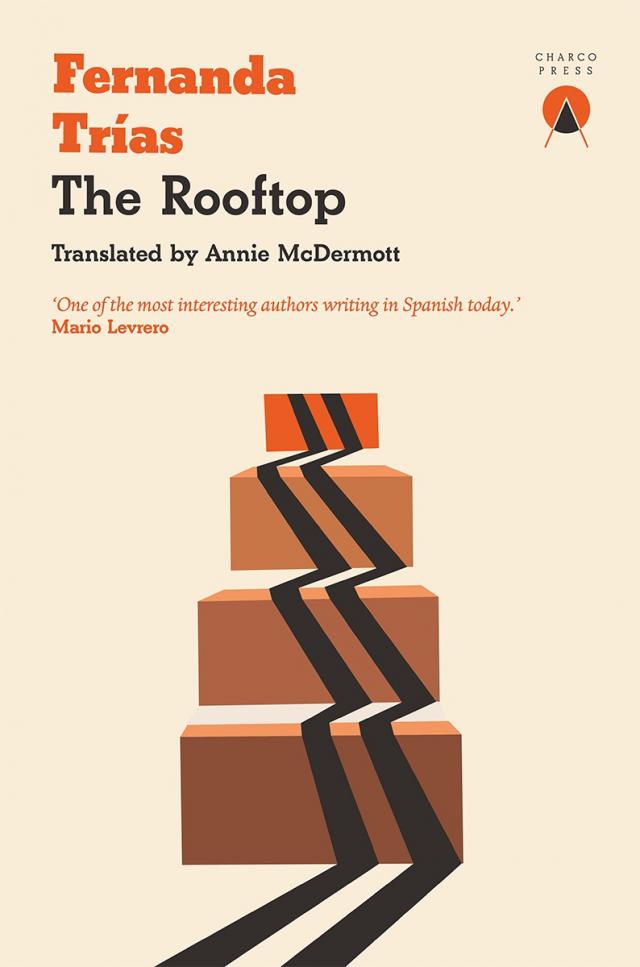
Cover designed by Pablo Font
Typeset by Laura Jones
Proofread by Fiona Mackintosh
Fernanda Trías, The Rooftop


