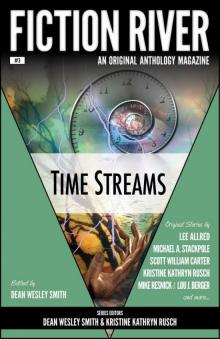
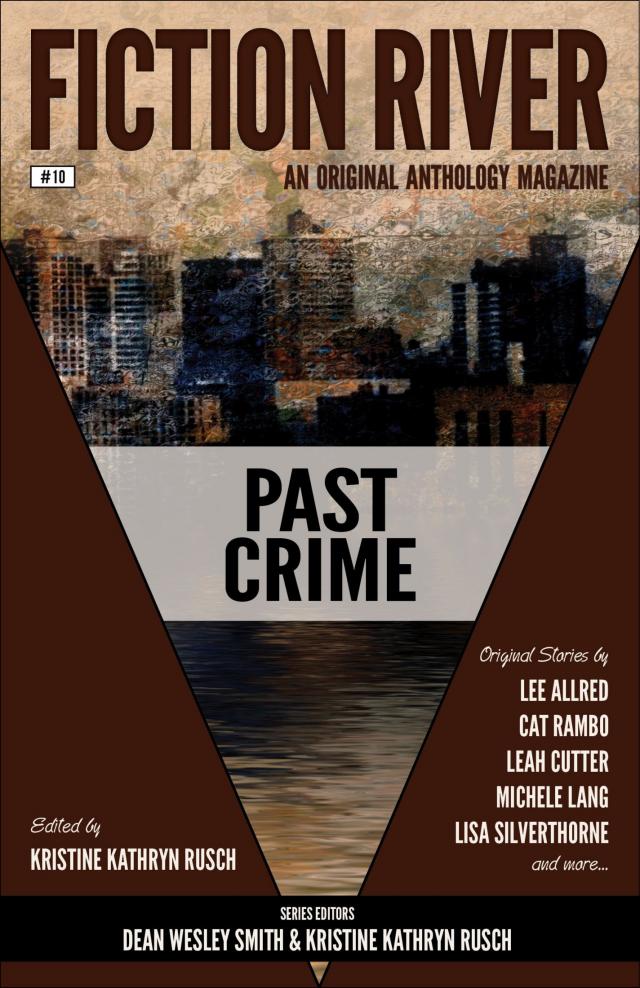
Fiction river past crime, p.1
Fiction River: Past Crime, page 1


Copyright Information
Fiction River: Past Crime
Copyright © 2014 by WMG Publishing
Published by WMG Publishing
Cover and Layout copyright © 2014 by WMG Publishing
Editing and other written material copyright © 2014 by Kristine Kathryn Rusch
Cover art copyright © Rolffimages/Dreamstime
Cover design by Allyson Longueira/WMG Publishing
“Foreword: A Reader’s World” copyright © 2014 by Dean Wesley Smith
“Introduction: Looking Backward” copyright © 2014 by Kristine Kathryn Rusch
“Stolen in Passing” copyright © 2014 by Dory Crowe
“New World Gambles” copyright © 2014 by Leah Cutter
“The Bank Teller” copyright © 2014 by Jamie McNabb
“An Education for Thursday” copyright © 2014 by Dean Wesley Smith
“The Curious Case of the Ha’Penny Detective” copyright © 2014 by Lee Allred
“The Horns of Hathor” copyright © 2014 by Richard Quarry
“Impressions” copyright © 2014 by Lisa Silverthorne
“The Raiders” copyright © 2014 by Cat Rambo
“The Monster in Our Midst” copyright © 2014 by Kristine Kathryn Rusch
“Blood and Lightning on the Newport Highway” copyright © 2014 by M. Elizabeth Castle
“Deathmobile” copyright © 2014 by Michele Lang
“The Stonewall Rat” copyright © 2014 by JC Andrijeski
This book is licensed for your personal enjoyment only. All rights reserved. This is a work of fiction. All characters and events portrayed in this book are fictional, and any resemblance to real people or incidents is purely coincidental. This book, or parts thereof, may not be reproduced in any form without permission.
Contents
Foreword: A Reader’s World
Dean Wesley Smith
Introduction: Looking Backward
Kristine Kathryn Rusch
Stolen in Passing
Dory Crowe
New World Gambles
Leah Cutter
The Bank Teller
Jamie McNabb
An Education for Thursday
Dean Wesley Smith
The Curious Case of the Ha’Penny Detective
Lee Allred
The Horns of Hathor
Richard Quarry
Impressions
Lisa Silverthorne
The Raiders
Cat Rambo
The Monster in Our Midst
Kris Nelscott
Blood and Lightning on the Newport Highway
M. Elizabeth Castle
Deathmobile
Michele Lang
The Stonewall Rat
JC Andrijeski
Acknowledgements
About the Editor
Copyright Information
Full Table of Contents
Foreword
A Reader’s World
Dean Wesley Smith
Fiction River exists now because this new world of publishing and reading exists.
For a very long time, more decades than I want to think about, actually, the publishing of books never took into account the desires of readers. Editors and almost all publishers were based in New York, inside an echo chamber with almost no feedback from actual readers. Publishers in that echo chamber were deathly afraid to try new things, let new and unique voices free to tell stories they wanted to tell.
As I heard many editor or publisher say during those decades: “It wouldn’t sell.”
Yet they never once asked readers what would or wouldn’t sell outside their publisher’s bubble.
So during those decades, almost everything published had to be similar to things done before. Everything had to be easily classified so it could be easily sold to distributors and chains, and put on certain shelves in certain places in bookstores.
Then along came the electronic bookstore, with unlimited shelf space that allowed readers to easily access any book, either in hardback, paper, or electronic formats.
Suddenly, readers took back control of publishing. Readers who lived outside that publishing bubble and, surprise, bought books no one thought would sell inside the bubble.
And that freed up innovative publishers (such as WMG Publishing, who started outside the bubble) to focus on trusting their readers to be willing to try new and different types of stories, as long as the quality of the storytelling was high.
Many major publishers still inside the bubble have not switched yet to this new world of selling directly to readers and trusting them. But they will, or they will perish because readers now control.
Readers are smart. They know what they want and can find it just fine, thank you very much.
Fiction River is a result of trusting readers.
Fiction River trusts readers to enjoy a crime story beside a science fiction story beside a fantasy story. And sometimes have all those elements in the same story. Fiction River trusts readers to find a volume they want to read when they want to read it, which is why all Fiction River volumes are still completely in print in all forms for any reader to find when they want to read it.
Every volume of Fiction River is unique. The series name is the same and the quality we guarantee of storytelling is high in every volume, but that’s where the similarities from volume to volume end. I edited a science fiction volume of stories focusing on moons. Kerrie L. Hughes edited a fantastic volume of urban fantasy stories called Fiction River: Hex in the City. Kevin J. Anderson has just finished editing a volume of fast-paced stories that cover varied genres called Fiction River: Pulse Pounders.
Now in this volume, Edgar Award-nominated writer Kristine Kathryn Rusch challenged professional writers to give her stories about crimes in the past that are now not crimes. And the professional writers came through.
This volume almost vibrates with the contained power of professional writers given the freedom to explore topics and crimes in the past that make each writer passionate. Trust me, this will be a volume of stories you won’t soon forget.
This volume would not exist without the change in publishing, without the freedom now given to innovative publishers and writers to take chances, explore topics that no publisher ten years ago would have allowed.
This volume would not exist without readers taking back control of reading.
Thank you.
—Dean Wesley Smith
Lincoln City, Oregon
April 7, 2014
Introduction
Looking Backward
Kristine Kathryn Rusch
Whenever I come up with an idea for an anthology, I have a vision of what I want in that volume. I never get exactly what I imagined.
I’m not complaining. What I imagine is what I would write for the anthology. That’s the problem with being both a writer and an editor.
I could be petulant and send brilliant stories back, with a “it’s not right for me,” and maybe I would if I were editing only one anthology in the next five years.
But Past Crimes marks my fourth solo volume of 2014, and my fifth solo volume since we started Fiction River. (For those of you who don’t know, Kristine Grayson is one of my romance pen names.) I have other solo volumes of Fiction River lined up for 2015, and I’m scheming ways to slide in some special editions and non-Fiction River anthologies. So I know that I’ll have more than enough chances to get that volume I envision—if I push hard enough.
But I don’t like to push. I like to be surprised.
The volume you hold in your hands is not the volume I imagined when I came up with the title for this anthology. It’s better. The story quality here is so high that I had trouble choosing my final table of contents. The stories that I couldn’t take were just as good; I simply ran out of room.
Now that publishing has changed so that I can edit without working for someone else or writing a goofy proposal to sell a by-guess-and-by-golly who-the-hell-knows anthology to a big publisher, the editing bug has bitten me hard. I’ve missed editing. Not the nightmare of dealing with a boss who had a different vision for the magazine than I did and not the strangeness of trying to get writers to commit to write for an as-yet-unsold volume of something or other that might never come out, but the pure joy of finding stories that I love and sharing them with readers.
I especially love asking truly gifted writers to give me stories on a particular topic and then seeing what they come up with.
Some editors write long requirements for their anthologies. No murders with knives, but murders with guns are okay; no dripping intestines, but blood spatter is fine—that sort of thing.
I think that stifles creativity. I want to inspire writers to think about a topic they’ve never contemplated before or, at least, contemplated in this way.
Hence Past Crime.
In March, Fiction River released its first special, also edited by me, called Crime. I didn’t title it Mysteries because I like crime stories. Something has gone horribly wrong, but it might be something as small as a traffic ticket. That whole for-want-of-a-nail thing…
The crime volume covered past and present. Someday, I’ll do a science fiction volume called Future Crime. We just don’t have it on the schedule yet.
Past Crime, however…that phrase evoked something concrete for me, the historical mystery writer, the woman with a B.A. in History, the writer who likes thinking about things that are and aren’t any more.
I wanted stories abo ut crimes that no longer exist. Crimes that aren’t crimes any longer. Now, that led some writers who tried to write for this volume to tie themselves into pretzels. They felt that they couldn’t write about murder (people still kill each other!) or serial killers (they still exist) or pickpockets or, or, or…
And that wasn’t my intent.
The end result could be a murder, but the precipitating event had to be based on some historical attitude or law that no longer exists. The obvious one for Americans is Prohibition. Once upon a time, it was illegal to sell alcohol in these United States, and that led to all kinds of mayhem, as M. Elizabeth Castle’s “Blood and Lightning on the Newport Highway” so beautifully shows.
But her story also contains murder and all sorts of crimes that still exist, none of which would have happened without the Volstead Act.
I’ll be honest: I did fudge with one story. It captured its time period so beautifully that I decided to include it. The paranoia of the moment made the world a different place, and I was willing to overlook a rule to include the piece. And no, I won’t tell you which story that is.
This volume contains all kinds of crimes that no longer exist in the U.S., such as slavery, pretending to be someone of a different race, and carrying a gun in the West. But some of the other crimes happen in cultures incredibly different from our own. Richard Quarry’s Egyptian tale shows us a world long gone as does Lisa Silverthorne’s dark investigation of 18th century England.
Some crimes aren’t that distant from us. Drinking in the Stonewall Bar in New York City in 1969 was illegal because Stonewall was a gay bar. The only reason it remained open was because of the protection the owners paid. That’s 45 years ago—close enough for some of us to remember, for others of us to touch.
As I went through the volume to put together my final table of contents, I was struck by how very powerful these stories are. Each author managed to capture a different moment in time, and a different attitude toward the world. They also managed to take us on a journey into the darker side of that period, and make us empathize with people long dead who actually had to live in these circumstances.
History doesn’t live in dry textbooks. The best history lives in fiction. And some of the best fiction is, in my not-so-humble opinion, in this volume. Enjoy!
—Kristine Kathryn Rusch
Lincoln City, Oregon
April 7, 2014
Introduction to “Stolen in Passing”
Dory Crowe’s story, “Stolen in Passing,” provides the perfect opening to Past Crime. Not only does the story have a crime that is no longer a crime, it also features legal behavior that is now criminal. In other words, by using this particular moment in history, Dory turns everything we know about legality and justice on its head.
Dory is one of four pseudonymous writing Crowes. This is the second time a Crowe has appeared in Fiction River. The previous Crowe story appeared in Crime. Crowe stories have appeared under various guises in both Daw Books and Level Best Books’ Best New England Crime anthologies. Dory’s first novel, Dark Secrets, a contemporary companion to “Stolen in Passing” will appear in 2015.
The Cape Cod house in this story actually exists, including the room that factors so deeply in the story’s action. Dory rediscovered the room at the age of twelve, proving to herself and the family that the myths and legends about the home were true all along.
Stolen in Passing
Dory Crowe
Wee Hours of Hallowe’en Morning 1857–Cape Cod, Massachusetts
“Open up. Please, dear God, open the door. Let me in.”
The commotion rose through the fog of a running dream—two sharp knocks followed five rhythmic raps and the stage-whispered plea. Never in her life had Marie-France hoped to hear that dear, sweet voice again—never.
The sound flowed like ice water into her heart. It sent chills to the very soles of her feet.
How had he found her?
Why, oh why, had he come?
***
“I ain’t gots no choice.” He stood in the moonlight streaming at odd angles through the bull’s-eye glass in the kitchen ell windows. The stiff flat brim of the black-tarred seaman’s hat he’d been so proud to wear twisted between his long, calloused fingers. His bellbottomed trousers and striped shirt hung in filthy tatters off his lanky frame. He smelled like a swamp. He bowed his nappy head, while his eyes peered directly into hers. “They’s after me, hard.”
“How hard?” The ice water began to freeze.
“I done lit out three week gone. They come on board my whaler. We’s docked in New Bedford. The Cap’n seen ’em coming. He tol’ the bo’sun and him and me rows away in a longboat. I catched me a packet to Boston. Storm fetched us up at Monomoy. I dunno how, but when we gets to Chatham, them slave catchers is right behind.”
“How close?”
He shrugged.
“Jethro.” She placed two fingers at his throat, lifted his chin and stared into those deep brown eyes, so like her own. “How, close?”
A tear rolled down one cocoa-colored cheek. He shivered. “Right behind.”
The ice cracked. Hot anger welled into every fiber of her being.
“And you brought them here?” She let his head drop. “To me!”
His chin sunk to his chest. A tear splashed onto one wide pine floorboard, then another. “I gots no place else to go.”
She could think of a thousand places: to the Quaker Meetinghouse in Bass River; to Walker’s Farm; to the woods, for the love of God. She stiffened her back and pointed her own chin at the door. “You must leave.”
The hat spun round and round. “Where can I go?”
His eyes pleaded. “What can I do?”
“How can you put me out?” His voice cracked.
“I’m a married woman,” she whispered, barely able to bring the words to her mouth. “I have a son.”
“And well you should remember that before entertaining strange colored men in my kitchen in the middle of the night.” Mother Thomas strode into the kitchen from the keeping room, pulling around her shoulders the Paisley shawl she wore everywhere—day or night, dead of winter or high noon summer. In the best of times, her granite face, drawn and pinched and lined with woe, would scare the bark off a tree. “What is the meaning of this? Who is this man?”
Jethro’s mouth opened, but Marie-France got there first. “A runaway.”
Mother Thomas’ eyebrows rose and disappeared under her nightcap. “A runaway? Here? In my kitchen?”
Marie-France nodded.
Jethro bowed his head and held his hat up under his chin. “I’s sorry, ma’am.”
“And well you should be!” Mother Thomas tightened the shawl around herself. “Do you have any idea what can happen to God-fearing people if a runaway is caught in their home?”
“He was just going.” Behind the folds of her nightgown, Marie-France waved Jethro toward the door.
“Yes, ma’am, I’s gonna take my leave.” He took one step backward.
Relief flooded through Marie-France like hot soup on a cold night. She would send him to Walker Farm. They’d know what to do. They’d—
A hound bayed in the distance. Out the window, where moonlight bathed the open marshlands in silver grey, yellow torchlight bounced and drew closer.
Jethro’s bare foot took root on the planking. His hat froze in mid-twist.
Blood pounded in Marie-France’s temples, behind her eyes.
Mother Thomas sprang to the door. She threw it open and waved her arms the way she herded chickens into their coop. “Shoo, now, shoo.”
“No!” Marie-France drew the door shut. “The dog, he will find him.”
Mother Thomas’s hands took a stance on her hips. “He can’t stay here.”
Marie-France threw the latch. “He cannot go. Not now.”
The baying grew louder, the torchlight ever nearer.
“Mama?” Asa Frank, dragging a small square of well-loved blanket in one hand and rubbing his eyes with the other, toddled into the kitchen from the keeping room. “Doggie.”