

Dirt, p.1
Dirt, page 1


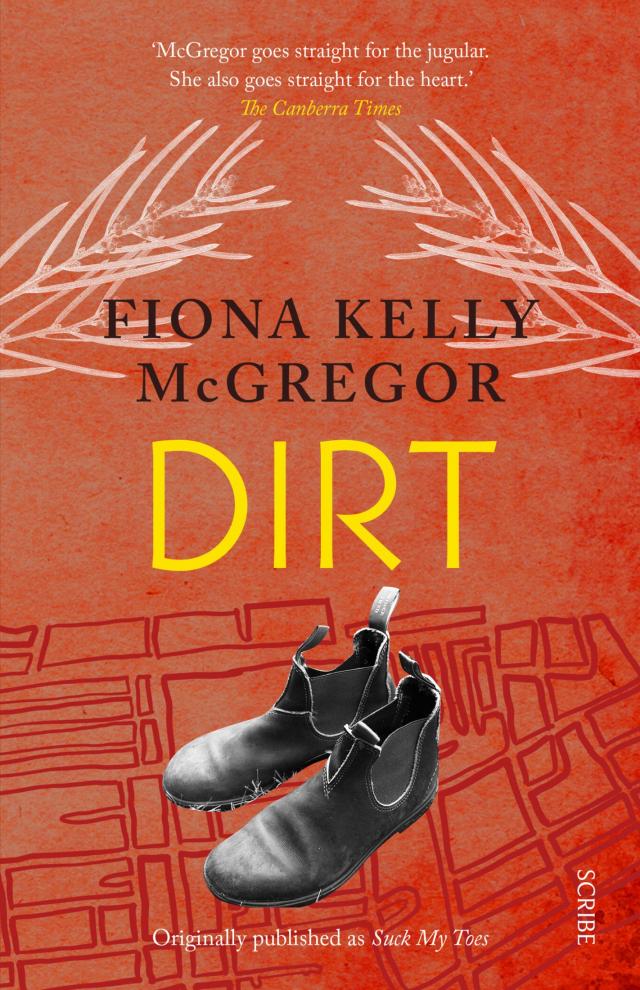
DIRT
Fiona Kelly McGregor is a Sydney writer and performance artist. She has published five books, four of which have won or been shortlisted for major prizes, including the Steele Rudd Award for this story collection. Her most recent novel, Indelible Ink, won The Age Book of the Year, and was published by Atlantic in the UK.
McGregor contributes essays, articles, stories and reviews to a range of publications. Her performance work has been seen internationally. She is currently working on a new novel.
Scribe Publications
18–20 Edward St, Brunswick, Victoria 3056, Australia
2 John Street, Clerkenwell, London WC1N 2ES, United Kingdom
3754 Pleasant Ave, Suite 100, Minneapolis, Minnesota 55409, USA
Published by Scribe 2013
First published as Suck My Toes by McPhee Gribble, Ringwood, 1994
Copyright © Fiona Kelly McGregor 1994
All rights reserved. Without limiting the rights under copyright reserved above, no part of this publication may be reproduced, stored in or introduced into a retrieval system, or transmitted, in any form or by any means (electronic, mechanical, photocopying, recording or otherwise) without the prior written permission of the publishers of this book.
A Cataloguing-in-Publication data record is available from the National Library of Australia
scribepublications.com.au
scribepublications.co.uk
scribepublications.com
This book is dedicated to the memory of my father, DGM.
Acknowledgements
Some of these stories, in slightly altered form, have appeared in the following publications:
‘Dirt’, Imago; ‘Who Let the Dog In?’ (as ‘Just Let Me Know’), Hermes; ‘Cappacino’, Australian Short Stories; ‘Committed’, Voices; ‘Suck My Toes’, Burn Magazine, Falling for Grace (Blackwattle Press, 1993); ‘Scars’, Body Lines (Women’s Redress Press, 1991), Wicked Women; ‘Drowning’, Outrage Anthology (Designer Publications, 1992); ‘Move’, Overland.
The author would like to thank the Eleanor Dark Foundation for a Varuna Fellowship granted during the writing of this book.
How selfhood begins with a walking away,
And love is proved in the letting go.
‘Walking Away’, C. Day-Lewis
CONTENTS
Dirt
Who Let the Dog In?
Cappacino
Growth
Gold
Committed
Suck My Toes
Three
Scars
Drowning
The Automatic Dial
Blood
Move
DIRT
Ruthie and Jane are playing in the bush. It’s a bright, hot day; they wear no shoes. The banksias are in flower. The girls call them boogie men. The boogie man’s gonna get you! Ray the dog runs back and forth along the track, wriggling around their legs.
The trees are all twisted. This one has an elbow, that one’s poking its finger in its stomach. They look like people who’ve got something to say but they don’t know how to say it. The way the bark rumples in places makes Jane think of Granny’s ankles spilling over her shoe strap. Knobs weep a sap which hardens to dark red toffee. The trees are called angophoras. Jane loves that sshhhh sound they make when the wind goes through them, and how they smell. Eucalyptus. And the smell of the dirt after the rain, rising up around her, steamy and coarse. Sometimes there’s a slithering sound in the bushes by the track. Whenever Jane hears this she thinks a snake’s going to come out and bite her. She sort of hopes one would, just to see what would happen, but it’s scary.
Regarding snakes, Jane’s still trying to decide whether it’s better to walk in front or behind, because obviously the snake would bite the first thing that trod on it. But then maybe it wouldn’t have time, it would just get surprised and angry then it would need a few seconds to prepare itself so it would be the second person who got bitten.
The girls have come down from Jane’s house which is right on the foreshore. There’s a little bit of bush then you have to cross the path to the beach to get to the big bit that goes along the harbour. Ruthie lives on the other side of the hill where there’s no bush and you can see the harbour bridge. It’s a much smaller house than the one Jane lives in because there are only three kids in Ruthie’s family as opposed to the seven older brothers and sisters that Jane has. Jane also has two parents. Her days are blurred with all these people, arrivals and departures, doors slamming, fights fights fights, the chaos in the kitchen and races to the bathrooms. Bags go first!
It’s Sunday afternoon and the real weekend has only just begun because on Sunday morning there’s Mass. Jane stayed at Ruthie’s last night and when she had to go Mass this morning Ruthie wanted to come too to see what it was like. Jane said but it’s boring. Still, Ruthie insisted. Ruthie’s mum said off you go girls, give my love to God. Jane knew that was funny but she couldn’t help being embarrassed. When Father O’Callaghan was saying may the Lord accept this sacrifice, Ruthie’s dog Sam, a fat old black labrador, wandered into the church. Click click click he went, up the middle aisle to the altar where he licked Father O’Callaghan’s shoes. Father O’Callaghan interrupted the Eucharistic Prayer with a booming whose dog is this? The girls scooted out the side door of the church and whistled till Sam reappeared. Jane felt naughty and worried she might be banned from Mass. Then she thought that might not be such a bad thing. Father O’Callaghan came down after lunch to have a little chat with Jane’s parents about The McCaughey Children. Jane’s mum said she was sick and went upstairs to lie down. Lucky Jane’s dad wasn’t there.
Ruthie goes to another school. It’s Church of England. Jane’s not sure what this means because Ruthie never has to go to Mass and they don’t say grace at dinner so they don’t seem to believe in God or anything. Also, she’s heard the parents say bloody and shit in front of the kids and everybody walks around the house in the nick. Jane pretends all this is normal. To Jane, Church of England seems like the pale colour of Ruthie’s uniform. Kind of boring but unmarked, an open space where you’d be allowed to do lots more.
Ruthie’s taller than Jane although she’s younger than her. Ruthie’s wearing her yellow and black striped T-shirt that makes her look like a bumblebee. She’s really brown except she’s got freckles on her face. Jane’s got freckles everywhere. She burns and blisters then goes a red like the bricks stacked outside the Brayton-Jones’s for their renovations. Renovations. Jane learnt that word from Ruthie because they’re going to do that at her house too. Jane wishes her mum and dad would do them, then she could say the word more often, it would belong to her.
As soon as they’re over the first rock and around the bend Jane’s hat is squashed into her back pocket. She hates wearing hats but her mum won’t let her outside without one. She calls Jane over to the kitchen drawer for her dose of blockout. It’s all thin and stingey and feels like something from the cleaning cupboard.
The sunlight around them is clogged with vegetation. There’s a big warship at the army reserve on the headland behind them. Jane wonders why they have warships if there’s no war. She keeps away from the army reserve although she’s in the bush every weekend and every holiday. The bush is her wilderness: if she sticks to the right tracks she can walk non-stop for almost two hours and never see people or come to a road. It’s full of the whistles, screeches and caws of birds.
Ray comes and licks her leg then runs back up the track to Ruthie. Ray is part basset, part alsation, with a handsome thick ruffle around his neck. Apart from Ruthie he is Jane’s best friend. He has a different noise for every occasion. He can almost talk. In dog years he’s just over thirty years old.
Ray shouldn’t be in the bush. There’s a sign at the point that says No Dogs Allowed. There’s another one that says Fires Prohibited. But today Ruthie and Jane are going to light one and bake apples. If Jane obeyed every rule she wouldn’t be able to do anything. Bless me Father for I have sinned. Don’t answer back. You can’t watch that movie. No eating on the streets in your school uniform.
Now the bush opens out. The land slopes down to the left and the harbour glitters through the trees. Boats moan past but you can’t hear the people on the beach anymore. That’s South Head opposite. From here it’s just a line between water and sky but when Jane goes over there to visit Granny in Double Bay it’s all hills and lots of streets just like this side of the harbour. Except from over there you can’t see Jane’s house, it just looks like bush, an endless green foreshore, with a few roofs poking out the top.
Through the gaps between the trees South Head rises gently into suburbs. It reminds Jane of one of the crescendo marks on her piano book. The girls are walking further into the harbour. They get to the high bit where the track turns. The trees here are scrawny and sick-looking with a disease called dieback. It is an open, sunlit and sad place. Bullants’ nests rupture the ground and the girls’ feet lift higher and faster. Ray yaps around them. They pause on the flat rock to pick prickles out of their dirt-blackened feet, hanging onto each other for balance. Then they go off the main track and through dense bush down another, unmarked, known only to them, and the sky spreads around them and the land narrows to a point in the middle of the harbour.
Magnificent! That was a word in Friday’s dictation. That’s the word for the view from the lookout rock: sea and sky plastered from ear to ear, cut through by a headland. The bush behind them sways and shirrs; it is a lap cradling them as they watch the movement of wind on water, a nd the yachts baubled with spinnakers – gum bubbles scattered across the harbour. When you watch the motor boats the sound they make is somewhere else, as though the revs are on invisible string looping and curving behind in the air. It’s funny to think of all those people down there who don’t know they’re being watched by the girls in the bush. It makes Jane feel like she’s got a secret when she can see people but they can’t see her. Secrets are important to Jane – you don’t get to have many living with nine other people.
To the left they can see through the Heads. They squint across the water. Jane sits with her arm around Ray. She loves the way his nose is so black and wet, twitching with smells, she loves to bury her head in the thick hair of his neck. She reads the three dimensions of the headland she’s studied as a cartoon during car trips over the bridge with Gregory’s Street Directory in her lap. Camp Cove, Watson’s Bay, Parsley Bay, Vaucluse Bay, Nielsen Park, Shark Bay, Rose Bay, Point Piper, Lady Martin’s (nudist!) Beach. And you can almost see to Double Bay, but you’d have to lean out so far you’d fall off the rock.
Sometimes Jane goes out on Ruthie’s dad’s boat. It’s got two sails, or three if it’s really windy. They sail across to Seven Shillings Beach. Jane and Ruthie hang on the rigging calling out port and starboard, because that’s what you’re supposed to say on boats. Jane wears a goldfish-yellow lycra cozzie and she imagines herself to be a fish too. Ruthie and she dive off the boat. They stay under for as long as they can, they wrap their arms around their bodies and spin around and around underwater, grabbing each other’s ankles till the ache in their lungs grows unbearable. Then they burst out of the water laughing and gasping.
‘Hi Granny!’ Jane waves at Double Bay. There’s a dent in the headland with a big Norfolk Island pine growing up from the middle of it. It looks like a Christmas tree from here, one of the little ones Jane’s mum puts on the hall table in December. The trees end up staying there all summer. In the mornings the headland is red with rooftops but now the sun has moved over the other side of the sky and lights the houses side-on. They look warm and dusty, like Turkish delight. Sometimes there’s a flash like a lighthouse – that’s the sun hitting a window. It’s like when Glen, Jane’s brother, gets out his pocket mirror and reflects it in Jane’s eyes. She hates it when he does that. It hurts.
Jane gets the creeps looking down there. It must be thirty metres to the rocks below. Bits of bush stick out all the way down. Blobs of seaweed swirl in holes in the rocks. The breeze coming off the harbour makes Jane’s sweat go cold. The trees shiver. The wind comes back with the sounds of people on the track behind them and it’s disappointing to hear they’re not alone. When the voices have faded they continue down the other side of the headland. Lorikeets catapult from the she-oaks up ahead that form a tunnel of shadow and silence. After that the path widens and the ground flattens, grass to either side. The trees get taller so you feel taller too, walking through them. Then to the left is a whole valley of ferns. Down below, in a cave above the rocks, a hermit lived during the Great Depression. Ruthie and Jane have gone down there a couple of times, but the bay is small and gets no sun, the rocks are all slimy and spiked with shells that hurt to walk on.
Ruthie stops. ‘The best spot’s back near the flat rock,’ she says.
Brimming beneath the flat rock is another one big enough for both of them to squat on and build a fire as well. The fire’s safe here in a niche of rock; they pile dirt in a semicircle in front, proud of their expertise. Ray flops down beside them. There’s some rude graffiti on the flat rock that says John fucked Mary here. It’s as familiar as the patterns of lichen, it’s always been on the rock. They place rocks over the semicircle of dirt then Jane crumples up the page of newspaper she snuck down her shorts with the box of Redheads. Ruthie puts leaves on then Jane puts on twigs then bigger branches. Jane strikes a match. She quickly smells it for the thick sharpness then puts it to the paper. The paper goes ffoomph! then burns like crazy. Jane drills holes in the apples with a stick while Ruthie piles more stuff on the fire. The fire’s really small but they’re impatient so they put their apples in it.
‘Hey Ruthie, what are you getting for Christmas?’
‘I’m gonna ask for a Malvern Star.’
‘Yair! Get the one with the really high handlebars.’
‘I am. I want a red one.’
‘Guess what?’
‘What?’
‘On Friday afternoon I came all the way down the hill, no hands.’
‘Gosh.’
‘Mum chucked a mental. She drove past when I was on the corner.’
‘Um-ah!’ Ruthie laughs.
They turn their apples in the dying fire. Looks like they won’t get roasted properly. Oh well.
There’s a crackling which isn’t the fire and a shadow comes over.
‘Hallo girls.’ It’s a man standing above them on the flat rock. He moves and the sun spears into Jane’s eyes. ‘Hi,’ she says back. She has her hand on the back of Ray’s head to tell him it’s all right because she felt him twitch and growl when the man came.
Ruthie doesn’t say anything. The man’s all sweaty and red in the face and he smells like Jane’s dad after a lunch with his mates.
‘Don’t start any fires you can’t put out!’ he grins at them.
Which makes Jane worry he’ll tell on them. He’s wearing mustard-coloured trousers and a woollen vest with lots of colours mixed up on it, like vomit. ‘Beautiful day,’ he says. But the girls don’t feel like it is anymore, now he’s arrived. ‘You come from around here?’ He crouches down.
‘Yes,’ says Jane. She can tell he doesn’t. He looks like a westie. He hasn’t got much hair. It’s gingery and greasy. She notices he’s wearing a thick gold ring on his left hand, just like her mum. He just crouches there, staring at them. Jane clamps her lips together; she clamps her knees together too. She turns side-on. Ray wriggles like he wants to stand up but Jane grips his collar and pats him. His ears are pointed and he’s huffing through his nose, getting the man’s smell.
Ruthie’s jabbing the coals, all sulky. Jane thinks she hates the man. He makes her feel funny and she wants to move away but why should they if they got there first? She’s knows she’s not supposed to talk to strangers in the park but what about the Good Samaritan and all those other people who were rude to Jesus just because he was poor and dirty? Jane feels a bit guilty because how would she know if this man was a good man or not? Up at the Junction there’s a strange man who shouts he’s Jesus come again and sometimes Jane worries he might be right and she might be acting like one of the Philistines who didn’t believe in Jesus and got sent to Purgatory.
They hear more people go by on the track. The man jerks his head around then says, ‘Well, I’ll be seeing you,’ then he walks off. Ray’s body relaxes and he does his happy whine and wags his tail. Jane’s glad everyone has gone but she wouldn’t mind someone being there that she knew. Even Glen would be good.
The girls don’t talk till they can’t hear the man anymore then Ruthie makes a face like she’s eaten a wormy apple. ‘He’s funny.’
‘Don’t be mean, Ruthie.’
‘Well, he is!’
‘He’s just trying to be nice. Maybe he’s lonely.’ But Jane’s tummy is all tight and she doesn’t want to eat her apple anymore. She thinks Ruthie is probably right although it doesn’t seem right.
‘Yuk,’ Ruthie spits out her mouthful. ‘My apple’s all sandy.’
Jane ate one from the bowl yesterday; the skin was wrinkled and yellow. She knew the apples were sandy but she thought if they baked them they’d be nice. A wind wooshes through the trees and blows dirt into her eyes and the bush feels unfriendly all of a sudden. Then there’s a crunching and the man’s back, walking like he’s in a hurry. This time Jane has to really grip Ray’s collar to stop him jumping up.
The man crouches down and points to the rude graffiti. ‘Do you know what this means?’
‘Yes,’ Jane mumbles, blinking and rubbing her eyes. He’s looking at Ruthie. He seems to like her better than Jane. Jane knows she’s too skinny, too white. Her brothers and sisters are always saying betcha don’t know what this means so she says, ‘I have sex education at school but Ruthie’s only in Grade Three so she doesn’t.’


