

First victim, p.1
First Victim, page 1


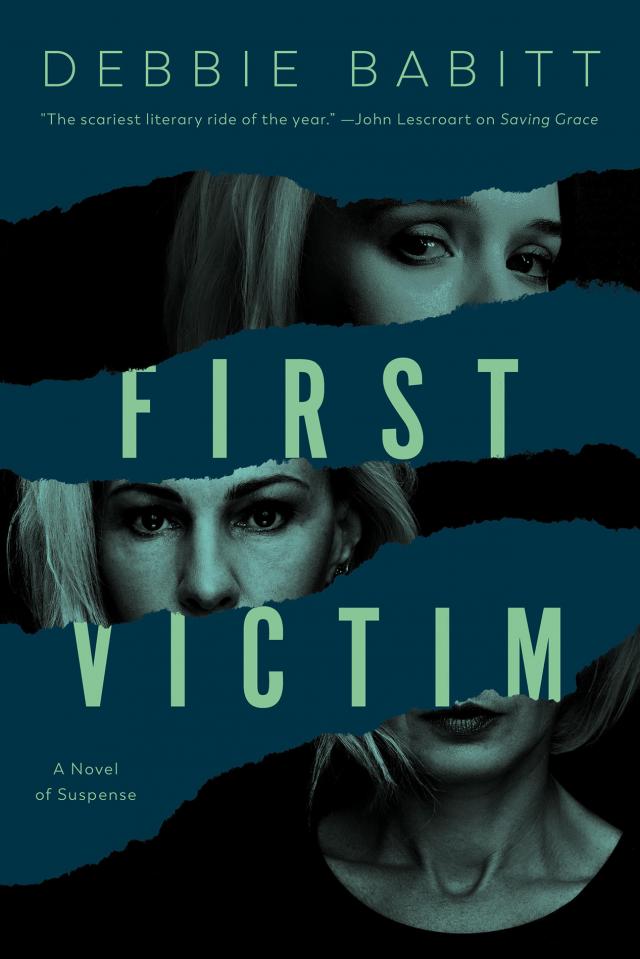
FIRST
VICTIM
A Novel of Suspense
DEBBIE BABITT
SCARLET
NEW YORK
To Ted
Vengeance is in my heart, death in my hand.
Blood and revenge are hammering in my head.
—William Shakespeare, Titus Andronicus
Do you believe everything happens for a reason? That our lives are predetermined before we’re born?
Or do you believe in karmic destiny? That we’re the masters of our fate and our actions have consequences none of us can escape?
What goes around comes around?
This wasn’t part of some preordained plan. Nor was it an accident of fate. No great cosmic mistake or tragic misalignment of the stars. Only a savage vendetta of violence that was the result of human thought and cunning.
Violence that shatters lives and drives good people to commit bad acts.
To do evil in return.
Is that justice? Or revenge? The instinct that reduces us to our most primal impulses. Exposing us for the bloodthirsty beasts we are. Isn’t the evolution of our brains what separates us from the animal kingdom?
Our ability to think. To reason. To make choices.
There’s always a choice.
And a cost.
She hears it now.
Under the sound of the water.
It reverberates in her head, drowning out everything else.
A plaintive wail that rips at her heart.
There is another primal impulse.
A mother’s need to protect her child.
She looks down.
She doesn’t have much time.
There won’t be a second chance.
She thinks about karmic destiny.
What goes around . . .
Slowly, she lowers the gun until it’s level with his heart.
PART I
CRIME
ONE
“All rise. Part Seventy-One to come to order. Please put away all reading material and turn off your cell phones. Case on trial. The People versus William Henry Young. Indictment number 02954-19. The Honorable Alice D. McKerrity presiding.”
Alice waves everyone back into their seats as she takes the bench. She detests pomp and circumstance. Bad enough judges still have to wear robes, a throwback to some archaic custom. But she has another reason to dispense with formalities.
Time.
The original judge on the case was hit by a car and is in critical condition. As one of the few trial judges working in August, a notoriously dead month, she agreed to help out. On one condition. That the trial be moved to her courtroom, which at the moment is erupting as prosecutor and defense attorney simultaneously leap to their feet.
“Your Honor, I have a matter before the—”
“Due to an unforeseen circumstance, the People request—”
Alice holds up a hand. “One at a time.” Her tone is sharper than she intended. But lately, she’s been finding it increasingly difficult to hold on to her patience. She takes a breath, turns to the defense attorney, a man she hasn’t seen in her courtroom before.
“Mitchell Laszlow. Legal Aid Society for the defendant. I am requesting an adjournment. I was only assigned this matter late yesterday afternoon and my client’s former attorney hasn’t sent me the case file.”
Which means he hasn’t seen Rosario material, the discovery documents all attorneys are entitled to before trial. “What happened to the defendant’s prior attorney?”
“He asked to be relieved.”
“Do you know why?”
“No, Your Honor.”
Maybe he couldn’t work out a deal for his client.
William Henry Young was charged with first-degree murder for killing a woman during the course of committing two other crimes: rape and torture.
What complicated the case was the fact that the victim was pregnant. Before New York enacted the Reproductive Health Act, the defendant could have been charged with double homicide. But the bill gives a woman the right to choose, which effectively removes abortion from the state’s penal code. The bill also means that unborn babies are no longer recognized as potential homicide victims.
With abortion a hot-button issue, the Manhattan DA tried to pacify prolifers by releasing a statement that the charge in this case was still murder one, and her office would be asking for the maximum—life without the possibility of parole. Which the jury will be likely to vote for after they find the defendant guilty. Then it will be up to Alice to either sentence the defendant to the maximum or find for mitigating factors and reduce the prison term. Not likely with a defendant who committed the ultimate offense against women, one that strikes at the very core of who they are.
God help him if there’s a female majority on the jury. Not that a God exists who would ever answer his prayer.
“. . . I’m only asking for a couple of days, Your Honor. To meet with my client and get up to speed on the case.”
“You and me both, Counselor.” Then Alice realizes what Laszlow just said. “Didn’t you see the defendant before court this morning?”
Attorneys typically meet with their clients in the interview room on the thirteenth floor of the courthouse after the defendants are brought in from Rikers Island. New York City’s maximum-security jail, Rikers sits on four-hundred-plus acres in the middle of the East River between the Bronx and Queens. But not for much longer. It’s projected to close over the next few years, to be replaced with smaller prisons scattered throughout the boroughs.
“I didn’t see my client today, Your Honor.”
“Why not?”
“He wasn’t there.” The prominent Adam’s apple in Laszlow’s neck bobs furiously as he talks. A strand of hair flops over his forehead despite his efforts to brush it away. He doesn’t look old enough to shave, let alone defend a brutal rapist-murderer.
“Tom.” Alice addresses the court clerk, who’s seated at his desk against the far wall. “Is the defendant on your list?”
Tom glances at his sheet. “Yes, Your Honor.”
Which means he should have been on the bus that transports prisoners from Rikers to 100 Centre Street.
“So where is he?”
“If you’ll allow me, Your Honor, I can explain.”
Alice looks over at the prosecution table. Katharine Forster is senior assistant to the bureau chief for the sex crimes unit. She’s a good lawyer who has appeared in Alice’s courtroom many times.
“That was the unforeseen circumstance I was trying to tell you about. The defendant is still at Rikers. He’s in solitary confinement. Early this morning he attacked another inmate with a plexiglass shank. Almost took out his eye.”
The gallery explodes. Alice shoots them a warning glance. Everyone knows that she runs a tight courtroom. She won’t abide lateness, laziness, or anyone trying to subvert the system or interfere with the process, whether it’s a defendant or a lawyer.
After the courtroom quiets down, she again addresses Forster. “You say the defendant’s in isolation? Not the prison hospital?”
“No, Your Honor.”
“Was he wounded in this attack?”
“Not as far as I know.”
Alice turns to Laszlow. “Did your client waive his right to appear at his own trial?”
“No, Your Honor.”
“Then I demand that the defendant be produced. Today.”
Now both prosecutor and defense attorney are looking at her as if she’d lost her mind. Forster finds her voice first. “But Your Honor, that will take hours.”
“I’m well aware of that fact.”
“But—” She’s scrambling, which is unusual. At trial, she’s never at a loss. “The man he attacked could lose his eyesight. What if the defendant tries something like that again?”
“Not in my courtroom.”
“Then I request for him to be cuffed and shackled.”
“Not in my courtroom,” Alice repeats. “You know as well as I do that seeing a defendant in chains is too prejudicial for the jury.” She turns to Tom. “We need Mr. Young sitting at the defense table this afternoon. Order a special bus if you have to.
“Your request is denied,” Alice tells Laszlow. “We’re adjourned until two-fifteen.”
She brings down the gavel.
TWO
Back in her chambers, Alice disrobes and checks her phone.
Less than forty minutes have passed since the last time she looked, right before court started. Since then, three new texts have come in, each one more frantic than the last.
She lets out a sigh and hits a number on speed dial. When Larry answers, Alice tells him that if Charles is refusing to bathe, he shouldn’t force the issue. She’ll give him his bath when she gets home. A bath in the morning isn’t essential, although Charles frequently sweats through his pajamas overnight, especially when he’s in the throes of nightmares that Alice can’t even begin to imagine. But she can’t keep running home every time there’s a new fire to put out.
Twice in the past few weeks, she’s had to adjourn early. Once in the middle of a hearing about search warrants after Charles threw a tantrum and wouldn’t stop crying. The second time during a bail application in front of two extremely irate lawyers. Charles was refusing to eat, which was far more worrisome than his unwillingness to take a bath.
Something’s got to give. Things can’t go on this way.
“Judge?”
She looks up from her phone.
Her court attorney
Alice feels vaguely guilty, like a child who has been caught out. “What’s up?”
“I’m going out for coffee. Can I get you anything?”
Alice gives the question her usual measured thought, debating whether she should go home after all, which is bound to be stressful. Or she could take advantage of some much-needed downtime in the privacy of her chambers before the craziness begins.
“I’d love an iced cappuccino,” she hears herself say. “Thanks, Shavonne.”
“Sure.” The younger woman makes no move to leave, concern wrinkling her dark features. “Is everything okay?”
Did she really think that her court attorney wouldn’t notice? When the two of them aren’t in court, where Shavonne always sits to the right of the bench, she’s at her desk in her tiny anteroom in front of chambers, guarding Alice’s private sanctuary. She’d have to be deaf, dumb, and blind to not know that something’s going on. Which makes Alice question how many of her other colleagues are wondering the same thing.
Shavonne’s waiting for her answer.
No! Alice feels like shouting. Everything is not okay.
If what’s happening in her life is the new normal, she has no idea how she’s going to cope.
What she really wants is a cigarette.
She’s tempted to ask Shavonne, who’s a pack-a-day smoker with no intention of giving up the habit. Unlike Alice, who quit four years ago and is feeling the craving more and more lately and would like nothing better than to share a smoke and exchange confidences the way she used to do as a girl with her best friend.
But as much as she’d like to, this is one secret that she can never divulge. Sometimes it feels as if most of her life has been about keeping secrets. Even if in this instance she has a very good reason, it doesn’t make her feel less guilty.
“Everything’s fine,” she says now, the lie leaving a bitter taste in her mouth. She watches Shavonne turn and walk away, the look on her face letting Alice know that she doesn’t believe her for a second.
Shavonne has been with her almost three years, longer than any of Alice’s other court attorneys. But their days together are numbered. Sometime soon, a white-shoe firm is going to snap her up, the lure of a fatter paycheck a temptation most young lawyers can’t resist or afford to pass up.
Alice will be sorry to see her go, something she’ll have to chalk up as yet another loss in her life. Soon she’s going to have to accept the fact that someone else she loves is in the process of leaving her too.
She questions now whether taking on a major trial was a wise decision. She, who makes decisions on the bench every day of the week. And the biggest one is hanging over her like a Damoclean sword.
She’d hoped that the trial would be a distraction from her increasingly chaotic personal life. An escape, if she were being brutally honest. But maybe she should be doing just the opposite—spending more time at home. Charles always seems better when she’s there.
Maybe after this trial is over. She has four weeks’ vacation owed to her that she hasn’t used. All she has to do is ask another judge to take over her calendar after Labor Day.
And beyond that? She doesn’t know. If things at home go from bad to worse, she could always arrange for an extended leave of absence. Short of stepping down from the bench altogether, which would mean forfeiting her pension that she isn’t eligible to collect until she turns seventy.
More decisions.
Alice feels another powerful craving for a cigarette.
She’s still fighting the urge three hours later when she gets the call.
The defendant is in the courthouse.
THREE
A hush falls over the courtroom as a door to the right of the bench opens.
The defendant stands there, flanked on either side by the two corrections officers who escorted him from the pens. From here Luiz Ramos, the court officer standing guard nearest the door, takes up the slack. Escorted by Luiz, who’s been with Alice for years, the defendant walks into the courtroom.
Hobbles in would be more accurate, constrained as he is by the cuffs and shackles binding his wrists and ankles. The chains seem incongruous against the off-the-rack blue suit that looks a size too small for him. Even from the bench, Alice can see that he’s built, his linebacker shoulders straining through the material of his suit jacket.
With a salt-and-pepper mustache and a beard that matches his thick head of wavy gray hair that’s partially held back in a ponytail, he looks like an aging biker. That’s a surprise. It’s rare that an older defendant passes through her courtroom. Criminals who stand trial are usually in their teens or early twenties, a time in their lives when they possess the least amount of impulse control.
William Henry Young appears to be completely in control. Alice isn’t the only one who can feel all that coiled energy beneath his submissive posture. Katharine Forster looks nervous as he’s liberated from his chains, despite the six officers—four males and two females—strategically positioned throughout the courtroom, the maximum number due to the violent nature of the crime. All armed and ready to act should the defendant attempt a repeat of what he did at Rikers.
As if sensing the judge’s eyes on him, Young raises his head. The smile transforms his face, making him appear almost human.
They rarely look like the monsters they are.
He’s looking at the floor again as the last of the shackles are removed, making Alice wonder if she imagined the smile. Or maybe he’s just trying to score points with her. Not that he’ll get away with anything in her courtroom, not with two of the six court officers seated a few feet behind the defense table.
The male officer has been in Alice’s courtroom once or twice before. She doesn’t recognize the woman seated next to him, but officers typically rotate between courtrooms. The female officer is almost as tall as her male counterpart, with a gaze that’s watchful and alert. If the need arises, she looks more than capable of restraining the defendant.
After Young takes his seat at the table, Luiz resumes his position by the door.
The corrections officers will return when it’s time for the defendant to be taken back to the pens. From there, another set of officers will escort him to the Manhattan Detention Complex, aka the Tombs.
An underground jail excavated during the era of the infamous Five Points, the Tombs’ official address is 125 White Street. Mazes of tunnels run beneath the stairways, and a bridge on the twelfth floor connects the building to the North Tower of 100 Centre Street so defendants can be transported to the courthouse without ever seeing daylight.
No elevator stops there. For civilians, that is. Only officers with keys can access the elevators that run down to the Tombs.
It’s the temporary prison of choice for defendants deemed too violent to be taken back to Rikers every night. Less likelihood of escape. Or attacking a fellow inmate. No doubt this defendant will spend the rest of the trial there.
As the first group of prospective jurors file in, Alice glances at the defense table. Young is rubbing his wrists where the chains dug into his skin. He barely acknowledges his attorney. Mitchell Laszlow sits rigid next to his client, no doubt wishing he were anywhere but here.
You and me both.
Once the jurors are seated, Alice introduces herself and gives her speech welcoming them to her courtroom. Then she tells them how jury selection, also known as voir dire, is part of our system of law. She motions to Tom, who has risen and has his hand on a large drum in the center of his desk. Inside the drum is a wheel containing the names of all potential jurors. Tom spins the wheel. When it stops, he calls out the names and directs each juror to a specific seat in the jury box. Once they have their first panel of sixteen—twelve jurors and four alternates—Alice introduces the lawyers. She nods to the prosecutor, who’s always first up. Katharine Forster picks up her legal pad as she gets to her feet.
They’re off and running.
Juror #3—a retired Navy SEAL—just raised his hand. When Forster acknowledges him, he asks, “Isn’t a fetus a life as well?”
Forster responds by instructing Juror #3 and the other members of the jury pool on the Reproductive Health Act that repealed the state fetal homicide law and doesn’t recognize unborn babies as potential murder victims. Killing a fetus isn’t a charge in the indictment against the defendant.


