

The confederate 4, p.1
The Confederate 4, page 1


The Home of Great Western Fiction!
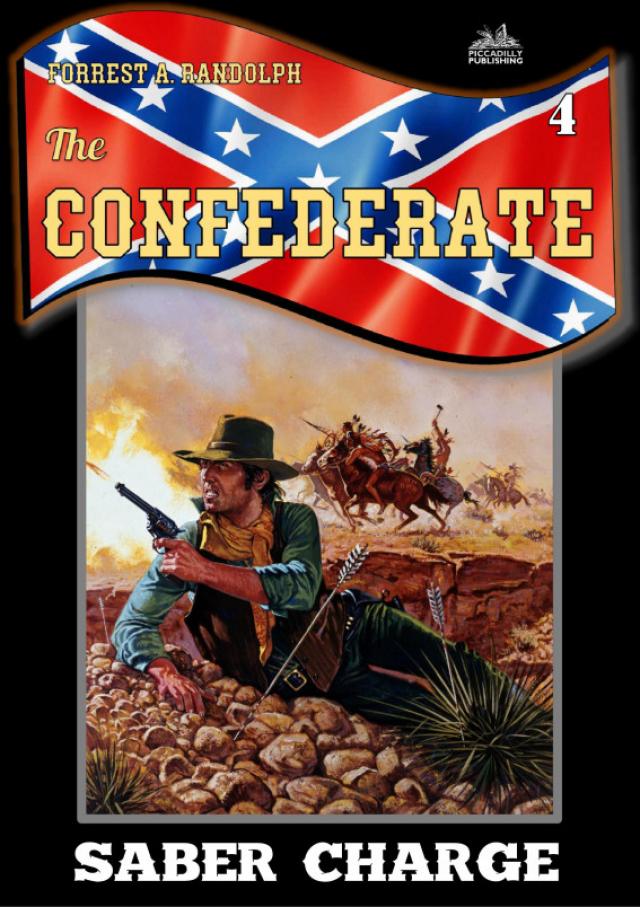
The Confederate … he wears the tattered gray that marks him as a rebel. But after General Lee’s surrender, Griff Stark is at war with a more powerful enemy than the Union … he’s fighting time!
It’s been more than two years since Stark’s only son, Jeremy, was spirited out west and taken captive by savage Indians. Griff must now follow a cold trail down into Mexico in the desperate hope of finding his boy before it’s too late.
But as weeks relentlessly pass, Stark becomes trapped in a war to the death with a renegade Mexican General. Once again, an old enemy looms out of the past: ex-Confederate Chester Braithwaite. And he is still working for the Federate Rail Consortium, still hell bent on killing Stark. Before he can save his son Griff Stark must save himself. With saber drawn and pistol held high, he rides to his fate. And live or die, when the guns fall silent and the smoke clears, those who survive will forever remember …
THE CONFEDERATE
THE CONFEDERATE 4: SABER CHARGE
By Forrest A. Randolph
First published by Zebra Books in 1985
Copyright © 1985, 2021 by Forrest A. Randolph
First Electronic Edition: September 2021
Names, characters and incidents in this book are fictional, and any resemblance to actual events, locales, organizations, or persons living or dead is purely coincidental.
You may not copy, store, distribute, transmit, reproduce or otherwise make available this publication (or any part of it) in any form, or by means (electronic, digital, optical, photocopying, recording or otherwise), without the prior written permission of the publisher. Any person who does any unauthorized act in relation to this publication may be liable to criminal prosecution and civil claims for damages.
Text © Piccadilly Publishing
Published by Arrangement with the Author.
Visit www.piccadillypublishing.org to read more about our books
CONTENTS
A Note from the Author
Dedication
The Bonnie Blue Flag (Lyrics)
A Tribute to the Author
Prologue
Chapter One
Chapter Two
Chapter Three
Chapter Four
Chapter Five
Chapter Six
Chapter Seven
Chapter Eight
Chapter Nine
Chapter Ten
Chapter Eleven
Chapter Twelve
Chapter Thirteen
Chapter Fourteen
Chapter Fifteen
Chapter Sixteen
Chapter Seventeen
Chapter Eighteen
Chapter Nineteen
Chapter Twenty
Chapter Twenty-One
Chapter Twenty-Two
Chapter Twenty-Three
Chapter Twenty-Four
Chapter Twenty-Five
Chapter Twenty-Six
A Note from the Author
The author wishes to express special gratitude to
Mark K. Roberts
for the valuable assistance he rendered
in the development and production of this book.
Forrest A. Randolph
This volume is dedicated with deep affection to
Patrick E. Andrews,
a longtime friend and fellow unreconstructed Rebel.
THE BONNIE BLUE FLAG (Lyrics)
And here’s to our Confederacy,
Strong we are and brave.
Like patriots of old we’ll fight,
Our heritage to save.
And rather than submit to chains,
To fight, we do prefer.
Hoorah for the Bonnie Blue Flag,
That bears that single star!
Prologue
WARM MAY SUN brought a sweet perfume to the high plains. Wispy tendrils of vapor rose from the damp ground. The previous night’s rain insured a humid day ahead. As he rode alongside Temple Ames, it made Griffin Stark think of a similar morning in late April, in the year 1863, along the Rappahannock River in far off Virginia. In a place called Fredericksburg …
… “That damned Yankee artillery is sure a caution, ain’t it, Major?” Sergeant Dunwittie remarked to Griffin Stark as they sat astride their matched grays on Marye’s Heights, overlooking the ravaged town of Fredericksburg and the fields so hotly contested four months ago.
The Union forces had not pressed the attack since, yet they had not withdrawn. His confidence destroyed in General Burnside, President Lincoln had replaced him with General Joseph Hooker. “Fighting Joe” Hooker had earned his name. He had a reputation as a skillful, hard-battling corps commander. He was also known as an ambitious officer and man, a troublemaker among the ranks of more conventional officers. After the long list of defeats by McClellan and Burnside, Mr. Lincoln felt more than willing to risk Hooker’s shortcomings if Fighting Joe would, as Lincoln put it, “Go forward and give us victories.”
Like McClellan before him, Hooker – who’s reputation with the ladies would soon give the nation a new appellation for the ladies of the night – began his command of the Army of the Potomac by demanding a buildup of troops and supplies. He earned the enmity of the officers by relieving all those who had served under Burnside.
A shrewd man, Hooker knew that the men saw their officers as figureheads. They stood for what the units did, or failed to do. In the minds of the simple men who filled the ranks, if the company, regiment, division, or corps got whipped, it was the fault of the officers. Hence, a general housecleaning was in order. And he established another thing. The constant bombardment of Confederate positions on the far banks of the Rappahannock.
Not that the Yankees had been all that accurate. There had been some casualties, a few deaths. More had come from the weather: pneumonia and frostbite. Griff removed his stiff gray campaign hat and wiped at his brow.
“Sergeant,” he declared. “They are more than a ‘caution,’ they’re an outright aggravation. We’d best get moving. We have to swing wide of town and cross the river in that screen of trees to the west of here.”
“Yes, sir.”
Twenty minutes later, Griff and Dunwittie, along with Private Daniel Harne, had crossed the Rappahannock and moved, unseen, behind Union lines.
“Notice those pole sheds,” Griff remarked to his small patrol. He had taken the routine detail in the place of Lieutenant Monroe, not because it had been required, but for the exercise and to alleviate boredom. Perhaps being shot at by the Yankees would eliminate the state of ennui he had settled into since the frantic days at Fredericksburg in December of the previous year.
“Prob’ly stacked high with powder and shot,” Dunwittie surmised.
“Yes. And only a few sentries,” Griff observed, a plan forming in his fertile brain. “Keep those in mind for our return, sergeant. We, ah, might stir up a little excitement for the Yankees.”
Dunwittie beamed. “Yes, sir!” he enthused.
“Uh, Major Stark, sir,” Harne drawled in a muted voice. “Over there, sir. I seen stuff like that up North oncst before.”
“What are they, Harne?”
“They’s big wicker baskets, sir.”
“I can see that. What are they used for?”
Harne, pleased to be a source of information for once, instead of a dumb private in the rear rank, chose to expound on his knowledge instead of give a direct answer. “See them piles of colored cloth under the tarps? They’s rubberized silk bags. Balloons is what they is. Hot air balloons. Those baskets git hooked up under them when they are full of hot air from a fire. Men can ride in ’em.”
“What would they be doing here? That sounds like some sort of circus stunt to me,” Griff returned.
“Don’t rightly know, sir. But the way it’s all done up, I’d say they was fixin’ to move ’em somewhere, an’ soon.”
“How’s that?”
“I was at this big exposition in Philadelphia. To use them balloons, the fellers had to stretch them out on the ground. These are all wrapped up tight-like. Same with the baskets. Looks like somethin’ that’s just come in and ain’t been put where it’s gonna be used.”
“Good thinking, Harne,” Griff praised him. “What use would they be out here?” Stark had asked the question to encourage logical thinking on the part of his men. He thought he knew the answer, but he wanted to see if they could come up with it, too.
“A feller can see fer a long ways from up there,” Harne went on.
“Humm. What good would that do if he couldn’t tell anyone on the ground about it?”
“He could drop notes,” Harne suggested.
“If he had, uh, one of those, ah, wigwag fellers along,” Dunwittie interposed, “he could send code by flags. Like they do in the navy.”
“That’s an idea, Sergeant. You didn’t by any chance happen to notice those jack-tars swaggering around over there, did you?”
“The ones with the striped shirts and floppy trousers?”
“The very men I mean, Sergeant.”
“I saw them, too, Major,” Harne remarked. “They was wearin’ those sissy-lookin’ hats with the big blue pompons on top.”
“They’re called ‘signalmen,’ I believe,” Griff told his men. “So, we have balloons and signalmen on hand. I’d say ol’ Fighting Joe was making ready to attack.”
“Here at Fredericksburg again?”
“Most likely somewhere else. Some place we’d least expect. Oh, he might well send a diversionary fo rce across to engage our troops on Marye’s Heights and in the streets of town, but I’m willing to bet Hooker goes for some other objective,”
“Like what, sir?”
Griff thought a moment. “Like the railroad tracks that helped Lee defeat Burnside and let Jackson keep the valley safe for a year and a half. With the bridges destroyed, rails torn up and locomotives blown apart, it would mean an end to rapid transportation for our troops.”
“There’s a rail yard and roundhouse at Chancellorsville,” Dunwittie offered.
“Hummm,” Griff mused. “A tempting target, if I’m right. But too easily defended and far behind our present lines. I think we had better get this all to Bobby Lee. We’ll head back, now, Sergeant.”
“Yes, sir. Ah, sir, what about those powder stores?”
“Flip a coin, Sergeant. Which might be more useful, blow up that powder or destroy these balloons before they can be moved?”
“Why, the balloons, of course.”
“Right. And that requires a night approach and a lot of stealth. If we set off that powder, the Yankees will be alerted. Let’s let it go for now. The volunteers who come over here to wreck the balloons can get it on the way out.”
General Hooker looked with satisfaction on the officers around the map table in his commodious Sibley tent. He stroked his small beard and nodded in approval when the commander of the First Corps tapped a silver table knife on a little used ford of the Rappahannock.
“Precisely where we will cross. Our scouts report little enemy activity in that area. The Rebels think they own the south bank of the Rappahannock. It is our job to show them otherwise,” Hooker declared pompously.
“How will we be able to affect absolute control, as the plan calls for, General? I mean, now that the balloons have been destroyed—”
Hooker glowered at his adjutant. “A minor matter, sir. Today is the twenty-ninth of April. Tomorrow our men will begin to march westward and affect crossings of the Rappahannock. By May first, we will be in the streets of Chancellorsville. My plans are perfect. May God have mercy on General Lee, for I will have none.”
“Take your squadron west along the bank of the Rappahannock, Major,” Jeb Stuart told Griff the next morning. “Patrol as far as the mouth of the Rapidan. The Yankees have something brewing for certain and General Lee wants to know what it is. If you find no evidence of enemy activity, press on along the Rapidan to the bridge over the Chancellorsville Road.”
The Rappahannock meanders leisurely southwestward from Fredericksburg. Major Griffin Stark took his command along its southern shore for a good six miles without spotting anything. Ahead by a couple of miles, the smaller Rapidan joined its mightier brother. The patrol, Griff thought, would be over before midmorning.
Another mile further on, he learned how mistaken he was.
“Yankees movin’ along the opposite bank, Major,” sharp-eyed Sergeant Dunwittie informed him in a whisper.
“I, ah, I see them now, Sergeant. How many do you make it to be?”
“A regiment — maybe more. There’s a clearing on that side, about a quarter mile up. We can get a better idea there.”
Dunwittie’s regiment turned out to be an entire division on the move. Behind it, came another and another. Seventy-five thousand Union soldiers, Griff later found out, had started out early that morning to reach fording places across both rivers. He sent a messenger back to Lee’s headquarters and decided to press on.
Riding swiftly, the Confederate cavalry soon outdistanced the foot-slogging infantry division. Beyond the mouth of the Rapidan, Griff found more evidence of Union activity. Another division stood fast, its artillery train bogged down in a small stretch of marshy ground, where the Rappahannock made a big bend. Griff had crossed over and now rested his men and horses on Yankee territory. He moved forward with six troopers to attempt to overhear conversations among the enemy soldiers.
“How the hell’s ol’ ‘Fuckin’ Joe’ expect us to get clear an’ hell up to that bridge over the river with this kind of ground to cover?” a sweating artillery captain demanded of his subordinate.
“I wouldn’t know, sir. But to do it by tomorrow is going to bust our guts.”
“You can say that again.” The captain paused and unbent from his hunched posture. He glanced at the land around him and then froze, eyes directed to a thin screen of brush and willow trees.
“I’ll be damned. There’s gray uniforms in those trees, Lieutenant Ashe.” He quickly drew his revolver and fired a .44 ball into the thicket.
Across the short distance, a man grunted at the impact of hot lead on his shoulder and there came a Rebel yell.
“Christ!” Lieutenant Ashe exclaimed. “It’s Jeb Stuart and his gray ghosts.” He, too, drew his sidearm.
From behind the stand of trees, a bugle sounded and more Rebel yells filled the morning air. Thunderous hoofbeats rolled across the marshland and a swarm of Confederate cavalry swirled in among the mired cannon.
Artillerymen fell to the heavy balls of the Starr revolvers and deadly accurate fire of Pearson carbines. A horse screamed in agony and went down in its traces. Captain Turner and Lieutenant Ashe ran in among the thick of the fighting, attempting to rally their men.
“This way!” Lieutenant Simpson shouted to his troops. “Swing right. Head them off.”
“Get between the artillery and that division up ahead,” Griff ordered the company that rode with his squadron staff. “We’ll have to hit and run.”
Griff plowed into the middle of a wall of blue uniforms. A Springfield barked sharply at his side and he felt the sting of powder grains on his cheek. The ball clipped a crescent bit out of the brim of his hat. He turned that way and triggered off his Starr.
A Union soldier’s face mushroomed red and he fell back on the trunnions of a twelve pound Napoleon. Ahead Griff saw the silver bars of a Union captain and forced his powerful horse in that direction. As he did so, he turned in the saddle and shouted to Sergeant Dunwittie.
“Ten men to spike cannons, the rest ride down these gunners.”
“Yes, sir.”
A rifle ball moaned past Griff’s ear and reflexively he ducked to the right. It saved his life as a .44 ball from Captain Turner’s Remington 1860 Army split air where Griff’s chin had been and smacked into the shoulder meat of a gray Confederate mount to the major’s rear. Griff whipped his revolver to the left and slipped back the hammer.
When it fell, a round ball sped to the hollow in Turner’s neck and popped a wet black hole there. Blood welled up and began to run as the Union officer’s head snapped back, and he spilled onto the ground beside the corpses of many of his men.
“Pull back,” a forward scout shouted as he rode pell-mell into the melee from his position ahead of the column of artillery. “Yankee infantry comin’ on the double.”
A metallic ring filled the air as Confederate cavalrymen drove brass spikes into the touch holes of Yankee cannon and broke them off with heavy mallets. They rammed the thick bases down the bores and seated them with a mighty swing.
Resistance had dwindled to a dozen artillerymen.
“Finish those cannon and let’s get out of here. General Lee will want to know,” Griff commanded.
A fast hour’s ride brought them to the stately white farmhouse where Lee made his headquarters behind the defensive line at Fredericksburg. Strangely, the news Griff brought seemed to cheer the soft-voiced warrior.
“So Joe Hooker has decided to get off his duff,” Robert E. Lee mused as he considered the map and the implications of Griff’s scouting report, along with others. “About time. He’s making for Chancellorsville. No doubt about that, gentlemen. Jubal,” he turned to General Jubal Early. “I’m going to leave you here with fifteen thousand men. Hold Fredericksburg. Hold it at all costs.
“Hooker is trying to turn my left flank. I intend to prevent that. I will take the remainder of the army and march at once for Chancellorsville. I cannot afford to have the right flank crumble behind me. Old friend, we’ve come a long way together. With God’s grace, perhaps we will see this dreadful conflict ended this day.” Lee blinked back the moisture in his eyes and addressed himself to Jeb Stuart.


