

A tyranny of queens, p.1
A Tyranny of Queens, page 1
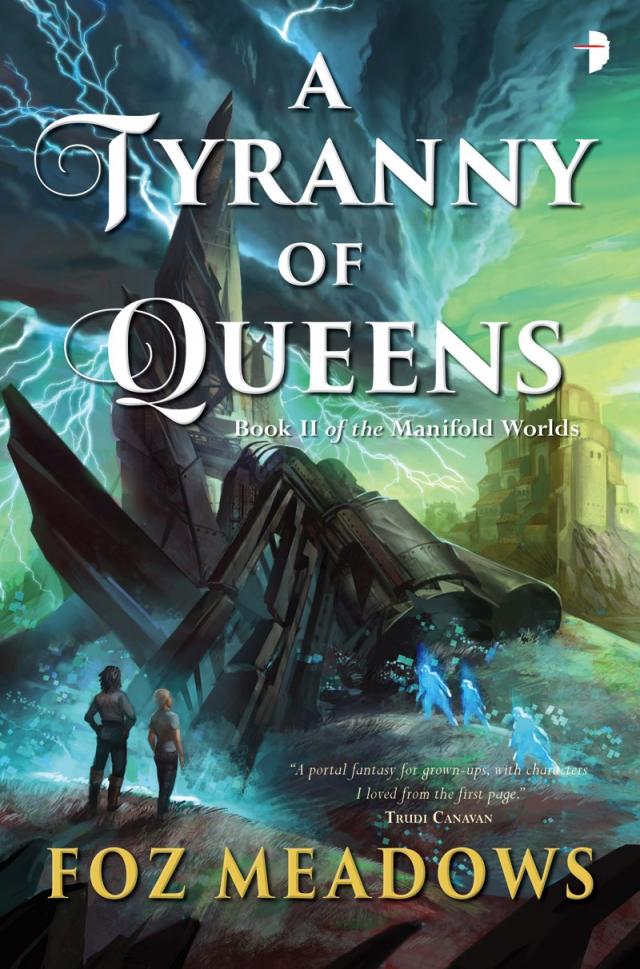


A Tyranny of Queens
Book II of the Manifold Worlds
Foz Meadows
Contents
Uncrossing the Rubicon
Chapter 1
Chapter 2
Chapter 3
Chapter 4
Chapter 5
Chapter 6
Chapter 7
Chapter 8
Whose Margin Fades
Chapter 9
Chapter 10
Chapter 11
Chapter 12
New Song’s Measure
Chapter 13
Chapter 14
Chapter 15
Chapter 16
Chapter 17
Chapter 18
On & On
Chapter 19
Chapter 20
Glossary
Acknowledgments
About the Author
For everyone who’s ever been
too brave to die, too scared to live;
for anyone
who tried on a death that didn’t fit:
you are not broken.
I love you.
Stay.
“… the older I get, the more I see how women are described as having gone mad, when what they’ve actually become is knowledgeable and powerful and fucking furious.”
Sophie Heawood
Part 1
Uncrossing the Rubicon
1
Boundaries
“It’s all right,” said Ruby, squeezing Saffron’s hand. They stood at the threshold of Lawson High, the gates hanging open like jaws. “I’ll protect you from asshats.”
“I’m not sure you’re meant to know that word,” said Saffron. It was an old joke, as comforting to her as it was annoying to her sister, but it came out more faint than teasing. “Why do you know that word, huh?”
“I’m fourteen, Saff,” said Ruby, bravely ignoring the slip. “I go to school. I have the internets.” She squeezed her hand again, harder than before. “And you.”
“Yeah,” said Saffron, a lump in her throat. “You do.” But for how long? That was the question.
As though she could hear the unspoken rider, Ruby sighed, releasing Saffron’s hand. It was her right, five-fingered and untattooed. Your good hand, their mother had called it over dinner, natural as breathing – pass the salt please, Saff – no, there, by your good hand – and even though Saffron sometimes thought of it that way too, she’d burned to hear it so presumptively labelled by someone else. Her left hand twitched, three fleshy fingers and two phantom ones, but did not form a fist.
“Seriously,” Ruby said, “I mean it. If anyone gives you shit–”
“You’ll defend my honour?”
Ruby squared her slender shoulders. “Yes.”
The posture was so reminiscent of Zech, her strength and pride as she’d stood before the Council of Queens, that Saffron almost stopped breathing. Zech had often reminded her a little of Ruby; the reverse, it seemed, was also true, and doubly painful for it. She gulped and nodded, unable to make a verbal response. Zech was only six days dead, but Saffron couldn’t mourn her, because nobody here even knew she’d ever existed. As far as everyone on Earth was concerned, Saffron had spent the past few weeks in captivity, hurt and manipulated by an unknown assailant who’d eventually let her go. It was a lie, of course, and one whose vileness roiled her guts, but how else to explain the time she’d lost to another world, the injuries she’d sustained?
The last time she’d walked into Lawson High her blond hair had been shoulder-length, her skin unmarked by anything more than freckles and childhood scars. Now, in addition to her two missing fingers and new tattoo – a pair of intertwined snakes biting each other’s tails, encircling her left wrist in vivid red-gold-black – she was missing a chunk of cartilage from her right ear. A trio of scars raked the right side of her face from just above her eye to the back of her skull, their raised lines clearly visible through the half-inch stubble of her hair. A similar triple-slash ran diagonally across her ribs on her left side, with assorted other, smaller scars on her outer thighs, arms, hips. Standing before her bedroom mirror, Saffron had touched each one in turn, an ache in her chest half loss, half dislocated pride.
Dragonmarks. Not that she could ever admit the provenance – even in Veksh and Kena, the Trial of Queens was shrouded in a secrecy she’d sworn to uphold – but she still knew the truth. I fought with dragons and bled in the dark. I’m not afraid of school.
“Come on, then,” she said to Ruby. “Let’s get this over with.”
Together they crossed into Lawson High. It was utterly anticlimactic, but Saffron’s pulse ticked up anyway. Everyone – her parents; her newly-appointed social worker, Ms Mays; even the headmaster, Mr Barton – everyone had said she could take more time before going back, had urged to the point of pleading with her to do so. You’ve only been home for six days, Saff! We just want what’s best for you. But after weeks of autonomy in Kena, being treated as though she was made of glass was maddening, not least because her every attempt at self-assertion was either met with paternalistic worry (You don’t have to try and be strong for us!) or was taken as proof of emotional instability. As though wanting fifteen consecutive minutes of privacy was somehow unreasonable!
As they passed the teachers’ car park, Saffron kicked angrily at a discarded Coke can, watching as it clattered away towards the admin building. God, I miss Gwen. I really miss Yena.
I miss Zech.
“You sure you don’t want me to wait with you?” asked Ruby, as they reached the metal bench outside the music rooms where Saffron habitually sat of a morning. “You know, just until your friends show up?”
“I’ll be fine,” said Saffron. She made herself smile as she sat down. “Promise.”
Ruby bit her lip. She was half a head shorter than Saffron, her proportions almost puppyish as her body raced to grow into itself. Her brown hair was tied back in a sloppy braid, escaping wisps framing her not-yet-fully-emergent cheekbones. Her eyes were greenish grey, but though they flashed with worry, in the end she nodded and said, “OK. I trust you.” A ghost smile flickered on her face. “Sometimes, anyway.”
I trust you. Three small words that meant the world, but which no adult had said to her since she’d come back. Saffron could have cried.
“Thanks, Ru,” she managed, voice inexplicably hoarse. “I’ll see you later, OK?”
“Sure,” said Ruby. She hesitated a moment longer, as though arguing with herself, then shouldered her bag and headed off to meet her own friends, braid swishing as she vanished around the edge of the building.
Saffron inhaled deeply, pulling her own bag onto her lap. It was, of necessity, new, her old one having been lost in Kena, and after a hurried weekend trip to the shops it was full of equally new possessions. Only her phone was unaltered – she’d left it charging by her bed the morning she’d first left Earth. When she hadn’t come home that afternoon, she’d since been told, her parents had tried to call her, only to hear the answering ring from her bedroom. Later, when her friends had started texting, worried and urgent at her absence, they’d turned it off rather than listen to the constant chiming.
Saffron was yet to turn it on again.
Distractedly she fiddled with the hem of her skirt, trying and failing to quell her nervousness. Like the phone, her uniform was purchased pre-Kena – as though her life was now divided into two different eras, PK and AK, like an archaeological record – but after three weeks of continuous exercise, fatigue, injury, magical healing and simple (if often delicious) food, it no longer fit her properly. She’d been slim before, but now she was wiry-hard, her body so stripped of its meagre softness that her hipbones jutted like knifehilts. She’d had to pin the skirt’s waistband so it didn’t fall down, while the blouse was a half-size too big. Her shoes, though, were AK, shiny and new and still being broken in, her heels protected from blistering by a pair of Band-Aids. This last detail made her want to laugh out loud. Band-Aids! For her heels! After weeks spent barefoot in the wilderness! It just felt so… incongruous.
“Holy shit. Saff?”
She jerked her head up, mouth gone dry.
It was Lyssi.
Her friend looked stricken, an unfamiliar expression on a familiar face, and for the second time in as many minutes Saffron could have cried. All the time she’d been in Kena, she’d barely thought of the people she’d left behind. At first, it had taken conscious effort, an active repression of loss and consequences, but at some point – she wasn’t sure when; after the flight from the compound, maybe, or in the aftermath of the battle of the Envas road – the process had become automatic. Compartmentalising, that was the word: she’d put her Earthly life in a box and shut it tightly, focusing instead on that literal new reality, and even now that she’d come home she hadn’t quite lifted the lid. Avoiding texts and social media both, she’d let her friends find out through the parental grapevine that she was back and, for a given value of the word, unscathed, and told herself it was pragmatism, not cowardice, to duck the responsibility of a more personal reassurance.
But now Lyssi was here, with her straight black hair and sparkly nail polish; Lyssi, who loved rabbits, hated seafood and was not-so-secretly addicted to Korean TV dramas; Lyssi, who’d been her best friend since their first day at Lawson High.
“Hi, Lyssi,” Saffron whispered, and almost fell off the bench when her friend lunged forwards, wrapping her up in a hug. She stiffened at the contact, throat tight with a mix of panic and guilt and ov
“You’re a… here!” gulped Lyssi, pulling back for long enough to claim the seat beside Saffron. Her light brown eyes were wide and worried, raking over the vivid lines of Saffron’s scars. “Oh, oh Jesus, Saff–”
“Don’t touch!” Saffron said quickly, grabbing Lyssi’s outstretched hand. And then, more calmly, “Please.”
Lyssi flushed, startled, but nodded compliance, and when Saffron released her she balled both hands tightly in her lap, as if warding against temptation.
“I’m sorry! I just, it’s so… Jesus, I don’t even know what to say, I thought you were just dead or lost and now you’re here, you’re… you’re–”
“I’m me,” said Saffron, who hadn’t quite realised until that moment how badly she wanted someone else to affirm it. “I’m still me, Lyssi.”
“Yeah, but–” Lyssi was tearing up, “–are you OK?”
And there it was: the question to which there was no simple answer, honesty being far too complex a prospect. What could she say, really? She had a sudden, manic urge to blurt out the impossible truth:
Well, Lyssi, I wasn’t raped, if that’s what you’re asking – and I’m sure you are, everyone seems pretty obsessed with the possibility – but I wasn’t exactly tortured, either. See, I actually followed a stranger through a magic portal and trapped myself in another world, in a country called Kena, where a nearly-queen cut off two of my fingers. I was rescued by a girl who turned out to be her daughter, only none of us knew that at the time, and after the ruling monarch set fire to our compound for harbouring his runaway consort, I ended up killing a woman (and a horse, too!) in an ambush on the road. I learned about how dream-magic links the worlds – which is how I’m meant to be checking in with my Kenan friends, by the way, only I’m terrible at remembering it all when I wake up, which is terrifying if I let myself think about it – and then we went to the neighbouring country, Veksh, to seek their aid.
And the girl who rescued me, Zech? She asked me to stand proxy for her in the Trial of Queens, so that we could speak to their Council, and I did. I ran a maze in darkness under an ancient city, and I fought as a dragon, with a dragon, which is where all these other scars came from – some sort of magical transference, and I still don’t know if that’s more or less strange than the fact that dragons exist at all – and because we survived it, Zech was made a queen. And then we went back to Kena, and her mother killed her anyway, and I ran home before I even knew that everyone else was safe, because I was scared and lost and my friend was dead, so no, Lyssi, I’m not OK, but not for the reasons anyone thinks, and I didn’t think lying about it would be easy, but I didn’t know it would be this hard, either.
What she actually said, after all this had flashed through her head, was, “I’m… about as good as I could be, really. I’m coping.” And then, when Lyssi still looked distraught, “I’m OK, Lyss. Really.”
Lyssi stared at her, not quite crying, a look of incipient protest on her face. Rather than let it come to fruition, Saffron leaned in and hugged her again, which was apparently the right decision: Lyssi made a heartfelt noise and gripped her back, the two of them swaying together.
I’m lying, Saffron thought wildly. I’m lying my ass off to everyone.
“I’m glad you’re back,” Lyssi whispered.
Saffron shut her eyes, the guilt like bile in her throat.
I’m not.
* * *
Yena knelt in supplication, watching her shorn curls fall to the floor. It was the sixth day of her mourning for Zech, and she could wallow no longer. Her family and friends in Kena were scrambling to secure their position, Kadeja still awaited trial, Safi was missing, and meanwhile the game of Vekshi politics continued unabated – a game from which Yena, by dint of her exegetical leanings and lack of legal status, was currently excluded. Yasha was no help on either front: with the Council yet to formally lift her exile and unlikely to do so until after Kadeja was dealt with, the matriarch was trapped in a cycle of rage and frustration, with Yena the only safe outlet for either emotion. Yena had little enough love for Yasha’s vehemence at the best of times, which this wasn’t, and she certainly had no sympathy for her pride. In Kena, in their now-burned compound, Yasha had been all-powerful, her word akin to Vekshi law, but in Yevekshasa her status was as nothing. For all her talk of politics and patience, Yasha lacked the humility to accept her demotion, even temporarily, preferring instead to exert control over her one remaining disciple.
But Yena had never been as loyal to Yasha as Yasha seemed to think; had only pretended, as Sashi had pretended, for the sake of peace in the family. But things had changed, and with Yasha refusing to bow her head and adapt it fell to Yena to make her own choices, not least because Yasha was maddeningly unconcerned with events in Kena. When Kikra, the Shavaktiin dreamseer, had told them about Leoden’s flight, the anchored portal under the palace and – most disturbingly of all – the captive worldwalkers, Yasha had declared them irrelevant. Irrelevant, after years of Kenan scheming! Yena couldn’t tell if her grandmother’s sudden complacency was due to her change in circumstances, her reaction to Zech’s death or some other factor: all she knew was that she couldn’t share in it.
At present, they remained in Yevekshasa on sufferance, their movements curtailed, their legal rights negligible and their information limited. Something had to be done, and if Yasha wouldn’t swallow her pride and do it, then Yena would.
Behind her, Mesthani a Vekte worked steadily, carefully, pausing only to dip her blade in a bowl of fragrant water.
“You’ve a good-shaped head,” she murmured, swiping a gentle thumb across Yena’s skull. “Shaved will suit you.”
Suit my face, maybe. Yena bit back the acerbic qualification with some effort. Mesthani was a queen of Veksh; however uncertain Yena felt about her current transformation into a prodigal daughter, she couldn’t voice such thoughts aloud and still be taken seriously.
The larger curls formed a soft black pattern on the stone, like some arcane script; her neck and shoulders itched beneath a dusting of finer strands. She wore a borrowed nek, a shapeless, sleeveless, undyed shift worn by Vekshi women as their hair was cut. Its plainness was part penitence, part practicality, which Yena thought a fair summation of much of Vekshi culture.
This observation, too, she kept to herself.
Instead of voicing heresies, she said, “My thanks for your help. I wasn’t sure my message would reach you.”
Mesthani chuckled. “Truthfully, it shouldn’t have, but your Shavaktiin are surprisingly resourceful.” In a slower, more careful tone, she added, “Surprising, that you didn’t seek your grandmother’s aid in this.” And then, more carefully still, “Or perhaps it’s no surprise at all.”
“I honour Yasha a Yasara, of course, regardless of her status,” said Yena, with equal delicacy. “But honour, as the Ryvke says, is not the same as obedience.”
For the space of a heartbeat, Mesthani’s hands stilled. The Ryvke was not quite a sacred text, but near enough to one: the collected writings and wisdom of the most revered queens and priestesses of Veksh, with new material added but rarely, posthumously, and only ever after fierce debate among the Archivists, whose relationship to the priestesshood of Ashasa could best be described as complicated. Mesthani had plainly not expected Yena to quote from it, which was either advantageous or a slight on her perception of Yena’s competence. Yena, naturally, hoped for the former.
As though she hadn’t hesitated, Mesthani said, “Yasha a Yasara’s approach to the Ryvke, as I recall, was always somewhat selective, even when she sat the Council.”
Now it was Yena’s turn to freeze. Of course she had seen her grandmother’s scars, a series of raking gouges on belly and thigh, and asked about their origins in childhood. Of course she had heard it whispered among the other expatriates and exiles at the now-burned compound in Karavos that Yasha had once sat the Council of Queens, along with a dozen other equally fanciful rumours. But the truth had always been taboo; not even her mother had ever confirmed it out loud. To hear it admitted so plainly now was dizzying.


