

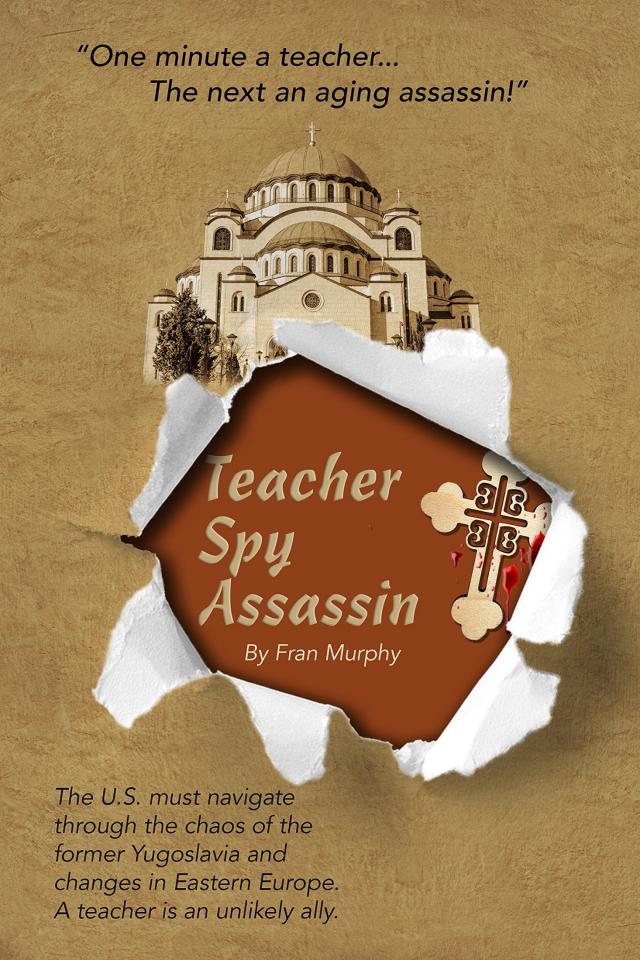
Teacher spy assassin, p.21
Teacher, Spy, Assassin, page 21


“Gotovo? What about Milica? What about your grandkids? You won’t get to see them grow up. They will never remember their grandfather,” I argued.
He put his hands up palms outstretched, gesturing for me to stop. His shoulders were hunched up. His face was telling me ‘what can you do.’
On the spot, I said, “If you don’t have that surgery, you’re fired.”
“But why?” he asked.
“Because I never employ stupid people and not having that surgery is dumb.”
I did not wait for a response. I walked away without looking back. I went immediately to my office and asked Petar to join me. I knew that Braco would go to Petar to ask what he should do. I also knew that what I had said would have been illegal back home. But what we had here was a 19th-century peasant living and working in the 20th century with a fatalism that would surely kill him. That, I could not abide.
“You did what?” Petar howled with laughter. “Of course, it was the right thing to do. Everyone has been telling him. Milica is heartsick. His children are bereft. I told him to get the surgery, too,” Petar added.
“I felt that if he is going to die one way or the other. Why not go down fighting?”
“I will help him understand,” Petar said.
“I hope the surgery is successful,”
“I will talk to some people at the medical school” Petar added, “to make sure he has the best surgeon in the best hospital.”
“Thanks,” I replied. He left my office chuckling.
Braco was in the outer office waiting to see Petar.
The school year ended. Linda and Liam enjoyed a week or ten days of rest from the busy school year. I continued in the office closing out the school year. And planning the next
Soon we were on a plane back to the US. We would spend most of this summer there. We would return for ten days in the camper, before returning to work, then opening the school.
We often went home for part of the summer to Rochester. I didn’t want Liam to grow up without knowing what it was like to be American. I wanted him to know his grandparents, his aunts and uncles, and his cousins. Our life, long-term, would be made in America, not overseas.
The summer had been a hug-fest for all of us. With two families to stay with, and grandparents, aunts and uncles, and lots of new Lego sets, Liam was in heaven. It felt good to be home. I was glad to have had 3 years in Europe, but I knew where home was.
On our first trip to Wegman’s, Rochester’s best-in-the-nation grocery chain, we were paralyzed. We could not wade through the bewildering choices. Whereas in Belgrade, you felt happy to have any toothpaste or coffee or butter, here you had to make selections. It overwhelmed us. We marveled at the out-of-season fruits and vegetables. It was exciting, but our first visit seemed more like a tourist stop to admire the abundance than functional shopping.
After that, we got used to it again and could function in a store.
That afternoon my mother called me to the phone.
“Don’t say anything right now,” The voice on the phone said. “It’s Jim from Belgrade. Now say ‘Hello Mr. Griffin.’”
“Hello, Mr. Griffin,” I said.
“Alexander, the administrator at “The Farm” wants to meet with you in DC. The appointment will probably take about three hours. Why don’t you decide to take the family to DC for 3 or 4 days? We will put you up at the Ritz Carlton for 3 nights. You will be able to take your meals there, on us, and Alexander will present some cash to you for your travel and a generous allowance for any other expenses you may incur, say $500.”
“Now say, ‘we might be able to do that, Mr. Griffin.’”
“We might be able to do that, Mr. Griffin,” I said aloud.
“If you want to meet with Alexander, call Linda into the room so we can select a date.”
“Linda,” I called loudly, “can you come here for a minute?”
Linda popped up from the recreation room.
“I have Mr. Griffin from the Riggs Bank in DC on the line. He wants to meet with me in person in DC with a small committee to see how they can get more business from overseas schools. He will give us a suite at the Ritz Carton for 4 days.”
“You did say a suite, not just a room didn’t you Mr. Griffin? And you did say 4 days, right?” I said into the phone.
“Look stop being an utter asshole. Yes, OK a suite and 4 days, but this negotiation is over,” Jim said over the phone.
“He says he will pay our meals at the Ritz, and even give us a thousand dollars to defray our mileage and any other expenses we may incur,” I said to Linda. “I think a trip to DC would be a great experience for Liam.”
“Cut the shit,” Jim said. “I said $500. OK, $1000, but stop it.”
“Do you want to go?” I asked.
“It sounds like fun,” she said.
“He wants to know when we could make it.”
“When is he free?” Linda asked.
“Mr. Griffin, when would you like to meet?” I asked the voice on the phone.
“What if you head down on Monday, and you meet Alexander Wednesday at 9:00 a.m. in Virginia,” Jim said on the phone to me.
“Linda, He wants us to drive down Monday. He will have tickets for a White House tour for Tuesday waiting for us at the Hotel, and I will meet Mr. Griffin on Wednesday at 9:00 a.m. We will head home Friday,” I said.
“Now I have to get you White House tour tickets for next week?” I heard Jim muttering on the phone. “Mike you are an asshole. I had better hear that your visit with Alexander was worthwhile.”
“That will work. Liam has a dentist appointment for a tooth cleaning on Wednesday,” Linda said.” But I can reschedule.”
“Thank you for your many kindnesses, Mr. Griffin. That will work fine,” I said graciously.
Jim was still sputtering about having to get the White House tour tickets as I hung up.
The drive to DC was enjoyable but long. It helped Liam connect to his native land. The hotel suite was magnificent. As promised, the White House tickets were waiting at the desk, on check-in. We went for a walk before dinner, Georgetown was charming.
The steaks in the restaurant, served with potatoes au gratin and asparagus with a thick hollandaise sauce and a fresh salad were delicious. Liam and Linda topped it off with an order of crème caramel to share.
The tour of the White House was perfect. The docents were well trained and charming. The sense of history imparted was wonderful. Here for all of us to see, were actual places, and things that connected us with the nation’s past. It was hard not to have your heart swell with pride at the nation’s history, even with the freely acknowledged mistakes that were not pushed under the rug by the guides. Perhaps the most startling for Liam was that this, the people's house, was built by slaves and often staffed by slaves.
We were surprised, again, by how close all the sights are to each other in DC. We spent most of the next day in the Smithsonian. Liam was captivated by the Natural History Hall, and the dinosaurs, in particular.
On Wednesday I was up early. I drove to Alexandria for my meeting. I parked outside the building bearing the street address Jim had given me. It was a six or seven-story office building with the bland name of a communications company on the sign outside.
I pushed the elevator button for the fourth floor and searched the hall for room 439. I entered the correctly numbered door only to find a narrow hallway cluttered with electronic equipment racks on both sides with lights flashing. I had not seen much of the new generations of computer equipment. In grad school, I had worked with an IBM 360. But this stuff was not that old monolith.
The very young man monitoring these devices asked, “may I help you?”
I felt I had somehow ended up in the wrong building or the wrong room. I said tentatively “I had a meeting with Alexander.”
“Are you David Callum?” the young man asked.
I said, “No, I am Mike O’Brien.”
“Sorry about the David reference. It’s just a small security check in the absence of a password. A bad guy would have lied saying, “Yes. I am David,” Then security would emerge and haul him away. Welcome, Mike. Alexander is expecting you.”
He walked me through the claustrophobically narrow hallway. It was perhaps 50 feet long. At the end, there were two doors without numbers or names. They looked like equipment lockers. He opened one. There was a secretary who greeted me by name and walked me into a plush office without windows. Alexander greeted me warmly and had me sit in a leather club chair. There was a woman in the room and another man, both professionally dressed.
“Thank you for being prompt, Michael,” Alexander began, “I have great respect for the insights you have brought us in our brief association. Your insights on the prefect of police in Romania was the most recent contribution, and it bore fruit. Thank you. This is Susan and Rafael. They are here to help me listen to the interview with you and to interpret it with me later. Do you want coffee or anything?”
“I could use a cup of coffee,” I said.
“Bring in a pot of coffee, Inga, and put together a tray of bagels and cream cheese. We will be here a while. Please hold my calls,” Alexander said.
Inga opened the only other door in the room, revealing a kitchenette where Inga prepared the food. The interview began benignly.
“How did your boy enjoy the tour of the White House?” he began.
“He had one of the most memorable experiences of his short life,” I said. “Thank you very much. I hope my visit today will be worth your time, effort, and money.”
“We have one question today. It will be asked in many ways, perhaps. I will be asking the questions mostly, or entirely. Susan and Rafael are here to listen. They are both among our best people. And when you leave today, we will try to wring whatever meaning there is in what you say.”
“Our question is what is next for Yugoslavia?” He added. “Tito is dead. What can we expect to happen? We would like you to begin with that broad question, then we may follow up with detail and implication questions.”
“I think it is very difficult to know what will come next in Yugoslavia,” I began. “Let me share with you some information that might be a bit predictive of what may follow, but the situation is fluid and may turn out quite differently.”
“First the collective presidency is not working as planned. I have asked Yugoslavs of my acquaintance ‘Who are the members of the Collective presidency?’ Not one can list all eight, only one in ten who I asked could list six members. Several could not name one not even the present president of the council.”
“There is no strong leader at home, or in the community of nations. Many feel naked, unprotected. The country’s diminished role in international affairs is already being felt in Belgrade. Embassy after Embassy is already planning to reduce the size of its mission. Landlords are lowering their rental rates for large villas in anticipation of having to compete with other landlords in a city with less international representation. Ordinary Yugoslav citizens cannot afford these big and modern spaces. If there are fewer diplomats, these accommodations will have to be broken up and reconfigured at considerable expense and rented to locals.”
“What is going on with the ethnic divisions?”
“The country is becoming pricklier. Linda, Liam, and I recently traveled to Zagreb in Croatia. We wanted to show Liam the old ‘upper City.’ There are some sculptures of a Dragon there that I knew Liam would like. He did.”
“After, we wanted to buy some fresh bread, sausage, and cheese to eat in the park. I saw a small family-owned bakery to buy bread. I approached the counter. I said in a super polite sentence, “Molim vas Gospodin, dai te mi hleb.” Meaning, ‘if you please, sir, give me bread’. He said, “I do not have hleb. I have kruh.” I did not know, until that moment, that ‘hleb’ is the Serbian word for bread. The Croatians use the word ‘Kruh’.
In the time of Tito, Serbo-Croatian was a merger of these two dialects. Some of the words in the newly merged language were selected from Serbian, some from Croatian. In the case of ‘bread’, the word chosen in the blended language was the Serbian word, ‘hleb.’”
I said, quite innocently, “What is kruh?”
He pointed at the bread and said, “That is kruh.”
I now understood the game. He wouldn’t accept that a foreigner understood and used a Serbian word but not a Croatian word for the same item. He was messing with me to satisfy his petty nationalist agenda.
“My Serbo-Croatian is not accent-free. He knew by my accent I was a foreigner. That made me a ‘guest’ by the local ethos. Serbo-Croatian was a twentieth-century creation. It was just one attempt of many to make a genuine country out of this hodge-podge of small ethnicities. To create a nation, it was felt a common language was needed. Most people spoke Serbo-Croatian in public but slipped into their dialects at home.”
I said to the man, “I do not want Kruh. I wanted Hleb. He told me again that he had none. I said, ‘Nema Para’ (I have no money), and left. He was willing to lose a sale, and violate a sacred national belief which was ‘foreigners are our guests’ to insist on a Croatian-only language from a foreigner.”
“This does support the idea that after Tito, Yugoslav national interests may take a back seat to ethnic interests,” I added.
“That is interesting. Is there other evidence of ethnic tensions between the Serbs and the Croats?” Alexander asked.
“The Serbs offer dark stories about the Croats.” I said, “They talk about their treatment as prisoners in Croatian-run German concentration camps. Stories of the Ustashe, the Croatian military serving under Hitler are everywhere. These stories are told, as if this group of Nazi collaborators during wartime, represent the national character of the Croats.”
“The worst story is one that I have never been able to verify. I heard it when I first came to Serbia. It was whispered, but now it is being told openly. It is said that a railway train car was sent from Croatia to Serbia. It was released from the locomotive and allowed to coast into Serbian territory. It was full of the decapitated heads of Serbian children. On the side of the car was a banner that read, “Stretan Bozic od Cardinal Stepinac.” (Merry Christmas from Cardinal Stepinac.)
Stepinac was tried and convicted of treason after the war in a Yugoslav court and served five months in prison. He served the remainder of his sentence under house arrest. The extent of his guilt is widely debated.”
“What about hostility toward the Serbs from the Croats?” Alexander asked.
“It is the old unter-mench stuff from the Nazi era. You know essentially, the Serbs are subhuman.”
“What about friction with the other minorities?”
“Before Tito’s death there were plenty of examples of this,” I said. “The most obvious and poisonous of these was the chronic tension between the religions, more than the nationalities. But the nationalities are somewhat separated by religion. Croatia and Slovenia are Catholic, a part of their heritage from years under the rule of the Austro- Hungarian Empire. The Montenegrins and Serbs are Orthodox Christians.”
The Serbs have their very own prelate and are therefore followers of the Serbian Orthodox religion. Bosnia has become a blend of ethnicities, but its population is dominated by Bosniacs who are Moslem. Kosovo, which is an autonomous province of Serbia is now dominated by Albanian refugees who are Moslem. Macedonia which historically has been Orthodox has become more Moslem with the influx of Albanian refugees.”
“Again, rumors are rumors and do not necessarily represent the truth. But the fact that they are repeated teaches us something about the tellers of these tales. The latest is that Albanian Moslems are raping Orthodox nuns and killing Serbian babies. There is no doubt that Serbs are relocating out of Kosovo to Serbia, many in Belgrade. The Serbs complain that while visiting their Holy Shrines in Kosovo they cannot find anyone to help them who speaks Serbian.
“If anything unites Yugoslavia, other than its short history as a unified country (just from the end of World War l to the present), it is the hatred of the Moslems. The Christian population of Yugoslavia seems to be infused with a native hatred for Moslems. This comes, in part, out of 400 years of Turkish (Ottoman) domination of the lower half of the country.
“But, the animosity toward Moslems was aggravated by Tito’s highly unpopular open-armed acceptance of predominantly Moslem refugees from Hoxha’s Albania.
“It was important for Tito to be seen as a magnanimous leader on the international stage. So, he welcomed Albanians into the country to show how generous and open-minded he was. He also hated Hoxha, who began as a Stalinist but when the Soviets softened and became the tiniest bit western, Hoxa dumped his relationship with Russia and adopted Mao as his protector. All of this pissed Tito off. So to thwart him, Tito was open-armed to Albanian refugees. That pissed Hoxa off.
“After working so hard to make one country and one language, Tito allowed the Albanians to study in their native language from childhood through university. This had two horrible effects. Because they did not speak the common tongue, the Albanians could not meaningfully integrate into the economy. Young men who spoke only Albanian had great difficulty even in serving effectively in the military.
“Further, the professoriate in the university, and teachers in the Albanian language school system, had to be Albanian, so they could teach the students in their language. Albanian is an extreme minority language that has almost no root words in common with any of the languages of Yugoslavia. There were not enough well-trained teachers who spoke Albanian; There certainly were not enough well-educated Albanian refugees to adequately fill those teaching roles. Those immigrants who were educated “well” in Albania and taught did not have the benefit of a high-quality education themselves, to properly teach the young.
“To make matters worse, the Albanians were resettled disproportionately in Kosovo, Serbia’s most sacred soil.
“This does sound grim,” Alexander said. “What are the implications of this for the country of Yugoslavia?”
“Personalities and events will determine that. All I am saying is that for the nation of Yugoslavia these are perilous times. There is a weak governmental structure. People do not have an allegiance to nor even familiarity with their leadership.”
He put his hands up palms outstretched, gesturing for me to stop. His shoulders were hunched up. His face was telling me ‘what can you do.’
On the spot, I said, “If you don’t have that surgery, you’re fired.”
“But why?” he asked.
“Because I never employ stupid people and not having that surgery is dumb.”
I did not wait for a response. I walked away without looking back. I went immediately to my office and asked Petar to join me. I knew that Braco would go to Petar to ask what he should do. I also knew that what I had said would have been illegal back home. But what we had here was a 19th-century peasant living and working in the 20th century with a fatalism that would surely kill him. That, I could not abide.
“You did what?” Petar howled with laughter. “Of course, it was the right thing to do. Everyone has been telling him. Milica is heartsick. His children are bereft. I told him to get the surgery, too,” Petar added.
“I felt that if he is going to die one way or the other. Why not go down fighting?”
“I will help him understand,” Petar said.
“I hope the surgery is successful,”
“I will talk to some people at the medical school” Petar added, “to make sure he has the best surgeon in the best hospital.”
“Thanks,” I replied. He left my office chuckling.
Braco was in the outer office waiting to see Petar.
The school year ended. Linda and Liam enjoyed a week or ten days of rest from the busy school year. I continued in the office closing out the school year. And planning the next
Soon we were on a plane back to the US. We would spend most of this summer there. We would return for ten days in the camper, before returning to work, then opening the school.
We often went home for part of the summer to Rochester. I didn’t want Liam to grow up without knowing what it was like to be American. I wanted him to know his grandparents, his aunts and uncles, and his cousins. Our life, long-term, would be made in America, not overseas.
The summer had been a hug-fest for all of us. With two families to stay with, and grandparents, aunts and uncles, and lots of new Lego sets, Liam was in heaven. It felt good to be home. I was glad to have had 3 years in Europe, but I knew where home was.
On our first trip to Wegman’s, Rochester’s best-in-the-nation grocery chain, we were paralyzed. We could not wade through the bewildering choices. Whereas in Belgrade, you felt happy to have any toothpaste or coffee or butter, here you had to make selections. It overwhelmed us. We marveled at the out-of-season fruits and vegetables. It was exciting, but our first visit seemed more like a tourist stop to admire the abundance than functional shopping.
After that, we got used to it again and could function in a store.
That afternoon my mother called me to the phone.
“Don’t say anything right now,” The voice on the phone said. “It’s Jim from Belgrade. Now say ‘Hello Mr. Griffin.’”
“Hello, Mr. Griffin,” I said.
“Alexander, the administrator at “The Farm” wants to meet with you in DC. The appointment will probably take about three hours. Why don’t you decide to take the family to DC for 3 or 4 days? We will put you up at the Ritz Carlton for 3 nights. You will be able to take your meals there, on us, and Alexander will present some cash to you for your travel and a generous allowance for any other expenses you may incur, say $500.”
“Now say, ‘we might be able to do that, Mr. Griffin.’”
“We might be able to do that, Mr. Griffin,” I said aloud.
“If you want to meet with Alexander, call Linda into the room so we can select a date.”
“Linda,” I called loudly, “can you come here for a minute?”
Linda popped up from the recreation room.
“I have Mr. Griffin from the Riggs Bank in DC on the line. He wants to meet with me in person in DC with a small committee to see how they can get more business from overseas schools. He will give us a suite at the Ritz Carton for 4 days.”
“You did say a suite, not just a room didn’t you Mr. Griffin? And you did say 4 days, right?” I said into the phone.
“Look stop being an utter asshole. Yes, OK a suite and 4 days, but this negotiation is over,” Jim said over the phone.
“He says he will pay our meals at the Ritz, and even give us a thousand dollars to defray our mileage and any other expenses we may incur,” I said to Linda. “I think a trip to DC would be a great experience for Liam.”
“Cut the shit,” Jim said. “I said $500. OK, $1000, but stop it.”
“Do you want to go?” I asked.
“It sounds like fun,” she said.
“He wants to know when we could make it.”
“When is he free?” Linda asked.
“Mr. Griffin, when would you like to meet?” I asked the voice on the phone.
“What if you head down on Monday, and you meet Alexander Wednesday at 9:00 a.m. in Virginia,” Jim said on the phone to me.
“Linda, He wants us to drive down Monday. He will have tickets for a White House tour for Tuesday waiting for us at the Hotel, and I will meet Mr. Griffin on Wednesday at 9:00 a.m. We will head home Friday,” I said.
“Now I have to get you White House tour tickets for next week?” I heard Jim muttering on the phone. “Mike you are an asshole. I had better hear that your visit with Alexander was worthwhile.”
“That will work. Liam has a dentist appointment for a tooth cleaning on Wednesday,” Linda said.” But I can reschedule.”
“Thank you for your many kindnesses, Mr. Griffin. That will work fine,” I said graciously.
Jim was still sputtering about having to get the White House tour tickets as I hung up.
The drive to DC was enjoyable but long. It helped Liam connect to his native land. The hotel suite was magnificent. As promised, the White House tickets were waiting at the desk, on check-in. We went for a walk before dinner, Georgetown was charming.
The steaks in the restaurant, served with potatoes au gratin and asparagus with a thick hollandaise sauce and a fresh salad were delicious. Liam and Linda topped it off with an order of crème caramel to share.
The tour of the White House was perfect. The docents were well trained and charming. The sense of history imparted was wonderful. Here for all of us to see, were actual places, and things that connected us with the nation’s past. It was hard not to have your heart swell with pride at the nation’s history, even with the freely acknowledged mistakes that were not pushed under the rug by the guides. Perhaps the most startling for Liam was that this, the people's house, was built by slaves and often staffed by slaves.
We were surprised, again, by how close all the sights are to each other in DC. We spent most of the next day in the Smithsonian. Liam was captivated by the Natural History Hall, and the dinosaurs, in particular.
On Wednesday I was up early. I drove to Alexandria for my meeting. I parked outside the building bearing the street address Jim had given me. It was a six or seven-story office building with the bland name of a communications company on the sign outside.
I pushed the elevator button for the fourth floor and searched the hall for room 439. I entered the correctly numbered door only to find a narrow hallway cluttered with electronic equipment racks on both sides with lights flashing. I had not seen much of the new generations of computer equipment. In grad school, I had worked with an IBM 360. But this stuff was not that old monolith.
The very young man monitoring these devices asked, “may I help you?”
I felt I had somehow ended up in the wrong building or the wrong room. I said tentatively “I had a meeting with Alexander.”
“Are you David Callum?” the young man asked.
I said, “No, I am Mike O’Brien.”
“Sorry about the David reference. It’s just a small security check in the absence of a password. A bad guy would have lied saying, “Yes. I am David,” Then security would emerge and haul him away. Welcome, Mike. Alexander is expecting you.”
He walked me through the claustrophobically narrow hallway. It was perhaps 50 feet long. At the end, there were two doors without numbers or names. They looked like equipment lockers. He opened one. There was a secretary who greeted me by name and walked me into a plush office without windows. Alexander greeted me warmly and had me sit in a leather club chair. There was a woman in the room and another man, both professionally dressed.
“Thank you for being prompt, Michael,” Alexander began, “I have great respect for the insights you have brought us in our brief association. Your insights on the prefect of police in Romania was the most recent contribution, and it bore fruit. Thank you. This is Susan and Rafael. They are here to help me listen to the interview with you and to interpret it with me later. Do you want coffee or anything?”
“I could use a cup of coffee,” I said.
“Bring in a pot of coffee, Inga, and put together a tray of bagels and cream cheese. We will be here a while. Please hold my calls,” Alexander said.
Inga opened the only other door in the room, revealing a kitchenette where Inga prepared the food. The interview began benignly.
“How did your boy enjoy the tour of the White House?” he began.
“He had one of the most memorable experiences of his short life,” I said. “Thank you very much. I hope my visit today will be worth your time, effort, and money.”
“We have one question today. It will be asked in many ways, perhaps. I will be asking the questions mostly, or entirely. Susan and Rafael are here to listen. They are both among our best people. And when you leave today, we will try to wring whatever meaning there is in what you say.”
“Our question is what is next for Yugoslavia?” He added. “Tito is dead. What can we expect to happen? We would like you to begin with that broad question, then we may follow up with detail and implication questions.”
“I think it is very difficult to know what will come next in Yugoslavia,” I began. “Let me share with you some information that might be a bit predictive of what may follow, but the situation is fluid and may turn out quite differently.”
“First the collective presidency is not working as planned. I have asked Yugoslavs of my acquaintance ‘Who are the members of the Collective presidency?’ Not one can list all eight, only one in ten who I asked could list six members. Several could not name one not even the present president of the council.”
“There is no strong leader at home, or in the community of nations. Many feel naked, unprotected. The country’s diminished role in international affairs is already being felt in Belgrade. Embassy after Embassy is already planning to reduce the size of its mission. Landlords are lowering their rental rates for large villas in anticipation of having to compete with other landlords in a city with less international representation. Ordinary Yugoslav citizens cannot afford these big and modern spaces. If there are fewer diplomats, these accommodations will have to be broken up and reconfigured at considerable expense and rented to locals.”
“What is going on with the ethnic divisions?”
“The country is becoming pricklier. Linda, Liam, and I recently traveled to Zagreb in Croatia. We wanted to show Liam the old ‘upper City.’ There are some sculptures of a Dragon there that I knew Liam would like. He did.”
“After, we wanted to buy some fresh bread, sausage, and cheese to eat in the park. I saw a small family-owned bakery to buy bread. I approached the counter. I said in a super polite sentence, “Molim vas Gospodin, dai te mi hleb.” Meaning, ‘if you please, sir, give me bread’. He said, “I do not have hleb. I have kruh.” I did not know, until that moment, that ‘hleb’ is the Serbian word for bread. The Croatians use the word ‘Kruh’.
In the time of Tito, Serbo-Croatian was a merger of these two dialects. Some of the words in the newly merged language were selected from Serbian, some from Croatian. In the case of ‘bread’, the word chosen in the blended language was the Serbian word, ‘hleb.’”
I said, quite innocently, “What is kruh?”
He pointed at the bread and said, “That is kruh.”
I now understood the game. He wouldn’t accept that a foreigner understood and used a Serbian word but not a Croatian word for the same item. He was messing with me to satisfy his petty nationalist agenda.
“My Serbo-Croatian is not accent-free. He knew by my accent I was a foreigner. That made me a ‘guest’ by the local ethos. Serbo-Croatian was a twentieth-century creation. It was just one attempt of many to make a genuine country out of this hodge-podge of small ethnicities. To create a nation, it was felt a common language was needed. Most people spoke Serbo-Croatian in public but slipped into their dialects at home.”
I said to the man, “I do not want Kruh. I wanted Hleb. He told me again that he had none. I said, ‘Nema Para’ (I have no money), and left. He was willing to lose a sale, and violate a sacred national belief which was ‘foreigners are our guests’ to insist on a Croatian-only language from a foreigner.”
“This does support the idea that after Tito, Yugoslav national interests may take a back seat to ethnic interests,” I added.
“That is interesting. Is there other evidence of ethnic tensions between the Serbs and the Croats?” Alexander asked.
“The Serbs offer dark stories about the Croats.” I said, “They talk about their treatment as prisoners in Croatian-run German concentration camps. Stories of the Ustashe, the Croatian military serving under Hitler are everywhere. These stories are told, as if this group of Nazi collaborators during wartime, represent the national character of the Croats.”
“The worst story is one that I have never been able to verify. I heard it when I first came to Serbia. It was whispered, but now it is being told openly. It is said that a railway train car was sent from Croatia to Serbia. It was released from the locomotive and allowed to coast into Serbian territory. It was full of the decapitated heads of Serbian children. On the side of the car was a banner that read, “Stretan Bozic od Cardinal Stepinac.” (Merry Christmas from Cardinal Stepinac.)
Stepinac was tried and convicted of treason after the war in a Yugoslav court and served five months in prison. He served the remainder of his sentence under house arrest. The extent of his guilt is widely debated.”
“What about hostility toward the Serbs from the Croats?” Alexander asked.
“It is the old unter-mench stuff from the Nazi era. You know essentially, the Serbs are subhuman.”
“What about friction with the other minorities?”
“Before Tito’s death there were plenty of examples of this,” I said. “The most obvious and poisonous of these was the chronic tension between the religions, more than the nationalities. But the nationalities are somewhat separated by religion. Croatia and Slovenia are Catholic, a part of their heritage from years under the rule of the Austro- Hungarian Empire. The Montenegrins and Serbs are Orthodox Christians.”
The Serbs have their very own prelate and are therefore followers of the Serbian Orthodox religion. Bosnia has become a blend of ethnicities, but its population is dominated by Bosniacs who are Moslem. Kosovo, which is an autonomous province of Serbia is now dominated by Albanian refugees who are Moslem. Macedonia which historically has been Orthodox has become more Moslem with the influx of Albanian refugees.”
“Again, rumors are rumors and do not necessarily represent the truth. But the fact that they are repeated teaches us something about the tellers of these tales. The latest is that Albanian Moslems are raping Orthodox nuns and killing Serbian babies. There is no doubt that Serbs are relocating out of Kosovo to Serbia, many in Belgrade. The Serbs complain that while visiting their Holy Shrines in Kosovo they cannot find anyone to help them who speaks Serbian.
“If anything unites Yugoslavia, other than its short history as a unified country (just from the end of World War l to the present), it is the hatred of the Moslems. The Christian population of Yugoslavia seems to be infused with a native hatred for Moslems. This comes, in part, out of 400 years of Turkish (Ottoman) domination of the lower half of the country.
“But, the animosity toward Moslems was aggravated by Tito’s highly unpopular open-armed acceptance of predominantly Moslem refugees from Hoxha’s Albania.
“It was important for Tito to be seen as a magnanimous leader on the international stage. So, he welcomed Albanians into the country to show how generous and open-minded he was. He also hated Hoxha, who began as a Stalinist but when the Soviets softened and became the tiniest bit western, Hoxa dumped his relationship with Russia and adopted Mao as his protector. All of this pissed Tito off. So to thwart him, Tito was open-armed to Albanian refugees. That pissed Hoxa off.
“After working so hard to make one country and one language, Tito allowed the Albanians to study in their native language from childhood through university. This had two horrible effects. Because they did not speak the common tongue, the Albanians could not meaningfully integrate into the economy. Young men who spoke only Albanian had great difficulty even in serving effectively in the military.
“Further, the professoriate in the university, and teachers in the Albanian language school system, had to be Albanian, so they could teach the students in their language. Albanian is an extreme minority language that has almost no root words in common with any of the languages of Yugoslavia. There were not enough well-trained teachers who spoke Albanian; There certainly were not enough well-educated Albanian refugees to adequately fill those teaching roles. Those immigrants who were educated “well” in Albania and taught did not have the benefit of a high-quality education themselves, to properly teach the young.
“To make matters worse, the Albanians were resettled disproportionately in Kosovo, Serbia’s most sacred soil.
“This does sound grim,” Alexander said. “What are the implications of this for the country of Yugoslavia?”
“Personalities and events will determine that. All I am saying is that for the nation of Yugoslavia these are perilous times. There is a weak governmental structure. People do not have an allegiance to nor even familiarity with their leadership.”


