

Valentine ackland, p.1
Valentine Ackland, page 1


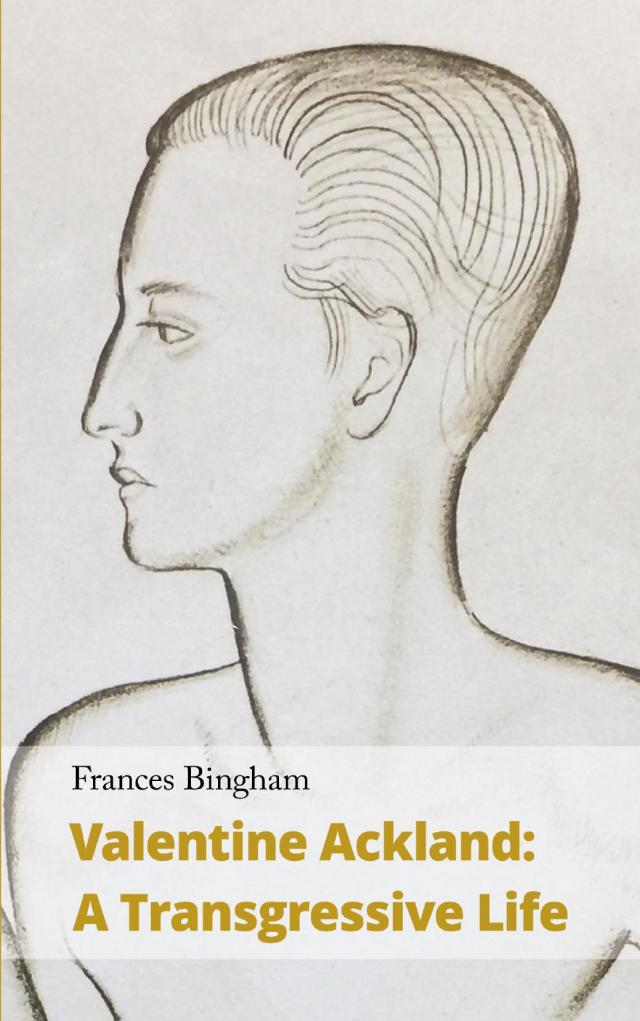
Valentine Ackland
Also published by Handheld Press
HANDHELD RESEARCH
1The Akeing Heart: Letters between Sylvia Townsend Warner, Valentine Ackland and Elizabeth Wade White, by Peter Haring Judd
2The Conscientious Objector’s Wife: Letters between Frank and Lucy Sunderland, 1916–1919, edited by Kate Macdonald
3A Quaker Conscientious Objector. The Prison Letters of Wilfrid Littleboy, 1917–1919, edited by Rebecca Wynter and Pink Dandelion
Valentine Ackland
A Transgressive Life
Frances Bingham
This edition published in 2021 by Handheld Press
72 Warminster Road, Bath BA2 6RU, United Kingdom.
www.handheldpress.co.uk
Copyright © Frances Bingham 2021.
All rights reserved. No part of this publication may be reproduced, stored in or introduced into a retrieval system, or transmitted, in any form, or by any means (electronic, mechanical, photocopying, recording or otherwise) without the prior written permission of the publisher.
The moral rights of the author have been asserted.
ISBN 978-1-912766-41-3
Series design by Nadja Guggi and typeset in Open Sans.
Printed and bound in Great Britain by Short Run Press, Exeter.
Dedicated to my dear mother
Caroline Bingham
1938–1998
Historian and Biographer
Illustrations
1.Valentine in her trousers, Chaldon, 1930s.
2.Looking inland over Chaldon towards the Five Maries …
3.… and the view seawards towards Chydyok, over the downs.
4.The husband (briefly) – Richard Turpin … and the lover – Bo Foster.
5.Young Valentine, her transition from Molly almost complete.
6.‘Don’t be afraid …’ – Newspaper cutting of Dorothy Warren.
7.Molly as a debutante.
8.The quintessential image of Valentine enacting her masculinity.
9.Valentine explores new freedoms.
10.Ackland family motoring.
11.Valentine’s lover – Sylvia asleep.
12.Valentine and Sylvia in the looking-glass at Frankfort.
13.Comrades in Spain – Sylvia, Asunción and Valentine.
14.Elizabeth Wade White’s passport photograph and signature.
15.‘Everywhere is the pattern of water’ – Sylvia fording the river, 1940s.
16.‘One love stays forever’ – Sylvia as she was in Chaldon in the 1930s.
17.Frome Vauchurch, the river front and deck overhanging the water.
18.‘She has done me much damage’ – Valentine’s sister Joan, in wartime uniform.
19.Valentine’s lighter with integral personal ashtray, chrome and crocodile leather.
20.The poet in her boyhood – Molly dressed for riding, aged 9, in 1915.
21.Advertising card for Valentine’s Small Antiques shop.
22.The inscription on Valentine and Sylvia’s gravestone, East Chaldon churchyard.
23.Memorial bookplate by Reynolds Stone.
24.Stele (detail) by Liz Mathews, shown in the National Poetry Library, London.
25.A manuscript poem by Valentine.
26.The garden at Frome Vauchurch.
27.Janet Machen with Valentine in Chaldon.
28.‘A view very like the one that Valentine and Sylvia saw’ – on the Dorset coast.
Contents
Illustrations
Introduction: It is Urgent You Understand
Chapter 1: Becoming Valentine
Chapter 2: An Essential Part of Me
Chapter 3: Valentine’s Trousers
Chapter 4: Sylvia’s Lover
Chapter 5: Comrade, Darling
Chapter 6: Dark Entry
Chapter 7: For the Duration Interned
Chapter 8: Lazarus Risen
Chapter 9: Lord Body
Chapter 10: Saint and Rogue
Chapter 11: The Good Englishman
Chapter 12: How Wild and Strange a Live Man Is
A Personal Note: The Quest for Valentine
Acknowledgements
Notes
Select Bibliography
Index
Frances Bingham writes across the literary spectrum, focusing on gender-transgressive lives like her own. As well as editing Journey from Winter: Selected Poems of Valentine Ackland, she has also published fiction, plays, and poetry, including MOTHERTONGUE, The Principle of Camouflage, The Blue Hour of Natalie Barney (Arcola Theatre, London), Comrade Ackland & I (BBC Radio 4), and most recently London Panopticon (with images by Liz Mathews).
Introduction: It Is Urgent You Understand
Valentine Ackland, poet and inveterate self-mythologising autobiographer, is best-known for cross-dressing, and being the lover of Sylvia Townsend Warner; she was proud of both attributes, but saw herself firstly as a poet. Her life encompassed Communism and Catholicism, war-work and pacifism, a life-partnership and many affairs, and – above all – the contradiction of being a fine poet and remaining little-known. Even if she hadn’t written, Valentine’s life would have been a remarkable one, representative of that extraordinary generation in Britain whose intellectual maturity coincided with the mid-twentieth century, and who rose to the challenges of that time with such verve and courage. But she did write: poetry of witness, commenting on the political state of the world and the plight of the powerless individual; poetry celebrating the natural world while lamenting its loss to the encroachments of war and progress; love poetry of passionate complexity, and metaphysical poetry which meditates on the human place in the universe. This writing, by a poet deeply connected to her time and committed to interpreting its events and their impact on her own life, gives that life another dimension. Valentine’s work expands the history of one fascinating individual into that of a wider community.
Her own life Valentine saw as a story; she retold it to herself and others, in its various versions, almost obsessively, as though without narrative to sustain her she might vanish, become merely a blank page. Some autobiographers can swing like a spider on their linear plumb line, the straight story of their life so far; others circle earlier events at an ever-greater distance, rounding outwards like an ammonite growing. Valentine was the hermit-crab variety, carrying her past everywhere, embellishing it and inhabiting it, using it both as camouflage and display, yet ready at need to jettison it for a similar, larger version of heavy identity. Her willingness to shape her life story to different artistic ends, and the parallel text of her poetry (not explicitly autobiographical, but a translation of experience) makes writing her biography an unusual task.
The outwardly significant events of her life, their places and dates, are well-documented through multiple evidence, and duly appear in this book. The detailed record of an inner life, a writer’s creative narrative, is also here, often in Valentine’s own words. Autobiography offers insights (both intentional and unintentional) to the writer’s mind, the colour of her thoughts, the weather of her relationships, which is why I’ve quoted so extensively from Valentine’s writing on herself. She was well aware that her diaries were revealing, of her weaknesses as well as her humour and passion. Once, after quoting something self-complimentary she added ‘Of course I ought not to copy this, but no one will know until after I’m dead, if then, so what odds?’ 1 This throwaway remark could be taken to apply to her entire life-writing oeuvre, so much of which is about her work, as well as the – sometimes dramatic – events of her life.
As Virginia Woolf ironically observes, in a frequently-quoted passage from Orlando: ‘life … is the only fit subject for novelist or biographer; life … has nothing whatever to do with sitting still in a chair and thinking … this mere wool-gathering; this thinking; this sitting in a chair day in, day out, with a cigarette and a sheet of paper and a pen and an ink pot. If only subjects, we might complain (for our patience is wearing thin) had more consideration for their biographers!’ And she completes the faux-diatribe by declaring that, as we all know, ‘thought and imagination – are of no importance whatsoever’. 2 And yet, in Orlando’s life, as much as in Valentine’s, the invisible inner life of thinking and writing is as eventful as the outer life of action.
Apart from her books and (many but scattered) magazine publications, Valentine’s writing has been preserved in the Sylvia Townsend Warner – Valentine Ackland Archive. When I was first researching both authors, these papers were still in Dorchester Museum, housed in an attic lined with oak cupboards – a haphazard treasury; part library, part paper-heap. There are dozens of notebooks, ranging from large ledgers and leather-bound account books through diaries of every size and format to tiny memorandum books for the pocket. All of these are crammed with poems, both finished and unfinished (some in many versions), notes, quotes, diary entries, travel journals, accounts, lists, reminders, prayers, jokes, menus, fragments of ideas. There are also shopping-lists, used envelopes, telephone message-pads, old photographs and post cards, with poems scribbled on the back. The history of a writer’s mind is here. There are many boxes and files of typed paper: short stories, articles, a play, a novel or two, a children’s book, the poems and – of course – memoir and autobiography in many versions and revisions. Some of Valentine’s writing is not represented in the archive at all, some pieces are duplicated many times.
Also in the archive is the mirror-image of all this; Sylvia’s papers, just as varied and unchronological, often telling the sam
Valentine was strongly aware of this future; the imagined reader of her diaries is sometimes addressed with apparent directness: ‘It is growing dusk already and I must go.’ 3 No doubt this is why she cross-referenced her diaries, dated her poems (sometimes to the hour), and carefully noted revisions; some of her typed poems carry explanations of origin, such as ‘written at about the time Sylvia was writing The Sea Change’. 4 This is all most constructive, and her self-cataloguing certainly made the task easier when I was editing her poetry. But explanatory notes, asides, later added comments addressed to the future researchers Valentine evidently expected, can seem disturbingly personal. (Although one grows used to it, even I was startled, admittedly, when I received a letter in the post, the envelope unmistakeably addressed to me by Valentine’s instantly-recognisable typewriter. Fleetingly imagining that it might contain some imperious instructions, I opened it to find an affectionate letter from the inheritor of the machine.)
With such careful provisions made for the future, it can seem that the dead use us, indifferent as they must be to who we are; so long as we’re resurrection-men, we will do. By the same token, it’s often presumed that the writer of life stories is just a kind of grave-robber, ransacking the catacombs for choice relics. But our mutual aim – a considered life – should be a kind of time-travelling co-operation between the quick and the dead; an exploration of one character by another, completed by the reader’s participation. It’s easier than usual to imagine this ideal when writing about Valentine, an avid reader of even the most obscure biographies, who actually typed up volumes of her own diaries with numbered pages; so helpful. (When quoting Valentine’s own words, her characteristic long dashes and ampersands are in the original texts, but ellipses indicate a word or phrase left out, unless marked as original in the notes.)
I was first commissioned to write a biography of Valentine twenty years ago, in 2001, but a few years later the publisher folded and the book didn’t come out. In a way this was lucky, from a research angle. Then, I met people who are no longer here to be interviewed and was given generous access to the archive in its original form. Now, I have access to documents such as de-classified MI5 files and the Elizabeth Wade White Papers which weren’t available until more recently. So this new biography contains both up to date research and memories which are older, and closer to its subject.
Within the ever-expanding definition of biography I personally prefer those books about people’s lives – or aspects of them – which leave one with the sensation of having met, known, liked or loathed someone, in all their complexity and contradiction. So I aim to give the impression of getting to know Valentine as one does get to know people, through a mosaic of their own anecdotes (and those others tell of them), meetings with their friends and relatives, discoveries about their pasts, revelations about their thoughts. However, there is no fictional writing here. If there’s a conversation, it’s a conversation somebody noted down; if a fast car drives along a lane between summer hedgerows, it did.
Of course, we now know far more about Valentine’s life than one would ever know about a living person, and also far less; no amount of research and scholarship can replace the briefest meeting. My interpretation is, however, based on a premise she would understand; that many stories make up a life, not in its entirety, nor in any final version, but as it is lived – changeable, vivid, real.
‘Reading my own works’, the poem which gives this introduction its title, is addressed directly to the reader, that imagined other in the future who will hear Valentine’s voice and see her words. It’s an extraordinarily direct statement of the poet’s need to communicate and belief in the power of poetry, and a perfect introduction to her authentic voice, which rings with integrity and self-awareness, as it sounds out powerfully, compelling attention. This poem encapsulates the often conflicting emotions of writing; the joyful experience of reading her own work, the fearful possibility that creativity may be merely a mirage. As a commentary on Valentine’s entire poetic life, the poem is completed by its specific inclusion of the reader; we may pour her poem away only half-emptied, but our very existence offers some sort of hope that we may, just possibly, understand.
I hear my own voice, over the desert of days,
Across the sandy stretch of the war I see my own words;
And I had almost forgotten that once I could speak.
You who read words when you want them,
Who turn on the tap of a book, who pour a poem
Half-emptied down drain – It is urgent you understand
How bounteous the words looked, how coolly the mirage
Flowed over sand. 5
1.Valentine in her trousers, Chaldon, 1930s.
Chapter One: Becoming Valentine
One November evening in 1925, two young women from London arrived at the village of Chaldon, in Dorset. They brought with them two suitcases, a gramophone, and a wooden boxful of records; the bare necessities. Both wore trousers (‘unheard-of then except among perverts’), 1 and had Eton-cropped hair, but this was the androgynous fashion of the moment; they were not a couple. The taller of the two, Mrs Turpin, had come to the country to recover from a recent operation to remove her hymen. Her friend Mrs Braden thought this was tremendously funny.
It was already evening when they reached Wool station, so on the dark journey to the village they would have sensed, not seen, that in turning off the main coast road they were entering an extraordinary hilly landscape. The winding, narrow lane was unmetalled in 1925, a mere cart track to an isolated place, and the cottage they had rented was all that two escaping Londoners could wish. Mrs Wallis’s was pleasingly primitive; tiny, lit by oil lamps and candles, with an earth closet at the bottom of the garden, and a sampler in Molly Turpin’s bedroom picking out the text ‘God is Love’. The two women had tea as soon as they arrived, followed by Bovril with cheese and biscuits for supper shortly after. Molly lay awake for a long time, in her delight at being alone in bed.
In the morning, she saw that they had approached the village along a valley. All around it, great shoulders of the downs heave up, and the little settlement is cupped in a hollow of hills. It seems cut off from the inland world. The drove lane labours up over an immense fold of the downs, skirts the Five Maries – a row of prehistoric barrows – close to the sky, with a view way across country, and drops sharply down to the coast road. Yet in the opposite direction, no road goes on towards the sea two miles beyond, for there are high chalk cliffs, and although the sound of the waves reaches the village sometimes, and storms can blow seaweed up to the sheep-fields, there is no way down to the beach here. The village itself, a few picturesque thatched cottages of pale local stone grouped round a triangular green, was obviously poor, but it had, most importantly, a pub, The Sailor’s Return.
The villagers observed these out-of-season visitors with interest. Rachel Braden, who had been there before, was shorter and curvier than her companion, and obviously ‘fast’, with a touch of theatrical glamour, if not quite a stage person herself. She was chatty, friendly, and argumentative. Her friend Molly Turpin, nineteen years old, almost six feet tall and extremely thin, could easily be mistaken for a youth (there was some discussion about her gender) and seemed more reserved, though very polite. She did not look well, being so thin and pale, but the two of them set off walking first thing in the morning, in the direction of the sea, taking some biscuits.





