

A sultry month, p.1
A Sultry Month, page 1


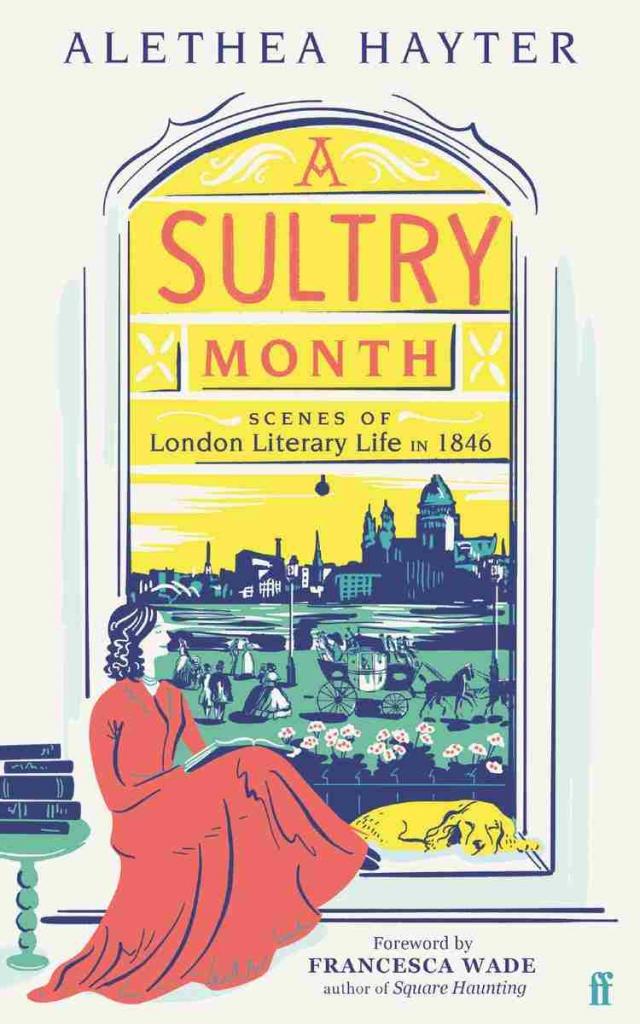
A SULTRY MONTH
Scenes of London
Literary Life in 1846
ALETHEA HAYTER
in remembrance of roger hinks
with whom this book was often discussed in its early stages and whose fine judgment and prodigious memory started me off on many rewarding researches
CONTENTS
Title Page
Dedication
Introduction
Author’s Note
I Thursday 18th June
II Thursday 18th June
III Thursday 18th June
IV Thursday 18th June
V Friday 19th June
VI Saturday 20th June
VII Sunday 21st June
VIII Monday 22nd June
IX Monday 22nd June
X Monday 22nd June
XI Tuesday 23rd June
XII Wednesday 24th June
XIII Wednesday 24th June
XIV Wednesday 24th June
XV Thursday 25th June to Monday 29th June
XVI Tuesday 30th June
XVII Wednesday 1st July and Thursday 2nd July
XVIII Saturday 4th July
XIX Sunday 5th July
XX Monday 6th July
XXI Tuesday 7th July
XXII Wednesday 8th July
XXIII July to September
XXIV Monday 13th July
Appendix
List of Sources
List of Illustrations
Index
Illustrations
About the Authors
Copyright
INTRODUCTION
by Francesca Wade
Early on Thursday 18th June 1846, the artist Benjamin Robert Haydon wrote in his diary: ‘O God bless me through the evils of this day.’ Hours later, he left five paintings and three trunks containing notebooks, journals and an unpublished memoir at the door of Elizabeth Barrett, a friend he had never met in person, but whose correspondence had sustained him through a period of unrelenting despair. Now aged sixty, Haydon had spent the past twenty-five years in and out of debtors’ prison; once again, unpaid loans and overdue rents were catching up with him. Four days later, on 22nd June, he left his home near the Edgware Road and went down to a gun-maker’s shop on Oxford Street, where he bought a pistol. Late that night, as he was loading it, London was engulfed by a sudden downpour of torrential rain, its chimneys and spires illuminated by flashes of lightning. A short walk away at 50 Wimpole Street, Barrett had been watching from her ivy-twined window for signs of the coming storm. It signalled the approach of autumn: the date she and Robert Browning, her secret fiancé of nine months’ standing, had set for their elopement to Italy.
Alethea Hayter’s A Sultry Month weaves a gripping narrative from the parallel events – personal or public; fleeting or life-changing – that preoccupied a handful of London’s artists and writers in the boiling hot summer of 1846. The action unfolds from Haydon’s visit to Barrett’s doorstep through to his suicide and burial, in Paddington New Churchyard, on Monday 13th July (his tombstone, its lettering now faded almost beyond recognition, stated that he ‘died broken hearted from pecuniary distress’). A coda takes us to the clandestine marriage of Barrett and Browning – whose weekly trysts and frantic correspondence impart a restless rhythm – held on 12th September while her overbearing family were out of town. In between, Hayter catches her characters in the messy process of living. They walk their dogs, visit London Zoo, host parties, read the latest bestsellers, complain about their friends and partners, wait nervously for the postman. Unexpected visitors set off fateful chains of events. Relationships ebb and flow. Gifts of flowers bloom and wilt. Reputations are made and broken.
Hayter’s condensed timeframe allows her to luxuriate in a wealth of detail, revealing her subjects in caustic asides or telling gestures. Her enormous skill is to present these characters as equals, wrapped up in the business of the day: she portrays each not with the respective status posterity has conferred, but as they saw themselves and each other at this particular point in time. Not many British readers today will be familiar with Ida Gräfin von Hahn-Hahn’s Gräfin Faustina (1841), a semi-autobiographical novel in which a sexually liberated countess travels to Asia in pursuit of romance and spiritual awakening. Yet in 1846 Jane Carlyle could write to a friend that she was engrossed in the one-eyed divorcée’s ‘dreamy novels’. Her arrival in London that summer (in the company of a man variously assumed to be her cousin, guardian or secret husband) heralded a flurry of invitations, as London’s literary set scrambled to impress their continental counterparts until Hahn-Hahn felt like ‘a particle whirled about in this world of diamonds and mud’. Even at the peak of his career, Hayter writes, Haydon was ‘notorious rather than successful’; nonetheless, he was praised as a genius by Keats and Wordsworth, and the Prime Minister Robert Peel responded, however grudgingly, to his increasingly desperate requests for money. Having recently failed to win a commission to design frescoes for the House of Lords, Haydon had organised his own solo exhibition at the popular Egyptian Hall on Piccadilly. Yet the crowds that flocked in their thousands to the building that summer were there not to admire paintings of the burning of Rome, but to gawp at ‘Tom Thumb’, an eight-year-old boy thirty-one inches tall dressed up as Napoleon (ironically the subject of the paintings of which Haydon was most proud). Haydon believed he ‘had been called by God to raise his country’s tastes, to vindicate the principles of high art’; he watched incredulous as the public passed him by. While Charles Dickens rallied large parties to join him for a raucous time with Tom Thumb, Haydon’s show closed early.
The simmering tensions that month were compounded by an unusual heatwave, which gives A Sultry Month its febrile atmosphere and distinctive sense of urgency. That enervating heat is both fact and metaphor: events and interactions, all June, seemed charged with the sort of temperature that cracks and curdles. We closely follow Haydon’s gradual dissolution, triggered by the flop of his final exhibition. But just as important to Hayter’s collage is the cast of minor characters on whom she draws for deft subplots and vignettes, zooming in for close-ups on intimate tableaux and out for dramatic panoramas. While Barrett and Browning exchanged longing letters, Thomas and Jane Carlyle’s twenty-year marriage rumbled on discontentedly: a warning to their younger friends, had they wanted to hear it, of the compromises and dissatisfactions that can corrode long domestic relationships. One of the book’s quiet heroines is the Irish art historian Anna Jameson, who had left an unhappy marriage to support herself and her female relatives by writing on art, travel and feminism; she won the hearts and respect of others by being, as Hayter infers, ‘a very good listener’. And Hayter’s rich tapestry is completed by the legions of unnamed characters who catch her eye as they move around the city: the Londoners who drowned bathing in the Serpentine or contracted sunstroke in the royal parks; the woman whose leg was amputated after she fell rushing for shelter during the deluge of 22nd June; the watchmaker who read in the paper about the efforts to raise funds for Haydon’s bereaved wife and children and committed suicide himself, expressing in his final note the hope that his own family might be better off.
Hayter is wonderfully alert to the dramatic potential of chance overlaps and crossed paths, and to the ways in which private events reverberate outward, their consequences unpredictable. She captures London in a state of flux: crowded, hot and smelly, its open fields fast transforming into new suburbs, the debris from building works polluting the city’s lakes and rivers. Meanwhile, significant political shifts were deepening a gulf between older and younger generations. On 25th June the Corn Laws (tariffs on imported grain, which kept the cost of living high) were repealed; Peel’s triumph was swiftly overshadowed by the Government’s defeat on a bill intended to alleviate the ongoing famine in Ireland, which led to his resignation one week later. Hayter is particularly good on the way news travels: letters fly across the city (with two posts a day, it was possible to receive a reply within hours) and headlines are digested and transformed into gossip, while partially recollected – or embellished – conversations are transcribed into diaries and resurrected in memoirs. These, of course, are the scraps and fragments of memory from which biography is constructed: in her foreword, Hayter tells us that no detail here has been invented, but is drawn entirely from her subjects’ own public and private writings.
Whether the latter are available to readers and writers is up to individual whims. Browning burned all his letters except those to Barrett; Haydon left instructions that all his journals be published, which infuriated Barrett, who had read an early version of his autobiography and found it distastefully full of rumours, reproaches and affirmations of his own genius. Of all Hayter’s subjects, the one who would be most surprised at their posthumous reputation is Jane Carlyle, ‘an intensely clever woman who had no real outlet for her cleverness’. ‘I can’t bear to be thought of only as Carlyle’s wife,’ she told a friend; she wished for a civil war, where she might find the purpose she lacked in ‘these merely talking times’. After her death in 1866, her husband (having read her diary in mounting horror) published a self-flagellating memoir expressing his remorse for his ill-treatment of her, and devoted himself to the publication of her collected letters, which have been deeply admired by writers from Virginia Woolf to Elizabeth Hardwick.
On its publication in 1965, Anthony Burgess described A Sultry Month as ‘a very original and moving essay in a form which is so new as to lack a name’. Now, we might call it ‘micro-biography’ or ‘group bio
AUTHOR’S NOTE
Nothing in this book is invented. Every incident, every sentence of dialogue, every gesture, the food, the flowers, the furniture, all are taken from the contemporary letters, diaries and reminiscences of the men and women concerned, nearly all of them professional writers with formidable memories and highly trained descriptive skills. Many of the anecdotes and personal descriptions are all too familiar to any student of the period. My object – like that of the Pop Artist who combines scraps of Christmas cards, of cinema posters and of the Union Jack to make a picture – has been to create a pattern from a group of familiar objects. It seemed possible to show a set of authors – all of whom have had their separate portraits painted many times at full length – as a conversation piece of equals, existing in relationship to each other at a particular moment, encapsulated with one dramatic event in an overheated political and physical climate.
While writing this book I have always had before my eyes the warning of Max Beerbohm’s ‘Savonarola’ Brown and his tragedy, whose stage directions read: ‘Enter Lucrezia Borgia, St Francis of Assisi and Leonardo da Vinci … Enter Dante … Andrea del Sarto appears for a moment at a window. Pippa passes … Enter Bocaccio, Benvenuto Cellini and many others’. My characters, unlike Mr Brown’s, all belong to the same century; but the mere fact that two events happen simultaneously in time does not give them a significant relationship. At the moment in June 1846 when this book starts, the second volume of Modern Painters had been out for two months, Poems by Currer Ellis and Acton Bell for one month, Mary Ann Evans’ translation of Leben Jesu for just a week; Vanity Fair and Mary Barton were being worked on, Wuthering Heights, Agnes Grey and The Professor were going the round of the publishers. But neither Ruskin nor George Eliot, neither the Brontës nor Mrs Gaskell, were in touch with the principal figures in this sketch at this period, and Thackeray not very closely at this particular moment, so these great names in Victorian literature will hardly be mentioned in this book. Others, who now seem to us minor writers, have been given the importance accorded to them by their contemporaries.
The last three volumes of the complete diaries of Benjamin Robert Haydon, in Professor Willard Pope’s monumental edition, were published when this book was already partly written, but I have drawn largely on them and on Professor Pope’s notes. The other primary sources for this book are the Life of B. R. Haydon, Historical Painter, from his Autobiography and Journals, edited by Tom Taylor; B. R. Haydon, Correspondence and Table Talk, with a Memoir by F. W. Haydon; and the many sets of letters by Thomas and Jane Welsh Carlyle and by Robert Browning and Elizabeth Barrett, above all their letters to each other. Among recent biographical studies, there are three to which I owe much – Mr Eric George’s The Life and Death of B. R. Haydon, Mr and Mrs Hanson’s Necessary Evil: the Life of Jane Welsh Carlyle, and Mr James Pope-Hennessy’s Monckton Milnes, the Years of Promise, 1809–1851. A list of these and other sources will be found at the end of the book. I have also included in an appendix a few notes on some dates and identifications.
I am most grateful to the following publishers for permission to quote copyright material: the Harvard University Press for The Diary of Benjamin Robert Haydon, edited by Professor Willard Pope; the Clarendon Press, Oxford, for Letters of William and Dorothy Wordsworth: the Later Years, edited by Professor E. de Selincourt; the Oxford University Press for Anna Jameson: Letters to Ottilie von Goethe, edited by G. H. Needler; the Oxford University Press, New York, for Elizabeth Barrett: Letters to B. R. Haydon, edited by Professor M. H. Shackford; Messrs John Murray for Jane Welsh Carlyle: Letters to Her Family, 1839–1863, edited by Leonard Huxley, for E. B. Browning: Letters to Her Sister, 1846–1859, edited by Leonard Huxley, and for Elizabeth Barrett to Miss Mitford, edited by Betty Miller; the University of Illinois Press for Letters of the Brownings to George Barrett, edited by Paul Landis; the Nonesuch Press for Letters of Charles Dickens, edited by Walter Dexter. I am also very grateful to the Master, Fellows and Scholars of Trinity College, Cambridge, for allowing me to consult the Houghton Papers in the Library, and for permission to quote some unpublished material from them.
I have chosen as illustrations to this book the portraits of its leading characters which are nearest in date to 1846, rather than the best-known likenesses or the best as paintings. I have not succeeded in tracing any unquestionable portrait of Robert Browning or Elizabeth Barrett which dates from the mid-1840s, so there are no portraits of them in this book. The portraits of Haydon, Samuel Rogers and Mrs Norton, Wordsworth, Talfourd, the bust of Mrs Jameson, and Keats’ drawing of Haydon are reproduced by permission of the National Portrait Gallery; the portrait of Carlyle by permission of the Scottish National Portrait Gallery; the portrait of Mrs Carlyle by permission of the National Trust; the photograph of the parlour of the Carlyles’ house by permission of the National Trust and the Gordon Fraser Gallery; Haydon’s picture of Curtius Leaping into the Gulf by permission of the Royal Albert Memorial Museum, Exeter; the print of Macready as King Lear by permission of the Raymond Mander and Joe Mitchenson Theatre Collection. The two panels by Haydon of Wellington and Napoleon are from the Devonshire Collection, Chatsworth, and are reproduced by permission of the Trustees of the Chatsworth Settlement. I am most grateful to Mr T. S. Wragg, the Librarian of Chatsworth, for help and advice. I have also had much help and information from the staff of the National Portrait Gallery, specially Mrs Isherwood Kay; the Scottish National Portrait Gallery; the Royal Albert Memorial Museum, Exeter; the Reading Museum and Art Gallery; and the Henry E. Huntington Library and Art Gallery, California. Professor Kathleen Tillotson gave me most valuable advice about a possible drawing of Elizabeth Barrett by Thackeray. Mr James Pope-Hennessy has kindly given me permission to reproduce the drawing of Monckton Milnes by Caroline Smith which he owns. Mr Carlos van Hasselt drew my attention to the unpublished letter by Haydon in the Collection Frits Lugt, Institut Néerlandais, Paris, and gave me permission to publish it as an illustration to this book.
Many other friends have helped me in the writing of this book. Mr and Mrs Basil Gray allowed me to stay in their hospitable house in the British Museum for weeks together, while I was working in the Reading Room. Lady Mynors found and despatched to Paris many heavy tomes for which I appealed at the shortest notice. Mrs Warriner drove me round London in her car, to identify the sites of the houses where the characters in this book lived. Mrs Lewis advised me about Sergeant Talfourd’s legal career. My sister Mrs Napier verified what flowers known to Victorian England would be actually in bloom in a heatwave in June.
Paris, 19641
I
Thursday 18th June
On Thursday 18th June 1846, the painter Benjamin Robert Haydon deposited at the door of 50 Wimpole Street five pictures and three trunks, which the poet Elizabeth Barrett, his friend by correspondence, had agreed to take in for a time. The pictures were portraits of the Duke of Wellington, of Wordsworth, of Mary Russell Mitford, and of Haydon’s wife and son. The trunks contained papers and the twenty-five vellum-bound folio volumes and odd notebooks which contained Haydon’s journals – all but the current volume.


