

Nosy neighbors, p.1
Nosy Neighbors, page 1


Praise for
The Lost Ticket
“It’s as sweet as it sounds—a literary cup of cocoa. Sampson reminds us that there’s value in the ‘failures’ in life—missed connections, broken relationships, unattained college degrees. They may, inadvertently, set us on the right path. Same for small daily interactions like a conversation on public transport. . . . If you’re looking for a little hope, or a reminder of how chance encounters can change life for the better, this is the ticket.”
—USA Today
“A heartfelt story about chance, loss, and aging, populated by messy characters you will root for in this delightful ride.”
—Montecito Journal
“Freya Sampson’s writing is like a feel-good magical potion made of everything that’s beautiful in life: a hug, a cup of tea, a warm blanket, a puppy. The Lost Ticket is the perfect sophomore novel: the descriptions of London are whimsical and immersive; the characters are relatable and lovable; the story is uplifting and romantic, full of emotions and heart, celebrating the importance of making human connections and embracing our dreams. This book is my happy place! Whatever Freya writes next, I’m on board.”
—Ali Hazelwood, #1 New York Times bestselling author of Bride
“It’s hard to think of another book quite as delightful as this one. The Lost Ticket is basically the best hug in the world in book form. It’s a story about love and second chances and the best kind of unlikely friendships. Pick up this book if you’re yearning for some joy in your life!”
—Jesse Q. Sutanto, national bestselling author of The Good, the Bad, and the Aunties
“The Lost Ticket is one of the loveliest novels I’ve read. Gorgeously written, it’s brimming over with hope, inspiration, and endearing humor. I completely adored this wonderful, warm hug of a book.”
—India Holton, national bestselling author of The Secret Service of Tea and Treason
“Freya Sampson’s The Lost Ticket is an unputdownable masterpiece of heart, hope, and humanity. I cheered, swooned, and gasped with each turn of the plot, staying up well past my bedtime because I needed to know what would happen next. Sampson’s lovable cast of characters will steal your heart, lift your spirit, and make you wish you were a passenger on the 88 bus. Do yourself a favor and buy this book; you won’t regret coming along for the ride.”
—Sarah Grunder Ruiz, author of Last Call at the Local
“A gorgeous story that’s equal parts heartbreaking and heartwarming. A reminder that love is unwavering and ageless and will always carry us through. Freya Sampson is a brilliant writer.”
—Lia Louis, author of Better Left Unsent
“In these chaotic times, this is a much-needed story about kindness, the importance of friendship, and the wonder of hope. The Lost Ticket is a delight, a beautiful example of how the ripples from one chance encounter can change many lives for the better. I loved it. Everyone should read this book!”
—Jenny Bayliss, author of A December to Remember
“Sampson’s true gift is bringing to life an improvised family of three-dimensional characters with real struggles and real humanity. In a way, The Lost Ticket is the ultimate literary British Invasion, uniting the Beatles’ ‘With a Little Help from My Friends’ with the Rolling Stones’ ‘You Can’t Always Get What You Want.’ ”
—BookPage
“Sampson has done a masterful job of misdirection, offering tidbits of information that seem to lead one way but then are shown to have been leading somewhere else altogether. This is an engaging read that touches on aging and the physical incapacities it brings, lost and misplaced love, the power of accepting people as they truly are, finding the reliance to build a life on one’s own, and the family that can be forged in friendships. A warming story of love and happiness found despite hardships, difficulties, and the passage of time.”
—Kirkus Reviews
Praise for
The Last Chance Library
“A wonderfully warm and uplifting story of kindness, community, and love that made me laugh, cry, and cheer.”
—Clare Pooley, New York Times bestselling author of Iona Iverson’s Rules for Commuting
“The Last Chance Library is a heart-squeezing and charming story about grief, love, and the power of community. An absolute delight.”
—Colleen Oakley, USA Today bestselling author of The Mostly True Story of Tanner & Louise
“Both spellbinding and tender, The Last Chance Library is a gorgeous love letter to books, a celebration of the characters that make a community, and an inspiring call to muster our courage and fight for the things that matter. Simply put, this book is sublime.”
—Libby Hubscher, author of Play for Me
“A sweet testament to the power of reading, community, and the library.”
—Booklist
“The Last Chance Library is absolutely irresistible! Curl up and indulge in Freya Sampson’s charming novel about a shy librarian in a small town with a great cause. You’ll have such a good time, and you’ll love the unexpected twist at the end!”
—Nancy Thayer, New York Times bestselling author of All the Days of Summer
“Sampson has created a gem of a book populated by vivid personalities and a story that weaves together heroes and villains, love and loss, mourning and growth, as it follows June and the Chalcot community as they seek to save their library—which offers so much more than books. A delightful exploration of personal growth, inner strength, and the importance of family, friends, and love.”
—Kirkus Reviews (starred review)
“Fans of libraries and heartfelt, humorous women’s fiction with a powerful message and a hint of romance won’t want to miss this one! It’s so good that readers may very well devour it in one sitting.”
—Library Journal (starred review)
“With The Last Chance Library, British author Freya Sampson delivers a refreshingly feel-good first novel about the sustaining power of books and how libraries unite communities and forge lasting relationships that improve lives. . . . The Last Chance Library unravels with great wit and tenderness. Sampson assembles clever, funny scenes where June transforms from a wallflower into a take-charge, crafty young woman who is forced to handle difficult people and navigate situations that enlarge her ingenuity. Readers will eagerly invest in the cause to save the library and be greatly amused by plot twists that play out with pleasant surprises and heart-tugging twists.”
—Shelf Awareness
TITLES BY FREYA SAMPSON
The Last Chance Library
The Lost Ticket
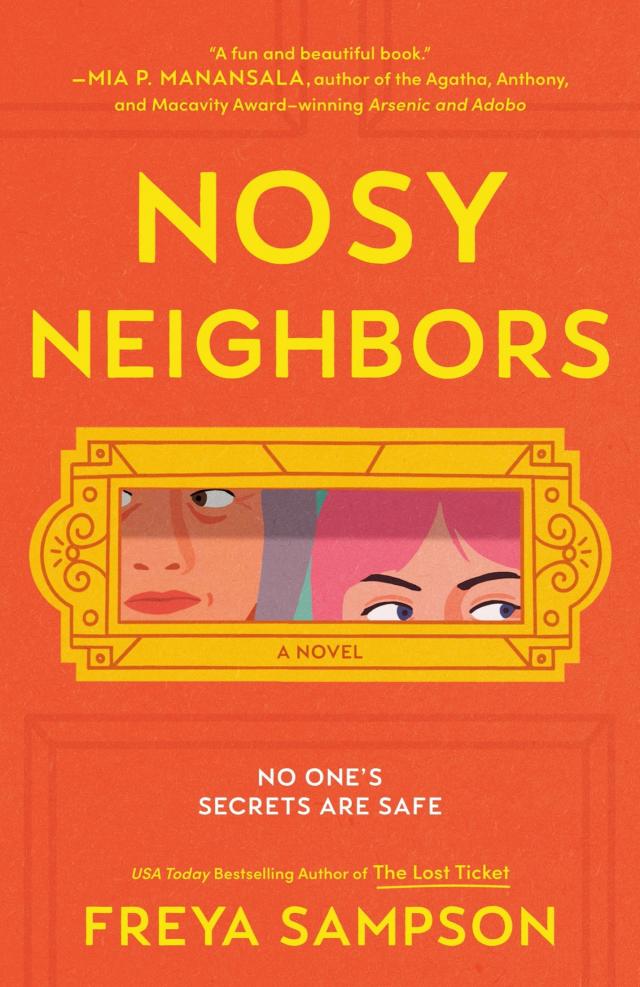
Nosy Neighbors
BERKLEY
An imprint of Penguin Random House LLC
penguinrandomhouse.com
Copyright © 2024 by Sampson Writes Limited
Readers Guide copyright © 2024 by Penguin Random House LLC
Excerpt from The Lost Ticket by Freya Sampson copyright © 2022 by Sampson Writes Limited
Penguin Random House supports copyright. Copyright fuels creativity, encourages diverse voices, promotes free speech, and creates a vibrant culture. Thank you for buying an authorized edition of this book and for complying with copyright laws by not reproducing, scanning, or distributing any part of it in any form without permission. You are supporting writers and allowing Penguin Random House to continue to publish books for every reader.
BERKLEY and the BERKLEY & B colophon are registered trademarks of Penguin Random House LLC.
Library of Congress Cataloging-in-Publication Data
Names: Sampson, Freya, author.
Title: Nosy neighbors / Freya Sampson.
Description: New York : Berkley, 2024.
Identifiers: LCCN 2023031118 (print) | LCCN 2023031119 (ebook) | ISBN 9780593550526 (trade paperback) | ISBN 9780593550519 (hardcover) | ISBN 9780593550533 (ebook)
Subjects: LCGFT: Novels.
Classification: LCC PR6119.A475 N67 2024 (print) | LCC PR6119.A475 (ebook) | DDC 823/.92—dc23/eng/20230714
LC record available at https://lccn.loc.gov/2023031118
LC ebook record available at https://lccn.loc.gov/2023031119
First Edition: April 2024
Cover illustration and design by Lila Selle
Adapted for ebook by Kelly Brennan
This is a work of fiction. Names, characters, places, and incidents either are the product of the author’s imagination or are used fictitiously, and any resemblance to actual persons, living or dead, business establishments, events, or locales is entirely coincidental.
pid_prh_6.3_146644690_c0_r0
Contents
Cover
Praise for Freya Sampson
Titles by Freya Sampson
Title Page
Copyright
Dedication
Chapter One
Chapter Two
Chapter Three
Chapter Four
Chapter Five
Chapter Six
Chapter Seven
Chapter Eight
Chapter Nine
Chapter Ten
Chapter Eleven
Chapter Twelve
Chapter Thirteen
Chapter Fourteen
Chapter Fifteen
Chapter Sixteen
Chapter Seventeen
Chapte
Chapter Nineteen
Chapter Twenty
Chapter Twenty-One
Chapter Twenty-Two
Chapter Twenty-Three
Chapter Twenty-Four
Chapter Twenty-Five
Chapter Twenty-Six
Chapter Twenty-Seven
Chapter Twenty-Eight
Chapter Twenty-Nine
Chapter Thirty
Chapter Thirty-One
Chapter Thirty-Two
Chapter Thirty-Three
Chapter Thirty-Four
Chapter Thirty-Five
Chapter Thirty-Six
Chapter Thirty-Seven
Chapter Thirty-Eight
Chapter Thirty-Nine
Chapter Forty
Chapter Forty-One
Chapter Forty-Two
Chapter Forty-Three
Chapter Forty-Four
Chapter Forty-Five
Chapter Forty-Six
Chapter Forty-Seven
Chapter Forty-Eight
Chapter Forty-Nine
Chapter Fifty
Epilogue
Acknowledgments
Readers Guide
Discussion Questions
Excerpt from The Lost Ticket
About the Author
_146644690_
For Bethany, my favorite person
One
DOROTHY
Years later, when the residents of Shelley House looked back on the extraordinary events of that long, turbulent summer, they would disagree on how it all began. Tomasz in flat five said it started the day the letters arrived: six innocuous-looking brown envelopes that fell through the communal letterbox one Wednesday morning in May. Omar in flat three claimed the problems came a few weeks later when an ambulance pulled up in front of the building, its siren wailing, and the body was loaded into the back. And Gloria from flat six said her astrologer had told her way back in January there would be drama and destruction in her near future (and, more importantly, that she’d be engaged by Christmas).
But for Dorothy Darling, flat two, there was never any question of when the trouble began. She could pinpoint the exact moment when everything changed: the single flap of a butterfly’s wing that would eventually lead to the tornado that engulfed them all.
It was the day the girl with pink hair arrived at Shelley House.
* * *
• • •
That morning had started out like any other. Dorothy was woken at six thirty by thumping from the flat overhead. She lay in bed for several minutes, her eyes squeezed shut as she chased the last shadows of her dream. When she could put it off no longer, she rose, her knees clicking obstinately as she moved through to the bathroom to perform her morning ablutions. In the kitchen, Dorothy lit the stove with a match and did her morning stretches while she waited for an egg to boil and her pot of English breakfast tea to steep. Once they were ready, she carried a tray through to the drawing room, where she consumed breakfast sitting at a card table in the bay window. So far, so normal.
As she ate, Dorothy observed her neighbors depart the building. There was the tall, ferocious man from flat five, accompanied by his equally ferocious, pavement-fouling dog. Next came the pretty-if-only-she’d-stop-scowling teenager from flat three, staring at her phone and pointedly ignoring her father, who followed her carrying a battered briefcase under one arm and an overflowing box of recycling under the other. As he emptied the contents into the communal bins, a tin can missed the deposit and rolled onto the pavement. The man hurried off after his daughter, oblivious. Dorothy reached for the diary and pencil she kept near at all times.
7:48 a.m. O.S. (3) Erroneous rubbish disposal.
Once the morning rush hour had passed, Dorothy washed up her crockery, dressed, brushed her long silver hair, and put on her string of pearls. She was back at the window by eight fifty, just in time to see the redheaded woman from flat six departing hand-in-hand with her current paramour, a tall, bovine man in a cheap leather jacket. After that there was a lull and Dorothy changed the beds and dusted the picture frames and objets on the mantelpiece, accompanied by Wagner’s Götterdämmerung to block out the din from the flat above.
And then, a little after ten, she was brewing her second pot of tea when she heard a tremendous bang from outside. Dorothy abandoned the kettle and rushed to the front window, where she watched an old, ramshackle blue car pull up in front of the building, its rear wheel mounting the curb. A great cloud of black smoke burped from the exhaust pipe as the engine puttered out, and a moment later the door opened and the driver emerged. It was a young person who looked to be somewhere in their twenties, although at first glance, Dorothy was unsure if it was a man or a woman. They had short, unkempt hair dyed a lurid neon pink and were dressed in a pair of dungarees of the sort one might expect a laborer on a building site to wear. The youth did not seem to have any kind of coat or knitwear, despite it being unseasonably cool for early May, and Dorothy could see tattoos snaking up their arms like graffiti. The person reached into the back seat of the car and heaved out a large, well-worn backpack, then kicked the door shut, causing the vehicle to shake precariously. It was only when they turned to face Shelley House that Dorothy realized she was looking at a young woman.
The girl’s face gave nothing away as she surveyed the building, but Dorothy could imagine her taking it in with a mixture of apprehension and awe. After all, one did not come across dwellings like Shelley House every day. Built during the reign of Queen Victoria and named after the English Romantic poet, its broad façade was a mixture of precise red brickwork and embossed white masonry, topped by an ornate balustrade. Wide stone steps led up to the imposing front door, over which the words SHELLEY HOUSE, 1891 were engraved in Gothic script. Impressive bay windows framed the door on the first two floors, while the highest floor—once the servants’ quarters before the building was converted into flats—had smaller, rectangular dormer windows. Dorothy could still remember the first time she had seen the building herself; how she had stopped in the middle of the pavement and stared, mouth agape, marveling at its grandeur and history. It was the most beautiful house she had ever seen, and Dorothy had pledged there and then that it would become her home. Thirty-four years later, it still was.
The pink-haired girl continued regarding the building, and as her eyes swept along the ground floor they seemed to pause for a moment on Dorothy’s window. Dorothy instinctively drew back, even though she knew nobody could see her through the net curtain. Still, she found her heart beating a little faster as she watched the young woman climb the steps and disappear from view at the front door. Who was she coming to visit in the middle of the working day? Perhaps the uncouth new tenant in flat four? Dorothy waited to hear the sound of a distant bell ringing and was therefore utterly confounded when she heard the unfamiliar chime of her own. Good gracious, it was for her! Should she answer it? It had been a long time since Dorothy had had a caller, and the girl hardly looked trustworthy. Perhaps she was one of those scoundrels who preyed on vulnerable elderly people, tricking her way into their homes, robbing them, and then leaving them for dead? Of course, Dorothy was neither vulnerable nor stupid enough to fall for such a trick, but this young rapscallion was not to know that. Should she fetch a knife from the kitchen drawer, just in case?
The bell sounded again, jolting Dorothy. She reached for her pencil—the nib was sharp enough to be used as a weapon, if circumstances required—and moved to her front door. Some years earlier, a previous landlord had installed an overly elaborate entry system whereby when someone rang her bell, a video appeared on a little screen by her door, showing Dorothy who was there and even allowing her to speak to them before she “buzzed” them in. Dorothy had been horrified by it, even when the engineer insisted that the video was one-way and the person outside could not see her. Now she lowered her face so that her nose was almost touching the screen. It showed a grainy black-and-white image of the woman, who was chewing a fingernail as she waited for an answer. What could she possibly want?
The bell sounded a third time, a longer, more persistent ring. Dorothy cleared her throat before she pressed the button labeled intercom.





